
An injury can change a person’s career, not just the next paycheck. To understand what a vocational expert’s role is in an injury claim, consider how the expert assesses medical limitations, work history, education, and skills to evaluate work capacity and earning potential. The expert may identify alternative occupations but doesn’t diagnose conditions or decide the claim.
A vocational expert assesses how an injury affects work and future earning capacity. Missed paychecks may not show the full impact, especially if returning to familiar work or retraining becomes difficult. A vocational assessment can help explain these work-related consequences through evidence.
This article explains how experts assess employability, what information they consider, and how their opinions may apply in motor vehicle, workplace, and slip-and-fall injury claims. It also covers what their reports and testimony can show, and what they cannot decide.
Key Takeaways
- A vocational expert connects medical work restrictions with a person’s education, skills, and employment history to assess changes in earning capacity.
- Alternative-job opinions depend on more than job titles: experts consider transferable skills, job demands, wages, and local labor-market conditions.
- Medical records, work history, interviews, and labor-market information can help support an expert’s assessment and report.
- Experts may explain their findings in testimony, but the judge or other decision-maker determines the outcome of the claim.
- Injury-related barriers to returning to work may arise in motor vehicle, workplace, and slip-and-fall claims, making legal representation relevant when earning capacity is disputed.
Why Are Vocational Experts Important in a Personal Injury Claim?
A vocational expert assesses how an injury affects employability and earning capacity by connecting medical limitations with education, work history, and skills. A common question is, “What is the role of a vocational expert in an injury claim?” The expert evaluates work-related effects, not the injury’s diagnosis or legal outcome.
To better understand how vocational testimony can address work capacity, watch this overview:
Work Capacity and Functional Limitations
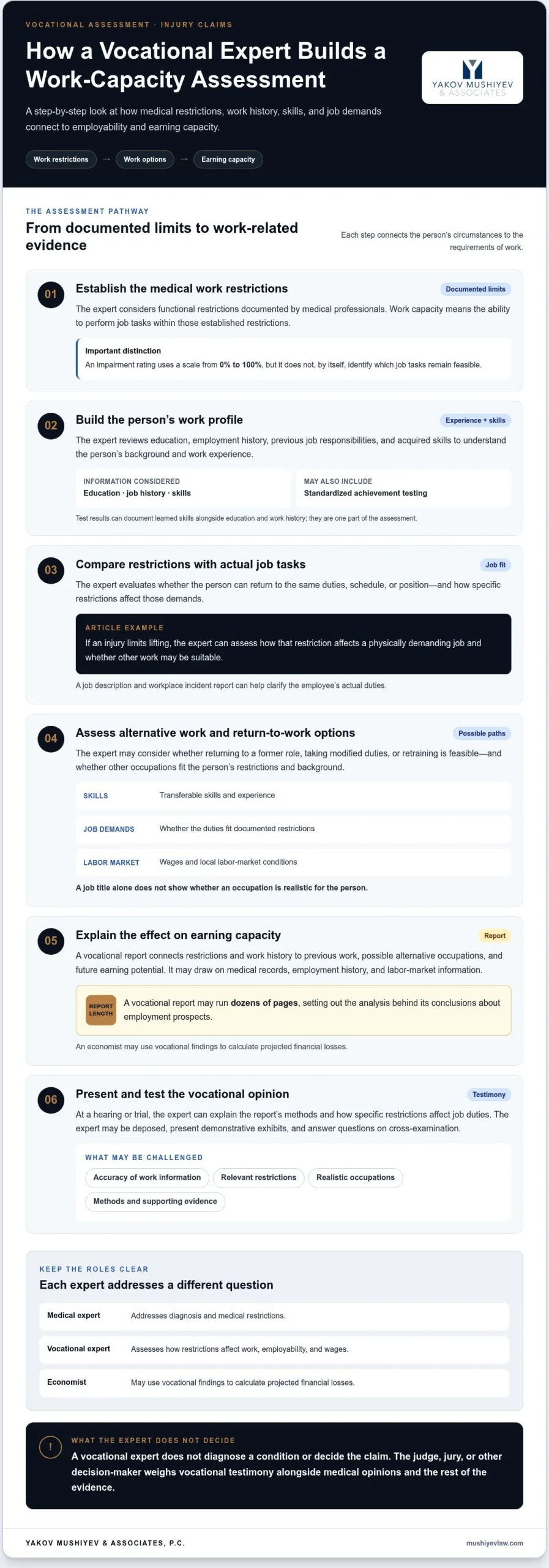
Work capacity is the ability to perform job tasks within medically established functional restrictions. It matters because an injured person may still be able to work but unable to return to the same duties, schedule, or position.
The expert considers education, previous job responsibilities, acquired skills, and restrictions documented by medical professionals. For example, if an injury limits lifting, the expert can assess how that restriction affects a physically demanding job and whether other work is suitable. A workplace incident report and job description can clarify the employee’s actual duties. A vocational expert may be useful when lasting restrictions make future work options or damages difficult to assess. Not every personal injury claim needs this evidence; an attorney can evaluate whether it addresses issues in dispute.
Vocational Reports and Return-to-Work Planning
A vocational report describes how restrictions affect previous work, possible alternative occupations, and future earning potential. It can help assess whether returning to a former role, taking modified duties, or retraining is feasible.
The report may draw on medical records, employment history, and labor-market information, and may run dozens of pages. An impairment rating uses a scale from 0% to 100%, but it doesn’t, by itself, identify which job tasks remain feasible. The expert relates documented limitations to work demands, helping explain how an injury may affect a return-to-work plan or future employment.
Expert Roles and Qualifications
A medical expert addresses diagnosis and medical restrictions. A vocational expert assesses how those restrictions affect work and wages. An economist may use the vocational findings to calculate projected financial losses.
Examples of vocational credentials include CRC, CVE, and ABVE certifications. The retaining attorney selects an expert whose experience fits the work-capacity questions. A reader may also ask, “What is the role of a vocational expert in an injury claim?” The expert offers a vocational opinion, while the judge or other decision-maker determines the claim. In personal injury cases, testimony may need to satisfy Daubert or Frye standards, depending on jurisdiction.
Do Vocational Experts Decide the Case?
No. A vocational expert gives an opinion about work capacity and employability; the judge or other decision-maker determines the claim. In a serious injury case, the expert’s report and testimony can help explain how an accident affects a person’s work options, but they do not determine the outcome by themselves.
Reports, Hearings, and Settlement Discussions
A vocational report sets out the expert’s analysis of work restrictions, possible occupations, and projected changes in earning capacity. It may run dozens of pages, connecting the person’s work history and limitations to conclusions about employment prospects. Attorneys can use that analysis in settlement negotiations to explain why missed wages alone may not reflect the injury’s full financial impact.
At a hearing or trial, the expert can describe the methods behind the report and explain how specific restrictions affect job duties. The expert may be deposed, present demonstrative exhibits, and answer questions on cross-examination. This scrutiny gives the opposing side a chance to challenge assumptions, evidence, and conclusions. The decision-maker then weighs the testimony alongside the rest of the case evidence.
Testing and Challenges to Testimony
Standardized testing, including achievement testing, can help document a person’s learned skills alongside education and work history. Test results are one part of the assessment, not a decision about whether someone can work. Their value depends on how the expert relates them to actual job duties and the person’s medically established restrictions.
An opposing attorney can challenge whether the expert relied on accurate work information, considered relevant restrictions, or identified realistic occupations. Questions about methodology and supporting evidence can expose gaps in an opinion. In personal injury cases, vocational testimony may need to satisfy Daubert or Frye standards, depending on the jurisdiction. Those standards affect whether the expert’s methods and opinions can be presented as evidence.
What the Decision-Maker Considers
A vocational expert does not decide whether an injured person should receive damages or how much a claim is worth. The expert addresses vocational questions, such as whether the person can return to previous work or perform other jobs. The judge, jury, or other decision-maker considers that evidence alongside medical opinions and other proof.
For example, if an insurer’s expert says a person can work in another occupation, the relevant questions include whether the proposed duties fit the person’s restrictions, skills, and experience. A report becomes more useful when it explains those connections rather than relying on a job title alone. If an accident has disrupted your work and earning capacity, car accident legal representation can help address how that evidence fits into an injury claim.
Determining employability and alternative occupations
A vocational expert assesses whether a person can return to previous work or perform other occupations within medically established restrictions. The analysis considers job duties, transferable skills, education, training, and local openings, not job titles alone. This distinction can show whether a theoretical alternative job is a realistic source of future earnings.
Experts compare the physical and cognitive demands of previous work with current restrictions. They then consider whether existing skills transfer to other roles and whether the labor market has suitable openings. For example, an engineer may have relevant technical knowledge but restrictions that rule out demanding fieldwork. The expert can assess whether other jobs use that person’s education and experience without exceeding established restrictions.
Occupational information supports this analysis. The U.S. Department of Labor’s Employment and Training Administration published the revised 4th edition of the Dictionary of Occupational Titles, a vocational reference. The Social Security Administration says vocational experts may use occupational information alongside their professional knowledge, training, and experience. Labor-market analysis also considers local job availability, job demands, and possible employer bias against workers with disabilities.
Job-number estimates need context. A list of occupations does not establish that suitable jobs are available in a particular area. An expert can examine local openings and explain whether the identified work matches the person’s restrictions and skills. For example, an analysis might find that only one management job had opened in a county during the last year. That evidence may challenge a broad claim that suitable work is readily available.
Education and occupational training shape the range of realistic alternatives. An expert considers completed schooling, specialized training, and skills developed through work. Supervisory experience, recordkeeping, scheduling, computer use, and customer service may transfer across industries. But transferable skills do not eliminate the need to meet a new job’s physical, cognitive, and training demands. An attorney can use this distinction to assess whether a proposed occupation fits the injured person’s actual background.
Self-employment also requires careful analysis. Tax returns, invoices, and contracts can help assess historical income for independent contractors and business owners. These records may show how earnings depended on physical labor, client relationships, or specialized tasks. If a lasting restriction prevents those tasks, the expert can assess whether the person’s remaining skills support another occupation or indicate reduced earning capacity.
Social Security disability analysis differs from personal injury damages analysis. The Social Security Administration does not consider whether alternative work pays similar wages when evaluating disability claims. In an injury case, however, comparing prior and potential earnings can help explain financial harm. One hypothetical analysis found medical limitations excluded a claimant from 90% of qualifying jobs, leaving 10% for consideration. The expert must connect those figures to the claimant’s restrictions and labor-market evidence.
Evidence used in vocational assessments
A vocational assessment combines records, interviews, testing, and labor-market evidence to evaluate work options. Each source helps connect an injured person’s abilities and restrictions with specific job demands.
The expert may review medical records, employment history, standardized test results, job opportunities, and wage or labor data. These materials help establish what work the person performed, which skills they developed, and what tasks remain feasible. A functional capacity evaluation can also provide information about physical abilities. The vocational expert uses the physician’s functional assessment to understand restrictions rather than determining them independently.
An interview can clarify details that paperwork may miss. A worker can describe daily tasks, tools used, work pace, and responsibilities that a job title does not reveal. For a self-employed person, tax returns, invoices, or contracts may help establish historical income and work activities. Comparing these details with records can make the assessment more specific to the injury claim.
Transferable Skills Assessments
A transferable skills assessment identifies abilities from previous work that may apply to other occupations. It matters because a worker may retain useful skills even when an injury prevents a return to a former job.
For example, supervisory experience, computer skills, recordkeeping, scheduling, customer service, and administrative work may transfer to different roles. The expert considers how those skills were used, the training they required, and whether alternative jobs demand additional abilities. A job match should reflect the worker’s actual experience, not just a similar-sounding title.
Education and testing can sharpen that comparison. An expert may review schooling, work samples, or standardized test results to understand learned abilities and training needs. Those findings help distinguish a realistic transition from a theoretical option requiring skills the person has not developed.
Job Restrictions
Job restrictions describe tasks a worker cannot safely or reliably perform because of medically established limitations. Assessing them matters because even one restriction can rule out occupations that otherwise seem suitable.
For instance, a permanent restriction against lifting more than 20 pounds may conflict with the essential duties of a physically demanding job. The expert compares that restriction with documented job demands, including lifting, standing, concentration, or repetitive movement. The medical evidence establishes the limitation; vocational analysis shows its practical effect on available work.
A well-supported assessment explains each connection: the restriction, the job task it affects, and the resulting impact on employability or earning capacity. This evidence can clarify disability-related work loss and support a damages analysis without treating every listed job as a genuine option.
Applications in motor vehicle, workplace, malpractice, and slip-and-fall cases
A vocational expert applies an injured person’s functional limitations to specific work demands. Across motor vehicle, workplace, malpractice, and slip-and-fall claims, the core question is how those limitations affect employment and earning capacity. The answer depends on the person’s position, duties, skills, and medically established restrictions, not simply the injury label.
After a motor vehicle accident, an expert may assess whether a person can return to driving-based work or needs retraining. Consider a 35-year-old union plumber who suffers a severe back injury in a car accident. If the injury prevents physically demanding plumbing tasks, the expert can compare those duties with the person’s restrictions and assess whether other occupations are realistic. The opinion can help explain potential changes in future earning capacity.
Workplace injury assessments focus on the employee’s actual responsibilities and safe work options. A construction worker whose injury limits lifting or climbing may be unable to return to the same position, even if some work remains possible. The vocational analysis can examine modified duties, transferable skills, and alternative employment. It helps determine whether proposed work fits the employee’s restrictions, rather than relying on a job title alone.
In a slip-and-fall claim, chronic pain or mobility limitations may affect jobs requiring standing, walking, or regular movement. An expert can compare those demands with the person’s functional restrictions and consider whether sedentary work is suitable. Workplace accommodations may also affect the analysis. A useful opinion explains how specific limitations change practical employment options, rather than assuming less physical work is automatically available or appropriate.
Vocational effects may also arise when an injury disrupts a person’s ability to work. The expert may compare the person’s work before the event with current restrictions and assess whether previous skills remain useful. The opinion addresses employment impact, not whether malpractice occurred. This distinction keeps the vocational analysis focused on work-related damages while other evidence addresses separate issues in the claim.
For people in Rosedale, Rochdale, and Queens, vocational evidence should connect medical restrictions to the actual position, work duties, and realistic alternatives. A clearly explained opinion can show the employment consequences of an injury, whether the dispute concerns returning to a former job or earning capacity in different work.
Yakov Mushiyev & Associates, P.C: Car Accident Legal Representation
Yakov Mushiyev & Associates, P.C. provides car accident legal representation when injuries disrupt work and future earning capacity. If an insurer disputes how your limitations affect employment, the firm can help address the evidence and explain its relevance to your injury claim.
The firm also represents people injured in truck, motorcycle, and pedestrian accidents, as well as slip-and-fall incidents. Relevant evidence depends on the accident, medical restrictions, work history, and claimed income impact. A vocational opinion may help clarify work-related damages, but it does not decide liability or the claim’s outcome.
If you have questions about how an injury affects your ability to work, contact Yakov Mushiyev & Associates, P.C. to discuss your situation.
Take the Next Step Toward Protecting Your Claim
Understanding a vocational expert’s role in an injury claim can help you ask a more useful question: does the evidence reflect how the injury has changed your working life? Before accepting an insurer’s view of your employment prospects, consider whether the analysis accounts for your actual job, experience, and future plans. A focused legal review can identify what needs to be addressed and how work-related losses fit into your claim.
Yakov Mushiyev & Associates, P.C. represents people seeking compensation after car, truck, and slip-and-fall accidents. If an injury has disrupted your work or an insurer disputes its effect on your earning capacity, contact the firm to discuss your situation and possible next steps.
Contact Yakov Mushiyev & Associates, P.C to take a clear, informed step forward.
Frequently Asked Questions
How Do They Help Prove Loss of Earning Capacity?
A vocational expert helps explain how an injury has changed a person’s ability to earn through work. The analysis can compare the person’s pre-injury career path with occupations that remain feasible under current restrictions. For example, evidence that a worker’s specialized experience no longer fits available work can help explain why future income may be reduced, even if the person has returned to some form of employment.
How does a vocational expert calculate lost earning capacity?
A vocational expert generally assesses work options and wage potential rather than calculating the final financial value of a claim. The expert identifies feasible occupations, considers their earning potential, and compares those options with the person’s prior work prospects. An economist may then use that vocational analysis to project financial losses over time. The calculation depends on supported work restrictions, employment history, and realistic alternatives, not a guaranteed outcome.
What does a vocational expert do in a personal injury claim?
A vocational expert explains how injury-related limitations affect work, employability, and earning potential. The expert may assess whether the person can perform the essential duties of a former position or transition to other work. This opinion can help a decision-maker understand employment effects that medical records alone may not describe. For an injured person in Rosedale, the analysis should connect documented restrictions to the actual demands of their occupation.
What information and records does a vocational expert review?
The expert may review medical records, job descriptions, résumés, education records, employment history, and labor-market data. Interviews can clarify responsibilities that a job title misses, such as lifting, scheduling, or client contact. For self-employment, tax returns, invoices, and contracts can show past work and income patterns. Clear records help the expert resolve differences between a written job description and the work the person actually performed.
How does a vocational expert calculate lost earning capacity and future lost wages?
The expert identifies work the injured person can realistically perform and compares its earning potential with the person’s likely career path without the injury. Future projections may account for wage growth, benefits, pension contributions, or raises when supported by evidence. An economist may use the vocational findings to calculate projected financial loss. Lost wages concern pay already missed; reduced earning capacity concerns future income potential.
How can a vocational expert’s opinion be challenged or cross-examined?
An opposing attorney can question whether the expert used accurate job duties, current restrictions, and relevant labor-market information. Cross-examination may examine whether suggested occupations require skills the person lacks or conflict with documented limitations. The attorney may also challenge the expert’s assumptions or methods during a deposition or trial testimony. In personal injury cases, admissibility may depend on applicable standards, including Daubert or Frye, depending on the jurisdiction.
These FAQ answers provide general information, not legal advice for a specific case.
Do vocational expert rules vary by state in personal injury claims?
Yes. Vocational testimony may need to satisfy Daubert or Frye standards, depending on the jurisdiction.
How are vocational experts selected and paid in injury cases?
The retaining attorney selects an expert whose experience suits the work-capacity questions.