
An uninsured driver’s employer isn’t automatically responsible for a crash. Whether you can sue an uninsured driver’s employer in Rochdale depends on whether the driver was working for the employer at the time, rather than commuting or running a personal errand. If the injured person was the employer’s employee, workers’ compensation rules may also affect the available claims.
It’s understandable to look beyond the driver when there’s no insurance to turn to. The key questions are how the trip related to the job and who was injured. Those details can shape which claims may be available.
This article explains when an employer may be held responsible, why an ordinary commute or personal trip can make a claim harder, and how exclusive-remedy protection may apply to an insured employer. You’ll also learn what evidence can help clarify the driver’s role and what legal options to consider after a serious collision.
Key Takeaways
- An employer isn’t automatically liable because its employee caused a crash; the driver’s purpose and connection to work are central.
- A commute or personal errand may weaken an employer-liability claim, while a work-related trip can change the analysis.
- Negligent hiring, supervision, or vehicle entrustment may raise separate questions about what the employer knew and how it managed the risk.
- Work records, trip details, and communications can help establish whether the driver was acting for the employer when the collision happened.
- If an injured person was the employer’s worker, workers’ compensation protections may affect whether a separate damages claim is available.
Does an employer have liability if an employee was commuting or on a personal errand when the crash occurred?
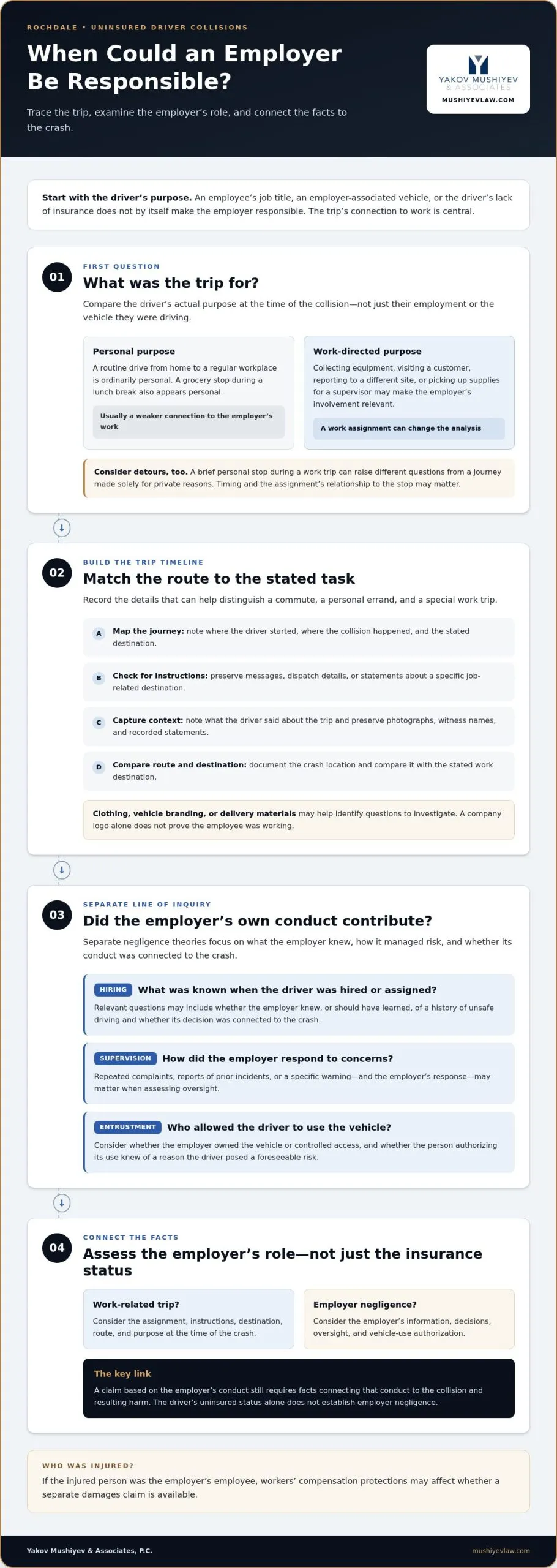
A driver’s lack of insurance doesn’t automatically make an employer responsible for a crash in Rochdale, Queens. The key issue is the driver’s purpose at the time: were they carrying out work for the employer or travelling for personal reasons? A routine trip from home to a regular workplace usually has a weaker connection to the employer than a work-directed delivery.
Consider an employee who leaves home and drives directly to an office. That trip is ordinarily personal, not a task performed for the employer. The analysis may differ if the employer directed the employee to collect equipment, visit a customer, or report to a different site first. The route, instructions, and reason for the trip matter more than the driver’s job title.
A personal errand presents a similar challenge. If an employee drives to a grocery store during a lunch break, the trip appears personal. If the employee instead picks up supplies for a supervisor, the employer’s involvement may be relevant. A brief personal stop during a work trip can also raise different questions from a journey made solely for private reasons.
If you’re asking whether you can sue an uninsured driver’s employer in Rochdale, separate the driver’s insurance status from the employer’s role. An employer isn’t responsible simply because the driver works there or drives a business-associated vehicle. The facts must connect the trip to the employer’s work, such as a delivery assignment or a manager’s request.
Build a clear timeline while details are fresh. Note where the driver started, where the collision happened, and what the driver said about the trip. Record any business name on the vehicle, delivery materials, or uniform. A company logo alone doesn’t prove the employee was working, but it may help identify questions to investigate.
- Routine commute: Record whether the employee was going from home to a regular workplace or had a work assignment first.
- Personal detour: Note the errand’s purpose and whether the employee had completed or paused a work task.
- Employer instruction: Preserve messages, dispatch details, or statements referring to a specific job-related destination.
- Crash location: Document the route and location, then compare them with the stated work destination.
These details can help distinguish a commute from a special work trip. For example, a driver sent from home to a customer’s address may have a different connection to work than an employee driving to the usual office. A detour to buy personal items may complicate the picture. Its timing and relationship to the assignment can matter.
Don’t treat an employer’s denial as the final word. Find out what task the driver had, who assigned it, and whether the trip involved a customer, delivery, or business location. Preserve photographs, witness names, and any recorded statements. These steps can help establish the trip’s purpose before memories fade or records become harder to obtain.
Can an employer be liable for negligent hiring, supervision, or entrustment of a vehicle to an uninsured driver?
An employer may face a separate negligence claim if its own conduct contributed to a crash. That differs from arguing that an employee caused the collision while working. For example, a business may have chosen an unsafe driver, ignored known warning signs, or allowed someone to use a vehicle despite a serious driving concern. The driver’s uninsured status alone doesn’t prove the employer acted negligently.
Negligent hiring focuses on what the employer knew, or should have learned, when hiring or assigning a driver. Imagine a delivery company receives reliable information that an applicant has a history of unsafe driving but assigns the person a route without addressing the concern. The questions include whether that decision was unreasonable and whether it was connected to the crash. A job title or employment relationship alone doesn’t establish that connection.
Negligent supervision concerns an employer’s oversight after a person starts work. Relevant details might include repeated complaints about unsafe driving, reports of prior incidents, or ignored instructions. If a manager receives a specific warning about a driver’s conduct and continues assigning that driver to deliveries, the warning and response may matter. A claimant still needs facts linking the employer’s oversight to the collision and resulting harm.
Negligent entrustment examines the decision to let someone use a vehicle. The vehicle may belong to the company, or the employer may control access to it. A key question is whether the person authorizing its use knew of a reason the driver posed a foreseeable risk. A crash involving an uninsured driver doesn’t, by itself, show that the employer knew the driver was unsafe or acted carelessly in allowing access.
Separate the insurance question from each negligence theory. Lack of coverage may affect practical routes for seeking compensation, but it doesn’t establish negligent hiring, supervision, or entrustment. Likewise, proof that an employer acted carelessly doesn’t automatically show that the conduct caused the collision. The driver’s actions, the employer’s information, and the sequence of decisions must be considered together.
To preserve useful details after a Rochdale collision, take these steps:
- Write down the employer’s name, the vehicle’s identifying details, and what the driver said about work.
- Save photographs, witness contacts, and any messages or documents already lawfully available to you.
- Record specific statements about earlier safety complaints or driving problems, including who made them and when.
- Keep a timeline of the crash, the vehicle’s apparent use, and any immediate explanation of its trip.
These details can help distinguish a real employer-negligence claim from an assumption based only on employment or missing insurance. Don’t confront an employer or try to obtain restricted personnel records yourself. A legal review with Yakov Mushiyev & Associates, P.C. can help assess how the available evidence relates to the employer’s decisions and the crash.
Keep records focused on the decisions that preceded the vehicle’s use: what information reached the employer, who received it, and what happened after a concern was raised. Those details can help distinguish a hiring decision from later supervision or permission to use the vehicle. Separately, consider whether the conduct contributed to the crash.
Under New York law, establishing an employer’s direct liability requires proving that the business breached a duty of care in how it hired, supervised, or entrusted the vehicle, and that this specific failure directly caused the collision. That standard of fault remains distinct from whether an employer can be held vicariously liable or whether the driver lacked insurance coverage.
What evidence is needed to prove the driver was working for the employer at the time of a Rochdale crash?
In Rochdale, Queens, the central evidence connects the driver’s trip to a specific work task. A company vehicle or uniform provides context, but neither proves the employee was working when the collision happened. A clearer picture comes from combining records, witness accounts, and trip details showing what the driver was doing and why.
Start with the collision scene. Photograph the vehicle, visible business markings, items inside that can be seen safely, and nearby signs identifying a business or delivery location. Record the time and exact location. If a witness heard the driver describe a delivery or work assignment, note the words used and the witness’s contact information.
Dispatch and job records can clarify the assignment. A delivery log might show a destination and scheduled stop; a work order might identify a customer visit. A text from a supervisor directing the employee to collect equipment may also matter. These records help compare the assigned task with the driver’s route and the crash location.
Preserve evidence lawfully and promptly. Save your photographs, messages, and notes in their original form. Don’t access an employee’s private phone, account, or workplace files. Instead, tell your attorney what records may exist, such as dispatch entries, route sheets, time records, or communications. Relevant evidence can then be pursued through appropriate legal procedures.
Several types of evidence may help establish whether the driver was working:
- Trip purpose: A delivery receipt or service appointment can show a work destination.
- Employer instructions: A supervisor’s message may connect the journey to a job request.
- Time and route: The collision time and location can be compared with an assigned route or schedule.
- Witness observations: A customer, coworker, or bystander may describe the driver’s activity before impact.
- Vehicle context: Business markings or work materials can support other evidence, but may not establish the trip’s purpose alone.
Look for details that support or contradict the explanation that the driver was working. For example, a receipt from a customer visit near the crash may fit an assigned route. A personal shopping bag and a statement about a private errand may point in another direction. Neither detail settles the issue alone. The timeline and the full set of records matter.
Keep a simple evidence log. For each item, note who provided it, when you received it, and what it appears to show. If a witness, such as a nearby shop employee, saw the driver leave a delivery location, record that observation separately from assumptions about the driver’s purpose. Clear notes distinguish firsthand facts from conclusions.
Insurance status is separate from work status. Proof that the driver lacked insurance doesn’t establish that the employer assigned or controlled the trip. If you’re assessing whether you can sue an uninsured driver’s employer in Rochdale, organize evidence around the assignment, route, timing, and employer instructions. That focused record can help establish whether the driver was working when the crash occurred.
Uninsured individuals
“Uninsured” can describe different situations after a Rochdale crash. The driver may lack auto insurance, or an injured person may lack health coverage. Those are separate facts. An uninsured driver, for example, can injure someone who has health coverage, while an uninsured passenger may be hurt by an insured driver. Keep each person’s insurance status distinct when describing the collision.
If the driver lacked auto insurance, that fact alone doesn’t establish the employer’s responsibility. The central questions remain whether the driver was working and whether the employer’s conduct contributed to the crash. A delivery driver’s work assignment, for example, is a different issue from the driver’s insurance documents. Record what you know about both, but don’t treat one as proof of the other.
If you’re injured and lack health insurance, focus first on care and organized records. Keep copies of bills, treatment instructions, receipts, and payment correspondence. Note the date and provider for each visit. If a clinic or hospital explains billing options, record the contact person and next step. These records help document the care you received and the expenses that followed the collision.
The scale of health coverage gaps is distinct from auto coverage. In 2024, 26.7 million people under age 65 in the United States were uninsured. That figure describes health insurance, not uninsured drivers in Rochdale or the number of crashes involving them. It offers context only; it doesn’t determine who caused a particular collision or whether an employer may be liable.
After a crash, make a separate record for each insurance question:
- Driver’s auto coverage: Save any insurance information provided and note who supplied it.
- Your health coverage: Record whether you have a policy and keep relevant provider correspondence.
- Employer connection: Note the driver’s stated work purpose, employer, and vehicle details.
- Collision evidence: Preserve photographs, witness names, and the incident report information.
Don’t assume that an injured person without insurance has no options, or that an uninsured driver automatically makes an employer liable. Those conclusions confuse separate issues. A careful review distinguishes the cause of the collision, the driver’s work status, the employer’s role, and the injured person’s available coverage. A work-directed trip, for example, may raise employer-liability questions even if the injured person has no health insurance.
Use precise language when speaking with a medical provider, insurer, employer, or attorney. Say whether you mean auto insurance or health insurance, and whose coverage you’re discussing. Keep original paperwork and date each note. If you’re injured in a Rochdale crash, get legal guidance on how your circumstances and evidence fit together before concluding that a lack of insurance ends the inquiry.
A separate point of reference is the HRSA COVID-19 Uninsured Program. The HRSA COVID-19 Uninsured Program reimbursed health care providers for COVID-19 testing and treatment for uninsured individuals and vaccine administration to uninsured individuals. That description is limited to those services; it does not establish that a particular crash-related bill was covered or reimbursed. Keep any information about such care separate from records about the collision, the driver’s auto coverage, and the employer’s role. Do not assume that this program resolves who is responsible for an injury or payment after a crash.
When organizing medical paperwork, identify the care received and the charge or payment information shown on each document. Keep provider correspondence with the related bill, and note any questions that remain unanswered. If a document concerns COVID-19 testing, treatment, or vaccine administration, keep it identifiable as such rather than treating it as proof of coverage for other services. The key is to avoid blending a program’s stated scope with the separate questions raised by a collision. A person’s lack of health insurance, the availability of a particular reimbursement program, and responsibility for the crash are not interchangeable facts. Preserve what you have, seek clarification about a bill from the provider, and record the response without drawing conclusions beyond the information received.
Yakov Mushiyev & Associates, P.C: Car Accident Legal Representation
Yakov Mushiyev & Associates, P.C. provides car accident legal representation for people injured in collisions, including crashes involving uninsured drivers. When an employer’s role is disputed, organizing crash evidence, work-related records, and injury documentation can help clarify the legal issues. The firm can help assess the collision and pursue a personal injury claim based on the facts.
If the crash involved a commercial truck or motorcycle, the firm also provides truck accident and motorcycle accident legal representation. You can discuss what happened, what evidence you have, and what steps may apply to your situation.
Contact Yakov Mushiyev & Associates, P.C to discuss your accident, or visit mushiyevlaw.com.
Take the Next Step Toward Clarity
If you’re weighing whether you can sue an uninsured driver’s employer in Rochdale, focus on turning uncertainty into a clear plan. A collision can leave you managing pain, disrupted work, and unanswered questions at once. You don’t have to sort through the legal issues alone.
The facts of your situation shape which steps make sense. A conversation with a lawyer can help identify what information to preserve, what questions remain, and how a car accident claim may proceed. Yakov Mushiyev & Associates, P.C. provides car accident legal representation for people dealing with the aftermath of a crash.
Reach out with the details you have, even if the employer’s role or the driver’s insurance status remains unclear. Start a conversation with Yakov Mushiyev & Associates, P.C about your accident and possible next steps. Taking that first step can help you move forward with greater confidence.
Frequently Asked Questions
Can an employer be liable for an employee’s car accident while driving for work in Rochdale, Queens?
An employer may be liable when an employee causes a crash while performing work duties. In Rochdale, Queens, the location provides local context, but the employee’s work activity and the crash facts remain central. A customer visit or delivery may connect a trip to the job. The specific circumstances determine how that connection is assessed. This is general information, not legal advice for a specific case.
What must a plaintiff prove to hold an employer liable under respondeat superior for a car accident?
Generally, a plaintiff must show that the employee caused harm through negligence and was acting within the scope of employment when the crash occurred. A work assignment, customer visit, or delivery may help establish that connection; a purely personal trip may point away from it. Evidence must support the employer’s relationship to the trip, rather than relying on the driver’s job alone. This is general information, not legal advice for a specific case.