
Welcome. Whether you flew into Kennedy for a conference, booked a room near LaGuardia before an early flight, or planned a staycation a few subway stops from home, the hotel is supposed to be the easy part. When a stay ends with a cracked wrist, a burned hand or a frightening encounter in a hallway, the questions pile up quickly, and many travelers start by searching for a hotel injury lawyer before they have even unpacked. This guide is arranged the way a stay unfolds, from the moment you pull up to the entrance until the shuttle takes you away, so you can find the part of the property where your injury happened and see how New York law tends to treat it.

Arrival: the Driveway, Valet Stand and Front Entrance
The first impressions of a property are also some of its first hazards. Guests step out of cabs onto rain-slick curbs, roll suitcases across uneven pavers, and wait under canopies that sometimes drain onto the walkway.
A few arrival incidents come up again and again:
- Revolving and sliding doors that stop abruptly, close on a hand or catch a child’s foot.
- Luggage carts with a sticky wheel or a loose rail that tip over when pushed up a ramp.
- Valet vehicles moved while someone is still standing beside an open door.
- Entrance mats that curl at the edges or bunch up, and bare stone floors left uncovered on a stormy evening.
If a valet employee drove the car that struck you, the hotel or the valet contractor is generally answerable for that worker’s carelessness on the job, much as any employer would be.
The Lobby: Polished Floors and the Notice Question
Hotel lobbies are designed to impress, which often means glossy marble or tile. Add tracked-in snow, a spilled coffee near the breakfast bar, or a freshly mopped patch with no warning cone, and that floor becomes a hazard. Falls like these are the bread and butter of our slip and fall practice.
New York does not make a hotel automatically responsible for every tumble. The property owes each guest reasonable care, and a claimant usually needs proof that the hotel caused the condition, was told about it, or ought to have spotted it. That last idea, constructive notice, comes from cases such as Gordon v. American Museum of Natural History, where the court explained that a defect must be visible and apparent and must have existed long enough for staff to discover and fix it. A housekeeping log showing nobody walked the lobby for hours, or a front-desk clerk who watched the puddle spread, can matter a great deal, and a hotel injury lawyer will usually ask for those logs early. A skylight that drips every time it rains is the kind of recurring problem that can also be relevant.
For more on how these premises rules work across properties of every type, see our premises liability page.
Elevators, Escalators and the Corridor to Your Room
Next on the tour: the ride upstairs. Elevators that stop a few inches off the floor, doors that close too fast, and escalators that jerk or snag clothing all hurt people in busy airport hotels. Hotels usually hire outside companies to maintain this equipment, so both the property and the service contractor may share responsibility. Our article on elevator and escalator injury claims goes into that layered responsibility in more depth.
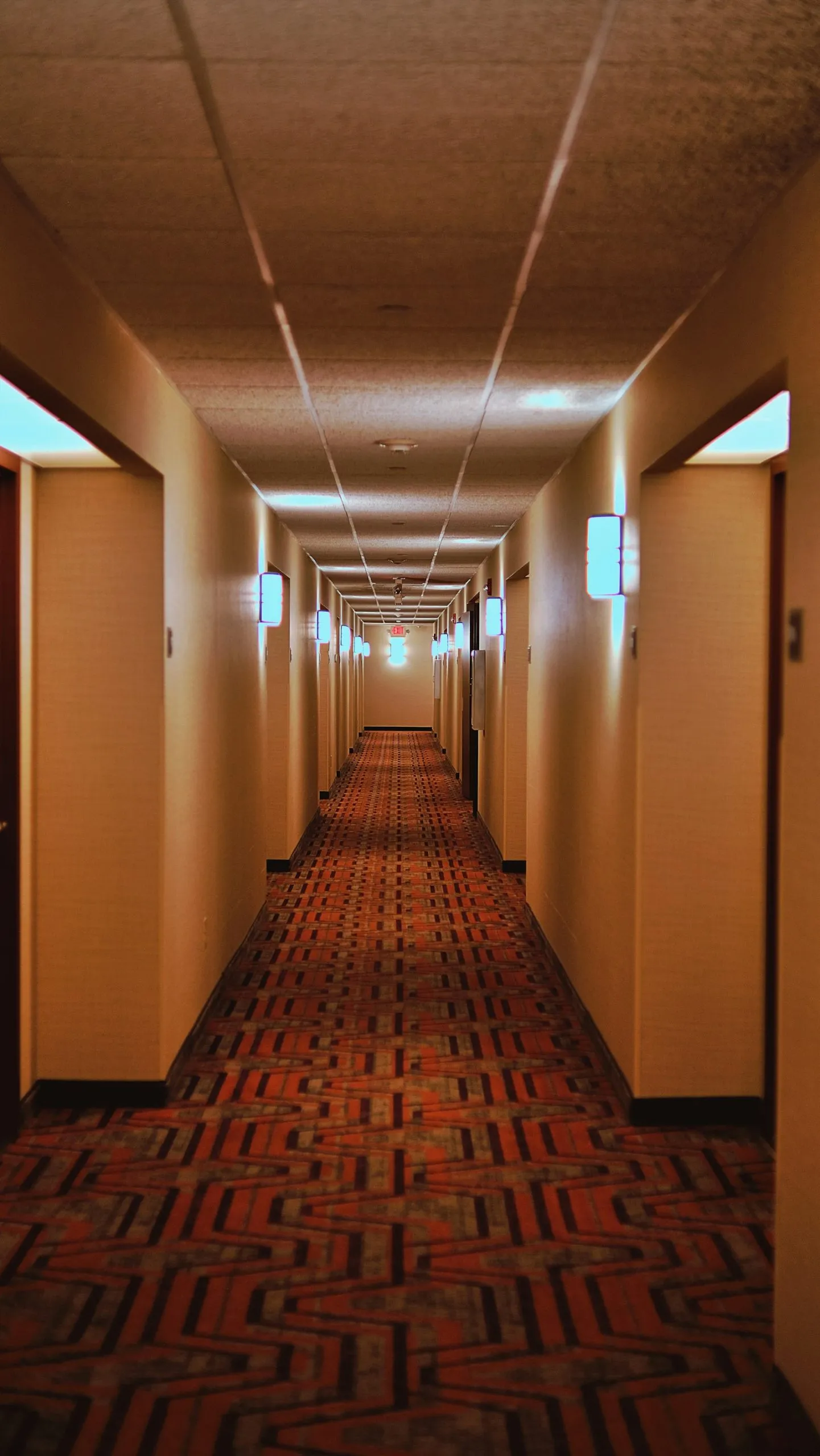
Hallways bring their own concerns: burned-out bulbs near stairwells, loose carpet seams, room-service trays left on the floor and leaking ice machines. State fire-safety and building rules, including posted exit information, apply to hotels as well.
Inside the Room: Bathtubs, Balconies, Furniture and Bed Frames
Once the door clicks shut, most people relax, yet the room is where many injuries happen.
The bathroom
A glossy tub with no textured strip or mat, no grab bar, and a shower door that slides off its track is a familiar recipe for a fall. Water heaters set far too high can scald a guest within seconds; if that happened to you, our page on burn and scald injuries covers the medical and legal side.
Furniture and fixtures
Chairs with a cracked leg, a desk lamp with frayed wiring, a bed frame whose slats give way, a heavy mirror or wall-mounted television that was never properly anchored: housekeepers and maintenance teams are in these rooms daily, which can make it harder for a property to claim it had no way of spotting the problem.
Balconies and windows
Loose railings and window guards are serious matters, especially when children are traveling with you. These cases often turn on inspection and repair records.
Bed bugs and food
Bed bug bites and illness after a meal in the hotel restaurant come up too. They are harder to prove because the source must be traced to the property, so photographs and prompt medical care are the starting point.
Amenities: Pool, Hot Tub, Gym and Breakfast Area
Hotel pools rarely have a lifeguard, and a sign reading “swim at your own risk” does not erase the property’s obligation to keep the deck, ladders, drains and water in safe condition. Slippery tile, missing depth markers and overheated hot tubs are common complaints. The CDC’s drowning prevention guidance is worth reading for any family traveling with young swimmers, and our companion piece on swimming pool injury claims explores those cases in detail.
In the fitness center, treadmills with worn belts, cable machines with frayed lines and free weights stored on unstable racks can all injure a guest. At the breakfast buffet, think spills near the juice station and hot surfaces within a child’s reach. Everywhere, the questions are what was wrong, who was supposed to check it, and for how long.
Security After Dark: When an Assault Becomes a Hotel’s Problem
Few things shake a traveler like being attacked in a place that promised a safe night’s sleep. The person who threw the punch is the obvious wrongdoer, but a hotel can also be held accountable when it failed to take reasonable precautions against crime it could have anticipated. That is the heart of a negligent security claim.
Warning signs we look for include broken or easily defeated door locks, keycards that were never deactivated after a prior stay, side entrances propped open, no identification check before handing out a duplicate key, unmonitored cameras, and a lobby with no staff overnight. Foreseeability is central: courts generally ask whether similar crimes had happened at or near the property before, so prior police reports and complaints can carry real weight. Any hotel injury lawyer handling these cases will want those records quickly. Our longer piece on holding owners accountable for inadequate security covers this in more depth.
Timing differs between the two potential defendants. A claim against the attacker personally for assault is generally subject to a one-year limit under CPLR § 215, while a negligence claim against the hotel ordinarily follows the longer rule discussed below.
Checkout: the Parking Lot, Garage and Airport Shuttle
The last leg of the stay brings its own risks. Airport-area garages and lots fill with rental cars piloted by tired travelers. Potholes and poor lighting lead to falls, and backing vehicles strike pedestrians. Our guide to parking lot crashes in Queens explains how fault is sorted out in those cases.
Then there is the courtesy shuttle. If you were hurt while riding in a hotel van that crashed on the Van Wyck or the Grand Central, the claim is treated as a motor vehicle case. So the van’s no-fault coverage generally handles treatment costs and some lost income for passengers, fault aside, with the application usually due within 30 days; our no-fault benefits guide walks through the forms. Recovering for pain from whichever driver caused the collision usually depends on meeting the “serious injury” definitions found in Insurance Law § 5102. Shuttle collisions are handled through our car accident practice.

Who Actually Runs the Hotel?
Here is a detail many guests never consider. The famous name on the sign is often not the company that owns the building or manages the staff. Plenty of properties are run by franchisees, independent owners or third-party management companies that license a brand. A housekeeping crew might be employed by one company, the security guards by another, and the elevator maintenance handled by a third.
One of the first jobs for a hotel injury lawyer is identifying the right parties, because a claim pointed only at the national brand can stall while the real decision-makers stay out of view. Deeds, franchise disclosures, management contracts and the name on your receipt all help sort out who controlled the space where you were hurt.
If You’ve Already Flown Home
Many of the people who reach out to a hotel injury lawyer in Queens no longer live anywhere near Queens. They were here for a wedding, a trade show or a layover and are now recovering in another state or another country. Leaving New York does not end the claim, but it does make some evidence harder to gather, so it helps to act from wherever you are. An injury at a New York property is often litigated in a New York court, and a local attorney can handle the work here while you heal at home.
Before you leave the property, or as soon as possible afterward, try to collect:
- The incident report itself, or failing that, the manager on duty who wrote it up.
- Photos and video of the spot where you were hurt, the lighting, any warning signs or the lack of them.
- Names and phone numbers of other guests or staff who saw what happened.
- Your folio, receipts, reservation confirmation and keycard sleeve, which show your room number and dates.
- Records from the urgent care, emergency room or doctor who treated you, here or after you returned.
Hotels keep surveillance footage for a limited time before it is recorded over, so an early preservation letter is important. Our article on requesting camera footage after a fall explains how that request is made.
Deadlines, Shared Fault and Alcohol
Most claims against a private hotel, its operator or a contractor must be filed in court within three years of the date you were hurt, under CPLR § 214. When a loved one was killed, the family’s wrongful death claim usually must be started within two years of the death. Where any government agency is involved, much shorter notice rules may apply, so it is wise to have counsel review the timeline promptly.
Expect the property’s insurer to argue that you share the blame: you were looking at your phone, you wore slick sandals, or you had a few drinks at the rooftop bar. Under CPLR § 1411, any portion of fault assigned to you lowers what you collect by that percentage but does not shut you out. Our article on how shared blame affects an award sets out the arithmetic.
How Our Firm Helps Hotel Guests
Consider us your local contact desk. Yakov Mushiyev & Associates receives visitors and New Yorkers alike in Suite 325 of 1 Cross Island Plaza in Rosedale, where Queens meets Nassau, and represents guests hurt anywhere in the five boroughs or across Nassau County. Our staff converses in Spanish, Russian and English, whether across a kitchen table, beside a hospital bed or by video from another state. Recoveries for the firm’s injured clients now exceed $80 million. A consultation is free, and you owe no fee unless we win. To get started, reach the office online or dial 718.775.3110.
Questions Hotel Guests Ask Us
Does a hotel have to pay for my injury just because it happened on their property?
No. A hotel is not an insurer of every guest’s safety. You generally need to show the property created the hazard, knew about it, or should have discovered it through reasonable inspection. Records, photos and witness accounts help establish that.
I was assaulted in my room. Can I bring a claim against the hotel and not just the attacker?
Often, yes. If the hotel failed to take reasonable security measures against a risk it could foresee, such as a pattern of break-ins or a broken lock it never repaired, the property may share responsibility alongside the person who attacked you.
I live in another state. Do I need to come back to New York to pursue a case?
Usually not for most of the process. Much of the work, including collecting records and negotiating, can be handled remotely, and video meetings make it easier to stay involved. You may need to appear for certain steps, such as a deposition or a trial, though those can sometimes be arranged around your recovery.
Will it hurt my claim that I had been drinking at the hotel bar?
It may reduce the amount you recover if the insurer proves drinking contributed to the accident, but shared blame in New York trims an award rather than erasing it. The hotel’s own failures, such as a wet floor or a broken railing, still count.
How quickly should I get the hotel’s video footage?
As fast as you can. Many systems overwrite recordings after a short period, so a written request to preserve footage should go out within days of the incident if possible.
Visit Yakov Mushiyev & Associates
Our office is at 1 Cross Island Plaza, Suite 325, Rosedale, NY 11422, just off the Cross Island Parkway on the Queens–Nassau border. If you can’t come to us, we’ll come to you: at home, in the hospital or by video.

Talk to a Queens hotel injury lawyer today
Yakov Mushiyev & Associates has recovered over $80 million for injured New Yorkers across the five boroughs and Nassau County. Consultations are free, available in English, Russian and Spanish, and there is no fee unless we win.
Call 718.775.3110 or contact us online for a free case review.
This article is general information, not legal advice. Every case is different. Attorney Advertising.