
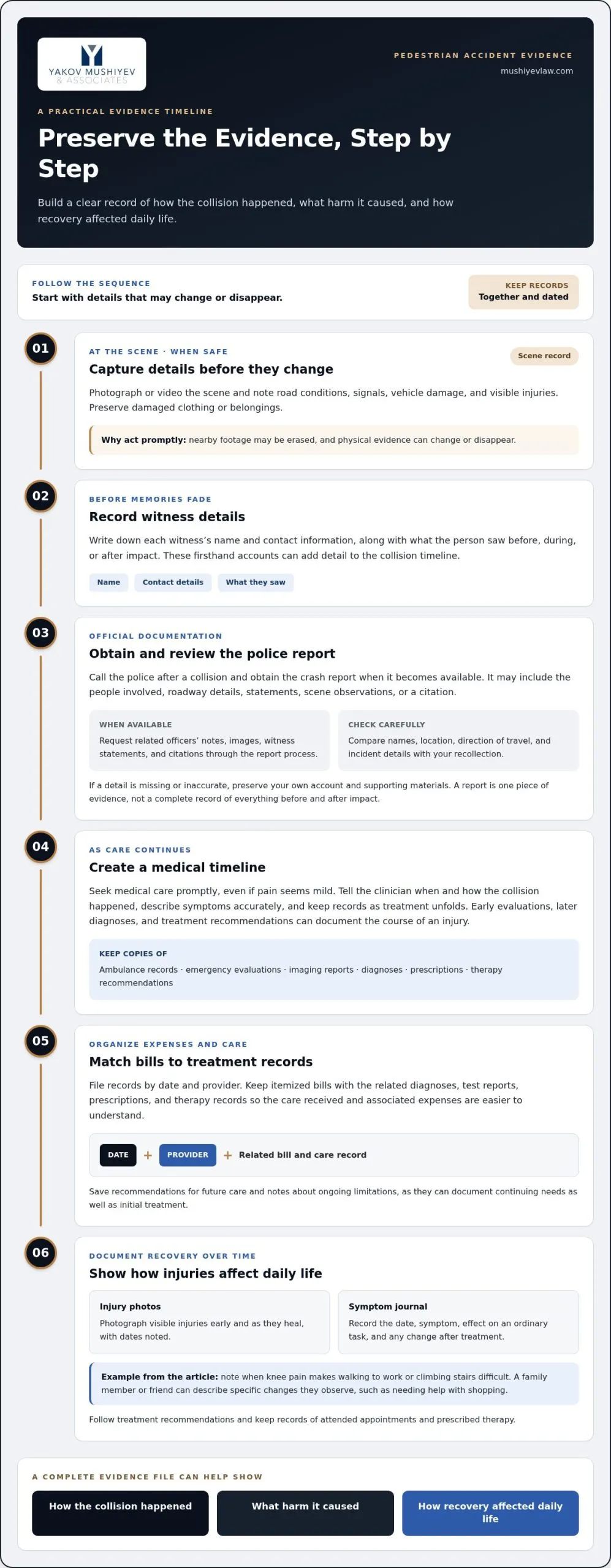
Evidence at a pedestrian accident scene can disappear before an injured person can return. To understand what evidence is needed for a pedestrian accident claim, preserve medical records and bills, the police report, photos and video, witness contact details, and notes about the road, signals, vehicle damage, and injuries. Together, these records can help show how the collision happened, what harm it caused, and how recovery affected daily life.
It’s understandable to focus first on treatment and the immediate aftermath. Still, preserving details early can help protect an accurate account of what happened. This article explains which medical records and official documents may matter, how scene photos and witness information can support a claim, and what you can preserve if you’re unable to document the crash yourself. Acting promptly matters because nearby footage may be erased and physical evidence can change or disappear.
Key Takeaways
- Keep treatment records, bills, and injury photos together to document both the harm and its impact over time.
- Use the police report as an early record of the collision, then review its details for accuracy.
- Nearby camera footage and physical evidence can disappear, so preserving them promptly may matter.
- Record witness contact details and what each person saw before memories fade.
- When it’s safe, document road conditions, signals, vehicle damage, and other scene details, and preserve damaged clothing or belongings.
Medical records and injury documentation
Medical records can connect injuries to a pedestrian collision and show how treatment unfolded. Collect records as care continues, not only after recovery: early symptoms, later diagnoses, and treatment recommendations help explain the full impact.
The video “Driver Hits Pedestrian and Lies About It” from Iacobelli Law Firm – Personal Injury Law discusses evidence used to establish what happened.
Records Linking Injuries to the Collision
Medical records can link an injury to the collision by documenting when symptoms began, what clinicians observed, and how they diagnosed and treated the condition. An emergency evaluation soon after impact may record pain or visible injuries, while later imaging or physician notes can show how the condition developed. This timeline helps distinguish collision-related harm from unrelated health issues.
Seek medical care promptly, even if pain seems mild at first. Some problems develop later, so tell the clinician when and how the collision happened and describe each symptom accurately. Follow-up notes can record changes, such as worsening pain or limited movement. Keep copies of ambulance records, emergency evaluations, imaging reports, diagnoses, prescriptions, and therapy recommendations. Don’t minimize symptoms or guess at a diagnosis.
Bills and Treatment History
Medical bills and treatment records show what care you received, when you received it, and the expenses associated with documented injuries. Keep itemized bills alongside diagnoses, test reports, prescriptions, and therapy records. Together, they can explain why treatment occurred and how it related to the injuries documented after the collision.
Organize records by date and provider. For example, file an emergency department bill with the related evaluation, then add imaging results and later physical therapy progress notes. This makes gaps or changes in treatment easier to understand. Save recommendations for future care and notes about ongoing limitations, as they can document continuing needs as well as initial treatment.
A symptom journal can add details a brief appointment note may not capture. Record the date, the symptom, its effect on an ordinary task, and any change after treatment. For example, note when knee pain makes walking to work or climbing stairs difficult. Ask a family member or friend to describe specific changes they observe, such as needing help with shopping.
- Keep appointment summaries, bills, test results, and prescriptions together by date.
- Photograph visible injuries early and as they heal, with dates noted.
- Follow treatment recommendations and keep records of attended appointments and prescribed therapy.
Consistent documentation gives a clearer picture of the injury and recovery. A complete file can show both the clinical course and the practical effects on daily life.
Police reports and official documentation
A police report can preserve statements, scene conditions, contributing factors, and citations after a pedestrian collision. Witness accounts add firsthand descriptions, while the report provides an official record that can help establish the sequence of events.
Police and Crash Reports
A police crash report is an official record of a collision and may include the people involved, roadway details, and statements gathered at the scene. It creates an early written account to compare with photographs, medical records, and later recollections. Call the police after a collision and obtain the report when it becomes available. Request related documentation, such as officers’ notes, images, witness statements, and citations, through the report process when available.
Officer Observations at the Scene
Officer observations record what police saw or documented at the collision scene, such as roadway conditions, traffic signals, weather, and vehicle positions. These details can establish the setting and provide context for witness accounts. For example, a report noting a signal’s status may matter when accounts differ about who had the right of way. An officer’s initial assessment can inform an investigation, but it doesn’t decide civil liability.
Read the report carefully and compare its details with what you remember. Check names, the collision location, direction of travel, and descriptions of the incident. If an important detail is inaccurate or missing, preserve your own account and supporting materials, such as dated photographs or a witness’s contact information. A report is one piece of evidence, not a complete record of everything that happened before and after impact.
Traffic Violations in Police Reports
A police report may state whether a driver received a traffic citation after hitting a pedestrian. That entry can show what conduct police identified at the scene, particularly if the violation relates to the collision. However, a citation isn’t the same as a civil liability decision. Compare it with witness statements, scene evidence, and other records to understand how the reported conduct fits the full account.
Witness statements can describe what someone saw before, during, and after impact; record each witness’s name and contact details so their account can be followed up. If a report lists a witness, compare that person’s statement with the report’s timeline and your recollection. An attorney can assess how those accounts and police observations fit together. Pedestrian accident legal representation can help organize and evaluate official documentation when the collision’s details are disputed.
Surveillance footage and accident-scene photography
Photos and video can preserve details about the collision, the driver, and resulting damage when figuring out what evidence is needed for a pedestrian accident claim. Act promptly because footage may be erased and physical evidence can change.
Photograph the scene, vehicle damage, your injuries, and damaged clothing when it’s safe. New York follows a pure comparative negligence rule, meaning your compensation can be reduced by your percentage of fault, but you can still recover damages even if you bear most of the responsibility for the incident.
Accident-Scene Photos and Videos
Accident-scene photos and videos can document conditions that may be difficult to recall later across Queens, Rosedale, and Rochdale. Capture the vehicle’s impact points, skid marks, road defects, lighting, obstructed signs, and crosswalk markings. Include wide views showing how the roadway connects, then closer images of specific details. This documentation can help explain where the collision occurred and what the driver could see.
Photograph injuries as soon as possible, then document how they change during recovery. Images of damaged clothing or personal items can also preserve details a written account may miss. If you couldn’t take photographs at the scene, police images, nearby cameras, or an investigator from Yakov Mushiyev & Associates, P.C. may help locate visual evidence.
Surveillance and Traffic Camera Footage
Surveillance footage from nearby businesses and traffic cameras may show a driver running a red light or turning without looking for pedestrians. It may also capture the movement of vehicles and people before impact. Identify cameras near the collision location, including those facing the crosswalk or intersection, while recordings may still exist.
Traffic-camera or security footage can be erased, so prompt preservation matters. An attorney at Yakov Mushiyev & Associates, P.C. can request that nearby businesses or other custodians preserve relevant recordings. Note each camera’s location and what it might show, such as the driver’s approach or the pedestrian signal.
Dashcam Video and Vehicle Data
Dashcam video may come from the involved vehicle or another vehicle nearby. Ask witnesses whether their vehicles recorded the collision and preserve any video they share in its original form. Vehicle electronic data recorders may capture speed, braking, steering input, and other operating details shortly before impact. That data can help clarify conflicting accounts.
Obtaining electronic evidence may require formal legal procedures. Attorneys at Yakov Mushiyev & Associates, P.C. can use discovery and subpoenas to seek relevant records, such as vehicle data, and can promptly request preservation of dashcam footage. Don’t assume a recording will remain available while a claim is investigated.
Preserve original files and note when and where each image or recording was made. For useful testimony and context, keep a simple record alongside each item:
- Who captured or provided the photo or video.
- Where the camera or photographer was positioned.
- Which scene detail, vehicle movement, or signal the recording shows.
Organized visual evidence helps connect a recording to the collision instead of leaving it as an unexplained file. Preserve the surrounding context, too, so the scene, damage, and driver’s actions can be assessed together.
Eyewitness statements and contact information
Witnesses can offer independent accounts of how a pedestrian collision unfolded. Their statements and contact details help preserve evidence that may support or challenge the accounts in police reports.
Eyewitness Statements
An eyewitness statement records what a person observed before, during, or after a collision. A witness may describe the vehicle’s approach, the pedestrian’s movement, or what happened immediately after impact. Ask witnesses to distinguish what they saw from what they assumed, such as identifying a red signal they personally observed rather than repeating someone else’s account.
Write down each account as soon as practical, while details remain clear. Note the witness’s position, view of the road, and any obstruction, such as a parked vehicle blocking sightlines. A witness near a crosswalk may have seen signal changes, while someone farther away may have noticed the driver turning. These distinct perspectives can help clarify the collision.
Witness Contact Information
Witness contact information allows investigators to follow up about a person’s observations. Collect each witness’s full name and preferred phone number or email, then record where they stood and what they saw. If someone must leave before speaking at length, request a reliable way to reach them later and note the time and location of the conversation.
Keep contact details with the witness’s own account, not in a separate, unlabeled note. Identify whether the person saw the impact, heard a statement, or arrived afterward. That distinction helps prevent secondhand information from being treated as a direct observation. Compare the account with police reports, scene photographs, and the vehicle’s known movements.
Filing deadlines also matter because witness evidence should be preserved while a claim is considered. Personal injury lawsuit deadlines differ by state. For example, Alabama and Ohio generally allow two years, while Nevada generally allows two years from the accident. Kentucky’s usual deadline is one year, but it may extend to two years when no-fault personal injury protection benefits apply.
- Record witness names and contact details promptly.
- Write down what each person observed firsthand and where they stood.
- Preserve each account alongside police reports and scene documentation.
- Note the state’s filing deadline early, since it affects how long remains to bring a lawsuit.
Clear witness records keep separate accounts distinct. A person who saw the driver approach may describe different details from someone who arrived after impact. Preserve both accounts accurately, including disagreements, rather than combining them into one version. This careful record can help an attorney assess how witness testimony fits the other evidence.
Evidence to collect at the accident scene
Scene evidence can preserve how the roadway, signals, and vehicles looked after impact. Collect details only when it’s safe, and don’t disturb vehicles or the scene before police document their positions.
Evidence supporting a claim should help show that another party acted negligently and caused the pedestrian’s injuries and losses. Photos, witness statements, road conditions, and vehicle positions can help establish what happened and connect it to the claim.
Evidence Supporting Fault
Evidence related to fault documents actions or conditions that may have contributed to the collision. Liability depends on how the crash happened, not simply on the fact that a pedestrian was struck. For example, photos of a damaged crosswalk sign, obstructed sightlines, or skid marks may add context to accounts of the driver’s actions and the pedestrian’s route.
Capture the relationship between details, not just close-ups. A wide photo can show where the vehicle stopped relative to a crosswalk, while a closer image records the impact point. Note each vehicle’s direction of travel and the pedestrian’s position without moving anything. These details can help explain the scene and may support a compensation claim when considered alongside other evidence.
Preserving and Documenting Evidence
Preserving evidence means keeping original items and recording where, when, and how each detail was documented. This matters because road conditions can change, and clothing or personal belongings may be discarded. Take photos only when safe, retain damaged items, and write down your memory of the event promptly so specific details don’t fade.
Wait until police have investigated and documented vehicle and scene positions before anything is moved. Then note the date, location, and subject of each photo. Keep original files rather than editing or cropping them; make separate copies for sharing. Label saved items clearly, such as “crosswalk facing north” or “jacket damage,” so their context remains understandable.
Useful scene records can include:
- Photos of vehicle impact points, skid marks, road defects, lighting, signs, and crosswalk markings.
- The condition and visibility of traffic or crosswalk signals, including whether a pedestrian walk signal was active.
- Damaged clothing and personal items, stored without altering them.
- A written account of what you remember, including the vehicle’s direction and where the impact occurred.
- Witness names and contact details, kept with notes about what each person observed.
Keep each item organized with its source and context. If a photo shows a road defect or obstructed sign, note its exact location and what it blocked from view. That connection helps others assess why the detail matters instead of treating it as an isolated image.
If scene evidence raises questions about liability, get help evaluating pedestrian accident evidence and organizing the records that may support your claim.
Yakov Mushiyev & Associates, P.C: Car Accident Legal Representation
Yakov Mushiyev & Associates, P.C. represents people injured in pedestrian accidents. If fault is disputed, important records are difficult to obtain, or an insurer challenges your account, the firm can help assess the evidence and explain how it relates to your claim.
Bring together the records you have, such as the police report, medical documents, photographs, and witness details. An attorney can review how those materials fit together and identify evidence that may need prompt preservation. You don’t need to have every document organized before seeking guidance.
If you want to discuss your pedestrian accident claim, contact Yakov Mushiyev & Associates, P.C.
Take the Next Step With a Clear Record
Knowing what evidence is needed for a pedestrian accident claim is a starting point; the next step is making the information usable. Create a brief timeline of key events and note which records or details still need attention. Keep original files and documents intact, and add a simple label explaining where each item came from. This gives you a practical overview to bring to a legal discussion without delaying care or recovery.
Yakov Mushiyev & Associates, P.C. represents people in pedestrian accident matters and also handles car accident, slip and fall, and truck accident claims. If you have questions about disputed facts or how evidence supports your claim, discuss the situation with the firm to consider a next step.
Contact Yakov Mushiyev & Associates, P.C. to discuss your pedestrian accident matter. A clear record can help you move forward with greater purpose and confidence.
Frequently Asked Questions
What medical records and bills are needed to document pedestrian accident injuries?
Gather records showing the care you received and the charges connected to it, including provider statements, test results, prescriptions, and therapy recommendations. Keep itemized bills with any insurance explanation of benefits so payments, adjustments, and remaining balances are distinguishable. For example, match each imaging charge to its report and date of service. This organized set can clarify which expenses relate to treatment following the collision.
How do you prove lost wages and other financial losses after a pedestrian accident?
Use pay stubs, tax returns, employer statements, and disability documentation to show missed work or reduced earning capacity. An employer statement can identify dates absent, usual duties, and changes to work after the collision. Keep receipts for other accident-related expenses and connect each to its purpose and date. A dated file helps distinguish injury-related costs from ordinary household spending, including for workers in Rosedale, Rochdale, and Queens.
What evidence helps establish driver negligence, such as speeding or failure to yield?
Evidence that puts the driver’s actions in context can help establish negligence. For example, a witness account describing a vehicle entering a crosswalk, paired with signal records or nearby footage, may clarify whether the driver yielded. Police documentation can note citations, while vehicle data may capture speed or braking. Compare each item’s timing and location; a collision reconstruction may help explain complex evidence when accounts conflict.
What evidence is needed to file a pedestrian accident claim with insurance?
Evidence for a pedestrian accident claim usually includes the police report, medical documentation, bills, proof of lost income, and records showing how the collision occurred. The driver’s insurer may ask for an account and relevant documents. A demand letter may present losses and supporting evidence before settlement discussions. Keep copies of what you send and note the dates and recipients. These general answers aren’t legal advice for your specific situation.