
A trial win is a major victory, but it may not be the final word. If you’re asking, “can the other side appeal if I win at trial,” the answer in a New York injury case is yes, subject to procedural rules and deadlines. An appeal does not automatically erase your compensation or give the defense a second trial. It is a focused review of the trial record, not an opportunity to present new witnesses or evidence.
It’s understandable to worry that an appeal could undo your result or leave your case unresolved. This guide explains when the losing side may appeal, what appellate judges review, and what outcomes are possible, including affirmance, modification, or reversal. It also explains why a notice of appeal does not automatically stop enforcement, how a stay may affect collection, and why deadlines depend on how and when the judgment or order was served. If you’ve won a car, truck, construction, or other injury case, keep your case documents together and get prompt, case-specific guidance about the judgment and next steps. For injured people in Rosedale, Rochdale, and Queens, understanding the actual court papers is more useful than trying to predict the outcome from the fact that an appeal was filed.
Key Takeaways
- Yes, the losing side may appeal after a New York trial, but the right to appeal does not guarantee that an appeal will be reviewed or change the result.
- If you’re asking “can the other side appeal if I win at trial,” remember that appellate judges generally assess the trial record and legal issues, not new evidence or testimony.
- A notice of appeal and a stay are different. Review the court papers to determine whether an order affects enforcement of your judgment.
- Keep the verdict, judgment, appeal notices, correspondence, and other case documents together. Record when each item was served or received.
- Ask your injury counsel to explain how the verdict, judgment, and stated appeal issues affect your case, and which steps may require prompt attention.
Can the Other Side Appeal If You Win at Trial in New York?
Yes. A losing party may appeal after a New York civil personal-injury trial if the applicable procedural and legal requirements are met. A defendant who disagrees with the judgment may seek review, but dissatisfaction alone does not establish a legal basis to change the result. The right to appeal also does not guarantee that the court will review every issue or reverse the judgment.
If you’re asking, “can the other side appeal if I win at trial,” the key distinction is this: the ability to appeal is not the likelihood of winning an appeal. Deadlines and procedures depend on the case, the specific judgment or order, and how and when it was served. Don’t assume the clock starts on the day the jury announces its verdict. Check the entered judgment and any notice of entry, then have counsel calculate the deadline using the actual service details.
For a brief overview of how the state’s highest court fits into New York’s appellate system, see the New York Court of Appeals. Most trial-level appeals do not go straight to that court.
To hear a general discussion of appeals following major verdicts, watch:
Who may appeal after a New York civil trial?
Generally, a party aggrieved by a judgment or qualifying order may seek review of the part that harmed their legal interests. If the defendant lost, that may mean challenging the verdict or a ruling that affected the outcome. A plaintiff may also appeal an issue they lost, such as a ruling that limited part of the case or a judgment that did not provide all the relief sought, if the applicable rules allow it.
An appeal is heard by an appellate court, not handled as another stage of the jury trial. In many cases, the first appellate review is in the Appellate Division of the appropriate department. Whether a particular ruling can be appealed, and whether permission is required, depends on the order and procedural posture. The appellate route is not identical in every case.
Does an appeal mean the verdict is automatically undone?
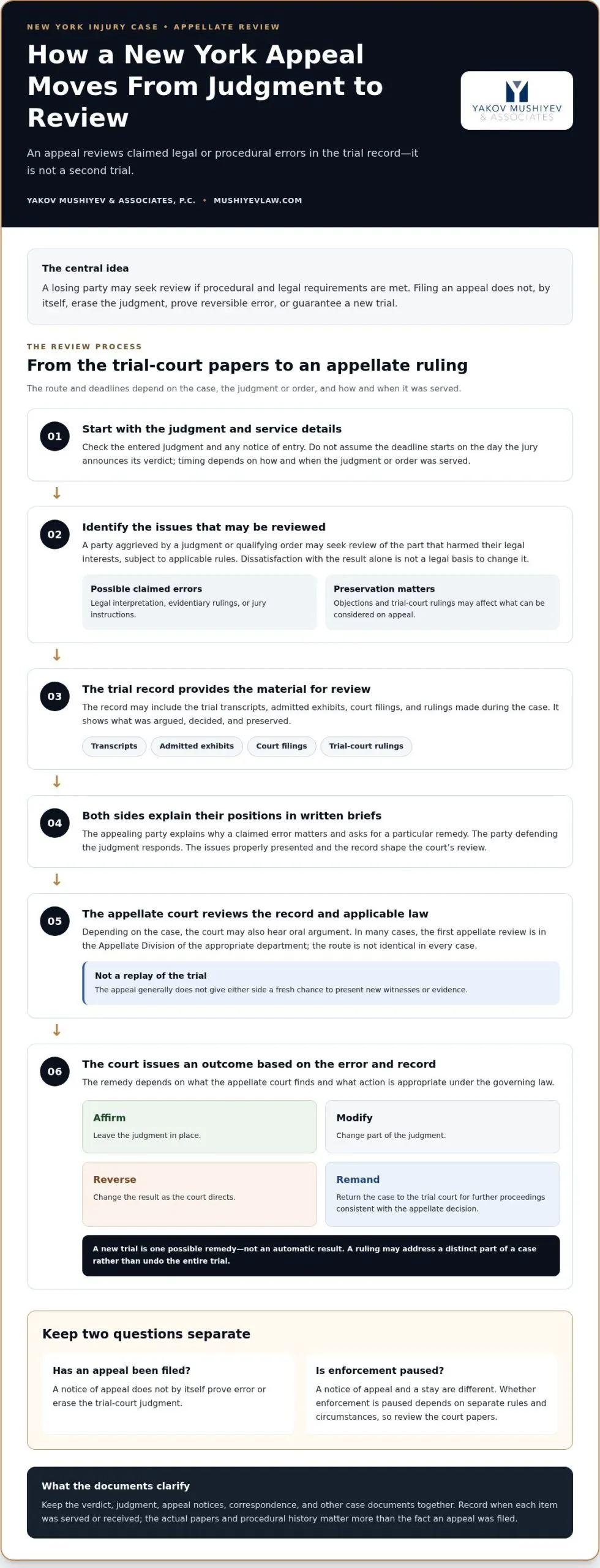
No. Filing an appeal does not by itself prove the trial court made a reversible error, erase the judgment, or guarantee a new trial. The appellate court considers the issues properly raised and decides whether the law supports changing the result. Possible outcomes depend on the error alleged and the record.
Keep the judgment and a later appellate ruling distinct. The judgment remains the trial court’s decision unless and until it is changed. Whether it can be enforced or enforcement is paused involves separate rules and circumstances. A defendant’s decision to appeal is not a prediction of the outcome. To understand what the appeal means for your case, review the actual documents and procedural history.
What Happens During a New York Appeal, and What Judges Review
A New York appeal is not a replay of the trial. The appellate court generally considers the trial-court record, the parties’ written briefs, and the law that applies to the issues raised. Appellate review examines alleged legal or procedural errors in the trial record; it does not ordinarily give either side a fresh chance to present witnesses and evidence.
The record may include transcripts, admitted exhibits, court filings, and rulings made during the case. The appealing party explains why a claimed error matters and asks the court for a particular remedy. The party defending the judgment responds. Depending on the case, the appellate court may also hear oral argument. The court’s review is shaped by the issues properly presented and the material that became part of the record.
What can the losing party challenge?
A losing party may argue that the court interpreted the law incorrectly, made an improper evidentiary ruling, or gave the jury an instruction that misstated the governing rules. A party may also challenge a verdict when the applicable legal standards and record support that argument. Simply believing the jury reached the wrong result is not, by itself, enough to establish that the judgment should change.
What happened at trial can affect what the appellate court considers. For example, if a party objected to evidence or an instruction, the objection and the judge’s ruling may appear in the record for review. Issues not properly raised or preserved at trial are generally harder to pursue on appeal, though the rules and exceptions depend on the circumstances. That is why the transcript and court filings matter: they show what was argued, decided, and preserved for review.
Can the appellate court order a new trial?
A new trial is one possible outcome, but it is not automatic. Depending on the issue and governing law, an appellate court may affirm the judgment, modify part of it, reverse it, or send the case back to the trial court for further proceedings. A remand means the case returns for action consistent with the appellate court’s decision. It does not, on its own, mean the opposing party receives an award or that every issue must be tried again.
For example, if a ruling affected only a distinct part of a case, the appellate court’s remedy may address that issue rather than undo the entire trial. In other circumstances, a new trial may be ordered if the court concludes that is an appropriate remedy. The result depends on the alleged error, the record, and the court’s ruling, not simply on the fact that an appeal was filed.
If you’re concerned about what the other side is challenging, injury counsel can help you understand how the trial record and judgment relate to those arguments. New York injury counsel can also explain how the verdict fits into the broader history of your injury case, without assuming what an appellate court will decide.
Can the Other Side Stop or Delay Your New York Verdict?
A losing party’s appeal and enforcement of a judgment are related, but they are distinct questions. Don’t assume that filing an appeal automatically stops collection or payment. Whether enforcement is paused can depend on the type of judgment, who appealed, the applicable New York procedure, and whether a stay applies or has been granted.
New York’s CPLR 5519 addresses stays pending appeal, with different rules and exceptions depending on the circumstances. Some situations may involve an automatic stay under the statute; others may require a court order or security, such as an undertaking. The specific judgment and procedural posture matter. Do not treat an appeal as an automatic pause without determining which rule applies.
Does filing an appeal automatically stop payment?
Not necessarily. The notice of appeal begins the appellate process, but it does not, by itself, answer whether the judgment can be enforced while review is pending. A stay may arise under an applicable statutory provision or require a separate application and court decision. Whether security is required also depends on the governing rule and circumstances.
For example, the effect of an appeal may differ depending on the appealing party and the kind of order or judgment involved. Review CPLR 5519 and its exceptions against the actual case documents before concluding that enforcement is paused. This calls for case-specific legal review, not guesswork.
What can happen to the trial award while review is pending?
If no stay applies or is granted, enforcement may continue under the rules governing that judgment. If a stay is in effect, collection may be delayed while the appeal proceeds, subject to the terms of the stay. Neither outcome should be assumed from the mere filing of an appeal. Review the judgment, any stay application or order, and the current case record.
| Situation | Possible effect on enforcement |
|---|---|
| Appeal filed | The appeal is underway, but filing alone doesn’t establish that enforcement is paused. |
| Stay applies under a statute | Enforcement may be paused according to the applicable provision and its conditions. |
| Stay granted by court order | Enforcement may be delayed as specified in the order, which should be reviewed carefully. |
This comparison is a starting point, not a determination of your case. A stay can have conditions, and the rules may differ based on the judgment and parties. Keep copies of notices, applications, and signed orders, and record when they were served or received. If the status of enforcement is unclear, have counsel review the docket and relevant documents promptly.
If you won compensation after a car crash, fall, or other injury, understanding the judgment’s status can help you plan your next steps. New York injury counsel can explain how the verdict and post-trial documents relate to your injury case.
What Should You Do If the Losing Side Appeals?
Receiving appeal papers after winning at trial can be unsettling. Start by preserving the documents and identifying the dates and court orders that may affect your case. If you’re wondering, “can the other side appeal if I win at trial,” focus first on what was filed, when it was served, and whether the papers or an accompanying order require action.
- Keep every document. Save the verdict, judgment, notice of entry, notice of appeal, appellate papers, proof of service, and related correspondence. Keep the original versions when possible.
- Record service details. Note when each document arrived and how it was delivered, such as by mail or personal service. Keep envelopes and delivery records if available.
- Contact your existing counsel promptly. Send counsel copies of the papers and ask which deadlines, court orders, and next steps apply to your case.
- Track new filings and orders. Keep a dated log of notices, applications, and court decisions. Don’t assume that an appeal has paused enforcement or that no response is needed.
Which papers and dates should you preserve?
Keep the trial verdict and entered judgment with any notice of entry, appeal documents, proof of service, and letters or emails about the appeal. Record when you received each item and the method of service. These details can matter because New York appeal deadlines depend on the type of case and document, as well as how and when service occurred. Don’t calculate your deadline from a general online rule alone.
A complete file also helps counsel compare the appeal papers with the trial history and identify the specific rulings or portions of the judgment being challenged. Keep the documents organized, and don’t write on or discard originals.
Why does prompt legal review matter?
The right response depends on the issues raised, the status of the judgment, and the procedural posture. Your existing injury counsel knows the case history and can review the papers in context. Share them promptly, even if you’re unsure whether a document requires action. General information cannot determine your individual deadline, obligations, or strategy.
If you’re still working through the broader steps in an injury matter, the New York personal injury claim process can provide useful context. A trial result and later court filings are part of the case record, so keep that record intact as questions arise.
Yakov Mushiyev & Associates, P.C. represents injured people in New York, including people hurt in car, truck, construction, and slip-and-fall incidents. The firm’s injury representation can help you understand your case documents and the questions to raise about what comes next, without assuming how an appeal will turn out.
How New York Injury Counsel Can Help You Understand the Verdict
A verdict is a major moment in an injury case. If the other side challenges it, you shouldn’t have to decipher the judgment and appellate papers alone. Your injury counsel can review the documents alongside the case history, identify what the opposing party says it wants reviewed, and explain which questions need attention. That can replace uncertainty with a clearer plan without promising that an appeal can be prevented or defeated.
For someone hurt in a crash, fall, or construction incident, the verdict may be only one part of the practical picture. The written judgment, notices, any stay-related orders, and unresolved issues can all matter. Counsel can help explain what those papers say and what they may mean for your injury case. The details of the record matter more than assumptions based on a general description of appeals.
What should you discuss with your injury lawyer?
Bring the verdict documents, judgment, notices, appeal papers, and recent correspondence. Then ask focused questions, including:
- What judgment or order was entered, and does it match the verdict?
- Have appellate papers been served, and what issues does the other side identify?
- Are there court orders or case-specific rules that affect enforcement or the next steps?
- Are any issues from the injury claim still unresolved?
These questions connect the paperwork to your actual case. For example, a notice challenging one ruling may raise different concerns from papers seeking review of the judgment more broadly. Counsel can explain the procedural choices available and what information is still needed to assess them. The answer depends on the documents and procedural history, not just on the fact that you won at trial.
A trial win matters, even when the other side challenges it
An appeal is a legal process. It is not proof that your case lacked merit or that the verdict has already been undone. You can recognize the work and importance of a trial victory while taking a challenge seriously and reviewing the record carefully. No one can promise how an appellate court will rule or when payment will occur.
If your injury involved a collision in Queens, the Queens car accident lawyer guide offers context about the firm’s injury advocacy in the community. Whether your case involved a car accident, truck crash, construction injury, or fall, counsel can help explain how the verdict and any new papers fit together.
If you’re still asking, “can the other side appeal if I win at trial,” the answer depends on the applicable rules and your case documents. Yakov Mushiyev & Associates, P.C. represents injured people in New York, including people in Rosedale, Rochdale, and Queens.
Move Forward With a Clear Plan
After a hard-fought trial, uncertainty about what comes next can weigh heavily. The question “can the other side appeal if I win at trial” deserves an answer grounded in your case, not assumptions. A careful review of the documents can help you focus on the decisions in front of you and avoid reacting to incomplete information.
Yakov Mushiyev & Associates, P.C. represents injured people in New York, including clients in Rosedale, Rochdale, and Queens. If appeal papers have raised new questions, discussing your injury matter with counsel can help you understand how the trial result fits into the broader case and what to address next.
Frequently Asked Questions
Can the other side appeal if I win a personal injury trial in New York?
Yes. The losing party may appeal a qualifying judgment or order if New York’s procedural requirements are met. For example, a defendant could seek review of a ruling or legal issue that affected the trial result. An appeal is not guaranteed to proceed or succeed, and the other side’s decision to challenge the result does not mean the verdict was wrong. The case documents determine what may be reviewed.
How long does the other side have to appeal in New York?
In most New York civil cases, the notice of appeal is due within 30 days after service of a copy of the judgment or order with written notice of its entry. The period may be extended by five days for service by mail or one day for overnight delivery. The service date and method matter, and exceptions apply. Have counsel calculate the deadline from the actual papers, not the verdict date.
Does filing an appeal automatically stop the other side from paying my verdict?
No. Don’t assume that filing an appeal automatically suspends enforcement or payment. Whether a stay applies can depend on the type of judgment, the parties, the applicable statute, and any court order or required security. For instance, the docket may show a separate stay application or order. Have counsel review the judgment and any stay papers before making financial plans based on an assumption that payment must stop.
Can an appeal make me go through a whole new trial?
Possibly, but a new trial is only one potential remedy and is not automatic. An appellate court could affirm the judgment, change part of it, reverse it, or return the case to the trial court for further proceedings. A remand may address a specific issue rather than require the entire case to be retried. The outcome depends on the arguments properly raised, the record, and the court’s decision.
What can the other side challenge after losing at trial?
The appealing party may argue that a legal ruling, evidentiary decision, or jury instruction affected the result, or raise a supported challenge to the verdict. For example, it might claim the judge applied the wrong legal standard to an issue. The argument must be grounded in the trial record and applicable law. Disagreement with the jury’s decision, without a recognized legal basis, does not alone establish that the judgment should change.
Can I appeal too if I won some issues but lost others?
Potentially. A plaintiff who is aggrieved by a judgment or qualifying order may seek review of an issue decided against them, subject to applicable deadlines and procedural rules. For example, you might want advice about a claim dismissed before trial or a ruling that limited the relief sought. A lawyer can review whether the issue is appealable, preserved in the record, and appropriate to raise, including whether a cross-appeal is relevant.
What should I do when I receive appeal papers after winning my case?
Save the papers, envelopes, and delivery records, then promptly send copies to your existing injury counsel. Record when and how each document arrived, and keep the verdict, judgment, notices, and related correspondence together. Don’t ignore a document because it appears routine. If your injury case arose in Queens, Rosedale, or Rochdale, counsel familiar with your case can help identify what the papers concern and which questions need timely attention.