
What if a request for production asks for records you’d rather keep private, or files you’re not sure have anything to do with your injury? If you’re asking “what is a request for production of documents,” the short answer is that it’s a formal part of discovery in a New York civil case. One side asks another to provide relevant documents or electronic files. It’s a structured evidence exchange, not permission to disclose everything.
After an accident, sorting through medical records, photographs, messages, and other materials can feel like another burden. You may also worry about sensitive information, which objections are appropriate, and how quickly you need to respond. Review the request item by item: check what each request asks for, whether it relates to the case, and whether a legal protection may apply. A careful response protects your position while addressing the rules that govern the case.
This guide explains what document requests may cover in a New York injury case, how written responses and objections work, and what to know about the response deadline. New York state civil cases generally require a response within 20 days after service, with five additional days when the request is served by mail. The right guidance can help you respond without disclosing more than the case requires.
Key Takeaways
- Learn what is a request for production of documents and how it fits into discovery in a New York injury case.
- Assess whether requested records or electronic files are relevant and responsive by comparing each request with the issues in the case.
- Distinguish materials that may be produced from information that may raise privacy or privilege concerns.
- Preserve potentially responsive records, organize them by request, and identify when legal guidance may help protect your position.
What Is a Request for Production of Documents in a New York Case?
If you’re asking what is a request for production of documents, it’s a formal discovery request seeking relevant documents or other materials that may be produced under the applicable rules. In New York state court, the request commonly takes the form of a notice for discovery and inspection under CPLR 3120. It allows a party to seek specified materials from another party in a civil case, such as records that may help clarify how an accident happened or the injuries involved.
That doesn’t make every personal record fair game. Consider the request’s wording, its connection to the claims and defenses, and any protections that may apply. The general Understanding Requests for Production overview describes the procedure’s broader purpose in civil litigation, but New York state practice has its own terminology and rules.
Document discovery is a written request to inspect or obtain materials. A deposition asks questions under oath, an interrogatory seeks written answers, and a trial subpoena can compel a person to appear or produce specified evidence. These procedures can all help gather evidence, but they are not interchangeable. First identify which document you received, who it was directed to, and what it requires.
What materials can a request seek?
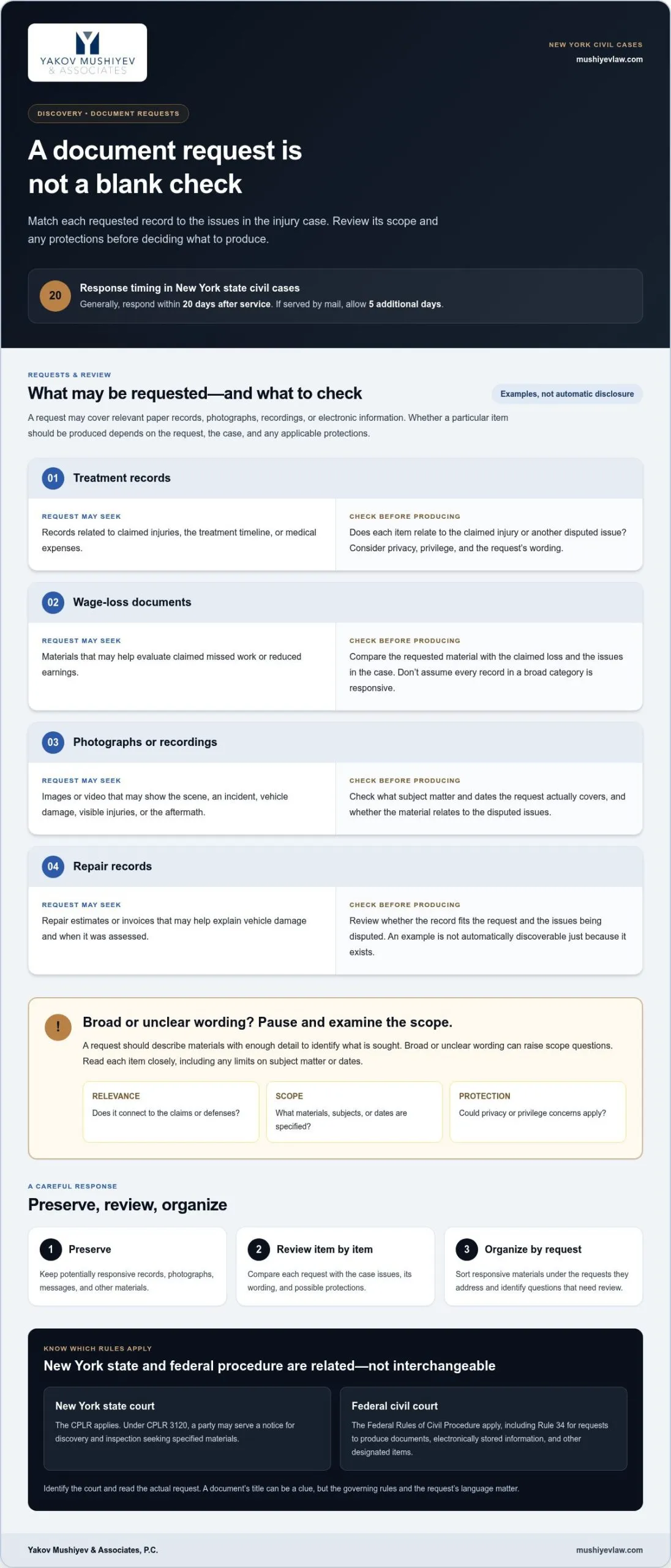
Depending on the request and the case, materials may include paper records, photographs, recordings, and electronically stored information. In an injury case, examples might include treatment records related to the claimed injuries, photographs of an incident location, or communications about an accident. An example isn’t automatically discoverable just because it exists. Its relevance and any applicable protections must be assessed.
- Paper records: Documents such as bills, reports, or other records connected to disputed issues.
- Photographs and recordings: Images or video that may show the scene, an incident, or its aftermath.
- Electronic information: Relevant emails, text messages, or files stored on a device or online.
A request should describe the materials sought with enough detail for the recipient to understand what is being requested. Broad or unclear wording can raise questions about scope. Read each item closely, including any limits on subject matter or dates, rather than assuming every record in a broad category must be produced.
How does New York terminology differ from federal practice?
New York state courts use the Civil Practice Law and Rules, or CPLR. Under CPLR 3120, a party may serve a notice for discovery and inspection seeking specified materials. Federal civil cases use the Federal Rules of Civil Procedure, including Rule 34 for requests to produce documents, electronically stored information, and other designated items. The procedures are related, but they aren’t interchangeable.
Before relying on a generic form or template, identify whether the case is in New York state or federal court and determine which rules govern. A document labeled “request for production” may use federal terminology, while a New York state-court paper may be titled “notice for discovery and inspection.” The title is a useful clue, but the court and the actual language of the request matter.
How a Document Request Works During Injury-Case Discovery
Once a civil action begins, the parties exchange information through discovery under the rules that govern the case. A document request helps each side gather materials relevant to the claims and defenses. It should describe what it seeks clearly enough for the recipient to identify the records or files at issue. Discovery is reciprocal: both sides may seek relevant information, subject to procedural rules, protective orders, and court supervision.
Imagine a Queens car-crash case in which the drivers disagree about how the collision happened and the extent of the injured person’s losses. Each side may request records that help examine those disputed issues. A request doesn’t resolve who is right. It creates a structured way to gather and evaluate evidence before the case progresses.
What might a request ask for in a personal injury case?
The requested categories depend on the allegations and disputed issues. For example, a request might seek:
- Treatment records: Records relevant to the claimed injuries, treatment timeline, or medical expenses.
- Wage-loss documents: Materials that may help evaluate claimed missed work or reduced earnings.
- Photographs or recordings: Images that may show vehicle damage, the collision scene, or visible injuries.
- Repair records: Estimates or invoices that may help explain vehicle damage and when it was assessed.
These are examples, not a checklist of records that must automatically be produced. Relevance, privilege, privacy concerns, the request’s wording, and the facts of the case all matter. A request that extends beyond the issues in dispute deserves careful review rather than automatic disclosure.
How can documents shape the evidence in a claim?
Records can help parties compare accounts with dates, reported symptoms, expenses, and other details. For instance, repair documents may help establish when damage was assessed, while treatment records may help show the sequence of care after a collision. Consistent information can clarify a timeline or support an explanation of claimed losses.
A gap or inconsistency may lead to follow-up questions or additional discovery, but it doesn’t decide the case by itself. The surrounding evidence and explanations matter. Discovery helps parties test evidence before trial or settlement discussions, so disputed facts can be examined rather than simply assumed.
Procedural rules depend on the court and the type of proceeding. A federal regulation reference, such as Cornell’s federal regulation page, should not be mistaken for the New York rules governing a state-court injury case. The court’s governing rules, any case-specific orders, and the wording of the request control the analysis. If a request raises questions about the scope of records in a Queens injury claim, guidance on New York accident claims can help you assess the issues before responding.
What Can You Produce, Object To, or Protect?
Review a document request item by item. Some materials may be responsive and nonprivileged; others may involve legal protections or raise a valid dispute about relevance, scope, or burden. A record’s sensitivity alone doesn’t automatically make it privileged or exempt from discovery. The request’s wording and the circumstances of the case matter.
| Type of material | What it may mean | Careful next step |
|---|---|---|
| Responsive, nonprivileged material | Records that fall within a request and relate to issues in the case, such as relevant photographs or treatment records. | Assess whether the specific item is responsive and whether any protection applies. |
| Potentially privileged material | Attorney-client communications or attorney work product may receive legal protection, depending on the circumstances. | Have the basis for protection reviewed before withholding or producing it. |
| Disputed requests | A request may be unclear, overly broad, burdensome, or insufficiently connected to the issues in dispute. | Identify the specific concern and determine the appropriate response under the governing rules. |
When might a request raise a legitimate objection?
A request may warrant an objection if it is vague, demands an excessively broad range of records, would impose an undue practical burden, or seeks material unrelated to the claims or defenses. For example, a request for an entire lifetime of records may deserve closer review if the case concerns a particular injury and period. The wording, issues, and applicable law shape the analysis.
An objection should state a specific legal or practical basis, not simply say “irrelevant” without explaining the concern. A protective order may sometimes address sensitive material or limit how it is handled, but it isn’t automatic, and no objection is guaranteed to succeed. Don’t ignore a request or assume that objecting eliminates every response obligation. Depending on the rules and circumstances, some portions may still require a response.
How should private or privileged material be handled?
Attorney-client communications and attorney work product may be protected, but whether a particular document qualifies depends on the circumstances. Medical and financial records can also contain highly personal information. That sensitivity deserves attention, yet privacy and privilege are different: sensitive information isn’t automatically shielded from discovery when the applicable rules permit its disclosure.
Get legal guidance before withholding, redacting, or producing a potentially protected document. A mistaken disclosure can be difficult to undo, while withholding responsive material without a sound basis can create its own problems. A careful review can assess the request’s scope, applicable protections, and whether a narrower response or protective measure may be appropriate. The goal is neither automatic disclosure nor reflexive refusal. It’s a response grounded in the actual request and the rules that govern the case.
How to Organize a Careful Response to a Document Request
A sound response starts with control: identify what was served, preserve potentially relevant material, and evaluate each request before producing anything. In practical terms, a request for production of documents is a formal demand that calls for a deliberate, organized response, not a reason to rush private files across without review.
- Record the service details. Save the request and note when and how it was served, who received it, and any response date stated in the papers.
- Verify the deadline. New York state practice generally provides 20 days to respond to a document demand, with five additional days when service is by mail. Confirm how the request was served, check the governing rules and any court orders, and calendar the applicable date. Don’t rely on a generic online schedule.
- Review each request separately. Identify the categories and time periods sought. Note which materials may be responsive, whether an objection may apply, and whether anything needs further review.
- Preserve and organize materials. Keep potentially responsive paper records and electronic files intact while the response is assessed.
- Prepare a written response. Depending on the request and applicable rules, the response may address what will be produced, specific objections, and responsive materials that cannot be located.
How do you search for responsive documents?
Use each request’s wording, categories, and date ranges to guide a focused search. Check likely locations, including paper files, email, messaging platforms, photographs, devices, and cloud-stored folders. Collect potentially responsive material in an organized way, preserve original files and available metadata, and keep notes about where records were found. If your search turns up a gap, record it for review rather than filling it with a guess.
What should you avoid when responding?
Don’t delete, alter, conceal, or selectively discard material that may relate to the case. Don’t send documents informally before assessing relevance, privacy, privilege, and response strategy. Even an apparently routine file can contain unrelated personal details or protected communications. Preserve first, then have the response reviewed. Uncertainty is not a reason to destroy or casually disclose evidence.
Deadlines and response requirements can depend on service details, the governing rules, and case-specific court orders. The general New York deadline is a starting point, not a substitute for checking the actual papers and circumstances. If a deadline is close, act promptly. A careful review can help identify responsive records, address objections, and avoid preventable disclosure or preservation problems.
If you’ve received a document request in a New York injury case, get guidance on your response before producing records or letting a deadline pass.
When New York Injury Claimants Should Get Legal Guidance
Receiving a document request doesn’t automatically mean the other side is acting improperly. Requests can be a routine part of a civil injury case, but routine doesn’t mean they should be answered without review. The scope, relevance, privacy concerns, and response requirements still matter. Asking “what is a request for production of documents?” is a useful starting point; understanding how a particular request affects your claim requires attention to the facts and applicable rules.
Legal guidance can be especially useful if a request seeks a broad medical history, includes communications that may be privileged, reaches beyond the issues in dispute, or arrives as a response deadline approaches. A lawyer can assess the requests in context, identify potential objections, help organize responsive material, and address disputes through the appropriate process. Not every objection will succeed, and not every request calls for the same strategy. The aim is a considered response that protects your position while complying with the rules that apply.
Why can discovery strategy affect an injury claim?
Documents may shape how the parties assess claimed injuries, financial losses, and contested events. A treatment timeline, for example, may become part of a discussion about the nature and course of an injury. A lawyer can evaluate requested materials alongside other evidence and the broader claims and defenses, rather than treating each document as an isolated item. That context can inform response choices, but it can’t guarantee a particular settlement value or outcome.
What should a claimant do after receiving a request?
Keep the request and any accompanying papers together. Record when and how they arrived, and preserve potentially relevant documents and electronic files. Don’t set the papers aside while trying to resolve every uncertainty on your own. Promptly raise unclear wording, broad requests, possible privilege issues, and deadline concerns with your attorney so they can be assessed in light of the case and applicable court requirements.
Understanding the New York personal injury claim process can help put discovery in perspective: it is one part of developing and evaluating an injury case. For claimants in Rosedale, Rochdale, and Queens seeking help with an accident-related claim, personal injury representation in Rosedale can include guidance on reviewing discovery requests and planning a response based on the claim’s circumstances.
If a request raises questions about your medical records, private information, or the scope of what’s being sought, discuss it with counsel before responding. Careful review can help you understand your options and take the next step with a clearer view of your rights.
Take Your Next Step With Confidence
A document request can feel like one more challenge after an accident, but you don’t have to decide alone what to disclose or how to respond. Asking “what is a request for production of documents” is a useful first step. The next is making sure your response reflects the facts of your claim and protects your interests.
Yakov Mushiyev & Associates, P.C. represents injured people in New York in accident-related personal injury matters, including car, truck, motorcycle, and pedestrian accidents, construction accidents, and slip and falls. The firm helps clients address the legal demands that follow an injury with careful, informed advocacy.
If you’re in Rosedale, Rochdale, or Queens and need help with an accident-related injury claim, contact Yakov Mushiyev & Associates, P.C. for legal guidance.
Frequently Asked Questions
Is a request for production of documents the same as a subpoena?
No. A request for production is generally a discovery demand directed to a party in a civil case. A subpoena is a court-authorized tool that may require a nonparty to provide records or require someone to appear, depending on its terms. The key distinction is who receives the document and what it requires. Read the actual paper carefully, since a subpoena may also demand documents.
What happens if I do not respond to a request for production?
Ignoring a request can lead the requesting party to seek court intervention, including an order compelling a response. Depending on the circumstances and any court orders, failure to comply may also expose a party to other remedies or sanctions. Don’t assume silence will protect private information or preserve an objection. If you’re having difficulty responding, promptly tell your attorney so they can assess the issue and address it through the proper process.
Can a request for production ask for text messages or social media records?
Yes, a request may seek electronic records such as texts, emails, photographs, or social media content if they are relevant and within its scope. For example, posts or messages about an accident, claimed injury, or activity may become an issue in a case. That doesn’t mean an entire account or every conversation must automatically be produced. Preserve potentially relevant material, and have the request reviewed before deleting, editing, or sharing content.
How long do I have to respond to a document request in New York?
In a New York state civil case, the general response period is 20 days after service; service by mail adds five days. The calculation can depend on how and when the request was served, and case-specific orders or agreements may affect the schedule. Keep the envelope and accompanying papers, record the date received, and verify the deadline promptly. Don’t apply this state-court timing to a federal case or rely on an undated online template.
Can I object to a request for production of documents?
Yes. An objection may be appropriate if a request is unclear, overly broad, unduly burdensome, or seeks material outside the issues in the case. State the particular concern and connect it to the request’s wording and applicable rules. A general objection may not adequately explain the problem, and objecting doesn’t necessarily excuse responding to every part. In a Queens injury case, counsel can assess which requests may warrant an objection and how to address them.
Do I have to produce my entire medical history in an injury case?
Not automatically. The dispute usually concerns which records relate to the injuries or losses at issue, and the relevant scope depends on the case. For example, records about an earlier condition affecting the same body part may be argued to matter, while unrelated treatment may raise scope and privacy questions. Sensitive medical information isn’t automatically privileged. Before agreeing to a broad release or withholding records, get advice on relevance and the request’s exact wording.
What is the difference between a New York document request and a federal Rule 34 request?
New York state-court discovery is governed by the CPLR and commonly uses a notice for discovery and inspection. Federal civil cases use Rule 34 of the Federal Rules of Civil Procedure. The terminology, procedures, and response schedule differ; federal responses generally are due within 30 days, subject to applicable rules and case-specific circumstances. Confirm which court is handling the case before using a form or calculating a deadline.