
What if the family members grieving after a fatal crash aren’t the ones legally authorized to file a wrongful-death claim? In New York, the deceased person’s estate representative generally brings that claim, so identifying who has authority is an important early step. A fatal car accident lawyer New York families turn to can help clarify the possible legal paths while they face urgent responsibilities and difficult decisions.
Insurance calls, paperwork, and preserving evidence can feel overwhelming. A fatal crash may involve a wrongful-death claim for eligible family members’ financial losses and a separate estate claim for conscious pain and suffering the deceased experienced before death. The claims serve different purposes, and deadlines may apply. Clear guidance early on can help your family preserve important evidence and avoid preventable delays.
This article explains who may pursue each claim, what can affect recovery, and why fault, insurance communications, and timing matter. It also describes how Yakov Mushiyev & Associates, P.C., a Queens personal injury firm serving Rosedale and Rochdale, can guide families through the next steps.
Key Takeaways
- A fatal crash may involve separate family and estate-related legal claims. Identifying which claims may apply is an important first step.
- Evidence about driver conduct, roadway conditions, and available records can help establish how the crash happened and how fault may be evaluated.
- Who has authority to bring a claim and which deadlines apply depend on the claim and circumstances. Don’t assume one deadline fits every case.
- Keep relevant records and communications in their original form. Careful documentation helps preserve important information.
- A fatal car accident lawyer New York families consult can help organize a claim, communicate with insurers, and explain legal decisions without promising a particular outcome.
After a Fatal Car Accident in New York, What Legal Paths May Be Available?
After losing someone in a crash, your family may be grieving while also facing urgent questions: Who can take legal action? What does the process involve? There may be more than one legal path, and each serves a different purpose. Understanding the distinction can help you prioritize questions without having to resolve every issue at once.
What is a wrongful-death claim in New York?
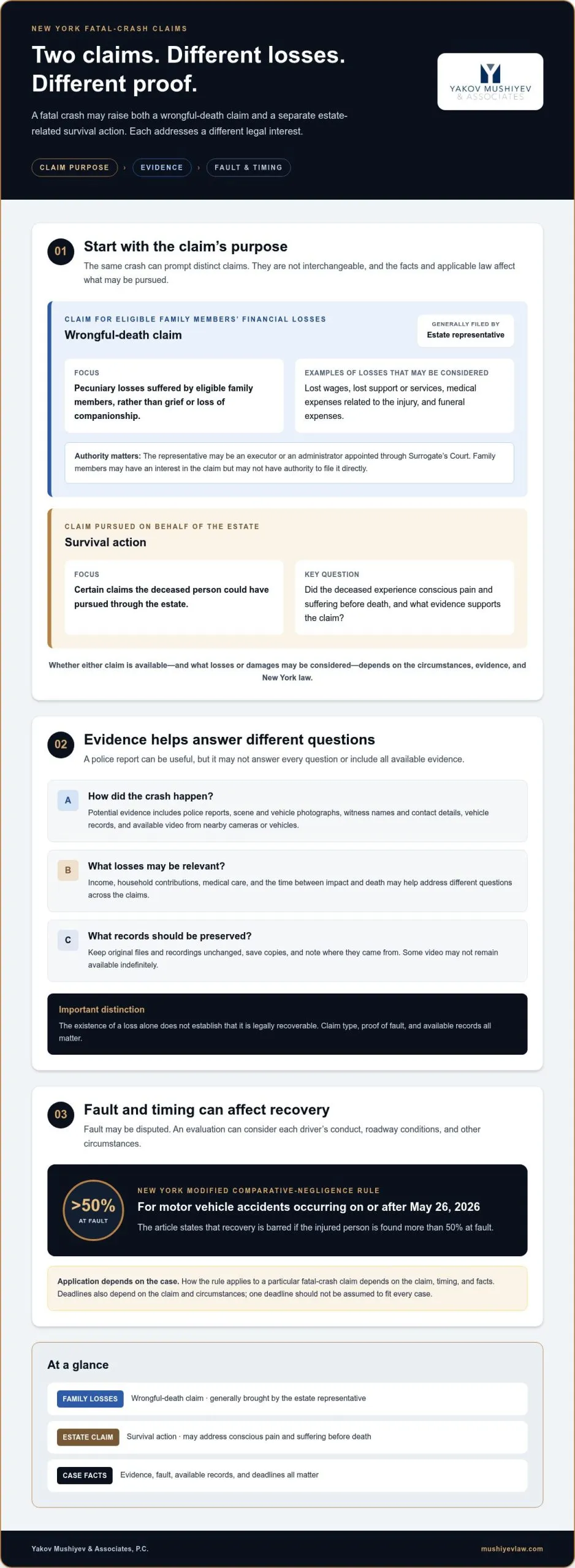
A wrongful-death claim is a civil claim seeking compensation for certain financial losses eligible family members suffer because of a person’s death. Under current New York law, damages generally focus on pecuniary losses, such as lost financial support and services, rather than grief or loss of companionship. A general wrongful death claim overview explains the basic concept, but New York law governs the rules that apply to a New York case.
In New York, the deceased person’s estate representative generally brings the wrongful-death claim. The representative may be an executor or an administrator appointed through Surrogate’s Court. Family members may have an interest in the claim, but they don’t necessarily have authority to file it directly. Who qualifies to share in a recovery, and which losses may be considered, depends on the law and the facts.
How can an estate-related claim differ?
A fatal crash can also raise questions about what the deceased person experienced before death. A survival action is brought on behalf of the estate and may seek damages for conscious pain and suffering experienced before death. Whether the claim is available and what evidence supports it depend on the circumstances and applicable law.
In short, a wrongful-death claim addresses eligible family members’ financial losses, while a survival action concerns certain claims the deceased person could have pursued through the estate. The claims involve different legal interests and aren’t interchangeable. A fatal car accident lawyer New York families consult can help assess possible claims, clarify who may have authority, and explain how the crash investigation relates to a separate civil case. A civil claim and any investigation into the crash are distinct processes. One does not automatically resolve the other.
These are general explanations, not a determination of your family’s legal rights. Eligibility, damages, and procedure depend on the facts and current New York law. A careful review can help identify which questions need attention and what steps may protect your family’s interests.
How New York Fatal-Crash Claims Address Fault, Evidence, and Possible Recovery
Understanding how a crash happened is central to evaluating a civil claim. Investigators and legal counsel may review driver conduct, roadway conditions, vehicle damage, and records from before and after the collision. A police report can provide useful details, but it may not answer every question or capture all available evidence. New York State’s traffic injury and fatality data offers broader context. An individual claim still turns on its own facts.
What evidence can help clarify how the crash happened?
Potentially relevant evidence may include police reports, photographs of the scene and vehicles, witness names and contact details, vehicle records, and available video from nearby cameras or vehicles. Different people or organizations may hold these records, and some video may not remain available indefinitely. A fatal car accident lawyer New York families work with can help identify relevant evidence and seek to preserve it. Keep original files and recordings unchanged, save copies, and note where they came from.
How can fault affect a fatal-crash claim?
Fault may be disputed. An evaluation can consider what each driver did and whether roadway conditions or other circumstances contributed to the crash. For motor vehicle accidents occurring on or after May 26, 2026, New York’s modified comparative-negligence rule bars recovery if the injured person is found more than 50% at fault. How that rule applies to a particular fatal-crash claim depends on the claim, timing, and facts, so New York counsel should review the circumstances.
Different claim types raise different legal questions. The table provides a general distinction, not a conclusion about what a particular family can recover.
| Claim type | Issues that may be examined |
|---|---|
| Wrongful-death claim | Potential pecuniary losses to eligible distributees, which may include lost wages, lost support or services, medical expenses related to the injury, and funeral expenses. |
| Survival action | Whether the deceased experienced conscious pain and suffering before death, and what evidence may support that estate-related claim. |
These categories are subject to New York law and the available evidence. Records of income, household contributions, medical care, or the time between impact and death may help address different questions in each claim. The existence of a loss alone doesn’t establish that it is legally recoverable. Claim type, proof of fault, and available records all matter. A brief description of a crash isn’t enough to predict a recovery.
Families in Queens, including Rosedale and Rochdale, can seek guidance on a fatal-crash claim to understand what evidence may matter and how the legal issues fit together.
Who Can Bring a Fatal Car Accident Claim in New York, and What Deadlines Matter?
Families may assume that a spouse, child, or parent can file a wrongful-death case directly. In New York, the person generally authorized to bring the claim is the personal representative of the deceased person’s estate. That role is different from the family members who may have an interest in the claim. Identifying both who can act and which deadlines apply is an important early step.
Who may have authority to pursue a claim?
A personal representative, such as an executor or administrator, generally brings a wrongful-death claim on behalf of eligible distributees. If the estate needs an administrator, an appointment through New York Surrogate’s Court may be part of the process. The representative’s authority to file is separate from deciding which relatives may benefit from a claim. A person’s relationship to the deceased doesn’t by itself settle eligibility or the allocation of any recovery. Those questions require review under current New York law and the family’s circumstances.
Why should families check deadlines promptly?
There isn’t one deadline that safely applies to every fatal-crash matter. Time limits can depend on the type of claim, who may be responsible, and other circumstances. A claim involving a public entity, for example, may have notice requirements that differ from the filing rules for other claims. Estate administration can raise procedural questions, too. A fatal car accident lawyer New York families consult can review the potential claims and parties before the family relies on a general deadline.
Public data can show the broader scale of traffic deaths. The Insurance Institute for Highway Safety’s state-by-state fatality data provides national context. Statistics don’t determine who may file or when a particular New York claim must be brought. Those answers depend on the legal and factual details of the case.
Prompt review can help protect options, not guarantee an outcome. It gives counsel an opportunity to assess who has authority, whether estate administration is needed, which deadlines may apply, and what steps to consider next. Keep crash-related and estate documents together, and include any notices or insurer communications in the review. Don’t assume an ongoing investigation, family discussions, or uncertainty about who will serve as representative makes it safe to wait. Early legal guidance can clarify the process while accounting for your family’s specific circumstances.
What Should Queens Families Do After a Fatal Car Accident?
In the days after a fatal crash, your family may be managing funeral arrangements, estate matters, and calls from insurers at the same time. You don’t have to resolve every legal question immediately. Start by preserving information and getting clear guidance before making decisions that could affect a claim.
Which records and details should families organize?
Keep documents in a folder or secure digital space as they become available. Don’t put urgent family responsibilities aside just to build a complete file. A lawyer can help identify what else may matter and what should be preserved in your family’s circumstances.
- 1. Save crash-related materials. Keep any police report, incident number, photographs, witness contact details, and messages about the collision. Preserve original files and don’t edit or annotate them.
- 2. Gather relevant financial and care records. Keep available medical bills, funeral documents, insurance information, and records that may show the deceased person’s income or contributions to the household.
- 3. Preserve communications. Save letters, emails, texts, and voicemails from insurers or other parties. Note the date and sender, and don’t delete messages even if they seem routine.
- 4. Pause before consequential decisions. Be cautious about giving recorded statements, signing releases, or accepting proposed terms. Seek legal review before taking a step you don’t understand or can’t easily undo.
How can Queens location affect practical next steps?
If the crash happened in Queens, its location may help identify where relevant records or local information could be found. The appropriate source depends on the crash site and the agency involved, so don’t assume a particular department handled the matter. Families in Rosedale and Rochdale can organize the information they already have while counsel considers whether additional local records should be requested.
For general guidance on the immediate aftermath of a collision, see the firm’s “What To Do Immediately After a Car Accident in Queens” guide. The related “Car Accident Lawyer Jamaica Avenue” guide may also provide useful Queens-area context. These resources don’t replace advice about a fatal crash, where estate questions and legal deadlines may need separate attention.
A fatal car accident lawyer New York families consult can help organize available records, preserve relevant communications, and explain which next steps fit the situation. Yakov Mushiyev & Associates, P.C. serves Rosedale and Rochdale in Queens and handles accident-related and wrongful-death matters. Request a complimentary initial assessment to discuss your family’s questions and possible next steps.
How a New York Fatal Car Accident Lawyer Can Guide Your Family
Legal work after a fatal crash can add strain to an already painful time. Counsel can bring structure to the process by identifying unanswered questions, coordinating the civil claim, and explaining choices in plain language. A fatal car accident lawyer New York families work with can also help them respond to confusing or premature demands while the facts and legal options are reviewed.
What can legal representation help families manage?
Depending on the case, legal work may include reviewing crash records, identifying evidence to pursue, communicating with insurers, and organizing information relevant to potential claims. Counsel can also help clarify who may have authority to act for the estate, which records may be useful, and which procedural questions need attention. Each step should reflect the actual facts, not assumptions about how another case unfolded.
Yakov Mushiyev & Associates, P.C. focuses on personal injury and accident-related representation, including wrongful-death matters. The firm serves Queens communities such as Rosedale and Rochdale. Families seeking broader context about the claim process can also explore the firm’s personal injury guidance for Rosedale, Queens.
What can families expect from an initial case discussion?
A complimentary initial assessment gives your family an opportunity to describe what happened and ask questions. If available, share the crash location, known parties, documents or communications you’ve received, and the concerns that feel most pressing. You don’t need to arrive with a complete file. Counsel can review the information you have, identify what remains unclear, and explain possible next steps without promising a particular result.
The discussion can help separate immediate practical questions from legal decisions that need more investigation. It may also clarify whether estate-related procedures or additional records should be considered. The goal is to understand possible options, responsibilities, and timing more clearly so your family can make informed choices.
Yakov Mushiyev and the team at Yakov Mushiyev & Associates, P.C. understand that each family’s circumstances are different. You deserve clear answers and steady guidance, not pressure or guarantees. Discuss your family’s next steps through a complimentary initial assessment.
Take the Next Step With Clear Guidance
A fatal crash can raise separate wrongful-death and estate-related questions. Who may bring a claim depends on legal authority and the family’s circumstances, while deadlines can vary by claim and other facts. Preserving records and getting timely legal guidance can help protect your family’s options while those issues are reviewed.
A fatal car accident lawyer New York families turn to can help investigate the crash, organize relevant information, and explain possible next steps. Yakov Mushiyev & Associates, P.C., a personal injury firm led by principal attorney Yakov Mushiyev, handles wrongful-death matters and serves Rosedale and Rochdale in Queens.
You don’t need to arrive with every answer or a complete file. A complimentary initial assessment gives you an opportunity to share what you know, ask questions, and discuss your family’s circumstances. Discuss your family’s next steps with the firm, and take the process one decision at a time.
Frequently Asked Questions
Who can file a wrongful-death lawsuit after a fatal car accident in New York?
Generally, the personal representative of the deceased person’s estate files the wrongful-death lawsuit, rather than a family member filing directly. The representative may be an executor or an administrator appointed through Surrogate’s Court. Eligible family members may have an interest in the claim, but authority to file and eligibility to benefit are separate questions. A fatal car accident lawyer New York families consult can help clarify those roles under the facts and current law.
How long does a family have to file a fatal car accident claim in New York?
For a general New York wrongful-death lawsuit, the deadline is generally two years from the date of death, not the crash date. Different rules may apply, including to claims involving a public entity, medical malpractice, or a pending criminal case. For example, a municipal claim may require a Notice of Claim within 90 days of the estate representative’s appointment. Prompt legal review matters because the applicable deadline depends on the claim and circumstances.
Can a family bring a claim if the driver who died was partly at fault?
Possibly, but the crash date and fault finding matter. For motor vehicle accidents occurring on or after May 26, 2026, New York’s modified comparative-negligence rule bars recovery if the deceased is found more than 50% at fault. If the person’s share of fault is lower, the effect may differ. Rules for earlier accidents may differ, so counsel should review the date, evidence, and claims before drawing a conclusion.
What damages may be available after a fatal car accident in New York?
A wrongful-death claim generally addresses eligible family members’ pecuniary, or financial, losses. Depending on the evidence and applicable law, these may include lost wages, lost support or services, medical expenses related to the injury, and funeral expenses. A separate estate survival action may raise different questions, including whether the deceased experienced conscious pain and suffering before death. Grief and loss of companionship are not currently recoverable wrongful-death damages under New York law.
Should a family speak with the insurance company after a fatal crash?
A family may receive calls or requests from insurers, but should be careful before giving a recorded statement, signing a release, or accepting proposed terms. Keep letters, emails, and messages, and note who contacted you and when. Don’t ignore communications, but don’t feel pressured to make consequential decisions before you understand them. Legal counsel can help assess what a request concerns and how a response may affect the potential civil claim.
What should I bring to a fatal car accident lawyer consultation?
Bring what you already have, but don’t delay seeking guidance to assemble a complete file. Helpful materials may include the crash report or incident number, insurance letters, photographs, witness details, medical and funeral records, and estate documents. A written list of known parties, the crash location, and your questions can also help focus the discussion. Counsel can identify additional records or evidence that may matter to your family’s circumstances.
Can a New York fatal car accident lawyer help if the crash happened in Queens?
Yes. Yakov Mushiyev & Associates, P.C. handles accident-related and wrongful-death matters and serves Rosedale and Rochdale in Queens. A lawyer can review the crash circumstances, help organize relevant records, and explain possible legal next steps. The crash location may help identify where records or other information could be found, but the appropriate sources depend on the case. Guidance can be useful whether the collision occurred in Queens or elsewhere in New York.
Does a fatal car accident lawyer guarantee compensation?
No lawyer can guarantee a settlement, verdict, or specific recovery. The outcome depends on matters such as evidence, fault, legal eligibility, applicable deadlines, and available insurance or other sources of recovery. A lawyer can investigate, explain potential legal paths, and advocate for the family, but cannot promise how a claim will resolve. Be cautious of anyone who assures you of a particular result before reviewing the facts.