
What if the hardest part of a Flushing slip-and-fall claim isn’t showing that you were hurt, but identifying who was responsible for the hazard? A slip and fall attorney Flushing Queens residents consult can investigate that question, but liability depends on the facts. A fall alone doesn’t prove that a property owner or another party was negligent.
If you’re unsure whether a spill, uneven sidewalk, icy entrance, or another condition caused your fall, that uncertainty is understandable. Property owners and insurers may dispute what happened, whether they knew about the hazard, or who controlled the location. The details matter, especially when a fall involves a sidewalk, apartment building, store, or transit property.
This article explains what may make a premises-liability claim viable and what evidence can help connect a hazard to the party responsible for maintaining the area. You’ll learn what to document, why photos, witness information, and maintenance records may matter, and how to start identifying the owner or entity in control. You’ll also learn why prompt action can help preserve evidence and legal options, without assuming that every fall leads to a successful claim.
Key Takeaways
- A fall or injury alone doesn’t establish liability. A claim may depend on evidence linking a hazardous condition to legally relevant fault.
- Inspection records, prior complaints, maintenance logs, and witness accounts may help show when a hazard appeared and whether it was addressed.
- Responsibility can depend on who owned, controlled, or maintained the location. Identify the property type and preserve details that may help an investigation.
- After a fall, address urgent medical needs, document the scene, report the incident, and keep photos, clothing, records, and witness contact information.
- When evaluating a slip and fall attorney Flushing Queens readers can ask about evidence preservation, public-entity deadlines, investigation strategy, and case updates.
Slip and Fall in Flushing: When an Injury May Become a Legal Claim
A fall on a busy sidewalk, inside a shop, in an apartment building, or near transit can leave you hurt and unsure who should answer for it. The location alone doesn’t establish responsibility. A slip and fall attorney Flushing Queens residents speak with may investigate who controlled the area, what hazard caused the fall, and whether evidence points to legally relevant fault.
A premises-liability claim concerns an injury connected to a dangerous condition on property and evidence that a responsible party failed to act reasonably. A wet floor or broken pavement may show that a hazard existed, but it doesn’t automatically prove negligence. The general concept is outlined in Premises liability law. Whether a particular fall supports a claim depends on the evidence and applicable law.
This video offers additional context about personal-injury representation in Queens and New York City:
What must an injured person generally show?
In general, the inquiry may consider whether a party was responsible for the property, whether a hazardous condition existed, and whether that party knew or reasonably should have known about it but failed to respond appropriately. These aren’t automatic checkboxes or a guaranteed formula. The facts matter, including how long the condition was present and what steps, if any, were taken to repair it or warn people.
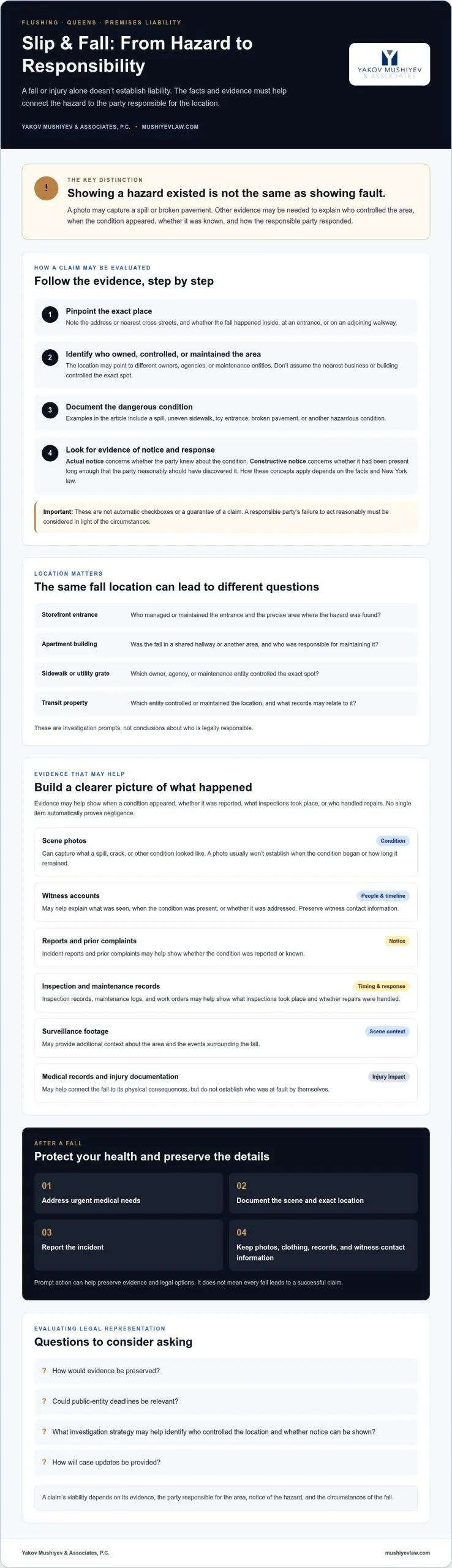
Evidence that a hazard existed is different from evidence that someone failed to respond reasonably. A photograph, for example, may capture a spill, while witness accounts or maintenance records may help explain when it appeared and whether anyone knew about it. Medical records and injury documentation can help connect the fall to its physical consequences, but they don’t establish who was at fault by themselves.
Why the exact Flushing location matters
The precise location of a fall can point investigators toward different parties and records. A storefront entrance may be managed differently from an apartment building’s shared hallway. A sidewalk, utility grate, or transit property may involve a different owner, agency, or maintenance entity. Don’t assume that the nearest business, building owner, or government body controlled the exact spot.
Record the address or nearest cross streets, and note whether you fell inside, at an entrance, or on the adjoining walkway. Those details can help identify who maintained the area and what evidence to seek. Liability still depends on control, notice of the hazard, and the circumstances of the fall, not simply on its Flushing location.
How to Prove a Flushing Property Owner Knew About a Dangerous Condition
Showing that a hazard existed is only part of the investigation. A claim may also turn on whether the party responsible for the area knew about the condition or whether it had been there long enough that the party reasonably should have discovered it. These concepts are commonly called actual and constructive notice. How they apply depends on the facts and should be assessed under New York law.
Notice evidence can help show whether a responsible party had a fair opportunity to discover and address a hazard before someone was hurt. A photograph can capture what a spill, crack, or other condition looked like, but it usually won’t establish when the condition began or how long it remained. The timeline may need to be pieced together from records and people who saw the area.
What evidence can show notice or control?
Potentially useful evidence includes incident reports, surveillance footage, inspection records, maintenance logs, work orders, prior complaints, and witness accounts. These materials may help establish when a condition appeared, whether it was reported, what inspections took place, or who handled repairs. None automatically proves negligence. Its significance depends on the surrounding facts.
Records may be held by a business, building manager, property owner, maintenance company, or public entity. Identifying who controlled the precise area can help determine where to look for relevant evidence. For sidewalk incidents, the New York City Department of Transportation explains NYC sidewalk maintenance laws. The responsible party still depends on the location and circumstances, so don’t assume every walkway has the same controller.
How the hazard itself can support the investigation
Document more than the presence of a hazard. Note its approximate size and visibility, the lighting, nearby drainage or leaks, any warning signs, and surrounding conditions that may help explain how it formed or whether it could be seen. Take close-up photos to capture details, then wider views showing the hazard in relation to entrances, walkways, or other landmarks.
While details are fresh, write down the date, time, weather, and precise location. Record what you observed and who may have witnessed it. If you’re considering speaking with a slip and fall attorney Flushing Queens residents search for, ask how evidence of notice and property control could be investigated in your situation. You can also review the firm’s slip and fall legal representation information.
Who May Be Responsible for a Slip and Fall in Flushing?
The location of a fall can help identify who to investigate, but it doesn’t settle liability. Ownership, actual control, maintenance arrangements, and applicable legal rules all matter. A storefront beside a sidewalk, for example, isn’t automatically responsible for every defect outside its entrance.
Use this guide to identify possible leads, not to assume a particular party is at fault:
| Location | Potential party to investigate | Evidence to look for |
|---|---|---|
| Private storefront | Business, property owner, or maintenance company | Lease or maintenance arrangements, inspection logs, incident reports, and video |
| Apartment common area | Owner, landlord, managing agent, or maintenance company | Management records, work orders, complaints, and records showing who maintained the area |
| Sidewalk | Abutting property owner or, depending on the facts, a public entity or another party | Exact defect location, ownership, maintenance history, and applicable exceptions |
| Utility grate or work area | Utility company, contractor, property owner, or public entity | Grate ownership, work permits or records, repair history, and control of the site |
| Transit property | Transit authority or another property or maintenance entity | Exact location, surveillance, incident records, and responsibility for upkeep |
Sidewalks, storefronts, and apartment buildings
New York City Administrative Code § 7-210 may shift responsibility for certain sidewalk defects to an abutting property owner, but its scope and exceptions matter. The rule generally addresses sidewalks next to commercial property and residential property with four or more units. Owner-occupied one-, two-, and three-family homes are among the exceptions identified in the applicable law. A lawyer should assess whether the rule applies to the specific location and claim.
For a storefront or apartment common area, investigate who actually maintained the spot where the fall occurred and when. Lease terms, assigned maintenance duties, and evidence of control can help clarify the roles of owners, tenants, and managers. Being next door alone doesn’t answer the question.
Transit property, utility grates, and public entities
A fall on MTA or other public property raises a separate issue: special notice procedures and deadlines may apply. In New York, claims against many government entities generally require a Notice of Claim within 90 days, with additional lawsuit deadlines. Different rules can apply to particular entities. Prompt legal review is essential. Don’t assume the ordinary deadline for a private-property claim applies.
A slip and fall attorney Flushing Queens residents consult can help investigate ownership, control, maintenance records, and applicable deadlines. Responsibility should be identified only after those facts and the relevant law are checked.
Steps After a Flushing Slip and Fall to Protect Evidence
A fall can leave you shaken. Focus first on your health, then preserve what you can without putting yourself at risk. Details, records, and witness accounts may help clarify what happened and who controlled the area.
- Address urgent medical needs. Seek appropriate care and follow medical advice. Tell healthcare providers what happened, and keep records of visits, discharge instructions, and expenses.
- Document the scene when it’s safe. Photograph the hazard up close and take wider views showing the surrounding area, lighting, warning signs, and nearby landmarks.
- Report the fall. Notify the business, property manager, or another appropriate contact. Ask that the incident be recorded and keep any report or reference number.
- Preserve records and belongings. Save photos, footwear, clothing, medical documents, and witness contact details. Write down what you remember while the details are fresh.
Document the scene and report the incident
Take pictures only if you can do so safely. Capture details that may help explain what the hazard looked like and where it was located. If someone witnessed the fall or saw the condition beforehand, ask for their contact information and note what they observed in their own words. Don’t coach them or ask them to guess.
Report the incident factually. Avoid speculating about who caused the hazard or accepting blame before you understand what happened. If asked to sign a statement, clarify its purpose and read it carefully first. Keep a copy if one is available.
Preserve medical and claim-related information
Keep appointment records, discharge instructions, receipts, and other documents related to your care. Make a brief timeline of the fall, symptoms, weather or lighting conditions, and conversations about the hazard. Separate what you personally observed from what someone else told you.
Public-property claims can involve strict notice procedures and deadlines that differ from ordinary filing periods. The applicable rules depend on the public entity and circumstances. If the fall involved a municipal sidewalk, transit property, or a public agency, seek legal guidance promptly so the relevant dates can be checked.
A slip and fall attorney Flushing Queens residents consider may be able to discuss how these details relate to a potential claim. If you’re ready to review the facts of your fall, contact the firm about slip and fall representation.
Choosing a Slip and Fall Attorney for a Flushing Queens Claim
Good legal guidance should help you understand what needs to be investigated, not promise an outcome before the facts are known. A fall near a storefront, in an apartment building, or on a sidewalk can raise different questions about control, evidence, and deadlines. Ask how the attorney would approach your specific location and which steps may be time-sensitive.
Questions to ask before choosing legal representation
Use an initial discussion to understand how the attorney would investigate your claim and what working with the firm would involve. Consider asking:
- How would you determine who controlled the exact area where I fell?
- What evidence should I preserve now, and how would you investigate records or video?
- Could a public entity or transit property be involved, and might a special notice deadline apply?
- Who will handle the investigation, and how will I receive updates?
- How do fees, case expenses, and the terms of representation work?
- What possible strengths, challenges, and next steps do you see based on the information available?
Clear answers matter. You should understand who will be your point of contact, what information the firm needs from you, and how the legal strategy may develop as evidence comes in. Read and understand the written representation terms before agreeing to them.
For additional background, read the firm’s Queens slip-and-fall claim guide and overview of the New York personal-injury claim process.
When to contact Yakov Mushiyev & Associates, P.C.
Yakov Mushiyev & Associates, P.C. represents injured people in slip-and-fall matters and serves Queens communities, including Rosedale and Rochdale. If your fall happened in Flushing, ask the firm directly whether it can assist with your location and circumstances.
If you’re considering a slip and fall attorney Flushing Queens residents may contact, share the basic facts: where you fell, what you observed, any incident report or medical documentation, and whether public property may be involved. The firm can discuss those details with you and explain whether it may be able to help. No attorney can determine the strength or outcome of a claim without reviewing its specific facts.
Protect Your Options and Take the Next Step
A fall doesn’t automatically establish liability. A potential claim depends on evidence connecting a hazardous condition to a party responsible for the area, including what that party knew or should have known. Preserving photos, witness details, reports, and medical records can help clarify the facts. The exact location matters too, particularly if public or transit property may be involved, because special notice requirements could apply.
If you’re looking for a slip and fall attorney Flushing Queens residents may consult, ask how the attorney would investigate control of the location, preserve evidence, and assess relevant deadlines. Yakov Mushiyev & Associates, P.C. represents people injured in slip-and-fall incidents and serves Queens communities, including Rosedale and Rochdale. If your fall happened in Flushing, ask directly whether the firm may be able to assist with your location and situation.
Discuss your slip-and-fall concerns with Yakov Mushiyev & Associates. Share the location, what happened, and any records you have to discuss possible next steps.
Frequently Asked Questions
Can I sue if I slipped on a Flushing sidewalk?
Possibly, but a sidewalk fall alone doesn’t establish a claim. Responsibility may depend on the defect, who owned or controlled that precise area, and whether New York City sidewalk rules or an exception applies. Take photographs showing both the defect and its location. A slip and fall attorney Flushing Queens residents consult can help assess the facts, but have New York counsel verify the applicable rules and deadlines, especially if a city agency may be involved.
How do I prove a property owner knew about a dangerous condition?
Evidence that may help includes prior complaints, inspection and maintenance records, incident reports, witness statements, and surveillance footage. These materials may establish whether the responsible party knew about the hazard or whether it existed long enough to be discovered through reasonable inspection. A photo may show what the condition looked like, but not how long it was present. The evidence needed depends on the circumstances and applicable law.
What should I do immediately after a slip and fall in Flushing?
First, address urgent medical needs. If it’s safe, photograph the hazard and surrounding area, note the time and exact location, and ask witnesses for their contact details. Report the fall to the business or property manager and keep any incident number. Preserve your footwear, clothing, and medical records. Don’t guess about who caused the hazard. If public property may be involved, promptly ask a New York attorney to check for special procedures.
Can I make a claim if there was no warning sign?
Possibly, but the absence of a warning sign doesn’t prove liability by itself. An investigation may need to determine what the hazard was, who controlled the area, whether the responsible party knew or should have known about it, and whether a warning or repair was reasonable. Photographs, witness accounts, inspection records, and maintenance history may help establish the circumstances. A lawyer can assess how the evidence applies to your situation.
What happens if I fell on property owned by New York City or a transit agency?
Claims involving a city agency or transit authority may have special procedures and shorter notice deadlines than claims involving private property. The applicable rules depend on which entity owned or controlled the location and the facts of the fall. Preserve evidence and get legal guidance promptly. Don’t assume that filing a lawsuit within an ordinary deadline is enough. Ask counsel to identify the responsible entity and verify every applicable requirement.
How much time do I have to file a Flushing slip-and-fall claim?
The deadline depends on the defendant and property involved. In New York, a lawsuit for a fall on private property generally must be filed within three years of the accident. Many government claims require a Notice of Claim within 90 days, but rules and exceptions vary by entity. Other deadlines may apply. Don’t rely on a general estimate. Ask a New York attorney to promptly verify the dates for your specific claim.
Do I need a slip and fall attorney if I already reported the accident?
Not necessarily, but reporting the fall doesn’t establish who was responsible or preserve every kind of evidence. Surveillance footage may be overwritten, witnesses can become harder to reach, and public-entity claims may involve prompt notice requirements. A lawyer can help identify potentially responsible parties, seek relevant records, and explain options without guaranteeing an outcome. Yakov Mushiyev & Associates represents injured people in slip-and-fall matters and serves Queens communities, including Rosedale and Rochdale. Ask the firm directly about your location.