
A failed mediation is a negotiation checkpoint, not the end of your Queens injury claim. If you’re asking what happens if mediation fails in Queens, the key point is that an unsuccessful session doesn’t automatically dismiss your claim or decide who’s at fault. It means the parties left without an agreement that day.
It’s understandable to worry that court is now unavoidable, delays will stretch on, or you should accept less than you believe your injuries warrant. But a mediation impasse isn’t a final answer. Settlement discussions may continue, and a lawsuit may move forward through the litigation process.
This article explains what an unsuccessful mediation can mean for a Queens personal injury claim, which steps may follow, and why the assigned court’s schedule and your case’s circumstances matter. It also covers why deadlines still deserve attention and how a personal injury attorney can help you review unresolved negotiations and understand your options before you decide what to do.
Key Takeaways
- In a Queens injury claim, mediation fails when the parties leave without an agreed resolution. That alone doesn’t establish fault, determine damages, or automatically end the claim.
- Wondering what happens if mediation fails in Queens? Your next step depends on the case’s stage and any agreements in place. Settlement talks may continue if both sides are willing.
- Compare continued negotiation, another mediation session, litigation, and trial by considering each option’s purpose, possible benefits, and unanswered questions with counsel.
- Organize mediation documents, settlement offers, medical records, and relevant communications so you can review your options with a clear record.
- Before accepting or signing terms you don’t understand, consider getting legal guidance about the proposed agreement and possible next steps.
What does it mean when mediation fails in a Queens injury claim?
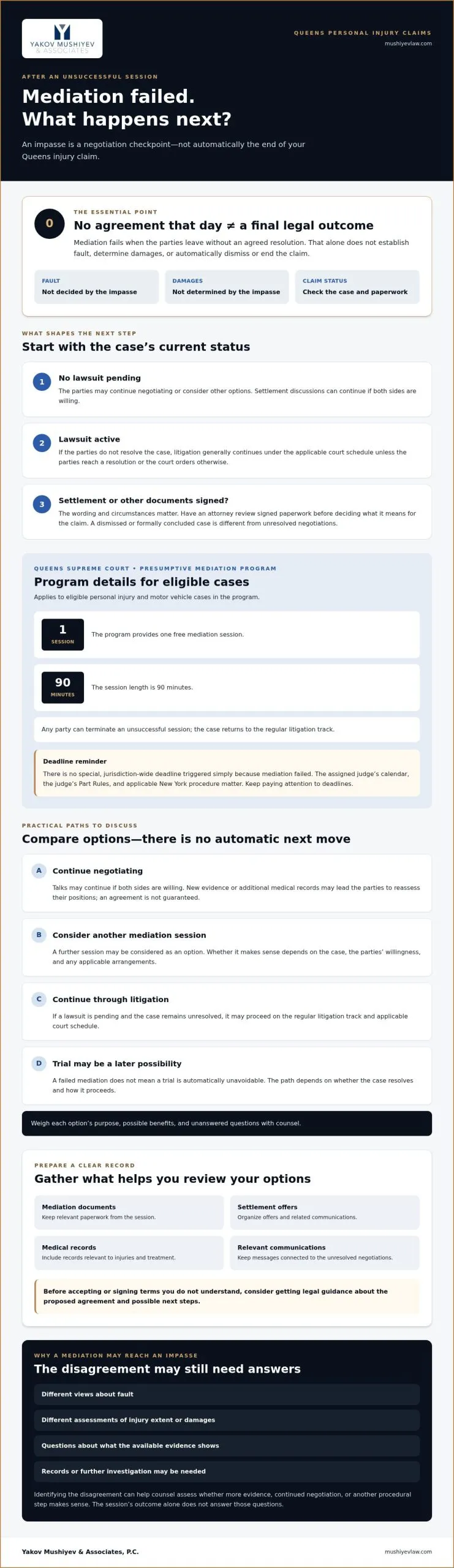
Mediation fails when the parties leave without an agreed resolution. In a Queens personal injury claim, that means negotiations didn’t produce a settlement at that session. It doesn’t, by itself, establish who was at fault, determine the value of your injuries, or automatically end your claim.
Mediation is a process in which a neutral mediator helps the parties try to reach a voluntary agreement. For a general overview of its purpose and principles, see Mediation. The key distinction is between leaving without an agreement and signing settlement documents. If you signed anything, the wording and circumstances matter. Have an attorney review the paperwork before deciding what it means for your claim.
This video discusses a workplace mediation, but its negotiation ideas may help explain how an impasse can occur:
Does failed mediation mean your Queens case is over?
No agreement at mediation is not the same as a final legal outcome. What happens if mediation fails in Queens depends partly on whether a lawsuit has been filed and whether the parties signed a settlement or other document. If no settlement was reached, negotiations may remain unresolved. A case that has been dismissed or formally concluded is different. Ask counsel to review the mediation paperwork and confirm the claim’s status rather than assuming it remains open or has ended.
Why might an injury mediation end without agreement?
An impasse can reflect a genuine difference in how the parties assess the claim, not misconduct. They may disagree about fault, the extent of the injuries, what the available evidence shows, or what a reasonable settlement would involve. Sometimes records or further investigation are needed before either side can evaluate the claim with confidence.
For example, the parties may have different views about how an accident happened or what medical documentation establishes about the injuries. Identifying the disagreement can help counsel assess whether more evidence, continued negotiation, or another procedural step makes sense. The session’s outcome alone doesn’t answer those questions.
What happens after mediation fails in Queens?
There isn’t one automatic next step. What happens if mediation fails in Queens depends on whether a lawsuit has been filed, where the case stands, and what the parties agreed to do. If no lawsuit is pending, the parties may continue negotiating or consider other options. If a lawsuit is active, the case generally continues according to the applicable court schedule unless the parties reach a resolution or the court orders otherwise.
For eligible personal injury and motor vehicle cases in Queens Supreme Court’s Presumptive Mediation program, any party can terminate an unsuccessful session, and the case returns to the regular litigation track. The program provides one free 90-minute mediation session. There is no special, jurisdiction-wide deadline triggered simply because mediation failed. Subsequent steps depend on the assigned judge’s calendar, the judge’s Part Rules, and applicable New York procedure.
Can settlement talks continue after an impasse?
Yes, if both sides remain willing to negotiate. Leaving mediation without an agreement doesn’t necessarily prevent later discussions. The parties may revisit their positions as the case develops, particularly if new evidence clarifies how the incident happened or additional medical records provide a clearer picture of the injuries and treatment. That doesn’t guarantee another offer or an agreement. It gives the parties an opportunity to reassess the claim using updated information.
Queens also has community dispute-resolution resources, which are separate from the court schedule for a pending lawsuit. NYC.gov provides information about the Community Dispute Resolution Center of NYC, including options for community mediation. Check whether a service fits your situation before treating it as a substitute for required court steps.
Could the case proceed toward trial?
If a lawsuit is pending and the parties don’t resolve it, litigation may continue through steps such as exchanging evidence, addressing disputes before the court, and preparing for trial. But a failed mediation doesn’t mean trial is immediate or inevitable. Negotiations may continue while the case moves forward, and the court’s directions and case-specific circumstances shape the schedule.
The right forum and next procedural step depend on the claim and its status. Don’t assume every injury claim belongs in Queens County Supreme Court or that the same schedule applies to every case. A personal injury attorney can review the court’s orders, applicable rules, and negotiation history to help you understand what needs attention. For a case-specific review of unresolved negotiations and possible next steps, consider speaking with a firm that handles Queens personal injury claims.
After Queens mediation fails, compare your practical options
There’s no single route every injury claim must take after an impasse. The right choice depends on the evidence, whether a lawsuit is pending, court directions, and any agreements already in place. Use this comparison to prepare focused questions for counsel. For broader context, review the New York personal injury claim process.
| Option | Purpose and possible benefit | Uncertainty | Questions to resolve with counsel |
|---|---|---|---|
| Continued negotiation | Keep discussing a possible resolution. New records or a clearer demand may help focus the discussion. | The other side may not agree or make another offer. | What evidence or information could change the discussion? |
| Another mediation session | Use a neutral mediator to support renewed settlement discussions. | Another session may not be available or productive, and agreement isn’t assured. | Are both sides willing, and do any court or program requirements apply? |
| Litigation | Continue a filed case through the applicable court process, which may help develop evidence and address disputes. | Timing, effort, and the outcome depend on the case and court schedule. | What evidence gaps, costs, and procedural steps need consideration? |
| Trial | Ask a judge or jury to decide unresolved issues in a case that proceeds to trial. | Trial is not automatic, and no result is guaranteed. | What are the strengths, risks, and likely demands of trial preparation? |
When might continued negotiation or another session make sense?
Further discussion may be more useful if important medical records are missing, an investigation is incomplete, or the parties need a clearer explanation of the claimed damages. Expert input may also help address a disputed issue, if appropriate for the case. Another mediation depends on the parties’ willingness and any applicable process requirements. It isn’t mandatory in every matter, and repeating mediation doesn’t guarantee resolution.
What should you weigh before litigation continues?
Consider the strength of the available evidence and its gaps, the time and demands of further litigation, and the disputed issues of liability and damages. Potential recovery can’t be evaluated reliably without the facts and applicable law. If your claim involves a car crash, the Queens car accident legal guide offers related context.
Arbitration is not an automatic next step after mediation. Before treating it as an option, ask counsel to check whether an agreement or court order applies and what it requires. A careful review can help you compare options without assuming any one of them is inevitable. That’s the practical answer to what happens if mediation fails in Queens: your options depend on the claim’s status and the terms that govern it.
How to protect your position after an unsuccessful mediation
After mediation, take practical steps to keep a clear record and identify what still needs attention. Keep every document, note the issues that remain disputed, and get advice before accepting terms. Save the mediation notice and written proposals, organize claim and medical records, list unresolved questions, and have any proposed agreement or court notice reviewed promptly.
What records and questions should you prepare?
Put the relevant materials together so you and your attorney can assess the impasse using the record rather than relying on memory. Gather:
- The mediation notice and any written proposals or settlement terms.
- Claim correspondence, relevant agreements, and court notices or orders, if a lawsuit is pending.
- Medical records and bills, along with updates about treatment and its effect on daily activities.
- A brief list of disputed issues, missing evidence, and questions about deadlines or the case schedule.
Keep copies in one organized folder and share relevant materials with your attorney promptly. Continue keeping accurate records of treatment and communications about the claim. Consistent documentation can help counsel evaluate the case, but it doesn’t guarantee that particular evidence will be accepted or determine the outcome.
Why do deadlines and signed documents need careful review?
Deadlines depend on the type of claim and its procedural status. Don’t assume that mediation pauses a filing deadline. In New York, mediation generally does not stop the personal injury limitations period unless the parties have a specific written tolling agreement. Claims involving a government entity may also have different notice requirements. Ask counsel to identify the deadlines that apply to your situation.
Read releases, settlement documents, and court notices carefully, and get legal advice before signing or accepting anything you don’t understand. A signed settlement may have important consequences for your rights. Prompt review can help clarify what a document requires and which steps remain.
If your injury involved a property hazard, see this Queens slip-and-fall claim guidance for related information. If you’re unsure what happens if mediation fails in Queens in your specific case, contact a Queens personal injury attorney to review your documents and next steps.
When to speak with a Queens personal injury attorney after mediation
Consider getting legal guidance if you’re unsure why the parties reached an impasse, what a proposed settlement would require, or which procedural step comes next. An attorney can review the available evidence, identify unresolved questions, and assess whether documents you received could affect your rights. That advice can help you make an informed decision without pressure to accept terms you don’t understand.
What should you ask a lawyer about failed mediation?
Bring the mediation paperwork, any written proposals, relevant claim correspondence, and current medical records. Then ask focused questions, such as:
- Which issues prevented agreement, and what evidence could help clarify them?
- What stage has the claim reached, and what steps may follow?
- Are there court dates, filing requirements, or other deadlines that need attention?
- What would a proposed settlement, release, or other signed term mean for the claim?
These questions can turn uncertainty into a practical discussion. If a document is unclear, ask for an explanation before signing or accepting it.
How can Queens injury counsel help evaluate next steps?
A personal injury attorney can assess the claim’s facts and available evidence, review settlement terms, and consider the procedure that applies to the case. The right approach may depend on how the injury occurred, what records are available, whether a lawsuit is pending, and what court directions apply. No review can promise a settlement or a particular result, but it can help you understand your options and prepare for the next decision.
Yakov Mushiyev & Associates, P.C. represents injured people in Queens-area personal injury matters, including car, truck, motorcycle, and pedestrian accidents, construction accidents, and slip-and-fall incidents. The firm serves Queens communities including Rosedale and Rochdale. If you’re still asking what happens if mediation fails in Queens, you can contact the firm to discuss your claim and the questions that remain.
For now, keep mediation and claim documents together, write down any upcoming dates, and seek case-specific advice before signing or accepting proposed terms. A clear record and a timely review can help you approach the next step with greater confidence.
Take the next step with a clear plan
A mediation that ends without agreement doesn’t, by itself, decide fault or bring an injury claim to a close. The answer to what happens if mediation fails in Queens depends on the claim’s status, any documents signed, and the next steps set by the parties or court. Negotiations may continue, or a pending lawsuit may proceed under its applicable schedule. Reviewing the paperwork and tracking important dates can help you protect your options.
Case-specific guidance can help you understand disputed issues, assess the evidence, and decide what questions to address before accepting proposed terms or moving forward. Yakov Mushiyev & Associates, P.C. represents injured people in car, truck, motorcycle, pedestrian, construction, and slip-and-fall cases, and serves Queens communities including Rosedale and Rochdale.
Discuss your Queens injury claim with our team to talk through your situation and possible next steps. You don’t have to make decisions in the dark. With your documents organized and the right questions on the table, you can move forward with greater clarity.
Frequently Asked Questions
Does failed mediation mean my Queens personal injury case is over?
No, an unsuccessful mediation alone doesn’t end a personal injury claim. It means the parties left without an agreed resolution. The effect depends on whether a lawsuit is pending and whether you signed settlement or other documents. If you’re unsure whether your claim remains active, have an attorney review the paperwork and check the case status before assuming it’s over or proceeding as if nothing changed.
What happens after mediation fails in a New York personal injury case?
The next step depends on the claim’s status, any agreements, and applicable court directions. If a lawsuit is pending, it may continue under the court’s schedule, with further litigation steps as required. In Queens Supreme Court’s eligible Presumptive Mediation program, an unsuccessful session can be terminated and the case returned to its regular litigation track. Ask counsel to check which forum and procedures apply to your specific case.
Can settlement negotiations continue after mediation fails?
Yes. Mediation ending without an agreement doesn’t necessarily prevent later negotiations, if both sides are willing to continue. Discussions may change as records are gathered, investigation progresses, or the parties better understand disputed issues such as fault or damages. That doesn’t mean another offer will be made or accepted. Your attorney can assess whether new information meaningfully affects your position and advise you about any proposed terms.
Will my case go to trial if mediation does not work?
Not necessarily. A failed mediation doesn’t automatically send a case to trial or mean trial is imminent. If a lawsuit is unresolved, it may continue through applicable litigation steps, and the parties may still settle before trial. Whether a case reaches trial depends on its circumstances, the evidence, court directions, and whether the parties resolve the dispute. Counsel can explain the likely procedural path without guaranteeing an outcome.
Do I have to accept a settlement offer made at mediation?
No, you don’t have to accept an offer simply because it was made during mediation. Take time to understand the proposed amount, release language, and what rights the documents may affect. Don’t sign or agree to terms you don’t understand. Ask your attorney to review the proposal and explain its consequences in light of your injuries, records, and claim. A case-specific review can help you make an informed decision.
Is mediation confidential in Queens personal injury cases?
Mediation is generally treated as confidential, but the exact protections can depend on the mediation program, applicable rules, and any agreements. Don’t assume every communication is protected in every circumstance or that confidentiality pauses legal deadlines. Before sharing sensitive information, review the program’s rules and ask your attorney what applies to your session. Queens court-connected mediation may have specific procedures, so check the governing materials for your case.
Should I hire a lawyer if mediation fails?
A lawyer can help identify why negotiations stalled, assess evidence gaps, review proposed releases, and explain what procedural steps may follow. Yakov Mushiyev & Associates, P.C. represents injured people in Queens-area car, truck, motorcycle, pedestrian, construction, and slip-and-fall cases, including in Rosedale and Rochdale. If you’re uncertain about your options, consider discussing your documents and case status with a personal injury attorney before making your next decision.