
What if a settlement has to account for treatment you haven’t received yet? How are future medical expenses calculated in a settlement when no one can know every detail of your recovery? A reliable estimate isn’t a guessed add-on. It’s a medical forecast supported by treatment records, provider opinions, and a clear account of the care your injuries are expected to require. Insurers may challenge whether that care is necessary or connected to the accident, so the reasoning behind each projection matters.
In New York personal injury claims, the strength of a future-care estimate depends on how clearly the evidence supports it. A life care planner may outline anticipated treatment, while a forensic economist may calculate the present value of projected expenses. Different assumptions about your recovery, future care, or costs can produce very different estimates.
This guide explains what evidence can support a projection, why the parties may value future care differently, and what to review before resolving your claim. Yakov Mushiyev & Associates, P.C. represents people injured in accidents and works to challenge unsupported reductions to documented care needs. Reviewing the medical evidence can help you assess whether a settlement accounts for treatment you may still need.
Key Takeaways
- Learn how are future medical expenses calculated in a settlement by tracing the evidence from injury diagnosis to projected care and costs.
- Understand how treating-provider opinions can show that anticipated treatment is connected to the accident and medically supported.
- Compare assumptions that can lead to disagreement about prognosis, treatment duration, service frequency, and costs.
- Use a practical checklist to identify unanswered questions in your prognosis, treatment plan, records, or cost estimates before settling.
- See how legal advocacy can organize future-care evidence and challenge unsupported reductions during settlement negotiations.
What Future Medical Expenses Mean in a Personal Injury Settlement
Treatment may still lie ahead even after settlement discussions begin. You might be weighing an offer while your doctor recommends more therapy, follow-up visits, or another procedure. Future medical expenses are anticipated costs of injury-related care, supported by medical evidence rather than speculation. They are one form of compensatory damages, but a projection must reflect the facts of the individual injury.
Past medical expenses are bills for care already received. Future medical expenses are estimates for treatment or services expected after the claim is resolved. A provider’s opinion about what care is likely to be needed helps distinguish a supported projection from a possibility that lacks enough medical grounding.
This video offers additional context on how future medical expenses may be considered in a personal injury case:
Which future care expenses might be considered?
Depending on the injury and medical recommendations, a future-care estimate might include follow-up appointments, prescription medication, physical or occupational therapy, procedures, or assistive devices. If the evidence supports an ongoing need, it may also include longer-term support or help at home. These are possible categories, not a checklist of care every injured person will need. The estimate should reflect the person’s condition and anticipated treatment.
Why the estimate matters before a settlement
A settlement may resolve a claim before projected treatment takes place. Before deciding whether an offer accounts for your injury’s future effects, understand what care your providers anticipate and what evidence supports that plan. If an ongoing need is overlooked or underestimated, the negotiated amount may not reflect the full picture presented by the medical evidence.
A settlement also doesn’t automatically pay each future bill as it arrives. The agreement’s terms determine how the claim is resolved, so don’t assume later expenses will be handled separately. Review what the offer accounts for, which medical recommendations support the projection, and whether questions about your recovery remain unanswered. This can help you separate what’s documented from what’s uncertain before making a decision.
How Doctors and Evidence Build a Future Medical-Care Estimate
Answering “how are future medical expenses calculated in a settlement” starts with the medical record, not a round-number guess. Treating-provider opinions help explain how an accident-related injury may affect future care. Medical records and qualified opinions support the assumptions behind the forecast. Each projected service should have a clear medical basis, with enough detail to explain why it may be needed and how it relates to the injury.
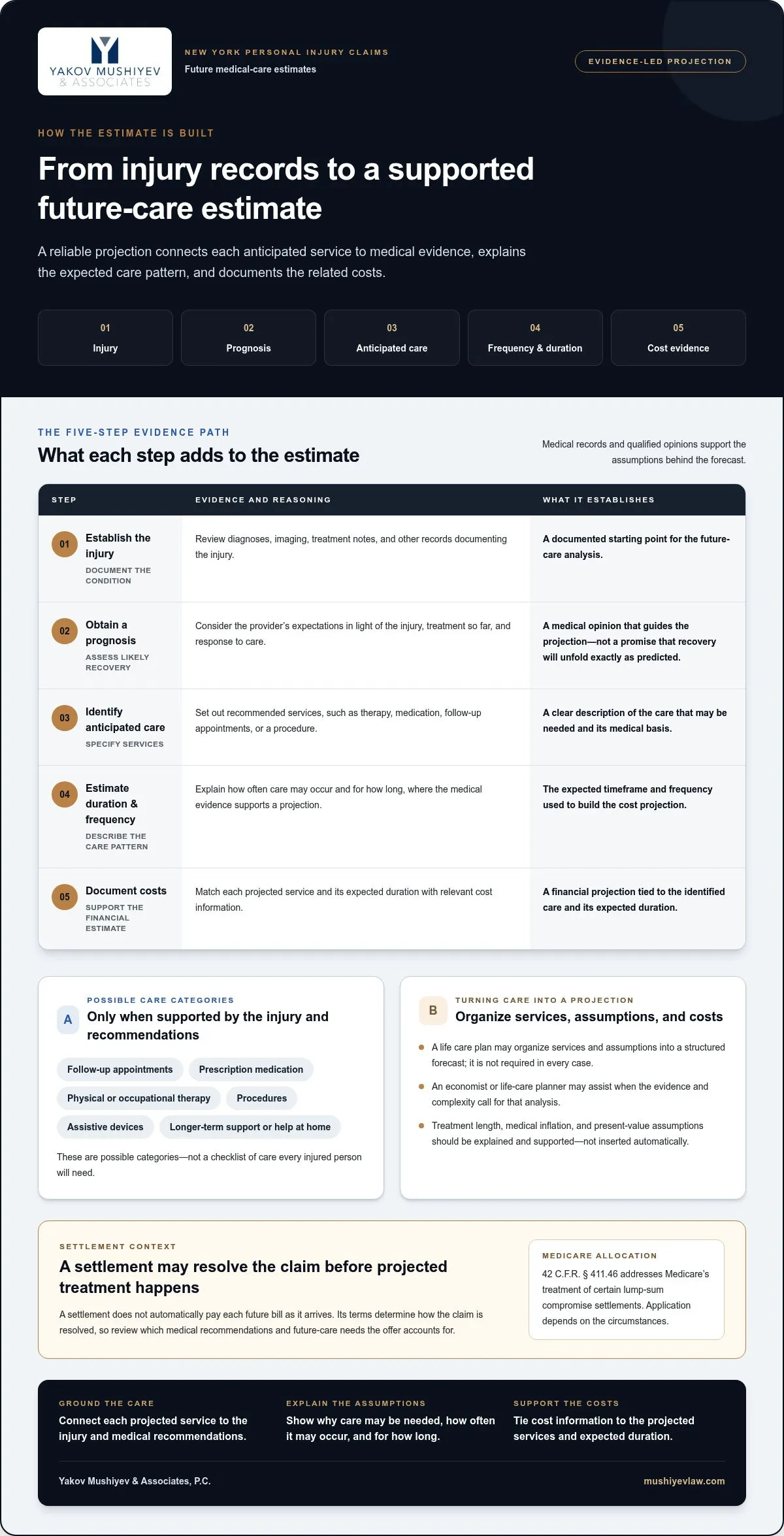
A future-care estimate commonly follows five steps:
- 1. Establish the injury: Review diagnoses, imaging, treatment notes, and other records documenting the condition.
- 2. Obtain a prognosis: Consider what the provider expects based on the injury, treatment so far, and response to care.
- 3. Identify anticipated care: Specify recommended services, such as therapy, medication, follow-up appointments, or a procedure.
- 4. Estimate duration and frequency: Explain how often care may occur and for how long, where the medical evidence supports a projection.
- 5. Document costs: Match each projected service and its expected duration with relevant cost information.
How a prognosis supports projected treatment
A prognosis draws on the diagnosis, treatment history, response to care, and functional limits. For example, a provider might explain why an injury continues to restrict movement and recommend therapy, including its expected frequency and duration. A prognosis is an informed medical opinion, not a promise that recovery will unfold exactly as predicted. The reasoning behind the opinion matters.
How projected treatment becomes a financial estimate
Once anticipated care is identified, its expected duration can be matched with cost information to develop a financial projection. A life care plan may organize services and assumptions into a structured forecast, but it isn’t required in every case. An economist or life-care planner may assist when the evidence and complexity call for that analysis. Assumptions about treatment length, medical inflation, or present value should be explained and supported rather than inserted automatically.
Medicare considerations may also affect how a settlement allocates funds for future medical expenses. The federal regulation at 42 C.F.R. § 411.46 addresses Medicare’s treatment of certain lump-sum compromise settlements. Its application depends on the circumstances, so evaluate a settlement’s medical allocation in context rather than treating it as a standard calculation.
If you’re reviewing a projection after an accident, a New York personal injury lawyer can help assess whether its assumptions are grounded in medical evidence and identify gaps that deserve attention.
Why Future Medical Expense Calculations Can Differ
Two estimates can use the same injury records and still reach different conclusions. The parties may interpret the prognosis differently, disagree about whether a service is medically necessary, or dispute whether the accident caused the condition requiring care. That disagreement doesn’t automatically make every future-care need speculative. The key questions are whether the projection has a clear medical basis and whether its assumptions are explained.
| Assumption | How estimates may differ |
|---|---|
| Medical prognosis | One view may anticipate lasting limitations; another may expect improvement or recovery. |
| Treatment duration | The parties may disagree about whether care will continue for months, years, or longer. |
| Service frequency | They may dispute how often therapy, follow-up visits, or other services will be needed. |
| Cost assumptions | Different supporting cost information or assumptions about future expenses can change the estimate. |
Records matter. Gaps in treatment notes, missing test results, or an incomplete history can make it harder to understand how the injury developed and why future care is recommended. Consistent documentation and a provider’s clear explanation can help answer questions, but they don’t guarantee that an insurer will accept a projection or that a settlement will reach a particular amount.
What happens when the insurer disputes future care?
An insurer may argue that proposed treatment isn’t necessary, is unrelated to the accident, or is expected to last for less time than projected. Address the specific disagreement with relevant records, treatment history, and provider reasoning that explain the connection between the injury and anticipated care. A broad estimate without that support may be easier to challenge. A documented dispute calls for a direct, evidence-based response.
How New York settlement rules may affect payment structure
The projected value of future care and the timing or structure of payment are separate questions. New York law contains structured-judgment provisions, including CPLR Articles 50-A and 50-B, but their applicability depends on the type of claim and other case-specific factors. They shouldn’t be assumed to govern every injury settlement. Because the rules may affect qualifying judgments differently from negotiated settlements, their application should be reviewed in the context of the specific case.
What to Review Before Accepting a Settlement for Future Care
Before accepting an offer, make sure you understand what the medical evidence says about care that may continue after the claim is resolved. If questions about treatment or costs remain unanswered, consider how those uncertainties affect the evaluation. A settlement may resolve your injury claim under its terms, so don’t assume future bills will be paid separately as they arise.
Questions the medical evidence should answer
Use this checklist to identify what still needs clarification:
- Prognosis: What does your provider expect, and which records or clinical findings support that opinion?
- Planned care: What treatment is anticipated, who recommends it, and how is it connected to the injury?
- Timeline: How long might care continue, and what medical facts support that estimate?
- Documentation: Are relevant treatment notes, test results, referrals, and recommendations included?
- Cost assumptions: What information supports the projected costs, and are the services and time period clearly described?
Some uncertainty may remain because recovery doesn’t follow a perfectly predictable schedule. The goal isn’t to treat every possibility as certain. It’s to distinguish medically supported needs from open questions and make sure the estimate explains its assumptions. If a provider hasn’t addressed the likely duration or frequency of care, that gap may deserve attention before you evaluate the offer.
Why the full injury claim context matters
Future treatment is one part of an injury claim’s broader evaluation. The circumstances of the accident, the documented effects of the injury, other claimed losses, and the settlement’s terms all matter. Understanding the New York personal injury claim process can help put a medical projection in context. If the injury followed a vehicle crash, review this Queens car accident claim guide for related considerations.
Liens, insurance coverage, and possible reimbursement obligations can affect how settlement funds are handled. The rules depend on the benefits involved and the facts of the case, so don’t rely on a general assumption about what must be repaid or how much will remain. Review these issues alongside the future-care evidence.
If you’re weighing an offer, discuss your future-care evidence with a New York injury lawyer before making a decision. A careful review can identify unsupported reductions and unresolved questions without promising a particular result.
How a New York Injury Lawyer Can Protect Future-Care Evidence
A future-care estimate is only as persuasive as the evidence behind it. A New York injury lawyer can organize medical records, compare a projection with treating-provider opinions, and flag assumptions that lack support. This review helps show what the evidence establishes, where the parties disagree, and which questions may need clarification before settlement negotiations move forward.
What legal review can clarify
Counsel can assess whether the forecast matches the documented injury and treatment history. If a projection includes ongoing therapy, for example, the records and provider explanation should clarify why it’s recommended and how long it may continue. A review can also identify missing records, unclear cost assumptions, or differences between a provider’s recommendations and the services included in the estimate. The goal isn’t to overstate future needs. It’s to present supported needs clearly and challenge reductions that don’t account for the evidence.
During negotiations, legal advocacy can connect medical documentation to the requested future-care damages and respond to disputes about necessity, causation, or duration. The answer to “how are future medical expenses calculated in a settlement” depends on the injury, evidence, and assumptions involved. A lawyer can help explain how those factors shape the claim, clarify settlement terms, and identify uncertainties that may affect your decision. No review can guarantee that the insurer will agree with a projection or produce a particular result.
Take the next step with a Queens injury team
Before discussing your claim, gather records and communications that help document your recovery. These may include treatment notes, test results, provider recommendations, care plans, and written settlement offers. An organized file can make it easier to identify what supports the future-care estimate and what remains unresolved.
If you were injured in Rosedale, Rochdale, or elsewhere in Queens, Yakov Mushiyev & Associates, P.C. represents people injured in accidents and can help assess the evidence and settlement issues in your claim. A clear review can show what the documentation supports before you make a consequential decision.
Discuss your New York injury claim with Yakov Mushiyev & Associates.
Protect the Care Your Recovery May Require
Future medical expenses shouldn’t rest on guesswork. They should be grounded in treatment records, provider opinions, and a clear explanation of the care your injury may require. Understanding how are future medical expenses calculated in a settlement can help you see why medical projections differ and which questions deserve answers before you accept an offer.
Review the recommended treatment, its expected duration, the records supporting it, and the assumptions behind its projected costs. If important medical questions remain unresolved, understand how they may affect your claim. A settlement decision can have lasting consequences, so make it with a clear view of the evidence.
Yakov Mushiyev & Associates, P.C. represents accident victims in Rosedale, Rochdale, and Queens. The firm can help examine future-care evidence and address unsupported reductions during negotiations, with your options grounded in the facts of your case. Discuss your New York injury claim with Yakov Mushiyev & Associates. You don’t have to sort through the uncertainty alone.
Frequently Asked Questions
How are future medical expenses calculated in a settlement?
Future medical expenses are estimated by identifying anticipated injury-related care, how often it may be needed, how long it may continue, and what the services are expected to cost. Medical records and provider opinions support the forecast, while a life care planner or economist may assist when a case calls for detailed projections. The estimate depends on the evidence and case-specific assumptions, not a standard formula.
What evidence proves future medical expenses after an accident?
Medical records and qualified provider opinions are central to supporting future care. Relevant evidence may include diagnoses, test results, treatment notes, referrals, a prognosis, and recommendations describing the type and expected frequency or duration of treatment. Cost information can help value the projected services. A life care plan may organize anticipated needs in some cases, but it isn’t necessary in every claim. The evidence should explain how the proposed care relates to the injury.
Can I include medical treatment I have not received yet in a settlement?
Potentially, yes, if the future treatment is reasonably supported by medical evidence and connected to the accident-related injury. A provider’s opinion should explain why care such as continued therapy, medication, or a procedure is anticipated, rather than merely possible. A projection doesn’t need to predict every detail of recovery, but unsupported possibilities may be challenged. The strength of the evidence and the facts of the injury determine whether and how future care is considered.
How do insurers challenge future medical expenses?
An insurer may dispute whether proposed care is medically necessary, caused by the accident, or expected to continue for the projected duration. It may also question the frequency of services or the assumptions behind their costs. Consistent treatment records and a provider’s clear reasoning can help address specific challenges by connecting the injury to anticipated care. That evidence can strengthen the presentation, but it doesn’t guarantee the insurer will agree with the estimate or settlement value.
Does New York law require future medical expenses to be paid as a lump sum?
No single payment structure applies to every situation. A negotiated settlement’s payment terms depend on the agreement, while qualifying court judgments may be subject to New York structured-payment rules. CPLR 4111 addresses periodic installments for certain future-damage awards over $250,000, but whether a provision applies depends on the case and type of award. A damages estimate and the timing or form of payment are separate issues that require case-specific review.
Should I settle before I know what medical care I will need?
Consider the medical evidence and unresolved questions before accepting an offer. If your provider hasn’t clarified likely treatment, its duration, or the basis for the recommendation, those gaps may affect how well the offer accounts for future care. Settlement terms can resolve claims, so don’t assume later expenses will automatically be handled separately. An injury lawyer familiar with Queens claims, including cases involving Rosedale and Rochdale residents, can help you understand the evidence and terms.
Are future medical expenses separate from past medical bills in a settlement?
Yes. Past medical bills reflect care already received, while future medical expenses are projections for treatment or services anticipated after settlement discussions begin. Both may be considered as parts of an injury claim, but a settlement may resolve the claim through a single overall amount rather than paying each future bill as it comes due. Review the offer and release terms carefully to understand what claims and expenses the agreement addresses.