
What if the workers’ compensation lien on your settlement is lower than the carrier’s first demand? If you’re searching for how to handle a workers comp lien on my settlement in Springfield Gardens, don’t assume the claimed amount is the amount you must repay. New York law gives a workers’ compensation carrier a right to reimbursement from certain third-party recoveries, but the lien and its effect on your net settlement deserve careful review.
It’s understandable to worry that reimbursement could consume more of your recovery than expected, or that settling could affect future benefits. The calculation isn’t simply the gross settlement minus the full lien. Attorney fees and case costs affect the amount available, and the lien generally must be reduced by its proportionate share of those expenses. Before settling, understand the carrier’s consent requirement and how a settlement may create a credit against future workers’ compensation payments.
This article explains how a Section 29 lien can interact with a third-party claim, which payment records and settlement terms to examine, and what questions to resolve before signing. By separating past-benefit reimbursement from possible effects on future benefits, you can get a clearer picture of your potential recovery.
Key Takeaways
- Learn why a workers’ compensation lien can reduce your third-party settlement, and why the carrier’s claimed amount needs careful review.
- Find out which lien records to request and how to separate claimed benefits from fees, costs, and disputed items.
- Understand how lien reimbursement differs from a possible future credit that may affect when workers’ compensation payments resume.
- Before signing, review a written breakdown of the gross recovery, deductions, lien repayment, and estimated net proceeds.
- Get a clearer picture of how to handle a workers comp lien on my settlement in Springfield Gardens by examining settlement terms and lien implications before agreeing.
Workers’ Comp Liens in Springfield Gardens: Why a Third-Party Settlement May Be Affected
A settlement offer can look substantial until you learn that a workers’ compensation carrier is seeking reimbursement from it. That demand can affect how much you ultimately keep, but the carrier’s claimed lien isn’t automatically the final amount owed. If you’re asking how to handle a workers comp lien on my settlement in Springfield Gardens, start by identifying what the carrier says it paid and how the third-party settlement may affect your recovery.
Workers’ compensation and a negligence claim serve different purposes and follow separate legal paths. Workers’ compensation can provide benefits for a work-related injury, while a third-party claim seeks recovery from someone other than your employer who may have caused or contributed to the injury. A carrier may claim a right to recover certain benefits it paid from a third-party recovery. You can review the general concept of a lien in Understanding Liens, but the rules governing a New York workers’ compensation lien depend on state law and the details of the claim.
For a plain-language overview of a workers’ compensation lien, watch this video:
When can one workplace injury lead to two claims?
A workplace injury may involve both a workers’ compensation claim and a separate personal injury claim. The compensation claim addresses benefits under the workers’ compensation system. The third-party claim concerns potential negligence by someone other than the employer. Each has its own issues, evidence, and resolution, so a proposed settlement in one track can have consequences for the other.
Example: A worker is hurt in a job-related crash when another driver allegedly causes a collision. The worker may have a workers’ compensation claim and may also pursue a negligence claim against that driver. Depending on the facts, other possible third parties could include a property owner, general contractor, or equipment manufacturer. Identifying a possible party doesn’t establish legal responsibility. Liability depends on the evidence.
What does New York Workers’ Compensation Law §29 address?
New York Workers’ Compensation Law §29 addresses how workers’ compensation benefits and certain recoveries from third-party claims interact. It provides a framework for a carrier’s reimbursement claim when an injured worker recovers from a potentially responsible third party. The statute’s application can depend on the facts, the settlement terms, and applicable rules. Don’t treat a lien notice as a final calculation or assume every listed payment will be reimbursed in full.
A Section 29 lien is a carrier’s claim to recover certain workers’ compensation benefits it paid from an injured worker’s third-party recovery. That claim is only one part of the settlement picture. Legal costs and other applicable rules may affect the amount ultimately reimbursed, and a third-party settlement can also raise questions about future benefits. Review the lien alongside the proposed settlement terms before accepting or signing.
How to Review a New York Workers’ Comp Lien and Estimate Your Net Settlement
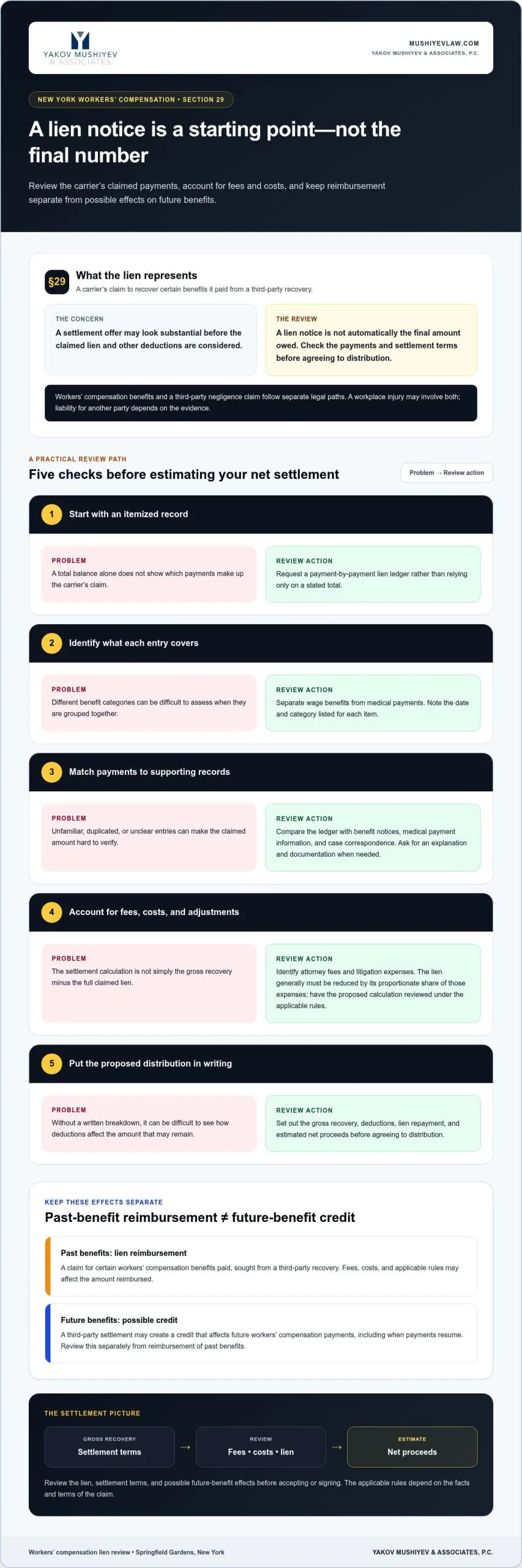
A carrier’s lien notice is a starting point for review, not a final settlement instruction. To understand how to handle a workers comp lien on my settlement in Springfield Gardens, trace each claimed benefit to a payment record, then account for fees, case costs, and any other settlement obligations. Keep past-benefit reimbursement separate from a possible future credit: one may reduce settlement proceeds now, while the other may affect future benefit payments.
The New York State Workers’ Compensation Board provides official information about New York workers’ compensation. For your settlement calculation, focus on the specific payments claimed, the third-party settlement terms, and the rules that apply to your case.
- Request an itemized lien ledger. Get a payment-by-payment accounting rather than relying only on a total balance.
- Identify the benefits included. Separate wage benefits from medical payments, and note the date and category listed for each item.
- Match entries to your records. Compare the ledger with benefit notices, medical payment information, and case correspondence. Flag entries you can’t match.
- Review fees, costs, and adjustments. Identify attorney fees and litigation expenses, then have the proposed reimbursement calculation reviewed under the rules that apply to your case.
- Estimate what may remain. Put the settlement terms and each proposed deduction into a written calculation before agreeing to the distribution.
Which records help verify the claimed lien?
Gather the carrier’s itemized payment history, benefit notices, relevant case correspondence, and proposed third-party settlement terms. Check whether wage-benefit entries and medical expenses are supported by records, and whether the dates and categories make sense. Duplicates, unfamiliar payments, or unclear descriptions deserve follow-up and legal review. Don’t assume an entry is wrong just because it’s unclear. Ask for an explanation and supporting documentation.
How can fees, costs, and reductions change the calculation?
Attorney fees and litigation expenses can affect the carrier’s reimbursement share. New York’s Kelly reduction generally requires a carrier’s lien to bear its proportionate share of attorney fees and costs in the third-party case. The exact calculation depends on the case’s figures and applicable rules, so have counsel review the proposed apportionment rather than applying a rough percentage yourself.
A practical estimate can be shown symbolically: gross recovery − attorney fees − litigation costs − adjusted lien reimbursement − other applicable obligations = estimated net proceeds. This is a framework, not a promised payout. The carrier’s claimed lien is not automatically the final amount deducted from your settlement.
Keep any potential future credit on a separate line. It concerns how a settlement may affect future workers’ compensation payments, not simply another past-benefit charge to subtract from the settlement today. Reviewing the ledger and settlement terms together can clarify both issues. If you’re resolving a construction or motor vehicle injury claim, a review of your injury settlement can help you understand the figures before finalizing the agreement.
Lien Reimbursement, Future Credit, and the Settlement Trade-Off
A third-party settlement can involve two separate questions: how much the carrier may recover for benefits already paid, and whether the recovery may affect future workers’ compensation payments. These are related, but they aren’t the same deduction. A settlement can resolve the reimbursement claim without automatically resolving every question about future benefits.
Past-benefit reimbursement
This concerns benefits the carrier has already paid and seeks to recover from the third-party settlement, subject to applicable reductions and rules. It can affect the settlement funds distributed now.
Possible future credit
This is a potential offset against later compensation benefits after a third-party recovery. A “workers’ compensation holiday” may mean payments pause while the carrier applies a credit, but the effect depends on the case.
What is future credit after a third-party settlement?
Future credit is a potential offset a carrier may claim against later compensation benefits under applicable legal rules. It is distinct from reimbursement for past payments. The settlement’s net recovery and any ongoing benefits may both matter when assessing the practical effect. Before signing, clarify how the proposed credit is calculated and which benefit categories it may affect in your circumstances. Resolving the lien doesn’t necessarily resolve those future questions.
A holiday doesn’t necessarily mean benefits are permanently ended, and its duration can’t be predicted from the settlement amount alone. The carrier may pause payments until the worker’s net recovery is exhausted, but the calculation and effect are case-specific. Understand what funds are treated as available for the credit and how that treatment relates to your benefit status.
Why do settlement timing and approval matter?
Timing is a strategic issue. Before accepting and finalizing a third-party settlement, address the lien, the carrier’s consent, and any approval required for the particular claim. New York’s Section 29 rules generally require an injured worker to obtain the carrier’s consent before settling a third-party claim. Settling without consent can jeopardize future workers’ compensation benefits. The applicable requirements should be reviewed against current law, the proposed terms, and the facts of your case.
Don’t sign a release simply because the parties have agreed on a settlement figure. First determine how the release affects the third-party claim, whether the lien and consent issues are resolved, and what the carrier asserts about future credit. The NYC Workers’ Compensation Law page provides a local government perspective on workers’ compensation obligations, but your individual settlement’s consequences require a case-specific review.
If you’re weighing how to handle a workers comp lien on my settlement in Springfield Gardens, compare the immediate net proceeds with the potential effect on future benefits before deciding. Reviewing the settlement documents, lien position, and benefit status together can help clarify that trade-off. For a construction or motor vehicle injury claim, a review of your injury settlement options can help you understand the issues before finalizing an agreement.
Before Signing a Settlement in Springfield Gardens or Queens
A settlement release can be final, so don’t sign while the lien amount, payment terms, or effect on workers’ compensation benefits is still unclear. If you’re researching how to handle a workers comp lien on my settlement in Springfield Gardens, follow a deliberate sequence: pause, gather your records, review the itemized lien, and assess the complete settlement terms. The goal is to know what the agreement resolves and what it may leave open.
Build a settlement file before negotiations conclude
Keep a complete, dated file so you can track what the carrier and settlement parties have said and when. Include benefit statements, lien notices, medical-payment records, settlement offers, fee agreements, and all proposed releases. Save correspondence about disputed entries or requests for an updated payoff figure. Keep documents addressing future compensation rights with the settlement papers so they’re considered as part of the same review.
For readers in Springfield Gardens and across Queens, a simple communication log can prevent confusion: note the date, who sent or received each message, what was requested, and whether a response arrived. Preserve updated lien statements as they come in. A payoff figure may need refreshing before funds are distributed, so record which version was used in the settlement calculations.
Questions to resolve before accepting the settlement
Before agreeing to the final terms, get clear answers to these questions in writing:
- What is the current itemized lien? Confirm which payments it includes and whether the carrier has provided an updated accounting.
- How is the proposed distribution calculated? Ask for the gross recovery, attorney fees, litigation costs, proposed lien repayment, any claimed reduction, other deductions, and estimated net proceeds to be shown separately.
- What happens after the settlement? Identify whether the carrier asserts a future credit and how the agreement addresses any ongoing compensation rights.
- Is consent or approval required? New York law generally requires an injured worker to obtain the carrier’s consent before settling a third-party claim. Confirm the applicable consent, compromise, or other approval requirements for your specific settlement before signing or releasing claims.
Read the release closely. A settlement agreement may resolve the claim against the responsible third party while separate workers’ compensation issues remain. Don’t rely on an oral assurance when the written terms say something different. If the lien is disputed, the payoff is unclear, or required consent hasn’t been addressed, raise the issue before finalizing the agreement.
Understanding the New York personal injury claim process can help you see how settlement decisions fit into the broader injury case. Yakov Mushiyev & Associates, P.C. represents injured people in construction and motor vehicle accident matters. For a focused review of the settlement and lien issues, contact the firm about your settlement concerns before you sign.
How a Queens Injury Lawyer Can Help Address a Workers’ Comp Lien
A workers’ compensation lien can affect more than the amount deducted at settlement. The third-party claim, lien calculation, release language, and potential future credit need to be considered together before you commit to terms. A Queens injury lawyer can organize those issues, identify unanswered questions, and help you understand the choices in front of you without promising a particular lien reduction or recovery.
Yakov Mushiyev & Associates, P.C. represents injured people in construction and motor vehicle accident matters. If a person or company other than your employer may have contributed to your injury, personal injury representation can help address the third-party claim and its connection to the workers’ compensation lien. The firm’s Queens construction accident rights guide offers context for workers assessing a possible construction-related third-party claim.
What can legal review clarify before settlement?
Counsel can consider how the injury and potential third-party responsibility relate to the compensation claim, then compare the carrier’s lien records with available payment documentation. The review can also identify whether the carrier’s accounting needs further investigation, how fees and costs affect the proposed distribution, and whether the settlement documents address the lien appropriately.
The release deserves close attention. Its wording may determine which claims are resolved, while settlement timing and consent requirements may affect the worker’s compensation position. Counsel can assess the proposed terms alongside the claim status and any asserted future credit, then identify issues to resolve before signing. That review won’t guarantee a particular outcome, but it can give you a clearer basis for deciding whether the agreement addresses the risks you’ve identified.
- Claim review: Identify how the third-party case relates to the workplace injury and which potential claims the proposed settlement resolves.
- Lien review: Organize the lien notices, payment history, and correspondence to pinpoint unclear entries or calculations that need follow-up.
- Settlement review: Examine the release, proposed distribution, timing, consent questions, and possible future-credit implications together.
Take the next step before you sign
If you’re in Springfield Gardens or elsewhere in Queens, preserve every settlement offer, lien notice, payment statement, and draft release. Bring the documents together so the proposed terms can be considered alongside the carrier’s position and the status of your injury claim. A case assessment can help identify which questions are specific to your settlement and what needs clarification before you decide.
If you’re still asking how to handle a workers comp lien on my settlement in Springfield Gardens, don’t face an unclear calculation alone. Yakov Mushiyev & Associates, P.C. represents injured people in construction and accident-injury matters. Learn more about construction accident rights under New York law, then contact the firm to discuss your settlement documents and next steps before signing.
Make Your Next Settlement Decision With Clarity
A settlement decision can shape more than what happens on the day funds are distributed. Before moving forward, understand what you’re agreeing to, what questions remain, and whether the terms fit your priorities. If you’re still asking how to handle a workers comp lien on my settlement in Springfield Gardens, focus on making the decision with a clear view of the consequences, not under pressure to accept an unexplained calculation.
Yakov Mushiyev & Associates, P.C. represents injured people in New York personal injury matters. A focused discussion can help you identify the issues that deserve attention in your particular claim before you sign. You don’t have to sort through uncertainty alone.
Contact Yakov Mushiyev & Associates, P.C. to discuss your injury claim and take a clear, considered next step toward protecting your recovery.
Frequently Asked Questions
Can a workers’ comp carrier take money from my third-party settlement in New York?
A carrier may claim reimbursement from a third-party recovery for workers’ compensation benefits it has paid, subject to New York law and the facts of the case. That doesn’t mean the carrier automatically receives the full amount it first demands. Before settlement funds are distributed, compare the carrier’s claim with the payment records and proposed settlement allocation, and confirm how the lien will be addressed in the closing documents.
How is a workers’ compensation lien calculated in New York?
The carrier’s starting figure generally reflects benefits it says it paid, such as wage-loss benefits or medical expenses. The final reimbursement calculation may also account for the carrier’s proportionate share of attorney fees and litigation costs under the Kelly rule. Check that each listed payment is supported, categorized correctly, and tied to your claim. The applicable calculation depends on the settlement and case-specific details.
Can I negotiate or reduce a workers’ comp lien on my settlement?
Possibly. A lien may warrant challenge or negotiation if the accounting includes unsupported, duplicated, or miscategorized payments, or if the proposed fee-and-cost allocation hasn’t been properly applied. A carrier may also agree to a compromise in appropriate circumstances, but a reduction isn’t guaranteed. Have the payment history and settlement terms reviewed before relying on any proposed adjustment, and make sure the resolution is documented in writing.
What happens if my settlement is less than the workers’ comp lien?
A settlement below the claimed lien amount calls for careful review, not an assumption that the carrier will automatically receive the entire recovery or that you personally owe the shortfall. The settlement amount, expenses, lien calculation, and any consent or approval requirements may affect the available options. Before accepting, get advice on how the proposed amount can be resolved under the rules that apply to your case.
Will settling my injury claim stop my workers’ compensation benefits?
Not necessarily, but a third-party settlement may affect future benefits through a carrier’s claimed credit, sometimes called a workers’ compensation holiday. Payments may be paused while the carrier applies that credit, depending on the circumstances and governing rules. The effect can differ by benefit type and claim status. Also distinguish a third-party settlement from a separate Section 32 agreement, which may settle some or all of the underlying compensation claim.
Does a workers’ comp lien apply to every injury settlement?
No. A Section 29 lien generally concerns certain third-party recoveries connected to a workers’ compensation claim, not every settlement involving an injury. For example, a settlement with a potentially responsible person or company may raise different issues than a claim involving only workers’ compensation. Whether a lien applies depends on the parties, benefits paid, recovery, and applicable rules. Workers in Rosedale or Rochdale should have the specific claim structure reviewed.
Should I sign a settlement release before the workers’ comp lien is resolved?
Don’t sign until you understand the lien, the release’s scope, and whether carrier consent or another approval is required. New York generally requires the carrier’s consent before an injured worker settles a third-party claim, and failing to obtain it can jeopardize future benefits. If you’re asking how to handle a workers comp lien on my settlement in Springfield Gardens, preserve the proposed release and get case-specific advice before agreeing to final terms.