
Could a fall on a wet floor, icy sidewalk, or damaged stairway leave you facing medical appointments, missed work, and questions from an insurer? If you’re looking for an abogado de resbalones y caídas in Queens, the strength of your claim may depend on more than the injury. It can turn on who controlled the property, whether a dangerous condition existed, and whether the responsible party knew or should have known about it.
After a sudden fall, it’s understandable to feel unsure about what to do next. Evidence can disappear, and a careless statement or rushed settlement decision may complicate your claim. Acting promptly can help preserve important details while you focus on your recovery.
This article explains how New York slip-and-fall claims work, what may help establish a property owner’s responsibility, and what evidence to preserve, including photos, witness information, incident reports, and medical records. You’ll also learn how a Queens injury attorney can investigate the property conditions, assess notice and control, and handle insurer communications. Understanding the process can help you make informed decisions and protect your rights.
Key Takeaways
- A fall alone doesn’t establish negligence. A claim may depend on the hazard, who controlled the property, and whether they had notice of the danger.
- Preserve photos, witness details, incident reports, and medical records. Acting promptly may also help preserve evidence such as surveillance footage.
- Document your treatment and how the injury affects work and daily life. These details can help explain the losses involved in a claim.
- An abogado de resbalones y caídas can investigate property conditions, organize evidence, and handle insurer communications while pursuing your claim.
- After a fall, prioritize medical care, report the incident, and keep a copy of any available report.
What makes a Queens slip-and-fall claim legally actionable?
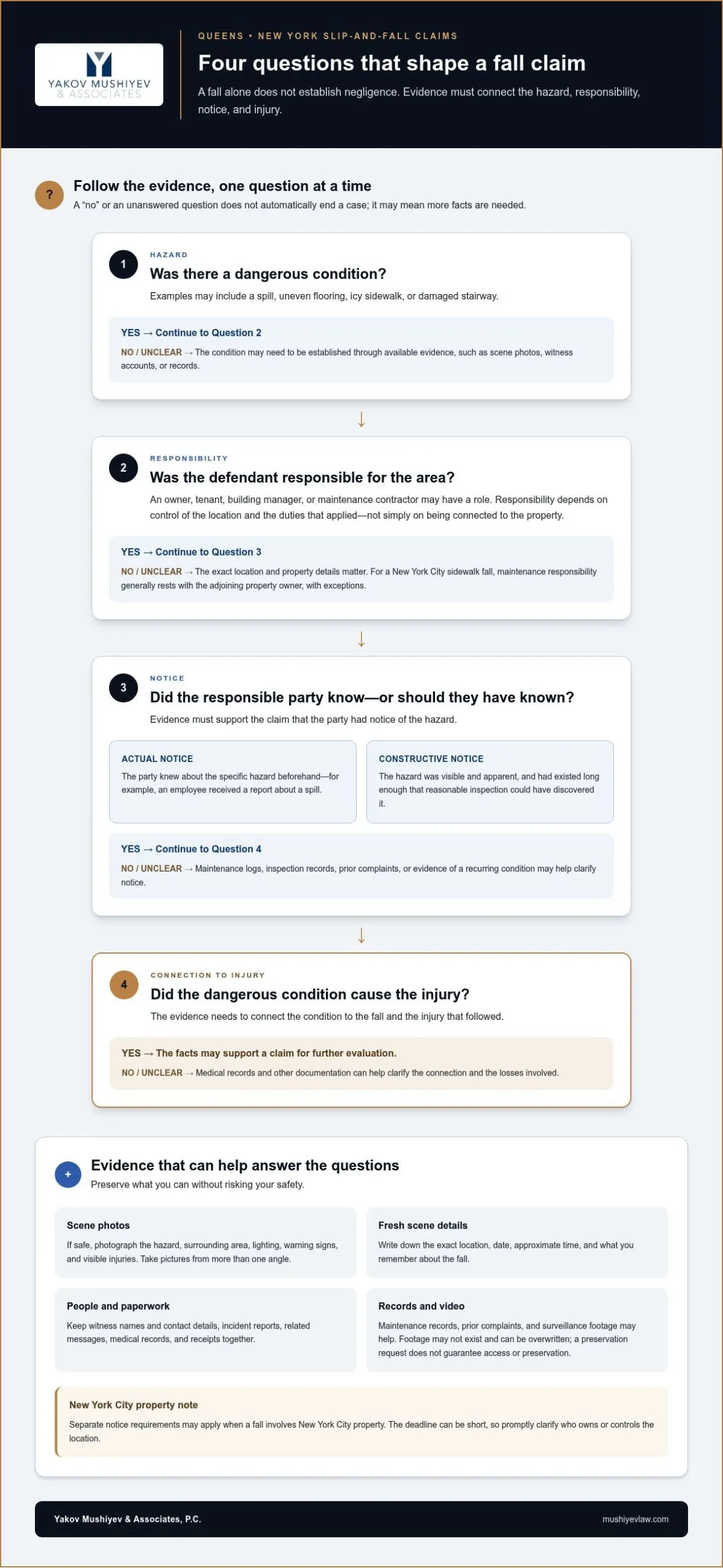
A fall can cause real pain without automatically making a property owner legally responsible. A claim generally requires evidence that a hazardous condition existed, the defendant was responsible for the area, the defendant knew or should have known about the hazard, and the condition caused the injury. The key is connecting the dangerous condition to someone’s failure to use reasonable care.
For example, a shopper might slip on a spill in a Queens store aisle, or a visitor might trip on uneven flooring in an apartment entry in Rosedale or Rochdale. In either situation, the fall alone doesn’t prove negligence. A broader overview of a slip and fall injury can explain the general concept, but New York claims depend on the specific evidence and circumstances.
Understanding those details is central to the work of an abogado de resbalones y caídas. This video offers an additional overview of slip-and-fall legal representation:
How actual or constructive notice can affect a claim
Actual notice means the responsible party knew about the specific hazard before the fall, perhaps because an employee had received a report about a spill. Constructive notice generally concerns a hazard that was visible and apparent and had existed long enough that reasonable inspection could have discovered it. A long-standing patch of uneven flooring or recurring water accumulation may raise questions about notice, but evidence must support the claim.
Who may control the place where the fall happened?
The property owner, a tenant, a building manager, or a maintenance contractor may have a role in caring for an area. That doesn’t make each one automatically liable. Responsibility depends on who controlled the location, what duties applied, and what happened. For a Queens sidewalk fall, responsibility is fact-specific. New York City sidewalk maintenance rules generally place responsibility on the adjoining property owner, with exceptions. The exact location and property details matter.
A careful investigation can help identify who controlled the area and whether the hazard was reported, observed, or left uncorrected. Those answers shape the claim. If a property owner or insurer blames you, the relevant question is what the evidence shows about the condition, notice, responsibility, and injury.
What evidence helps prove a New York slip-and-fall case?
Evidence can help show what caused your fall, how long a hazard may have been present, and what injuries followed. Photos can capture a spill or damaged surface before it is cleaned or repaired. Witness accounts, incident paperwork, and medical records can add context. No single item proves a claim by itself, and missing one type of evidence doesn’t automatically end your case.
After receiving medical attention, preserve what you can without risking your safety. A clear, focused record can help an attorney investigate the condition and identify other evidence that may exist.
What to document at the scene and afterward
- Photographs: If it’s safe, photograph the hazard, surrounding area, lighting, nearby warning signs, and any visible injuries. Take pictures from more than one angle.
- Scene details: Write down the exact location, date, approximate time, and what you remember about the fall while your memory is fresh.
- Witness information: Record the names and contact details of people who saw the fall or the condition beforehand, if available.
- Records: Keep incident reports, related messages, medical records, and receipts together. Ask the property owner or manager how to obtain a copy of any incident report.
Keep the original files when possible, and avoid editing photos or deleting relevant messages. If you couldn’t take pictures or get witness details, preserve other records and share what you remember with an abogado de resbalones y caídas.
Why notice evidence and surveillance footage matter
Maintenance logs, inspection records, and prior complaints may help show whether a property representative knew about a hazard or had a reasonable opportunity to discover it. For example, records of repeated water accumulation could help an investigator determine whether the condition was recurring. These records may be held by a property owner, manager, or another responsible party.
Surveillance video may show the area before and after a fall, but a recording may not exist. Retention periods vary, and footage may be overwritten. A prompt preservation request can alert the relevant party that specific footage may matter, but it does not guarantee access or preservation. An attorney can identify likely sources and make focused requests.
If the fall involved New York City property, separate notice requirements may apply. The New York City Comptroller explains how to file a Notice of Claim. The deadline can be short, so promptly clarify who owns or controls the location. To learn how the firm handles Queens falls, visit its slip-and-fall legal representation page.
How do injury, shared fault, and compensation affect a fall claim?
A fall claim isn’t valued by the accident alone. The nature and severity of the injury, the treatment it requires, and its effect on your ability to work or manage daily tasks can all matter. Medical records and other documentation help connect those losses to the fall. An abogado de resbalones y caídas can assess how the evidence, injury, and responsibility fit together, but no category of loss guarantees a particular recovery.
Which losses may be considered after a fall?
Potential losses are often discussed in economic and non-economic categories. Which ones apply depends on the facts and supporting evidence.
- Economic losses: Medical expenses already incurred and reasonably supported future care needs may be considered. Bills, treatment records, and medical opinions can help document them. Wage and employment records may support missed-work losses. Evidence of how the injury affects your ability to earn may be needed to establish reduced earning capacity.
- Non-economic losses: Pain, physical limitations, and disruption to ordinary activities may also be relevant. Treatment notes and a clear account of changes in daily life can provide context, though every claim is different.
Keep information accurate and consistent. The goal is not to exaggerate, but to create a reliable record of how the injury has affected you over time.
What if the insurer says you caused your own fall?
An insurer may examine your footwear, attention, any warning signs, and the conditions around the hazard. Those questions don’t automatically determine who was responsible. New York follows a pure comparative negligence approach: a person’s share of fault may reduce their recovery, but partial fault does not by itself bar a claim. The state’s pure comparative negligence rule sets out this framework.
Respond truthfully if asked about the incident, and avoid guessing when you don’t remember a detail. Don’t let an accusation replace a review of all the circumstances, including the hazard and the property’s response to it. Before accepting a proposed resolution, understand what it covers and how it accounts for your documented injuries and losses. Once accepted, a settlement may limit your ability to pursue additional recovery, so careful review matters.
What should you do after a slip and fall in Queens?
A sudden fall can leave you shaken and in pain. Focus first on your health, then take practical steps to create a clear record of what happened. You don’t need to answer every question at the scene. Follow these steps as your condition and circumstances allow.
The first steps to take after an injury
- Get medical attention. Seek appropriate care and follow the treating professional’s instructions. Tell them about symptoms related to the fall, even if they seem minor at first.
- Document the scene if it’s safe. Photograph the condition and surrounding area, and note the location, date, approximate time, lighting, and any warning signs. Don’t put yourself at risk to collect evidence.
- Report the fall. Notify a property owner, manager, or other responsible representative. Ask how to obtain a copy of any incident report, and note when and to whom you reported it.
- Write down what you remember. Describe what happened while the details are fresh. Separate what you directly saw or felt from what you’re unsure about.
- Preserve relevant items and records. Keep the clothing and footwear you wore, along with related messages, paperwork, and medical records. Don’t wash, repair, discard, or alter items that may help explain the incident.
If the fall involved New York City property, a Notice of Claim generally must be filed within 90 days. Deadlines and rules can depend on who owned or controlled the location, so don’t assume the ordinary timeline applies. The firm’s slip-and-fall rights guide for Rosedale and Rochdale offers local context for protecting your rights.
Protect your claim when an insurer contacts you
An insurance representative may ask questions, request records, or seek a recorded statement. Be truthful, but don’t guess about details you can’t recall or downplay symptoms. Keep copies of communications and note when calls or requests occur. If you’re unsure what a question means, take time to understand it before responding.
Before signing a release or accepting a settlement, make sure you understand what rights you may be giving up and whether the proposed resolution accounts for your situation. A Queens abogado de resbalones y caídas can review the facts, help organize communications, and explain the issues to consider. For guidance on a Queens slip-and-fall claim, speak with a slip-and-fall attorney.
How a Queens slip-and-fall lawyer can build and pursue your claim
After a fall, you may be managing pain, treatment, and uncertainty while a property owner or insurer assesses what happened. Legal representation can bring structure to the process. A Queens slip-and-fall lawyer can investigate who controlled the area, what maintenance practices applied, and whether records or prior complaints shed light on the hazard. The goal is to build a claim grounded in evidence, not assumptions.
What legal representation can take off your shoulders
An investigation may include reviewing property records, maintenance practices, inspection logs, prior complaints, and other available information. Counsel can examine how long a hazard may have existed and whether the responsible party had notice of it. They can also organize medical documentation and witness accounts, preserve relevant evidence, and manage insurer communications so your account and records are handled carefully.
Each case requires its own strategy. The available evidence, the nature of the injuries, and the applicable law shape the next steps. Negotiation may be an option, while litigation may be considered when the dispute calls for it. The right path depends on the facts, and neither path guarantees a particular result.
For a closer look at what to expect, read the firm’s New York personal injury claim process guide. It can help you understand how a claim may move forward while your attorney evaluates the evidence specific to your fall.
When to seek legal guidance about a Queens fall
Prompt guidance can help identify potentially responsible parties and pursue evidence before records become harder to obtain. That can matter when ownership or control is unclear, a dangerous condition may have been repaired, or surveillance footage could be subject to routine deletion. Deadlines can differ, especially when a public entity may be involved, so don’t rely on a general deadline without confirming which rules apply to your circumstances.
Yakov Mushiyev & Associates, P.C. represents injured people in slip-and-fall claims in Queens, including Rosedale and Rochdale. If you’re unsure what your evidence means or how to respond to an insurer, an abogado de resbalones y caídas can review the facts and explain the issues to consider. Request a case review with Yakov Mushiyev & Associates, P.C. to discuss your Queens fall and possible next steps.
Take the Next Step to Protect Your Queens Fall Claim
A slip-and-fall claim depends on more than the fact that you were injured. Evidence must help show how the hazardous condition, property responsibility, and notice connect to the incident. Photos, witness information, incident records, and medical documentation can preserve important details. Acting promptly also matters, especially when evidence may be lost or deadlines may differ.
If an insurer questions your account or suggests you caused the fall, you don’t have to sort through the facts alone. An abogado de resbalones y caídas can investigate the property conditions, organize evidence, and help manage claim communications without promising a particular outcome.
Yakov Mushiyev & Associates, P.C. represents people injured in slip-and-fall incidents throughout Queens, including Rosedale and Rochdale. Take a clear next step: request a case review with Yakov Mushiyev & Associates, P.C. With informed guidance, you can make decisions about your claim with greater confidence and focus on moving forward.
Frequently Asked Questions
Can I sue if I slipped and fell in a Queens store?
Possibly, if evidence shows a dangerous condition caused your injury and the store was responsible for the area and knew or should have known about the hazard in time to address it. A fall alone doesn’t establish liability. Photos, an incident report, witness accounts, and medical records may help clarify what happened. A lawyer, or abogado de resbalones y caídas, can assess how those facts apply to your claim.
How do I prove a property owner knew about a dangerous condition?
You may show actual notice, meaning someone responsible knew about the specific hazard before the fall, or constructive notice, meaning the hazard was visible and existed long enough that reasonable inspection could have found it. Reports, prior complaints, inspection or maintenance records, and surveillance footage may help. For example, records of repeated water accumulation could matter. The available evidence and circumstances of the condition determine whether notice can be established.
What if there were no witnesses to my slip-and-fall accident?
No witnesses don’t automatically prevent you from pursuing a claim. Other evidence may help document the scene and what followed, including photographs, an incident report, medical records, surveillance footage, and maintenance records. Write down your recollection while it’s fresh, separating what you observed from what you’re unsure about. If video may exist, prompt action to preserve it can matter because footage may be overwritten under varying retention practices.
Can I still recover compensation if I was partly at fault for my fall?
Yes, partial fault doesn’t automatically bar a slip-and-fall claim in New York. The state follows pure comparative negligence, so a claimant’s recovery may be reduced in proportion to their share of fault. Insurers may question footwear, attention, or whether warning signs were present, but those arguments don’t decide the case by themselves. The facts and evidence must be considered together, including the hazard and the property’s responsibility for the area.
How long do I have to file a slip-and-fall lawsuit in New York?
For many personal-injury claims involving private property, New York’s general deadline to file a lawsuit is three years from the accident. Different rules apply to claims against government entities. For example, a claim against New York City generally requires a Notice of Claim within 90 days, followed by a lawsuit within one year and 90 days. Exceptions may apply, so promptly get advice about the specific property and circumstances.
What should I do if I fell on a New York City sidewalk?
Get medical attention, report the fall, and safely document the precise location and sidewalk condition with photographs and notes. Sidewalk responsibility in New York City is fact-specific. It generally falls on the adjoining property owner, with exceptions for certain owner-occupied one-, two-, and three-family homes. A claim against the City may require prior written notice of the specific defect, and government deadlines can be short. Identify who controlled the location promptly.
How much is a Queens slip-and-fall claim worth?
There’s no reliable standard amount for a Queens slip-and-fall claim. Potential value depends on factors such as injury severity, treatment, documented medical expenses, time missed from work, effects on earning capacity, and evidence of property responsibility. Pain and limitations may also be relevant. Shared fault can affect recovery, too. An attorney can review the injuries, records, and liability evidence, but no estimate should be treated as a guaranteed outcome.