
An employer isn’t always the only party responsible for a construction injury. A construction accident third-party liability claim in Rochdale may be possible when someone other than the injured worker’s employer acted negligently and directly caused the harm. Workers’ compensation may cover work-related treatment, while a separate lawsuit may seek damages such as pain and suffering or lost income.
It’s understandable to focus first on the injury and the workers’ compensation claim. But a site owner, contractor, subcontractor, or equipment maker may also be responsible, depending on what happened and how the hazard arose. If you’re considering a construction accident third-party liability claim in Rochdale, settlement terms, releases, and an insurer’s reimbursement rights may affect how much of a recovery you keep.
This article explains who may be liable, what evidence can help establish how an accident happened, and how workers’ compensation and third-party claims can interact. It also explains why settlement terms matter before you resolve a claim. Understanding these issues can help you consider a construction accident third-party liability claim in Rochdale and its possible next steps.
Key Takeaways
- A construction injury may involve a third party beyond your employer, such as a contractor, site owner, or equipment maker. Liability depends on that party’s role and how its conduct contributed to the accident.
- Workers’ compensation and a third-party claim can address different losses, but a third-party recovery may be affected by reimbursement rights.
- Before resolving a claim, understand what a settlement or release covers and whether it could affect claims against other responsible parties.
- Evidence such as scene photos, witness accounts, and incident records can help establish how the accident happened and who may be responsible.
When Can Your Construction Site Be Liable for Third-Party Claims?
A construction injury may support a claim against a responsible party other than the worker’s employer. In New York, workers’ compensation and a third-party lawsuit can arise from the same accident, but they address different legal issues.
Third-Party Claims and Workers’ Compensation
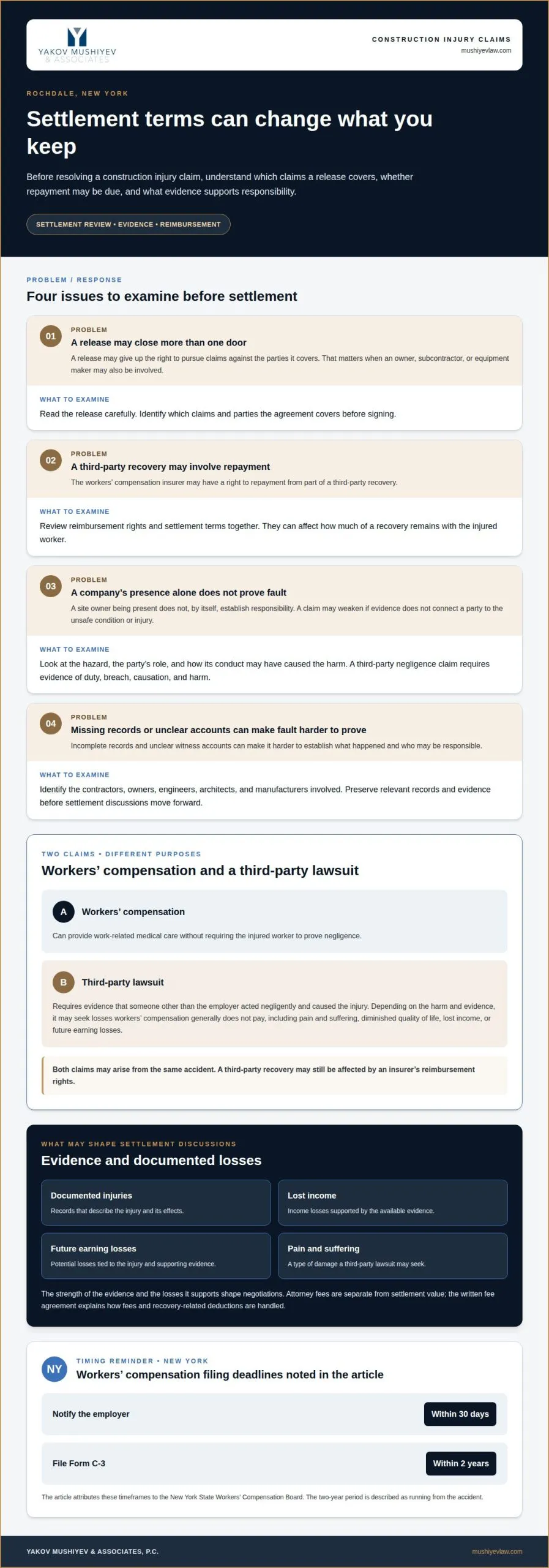
Workers’ compensation can provide work-related medical care without requiring an injured worker to prove negligence. A third-party claim, by contrast, requires evidence that someone else’s negligence caused the injury. This distinction matters if a contractor, property owner, or equipment maker contributed to a hazard. A New York worker may seek compensation benefits while also pursuing damages from a responsible non-employer.
Massachusetts rules do not govern an accident in Rochdale, New York. Here, workers’ compensation may cover work-related treatment, while a third-party lawsuit may seek damages beyond those benefits. The insurer may also have a right to repayment from part of a recovery.
Damages Outside Workers’ Compensation
Workers’ compensation generally does not pay for non-economic losses such as pain and suffering or diminished quality of life. Depending on the harm and evidence, a third-party lawsuit may seek those damages, along with lost income or future earning losses. This distinction can matter when an injury affects both a worker’s ability to earn and daily life.
New York Labor Law § 240 addresses certain elevation-related risks on covered work; according to the New York State Senate, it is known as the Scaffold Law. New York Labor Law Section 241 concerns safety requirements for construction, excavation, and demolition projects. A site owner or contractor may face a claim when applicable duties and the facts support liability.
After an accident in Rochdale, report the injury to the employer in writing, seek medical care, and document the scene and injuries. Get witness contact details, and avoid giving an insurer’s recorded statement without understanding its purpose and consequences. According to the New York State Workers’ Compensation Board, notify the employer within 30 days and file Form C-3 within two years of the accident.
For an injury in Rochdale, New York, workers’ compensation claims are handled by the New York State Workers’ Compensation Board, not Massachusetts agencies or courts. A third-party lawsuit proceeds in the court with jurisdiction over the claim. OSHA’s policies are intended to protect construction workers.
Potential effects of settlements, releases, and reimbursement rights
A construction accident recovery may involve several parties, separate claims, and an insurer seeking repayment. Before settling, understand which claims and parties the agreement covers.
Settlement and Reimbursement Effects
A settlement resolves specified claims, while a release may give up the right to pursue claims against the parties it covers. This matters when a construction injury may involve a subcontractor, owner, or equipment maker as well as another company. Read the release carefully to understand its scope before signing.
Workers’ compensation and a third-party lawsuit may arise from the same accident. The workers’ compensation insurer may have a right to repayment from part of a third-party recovery. Settlement terms, releases, and reimbursement rights can therefore affect how much of the recovery remains with the injured worker.
Settlement Calculations and Attorney Fees
For an accident in Rochdale, New York, Massachusetts rules are not the right framework. Settlement negotiations may consider documented injuries, lost income, future earning losses, pain and suffering, and evidence linking a party’s conduct to the harm. The strength of that evidence and the losses it supports shape negotiations.
Attorney fees are separate from settlement value. Review the written fee agreement to understand how fees are calculated and how recovery-related deductions are handled. Don’t assume a Massachusetts percentage applies to a New York claim.
Risks to Recovery
A claim may weaken if the evidence does not connect a particular party to the unsafe condition or injury. A site owner’s presence alone, for example, does not establish responsibility. The facts about the hazard and the owner’s role matter. Missing records or unclear witness accounts can also make fault harder to prove.
A release may affect claims against the parties it covers, while reimbursement rights can reduce the amount kept from a recovery. Identify the contractors, owners, engineers, architects, and manufacturers involved, and preserve relevant records and evidence before settlement discussions move forward.
For a construction injury with several potentially responsible parties, reviewing settlement and reimbursement issues can help clarify the claims and obligations at stake.
What Are Examples of Third-Party Liability in Construction Accidents?
A company other than the injured worker’s employer may face a negligence claim if its conduct caused the injury. The examples below show why a specific failure, rather than a company’s mere presence, can matter.
Negligence Claims Against Other Companies
A third-party negligence claim seeks damages from a company other than the worker’s employer when that company’s negligence directly caused the injury. The claim requires evidence of a duty, a breach, causation, and harm. This distinction matters when workers’ compensation does not address every loss, including pain and suffering.
For example, a general contractor may create a job-site hazard that injures a subcontractor’s worker. The worker may receive compensation benefits and pursue a separate negligence claim against the contractor. The contractor’s role alone does not prove liability; evidence must connect its conduct to the accident.
Examples of Third-Party Negligence
Construction accidents may involve companies working on, supplying, or maintaining a site. For example, a janitorial crew may leave a surface unsafe, causing a worker to slip and fall. A driver employed by another company may cause a collision on or near the jobsite, potentially implicating both the driver and the employer.
Defective construction equipment is another possible cause. If a product defect caused an injury, the maker may face a claim. Evidence about the equipment and how the accident happened can help connect the alleged defect to the harm.
Contractor and Subcontractor Conduct
A contractor or subcontractor may be negligent if its actions, or failure to follow safety protocols, create a hazard that injures someone. For example, a subcontractor’s unsafe work may expose another crew to danger, or a general contractor may create a hazard during site operations.
Responsibility depends on conduct and evidence, not simply a company’s title. Project contracts and the degree of control a general contractor exercises over the work may matter when assessing its safety responsibilities. Photos, incident reports, witness statements, and safety records can help establish what happened, who controlled the relevant work, and how that conduct caused the injury.
Third-party liability in construction accidents
A construction accident claim against a third party focuses on whether someone other than the worker’s employer acted negligently and directly caused the injury. For example, a property owner may be responsible if an unsafe condition caused a fall and the owner failed to address or warn about a known hazard. Ownership alone does not establish liability; the condition and the owner’s role matter.
Control is another key issue. A general contractor’s responsibilities for coordination, safety rules, and known hazards depend on project contracts and its degree of control over the work. If a contractor created a hazard that injured another company’s worker, evidence about its actions and control may help establish responsibility. A contractor’s presence at a construction site, by itself, does not prove liability.
Equipment claims require a different investigation. If a defective machine caused an injury, the manufacturer may be responsible. Poor maintenance or improper repair may point to a maintenance provider, rental company, or another entity. Preserve the equipment instead of discarding or repairing it, since its condition may be important evidence. Inspection records and repair history can help show whether a defect or service failure caused the accident.
More than one party may have contributed to an injury. A site owner’s unsafe condition, a contractor’s work practices, and defective equipment may all warrant investigation. Insurance policies may be potential sources of recovery, but coverage alone does not establish negligence or determine who caused the harm. Evidence such as photos, incident reports, witness accounts, contracts, and equipment logs must connect each party’s conduct to the injury.
If the accident involves several companies or a disputed hazard, discuss the parties and evidence in your construction accident claim.
Yakov Mushiyev & Associates, P.C.: Construction Accident Legal Representation
Yakov Mushiyev & Associates, P.C. represents people injured in construction accidents. When the cause is disputed or several companies may be responsible, the firm can assess potential claims and advocate for the injured worker.
A construction accident can leave you facing medical needs, lost income, and questions about who is responsible. Legal representation can help examine how the injury happened, identify potentially responsible parties, and address how settlement terms or reimbursement rights may affect a claim. You don’t have to sort through these issues alone.
If you were injured in a construction accident and want to discuss your situation, contact Yakov Mushiyev & Associates, P.C.
Choose a Clear Next Step
A construction injury can disrupt your health, income, and sense of control. You don’t need every answer before taking action. A focused review of what happened can help clarify which parties and records matter, and which decisions deserve careful attention before a claim moves forward.
If you’re considering a construction accident third-party liability claim in Rochdale, bring your questions and any information you have about the incident. Yakov Mushiyev & Associates, P.C. handles construction accident matters, as well as car accident, slip and fall, and truck accident cases. The firm can help you understand the legal issues related to your injury and consider a path forward.
Taking a first step can make a difficult situation feel more manageable. Contact Yakov Mushiyev & Associates, P.C. to discuss your circumstances and the support you need.
Frequently Asked Questions
Who Else Can Be Held Liable?
Depending on the facts, someone other than your employer may be responsible for a construction injury. Potential parties include a property owner, general contractor, subcontractor, architect, engineer, equipment manufacturer, or maintenance provider. Project records, for example, may show which company controlled a particular task or piece of equipment. In Rochdale, Queens, identifying each company’s role can help clarify who may be responsible.
Can I bring a claim if defective equipment caused my construction injury?
Yes, a claim may be possible if defective equipment caused your injury and the evidence supports responsibility. Potentially responsible parties may include the manufacturer, distributor, rental company, or a business that maintained or repaired the equipment. Keep the equipment’s identifying information and any available inspection or repair records. These details can help establish which product was involved and whether its condition contributed to the accident.
Can I sue a general contractor if my subcontractor employer had workers’ compensation insurance?
You may pursue a claim against a general contractor if evidence shows its negligence directly caused your injury. Your subcontractor employer’s workers’ compensation coverage does not, by itself, determine whether you have a separate claim against another company. Relevant facts may include who controlled the work, who created the hazard, and whether the contractor’s conduct contributed to the accident.
Does accepting workers’ compensation benefits waive a claim against another company?
Accepting workers’ compensation benefits does not automatically resolve a separate claim against a non-employer. However, settlement documents, releases, and reimbursement rights may affect which claims remain and how much of a recovery you keep. Before signing a release, understand which parties and claims it covers. Depending on its terms, a release naming one company may have consequences beyond the immediate payment.
What Does It Cost to Hire a Construction Accident Lawyer?
Yakov Mushiyev & Associates, P.C. handles construction accident cases on a contingency basis, with no fee unless the firm wins. The retainer agreement sets out the percentage and expense details, so don’t rely on a general estimate. Review the agreement to understand how fees and case expenses are handled. The firm’s FAQ answers are general information, not legal advice about your specific case.
What is a third-party liability claim for a construction accident?
It is a claim seeking accountability from someone or a company other than the injured worker’s employer for negligence that caused the accident. For example, a delivery company’s driver may cause a collision near a construction site. The claim focuses on that party’s conduct and its connection to the injury. A lawyer must assess the facts to provide case-specific guidance.
These FAQ answers are general information, not legal advice. Consult a lawyer for guidance specific to your case.