
A hit-and-run does not automatically rule out compensation. In New York, eligibility for MVAIC for a hit-and-run victim generally depends on where the crash occurred, the victim’s residency, and whether another applicable insurance policy may cover the injury. An insured vehicle owned by you or a member of your household may affect eligibility. Pedestrians struck by an uninsured or unidentified vehicle may also qualify.
It’s understandable to feel that the driver’s disappearance leaves you with nowhere to turn. But MVAIC has a process for eligible people injured by uninsured or unidentified vehicles, and deadlines matter: according to the Motor Vehicle Accident Indemnification Corporation, a hit-and-run notice of intention to make a claim must be filed within 90 days of the accident.
This guide explains MVAIC eligibility, how a pedestrian’s claim may qualify, and what the filing process involves. It also covers how household insurance and evidence about the fleeing vehicle can affect a claim, helping you understand the next steps and protect your opportunity to seek benefits.
Key Takeaways
- Pedestrians injured by an uninsured or unidentified vehicle may have a path to MVAIC benefits, even without being in a car.
- Insurance available through you or a household member can affect whether MVAIC is an option.
- Learn which claim forms and supporting information are involved in an MVAIC filing.
- Understand how evidence identifying the fleeing vehicle can affect a hit-and-run injury claim.
Does uninsured motorist coverage apply if I was on foot?
A pedestrian struck by an uninsured or unidentified vehicle may qualify for MVAIC benefits. Whether MVAIC applies depends in part on whether other insurance can cover the injury.
The Motor Vehicle Accident Indemnification Corporation (MVAIC) provides no-fault and bodily injury coverage for eligible New York residents injured by uninsured or unidentified vehicles. Unlike a claim against an identified driver, an MVAIC claim may offer a path to recovery when the driver cannot be found or has no insurance.
Hit-and-Run and Stolen-Vehicle Coverage
Hit-and-run coverage may apply when an unidentified vehicle injures a pedestrian, but a bodily injury claim generally requires physical contact with the vehicle or qualifying property. New York Uninsured Motorist coverage generally also requires physical contact between the victim’s vehicle and the fleeing car. In a crash involving a stolen vehicle, whether another policy applies and whether the vehicle is identified can affect available coverage.
MVAIC no-fault benefits address accident-related expenses, while bodily injury coverage is a separate route for eligible claims. According to the Motor Vehicle Accident Indemnification Corporation, MVAIC no-fault coverage in New York is up to $50,000 for accident-related medical expenses, lost wages, and other costs. Uninsured Motorist bodily injury coverage may be available, depending on the circumstances. No-fault benefits don’t cover pain and suffering, and MVAIC doesn’t pay vehicle damage.
Coverage Through a Household Member
Coverage through a resident household member means a policy for an insured vehicle owned by someone in your household may provide benefits for your injuries. That policy matters because MVAIC generally requires that no other insurance coverage be available. If you or a household relative owns an insured motor vehicle, a claim must be filed with that insurer to determine whether the policy covers you.
For a pedestrian, covered personal injury expenses may include medical care and lost wages. Recovery beyond no-fault benefits generally requires meeting New York’s serious-injury threshold. The applicable policy and available benefits depend on the coverage connected to the injured person and household.
How Does a Lawyer File a Claim with MVAIC?
A lawyer can assess the crash location, residency, available insurance, and evidence before preparing an MVAIC claim. Deadlines matter from the outset.
Residency and Accident Location Requirements
MVAIC eligibility generally requires a New York State accident and New York residency when it happened, with limited exceptions. These requirements determine whether the claim can proceed under New York Insurance Law Article 52. A lawyer evaluates both facts and the insurance available to the injured person. A New York resident hurt in a crash outside the state does not meet the stated accident-location requirement.
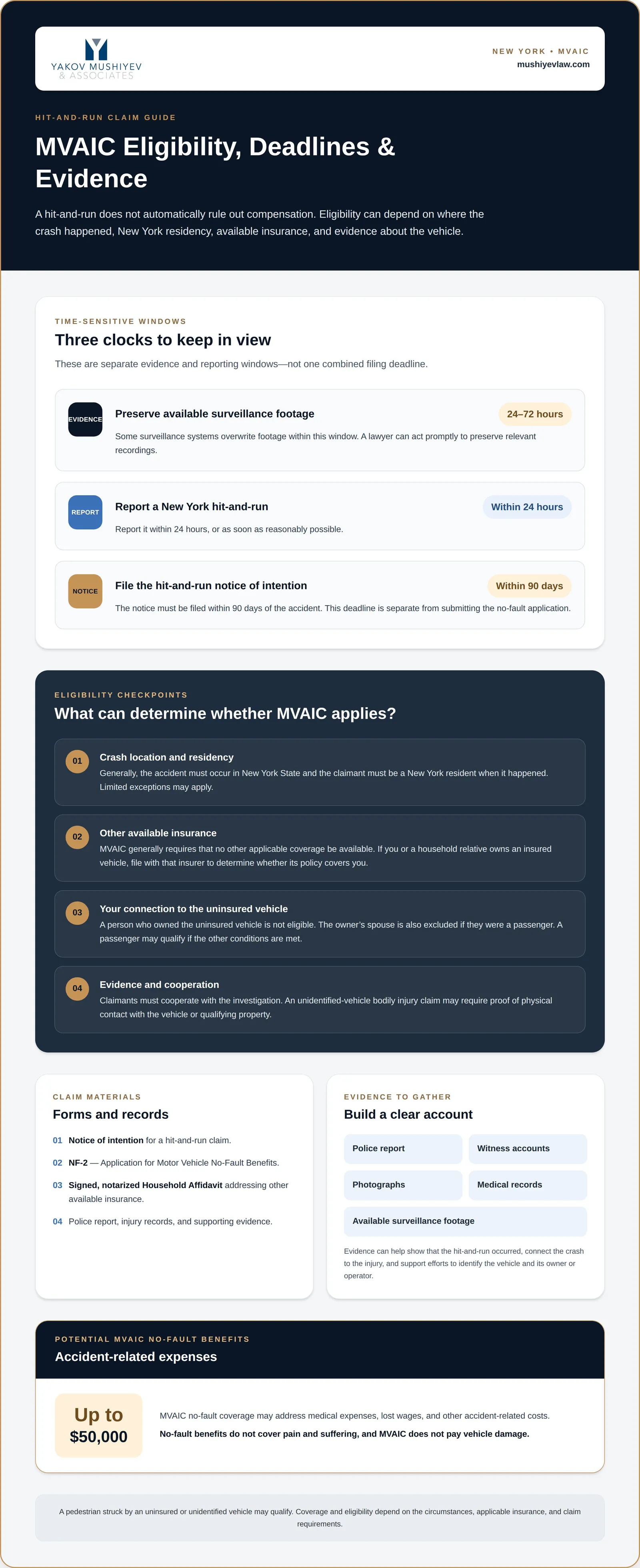
For a New York hit-and-run, the notice of intention to make a claim must be filed within 90 days of the accident, according to the Motor Vehicle Accident Indemnification Corporation. A lawyer prepares and submits this notice, then coordinates the required MVAIC forms. The claim may also include an NF-2, the Application for Motor Vehicle No-Fault Benefits, and a signed, notarized Household Affidavit addressing other available insurance. These documents help establish the basis for seeking MVAIC benefits.
Police reporting is another important step. A New York hit-and-run should be reported within 24 hours, or as soon as reasonably possible. A lawyer can organize the report, injury records, and claim documents into a consistent account of the motor vehicle accident. The notice deadline remains separate from submitting the no-fault application, so each filing needs attention.
Evidence for an MVAIC Claim
Evidence for an MVAIC claim can help establish that a hit-and-run occurred and connect the crash to the injury. A police report, witness accounts, photographs, medical records, and available surveillance footage may support those facts. Evidence is especially important because an unidentified-vehicle claim may require proof of physical contact with the vehicle or qualifying property.
Some surveillance systems overwrite footage within 24 to 72 hours, so a lawyer can act promptly to preserve relevant recordings. The lawyer can also assess whether the evidence supports the claim and whether reasonable efforts were made to identify the vehicle and its owner or operator. Legal representation for a pedestrian accident can help organize the records and filings.
MVAIC eligibility requirements
Eligibility for MVAIC for a hit and run victim depends on insurance availability, the claimant’s role, and cooperation with the investigation. A New York resident injured in a New York accident may qualify if no other applicable automobile insurance is available. New York Insurance Law Article 52 sets out the eligibility requirements, and specific exclusions can prevent coverage.
Available automobile insurance can affect eligibility for MVAIC benefits. If the claimant or a household relative owns an insured vehicle, a claim must first be filed with that insurer to determine whether its policy provides benefits. The Household Affidavit addresses other available coverage. This review matters because existing insurance can affect access to MVAIC.
Ownership of, and relationship to, the uninsured vehicle also matter. A person who owned that vehicle is not eligible for MVAIC benefits. The owner’s spouse is also excluded if they were a passenger in the vehicle. By contrast, a passenger in an uninsured vehicle may qualify if the other eligibility conditions are met.
Claimants must cooperate with MVAIC’s investigation and provide information relevant to the accident, insurance, and bodily injury. The notice of intention for a hit-and-run claim must be filed within 90 days of the accident. Missing that deadline can put the claim at risk. Eligibility for MVAIC for a hit and run victim therefore involves both meeting the coverage rules and completing required filings on time.
Other applicable insurance, vehicle ownership, and the claimant’s relationship to the owner can disqualify someone. A separate injury threshold applies to claims for damages beyond no-fault benefits. Under New York Insurance Law § 5102(d), a qualifying injury can include one that prevents normal activities for at least 90 of the 180 days following the accident. These are distinct tests: meeting the MVAIC eligibility rules does not, by itself, establish the serious-injury threshold.
Eligibility for hit-and-run victims
For an unidentified vehicle, eligibility depends on more than the driver’s disappearance. A claimant must meet MVAIC’s coverage requirements, and the evidence must support that a motor vehicle accident caused bodily injury.
Physical contact is a key issue in an unidentified-vehicle claim. New York generally requires contact between the injured person and the vehicle, or qualifying property. For example, a pedestrian struck directly by a fleeing car may meet this requirement. Someone who swerves to avoid a car but is never touched faces a different evidentiary issue.
Police documentation can help establish the circumstances of the crash, while witness accounts, photographs, and medical records may connect the event to the injury. The claim also needs evidence of reasonable efforts to identify the vehicle and its owner or operator. If the driver is later identified, the available claim route may change, particularly if the vehicle’s insurance status becomes known.
MVAIC is particularly relevant when the vehicle remains unidentified or is uninsured and no other applicable insurance covers the injured person. A household policy may affect eligibility, so the claim must account for available coverage, not focus only on the fleeing driver. Pedestrians and bicyclists injured by an unidentified or uninsured vehicle may qualify under these rules.
Eligibility for bodily injury compensation beyond No-Fault benefits involves a separate injury threshold. Under New York Insurance Law § 5102(d), a serious injury can include an injury preventing normal activities for at least 90 of the 180 days following the accident. Meeting that threshold may support a claim for damages beyond No-Fault benefits, including pain and suffering.
An unidentified-driver lawsuit against MVAIC also requires court permission and proof of reasonable efforts to identify the vehicle, owner, and operator. That makes the distinction between an unidentified and identified driver central to the claim. Get legal help assessing a hit-and-run claim and the evidence supporting it.
Yakov Mushiyev & Associates, P.C.
Yakov Mushiyev & Associates, P.C. represents people pursuing injury claims after hit-and-run crashes. If you’re unsure whether household insurance affects your eligibility for MVAIC for a hit and run victim, or how evidence and filing deadlines shape your claim, legal guidance can help clarify the issues and next steps.
The firm can review the accident circumstances, available insurance, and records supporting your injury claim. This can be important when the driver is unidentified, coverage is disputed, or a filing deadline is approaching. You don’t have to navigate the claim process alone.
Contact Yakov Mushiyev & Associates, P.C. to discuss your hit-and-run injury claim.
Move Forward With a Clear Plan
After a hit-and-run, unanswered questions can add to the strain of an injury. A focused legal review can help clarify the issues and identify a practical way forward. Understanding eligibility for MVAIC for a hit-and-run victim is one part of that review; your circumstances and the effects of the crash deserve attention, too.
Yakov Mushiyev & Associates, P.C can discuss the legal questions surrounding your accident and help you understand what may matter as you consider next steps. A conversation can focus on your concerns, the information relevant to your situation, and the choices ahead. You deserve clear guidance without pressure or promises about an outcome.
Taking time to discuss your situation can help you make decisions with greater clarity. Contact Yakov Mushiyev & Associates, P.C to talk about your next step and move forward at a pace that feels manageable.
Frequently Asked Questions
Who Is Eligible to Receive MVAIC Benefits?
MVAIC may cover a New York resident injured in a New York crash involving an uninsured or unidentified vehicle if no other applicable auto insurance is available. Pedestrians, bicyclists, and passengers may qualify under the relevant rules. For example, a Rosedale resident struck by a fleeing vehicle would still need to meet the insurance and claim requirements. The uninsured vehicle’s owner and certain passengers are excluded.
Can You Recover Compensation for Pain and Suffering Through MVAIC?
MVAIC no-fault benefits don’t pay for pain and suffering. A separate bodily injury claim may seek that type of compensation if the injury meets New York’s serious-injury threshold. The distinction matters: reimbursement for medical expenses and damages for pain and suffering are different forms of recovery. The injury evidence and circumstances of the crash affect whether a separate claim can proceed.
Who pays for my injuries if the other driver is never found?
If the driver remains unidentified, MVAIC may provide benefits when you meet its eligibility requirements and no other applicable insurance is available. A policy for an insured vehicle connected to you or a resident household member may need to be considered first. For example, a household member’s policy could affect which coverage applies. The available payer depends on the applicable policy and the facts of the crash.
Can I Still Recover Compensation If the Driver Is Never Caught?
Yes. An unidentified driver doesn’t automatically prevent recovery through MVAIC. The claim must satisfy the program’s requirements, and evidence must support that the crash occurred and caused injury. Witness descriptions, scene photographs, and records linking the impact to the injury can help establish the facts. For an unidentified-vehicle bodily injury claim, physical contact or qualifying property contact is generally required.
Can You Sue Beyond No-Fault After a Hit and Run?
Yes, a separate bodily injury lawsuit may be possible if the injury meets New York’s serious-injury threshold. When the driver is unidentified, pursuing MVAIC in a lawsuit requires court permission and reasonable efforts to identify the vehicle, owner, and operator. This differs from pursuing no-fault benefits. The evidence and procedural requirements determine whether further compensation may be pursued.
Do Uninsured New Yorkers Have Other Options?
Potential options include coverage under a policy for an insured vehicle owned by a resident household member, or an MVAIC claim if the eligibility requirements are met. New York auto policies must include Uninsured Motorist coverage, though a hit-and-run claim generally requires physical contact between the victim’s vehicle and the fleeing car. The right route depends on the injured person’s role, available policies, and evidence about the crash. This FAQ provides general information, not legal advice for your specific case.