
An uninsured driver doesn’t have to leave every crash-related bill unanswered. If you’re asking what MVAIC is and how it can help you, it’s a New York safety net for eligible people injured when no applicable auto insurance is available. Understanding what MVAIC is and how it can help you starts with knowing that no-fault benefits may cover medical expenses and lost earnings, up to $50,000 per injured person. The Motor Vehicle Accident Indemnification Corporation also provides up to $25,000 in bodily injury coverage per injured person.
Eligibility depends on details such as where the crash happened, your New York residency, and whether another insurance policy may apply first. Knowing what MVAIC is and how it can help you also means understanding its history: the New York State Legislature created MVAIC in 1958 under Article 17-A, now Article 52, of New York Insurance Law. This guide explains who may qualify, what costs benefits may cover, and which deadlines can affect a claim.
Key Takeaways
- Assess whether your crash, residency, and access to other insurance may affect MVAIC eligibility.
- Learn which medical expenses and lost earnings no-fault benefits may help address.
- Understand the reporting and filing deadlines that can shape an MVAIC claim.
- See how Yakov Mushiyev & Associates, P.C. can provide legal representation after a car, truck, motorcycle, or pedestrian accident.
Eligibility for MVAIC benefits
MVAIC may help after a New York crash causes an injury and no applicable auto insurance is available. Eligibility generally requires you to have been a New York resident when the accident happened and the crash to have occurred in New York State. A pedestrian or bicyclist struck by an uninsured or unidentified vehicle may qualify, as may a passenger in an uninsured vehicle.
MVAIC is generally a last resort. You usually must first pursue applicable coverage under an involved vehicle’s policy or a relative’s household policy. Claimants submit a household affidavit confirming that no other auto insurance was available. A person who owned the uninsured vehicle involved in the crash cannot qualify. The uninsured vehicle owner’s spouse generally cannot qualify as a passenger either.
Benefits have separate purposes and limits. MVAIC provides up to $50,000 in no-fault medical benefits per injured person. The Motor Vehicle Accident Indemnification Corporation provides up to $25,000 in bodily injury coverage per injured person. Bodily injury liability coverage is capped at $50,000 per accident. These limits do not mean every injured person receives the maximum; eligibility and covered losses matter.
After a New York hit-and-run, an injured person may seek MVAIC benefits if the driver cannot be identified and other eligibility rules are met. For a bodily injury claim involving an unidentified vehicle, New York generally requires physical contact with that vehicle or qualifying property. That physical-contact rule differs from the requirements for no-fault benefits. The crash must also be reported to police, a peace officer, or the DMV within 24 hours, according to the New York State Legislature.
What injuries and accident situations are excluded from MVAIC coverage? No-fault benefits don’t cover pain and suffering or vehicle damage. A claim may also be unavailable to the uninsured vehicle’s owner or, generally, to the owner’s spouse riding as a passenger. These limits make it important to distinguish no-fault benefits from bodily injury coverage.
Help with medical bills and lost wages
After a motor vehicle crash, treatment costs and missed work can strain a household before fault is resolved. New York no-fault benefits can help eligible people pay medical expenses, lost earnings, and other covered costs, regardless of who caused the crash. For a qualifying MVAIC claim, these benefits address immediate economic losses, not pain and suffering. The reason for the claim and available insurance determine which coverage may apply.
New York’s basic no-fault benefit limit is $50,000 per injured person for eligible expenses. That overall limit can include medical treatment and lost income, so it is not a separate $50,000 allowance for each category. Medical expenses may include care related to the crash. Keep bills and treatment records together, because they help connect the claimed expenses to the injury.
Lost-income benefits have a separate calculation within the no-fault framework. They cover up to 80% of lost income, capped at $2,000 per month for up to three years. For example, someone unable to work after an injury may seek documented wage loss, subject to those limits. New York no-fault benefits may also provide up to $25 per day for essential services, such as household help.
An identified vehicle may have an applicable policy, while an uninsured or unidentified vehicle can raise different MVAIC issues. New York generally requires written notice for a no-fault claim within 30 days, subject to exceptions when a clear and reasonable justification explains the delay. The NF-2 form is titled Application for Motor Vehicle No-Fault Benefits. A resident seeking benefits should preserve medical records, wage evidence, and the reason for any delay, since these details support the application.
Understanding which bills and earnings losses fit the claim can be difficult while treatment continues. Get legal guidance after a motor vehicle crash to assess how available coverage may apply.
What Deadlines Apply to MVAIC Claims?
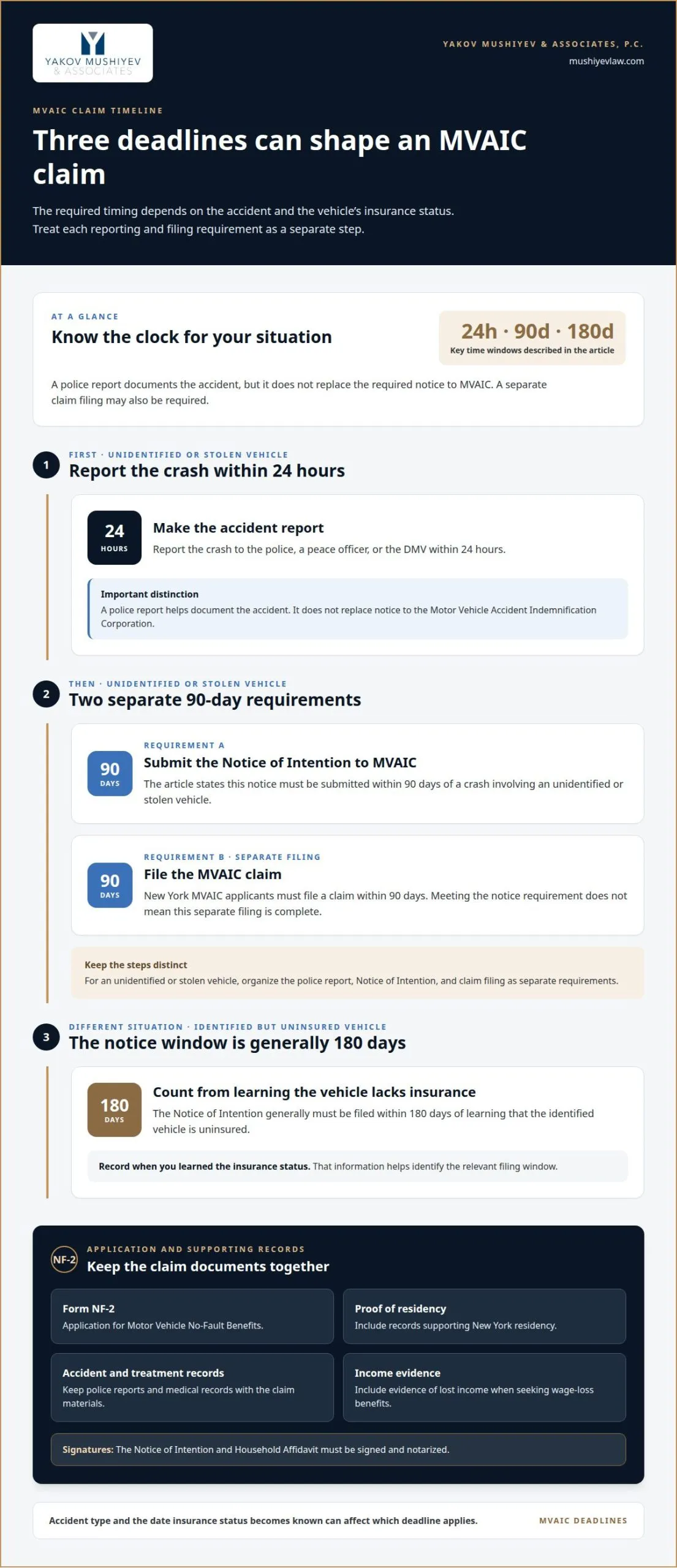
After an unidentified or stolen vehicle causes a motor vehicle accident, reporting and filing are separate steps. The crash must be reported to the police, a peace officer, or the DMV within 24 hours, according to the New York State Legislature. A police report helps document the accident, but it does not replace the required notice to the Motor Vehicle Accident Indemnification Corporation.
A formal Notice of Intention to MVAIC must be submitted within 90 days of a crash involving an unidentified or stolen vehicle, according to the New York State Legislature. Separately, New York MVAIC applicants must file a claim within 90 days, according to the Motor Vehicle Accident Indemnification Corporation. Treat each requirement as its own deadline; meeting one does not mean the other is complete.
The notice period differs when the vehicle is identified but uninsured. In that situation, the Notice of Intention generally must be filed within 180 days of learning the vehicle lacks insurance. Record when that information became known, because it determines the relevant filing window. The accident type and date of discovery shape which deadline applies.
An MVAIC no-fault application uses Form NF-2, titled Application for Motor Vehicle No-Fault Benefits. An applicant should assemble supporting documents, including proof of residency, police reports, medical records, and evidence of lost income. The Notice of Intention and Household Affidavit must be signed and notarized. Together, these records support the claim and help establish eligibility for compensation through MVAIC.
Keep copies of submitted forms and supporting evidence with the accident date and deadline information. For an unidentified vehicle, organize the police report and Notice of Intention around the 24-hour and 90-day requirements. For an identified uninsured vehicle, preserve the information showing when its insurance status became clear. These distinctions matter to the Motor Vehicle Accident Indemnification Corporation process, and a missed filing window can put access to benefits at risk.
MVAIC’s history and legal basis
The New York State Legislature created the Motor Vehicle Accident Indemnification Corporation in 1958 under Article 17-A of New York Insurance Law. That article is now Article 52. The change in article numbering matters: current MVAIC claims operate under Article 52, even though the corporation’s origins trace to Article 17-A.
The law addressed a gap in protection for people injured when no auto insurance could respond. New York State created MVAIC in the 1950s to protect pedestrians and cyclists in certain accidents without available auto insurance. Its role reflects a specific public purpose: eligible injured people may seek defined benefits when ordinary auto coverage is unavailable.
MVAIC is not a replacement for every insurance policy or a general source of compensation. Its legal framework sets eligibility requirements, benefit categories, and claim procedures. Depending on the accident and available insurance, a claim may involve no-fault benefits for covered economic losses or bodily injury liability. Each route has distinct rules, so identifying the type of claim is an important first step.
Article 52 also helps explain why an unidentified driver case can involve additional legal steps. A bodily injury lawsuit against MVAIC involving an unidentified driver requires court permission to proceed. That requirement is separate from submitting a benefits claim. It underscores that the law treats administrative benefits and a lawsuit as different processes, even when both arise from one motor vehicle accident.
The practical takeaway from MVAIC’s history is its limited, statutory role. It exists to address certain injuries involving uninsured or unidentified vehicles, not to erase the need to establish eligibility or follow claim procedures. If an uninsured-driver crash raises questions about how Article 52 applies, discuss your accident claim with a legal professional.
Yakov Mushiyev & Associates, P.C.
Yakov Mushiyev & Associates, P.C. can help you assess your legal options after an uninsured or hit-and-run crash. When MVAIC eligibility, available insurance, and potential claims overlap, the facts and supporting records matter. The firm represents people injured in car accidents and can explain the issues surrounding your accident and possible next steps.
Consider seeking legal guidance if you’re unsure which policy may apply, have questions about claim documents, or need to understand how an injury claim relates to MVAIC benefits. The firm also represents people injured in truck and motorcycle accidents, as well as slip and fall incidents. Its role is to provide legal representation for accident-related injuries, not to promise a particular MVAIC decision or payment.
If you have questions about an accident and MVAIC, contact Yakov Mushiyev & Associates, P.C. to discuss your situation.
Take the Next Step Toward Clarity
If you’re asking what MVAIC is and how it can help you, the next step is to connect the rules to your accident and recovery needs. A focused legal review can help clarify how the insurance history, injury claim, and potential compensation fit together. This can help you make informed decisions while medical care and daily responsibilities continue.
Yakov Mushiyev & Associates, P.C provides legal representation for car accidents, slip and falls, and truck accidents. If you’re uncertain how an MVAIC issue affects your options, contact the firm to discuss your situation. Contact Yakov Mushiyev & Associates, P.C and take a considered step toward understanding your path forward.
Frequently Asked Questions
What Coverage Does MVAIC Provide for Victims?
MVAIC may provide no-fault benefits for eligible medical care and income losses, as well as bodily injury liability payments in qualifying cases. These are distinct forms of coverage: no-fault benefits address eligible economic losses, while a bodily injury claim concerns legal liability for the injury. For example, a pedestrian struck by an uninsured vehicle may need to determine which type of claim applies.
What is the Motor Vehicle Accident Indemnification Corporation in New York?
The Motor Vehicle Accident Indemnification Corporation is a New York entity that handles certain claims when auto insurance isn’t available after a crash. It operates under New York Insurance Law, which sets eligibility and filing rules. For someone injured in Queens, determining whether another policy applies is part of assessing whether an MVAIC claim may be available.
Can You Recover Compensation for Pain and Suffering Through MVAIC?
No-fault benefits through MVAIC don’t pay for pain and suffering. A separate bodily injury claim may allow non-economic damages when the legal requirements for a lawsuit are met. In New York, a substantial disability lasting at least 90 days can qualify as a serious injury for pursuing non-economic damages. Medical records and evidence of how the injury affects daily life can matter.
What does MVAIC stand for and what is it?
MVAIC stands for Motor Vehicle Accident Indemnification Corporation. It is a New York claims mechanism for eligible people injured in certain crashes involving uninsured or unidentified vehicles. It isn’t general accident insurance: eligibility, available policy coverage, and the type of loss all affect whether a claim may proceed. Its legal foundation is in New York Insurance Law.
Who is eligible for MVAIC benefits in New York?
Eligibility generally depends on the crash occurring in New York, the injured person’s residency, and whether other auto insurance is available. A pedestrian, bicyclist, or passenger may qualify in certain cases involving an uninsured or unidentified vehicle. For example, an injured Queens resident may need to establish residency and show that no applicable household policy can respond. Vehicle owners involved in the crash face additional restrictions.
What expenses does MVAIC cover after a car accident?
Eligible no-fault benefits may help cover crash-related medical expenses, lost earnings, and certain necessary services. Examples include treatment bills, income lost because an injury prevents you from working, and essential household assistance. The benefits don’t cover vehicle damage or pain and suffering. Keep records connecting treatment, missed work, and services to the accident, as those documents can support the expenses claimed.
These FAQ answers provide general information, not legal advice for a specific case.