
The at-fault driver’s policy may not be the only source of recovery after a crash. Understanding SUM/UM coverage in your own policy starts with knowing that uninsured motorist coverage may help when the driver has no liability insurance, while underinsured motorist or New York SUM coverage may apply when available limits fall short. Bodily injury and vehicle damage can involve different protections.
It’s reasonable to expect the other driver’s insurance to pay for the harm they caused, but low limits can leave a serious gap. This guide makes understanding SUM/UM coverage in your own policy more practical by explaining how UM and UIM claims work, how New York SUM limits relate to liability coverage, and when limits may or may not stack across vehicles. You’ll also learn how injury claims differ from vehicle-damage claims. With a clearer understanding of SUM/UM coverage in your own policy, you can identify which coverage questions matter after a crash in Rosedale, Rochdale, or elsewhere in Queens.
Key Takeaways
- UM coverage may help when the at-fault driver has no insurance; UIM or SUM coverage may help when their available limits are too low.
- Whether bodily injury limits can be stacked depends on the state’s rules and the policies involved.
- Injury coverage and vehicle-damage coverage are different protections, so the type of loss matters when identifying possible coverage.
- Hit-and-run reporting deadlines and policy requirements can affect a claim, so acting promptly after a crash matters.
UM/UIM: What Is Uninsured Motorist Coverage?
UM coverage may help after a crash with an uninsured driver; UIM or New York SUM coverage may help when available liability limits fall short. The type of loss matters: bodily injury and vehicle damage may involve different protections.
Uninsured and Underinsured Coverage Differences
Uninsured motorist coverage applies when the at-fault driver has no liability insurance; underinsured motorist coverage addresses insufficient liability limits. This distinction matters because a driver can have insurance that still leaves injury losses unpaid. UM or UIM bodily injury coverage may provide another source of payment when you’re legally entitled to recover from the responsible driver. It doesn’t automatically cover damage to your car.
Optional Supplementary Coverage
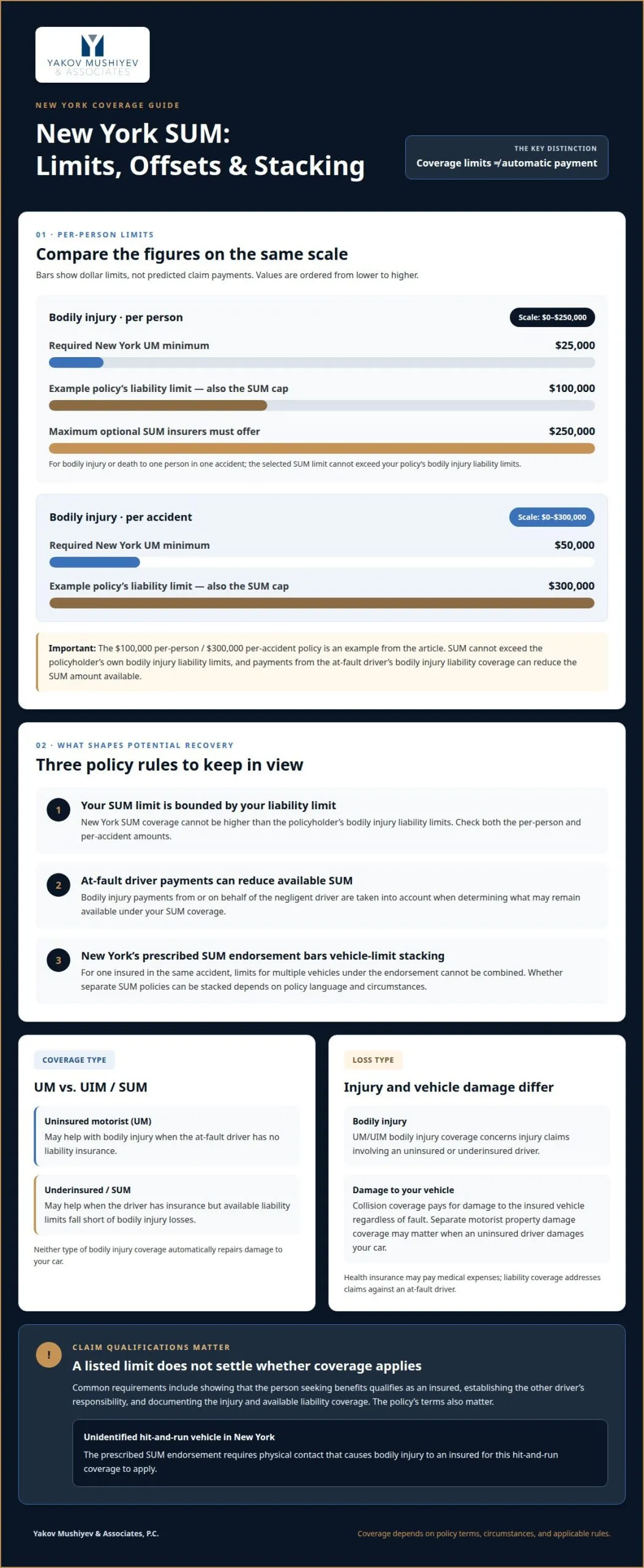
Supplementary uninsured/underinsured motorist coverage, or SUM, adds protection when an at-fault driver’s liability coverage cannot cover an insured person’s bodily injury losses. New York insurers must offer optional SUM coverage up to the policy’s bodily injury liability limits, subject to a maximum of $250,000 for bodily injury or death to one person in one accident. The SUM limit also cannot exceed the policyholder’s liability limits, so the selected limits affect the potential recovery.
Coverage for Uninsured and Hit-and-Run Drivers
UM coverage may apply when an uninsured driver causes bodily injury, while hit-and-run eligibility depends on the policy and state rules. New York’s prescribed SUM endorsement covers an unidentified hit-and-run vehicle only when physical contact causes bodily injury to an insured. This requirement can affect whether a claim qualifies. New York State Senate identifies Section 5102(d) as the state’s serious injury threshold, another legal consideration in injury claims.
Mandatory Uninsured Motorist Coverage
New York motor vehicle liability policies must include uninsured motorist coverage, with minimum limits of $25,000 per person and $50,000 per accident. Those limits describe the available coverage, not an automatic payment for every crash. The claim still depends on the policy’s terms, the driver’s responsibility, and the injury evidence. Separate motorist property damage coverage may matter if the uninsured driver damages your vehicle, because bodily injury protection does not itself repair a car.
Stacking bodily injury limits across multiple vehicles
Stacking may increase available bodily injury coverage only when state rules and policy terms permit it. In New York, the prescribed SUM endorsement prohibits combining limits for multiple vehicles to calculate coverage for one insured in the same accident. Whether separate SUM policies can be stacked depends on the policy language and circumstances. Understanding SUM/UM coverage in your own policy means distinguishing separate policies from multiple vehicles listed under one policy.
Calculating Stacked Coverage Limits
Where stacking is allowed, the selected uninsured or underinsured motorist bodily injury limit may be multiplied by the number of covered vehicles. For example, a hypothetical policy with a $50,000 per-person limit covering two vehicles could produce a combined $100,000 limit if the state and policy permit stacking. That calculation does not itself determine payment. The injured person’s losses, applicable accident limit, and other coverage terms still matter. In New York, vehicle limits cannot be combined under the prescribed SUM endorsement.
SUM Limits and Liability Limits
New York SUM coverage cannot exceed the policyholder’s bodily injury liability limits. A policy with $100,000 per person and $300,000 per accident liability limits therefore caps SUM coverage at those same limits. Payments from the negligent driver’s bodily injury liability policy can reduce the SUM amount available. Understanding SUM/UM coverage in your own policy also means identifying the starting limit and accounting for payments already received, rather than treating the listed limit as an automatic additional recovery.
State Requirements and Coverage Limits
State rules determine whether UM/UIM coverage is required, what limits are available, and whether stacking is permitted. In New York, the endorsement’s no-combining rule applies to multiple vehicles for one insured in the same accident. When reviewing coverage, distinguish the liability limit, the SUM limit, and any limits under separate policies. Those terms shape potential recovery after an injury.
Health insurance may pay medical expenses, liability coverage addresses claims against an at-fault driver, and collision coverage pays for damage to the insured vehicle regardless of fault. UM/UIM bodily injury coverage addresses injury claims involving an uninsured or underinsured driver.
If an injury claim raises questions about available coverage, get help evaluating a SUM claim before deciding how to proceed.
How UM and UIM claims can help when an at-fault driver has insufficient insurance
UM/UIM claims may provide another route to compensation when the responsible driver’s insurance cannot cover bodily injury losses. UM applies when the driver has no liability coverage; UIM applies when the driver has coverage but its limits are insufficient. In New York, SUM benefits are reduced by bodily injury payments from or on behalf of the negligent driver. That calculation affects how much may remain available under your policy.
Common claim requirements include showing that you qualify as an insured, establishing the other driver’s responsibility, and documenting the injury and available liability coverage. A claim may also fail if the policy’s terms do not cover the accident or the person seeking benefits. For an unidentified hit-and-run vehicle, New York’s prescribed SUM endorsement requires physical contact causing bodily injury to an insured. New York’s serious injury threshold, Section 5102(d), may also matter in an injury claim.
Act quickly after a hit-and-run. According to the New York State Department of Financial Services, New York hit-and-run accidents involving a UM claim typically must be reported to police within 24 hours. Preserve the police report, insurance details, and records showing the injury and treatment. UM and SUM claims in New York are resolved through binding arbitration against the policyholder’s own insurer, rather than through an ordinary lawsuit against that insurer.
A household member’s claim doesn’t automatically mean their policy will face a surcharge. Under the facts addressed in a New York opinion, an insurer may not surcharge a brother’s policy for a claim when his vehicle wasn’t in operation. The result depends on the circumstances, not simply on the family relationship.
Meaningful SUM coverage is estimated to cost roughly a dollar a week, though premiums depend on the policy and selected limits. That estimate concerns coverage, not legal representation. After a hit-and-run or a crash involving insufficient liability coverage, promptly addressing reporting and claim requirements can help protect your ability to pursue benefits.
Underinsured motorist coverage for bodily injury and property damage
Underinsured motorist coverage addresses a gap when an at-fault driver’s liability insurance cannot cover injury losses. It generally separates into bodily injury and property damage coverage, and the distinction matters after a crash: medical expenses, lost income, and vehicle repairs are different losses. In New York, SUM coverage concerns bodily injury, so it should not be treated as automatic protection for damage to your car.
For bodily injury, New York SUM benefits are reduced by payments made under the negligent driver’s liability coverage. The amount potentially available therefore depends on the SUM limit and liability payments already received. Injury documentation and evidence of the other driver’s coverage help establish the claim. A policy’s stated SUM limit is not necessarily the additional amount payable after another insurer has paid.
Vehicle damage needs a separate coverage analysis. Collision coverage pays for damage to the insured vehicle regardless of who caused the crash. Uninsured motorist property damage coverage, where included in a policy, may cover damage caused by an uninsured driver; its terms can include limits or a deductible. Some states exclude hit-and-run vehicle damage from this coverage. Without applicable property-damage or collision coverage, repair costs may remain unresolved through your own insurance.
Keep injury and vehicle-damage claims distinct. For example, a New York crash may involve a SUM claim for bodily injury while collision coverage, if included in the policy, handles vehicle repairs. A payment under one type of coverage does not turn it into another. Review the policy’s coverage categories, applicable limits, and payment terms to understand which losses each part addresses.
If a crash has left you facing injury losses and vehicle damage, get legal help evaluating your accident claim and its coverage issues.
Yakov Mushiyev & Associates, P.C.
Yakov Mushiyev & Associates, P.C. represents injured people in New York accident claims and can help assess how UM or SUM coverage may relate to a crash. If an insurer disputes available limits, policy terms, or payments from another driver’s insurer, legal representation can help clarify the issues and protect the claim process.
The firm represents people injured in car, truck, and motorcycle accidents, including claims where injuries and insurance coverage intersect. A review can focus on the responsible driver’s liability coverage, the policy’s UM or SUM provisions, and how injury evidence supports the claim. These details matter when the other driver’s insurance may not cover the full loss.
For help understanding your options after a crash, contact Yakov Mushiyev & Associates, P.C.
Take the Next Step With Clarity
An insurer’s first position doesn’t have to be the final word on your crash claim. Before accepting a resolution, consider how the policy language, injury documentation, and payments already made fit together. A clear understanding of SUM/UM coverage in your own policy can help you ask focused questions and recognize when a coverage issue needs closer attention.
Base decisions on the full record, not a single estimate or explanation. Evidence connecting your injuries to the collision and identifying available coverage can shape what happens next. If the insurer’s position leaves important questions unanswered, legal guidance can help you assess the dispute and choose a deliberate next step.
Discuss your crash claim with Yakov Mushiyev & Associates, P.C.
You deserve a clear path forward, and you don’t have to face difficult coverage questions alone.
Frequently Asked Questions
These answers provide general information, not legal advice about your specific case. Consult a lawyer for case-specific guidance, including after a crash in Rosedale or Queens.
Can I stack multiple SUM policies on one accident?
Not by combining vehicle limits under New York’s prescribed SUM endorsement for one accident. If separate policies may cover you, New York’s priority rules consider first the policy covering the vehicle you occupied, then a policy naming you, then one covering you as another insured. Recovery cannot exceed the highest limit available for one vehicle under one policy. Policy priority matters when household coverage overlaps.
Do any exclusions apply?
Yes. Coverage can be limited by policy terms and the type of crash. For example, New York’s prescribed SUM endorsement covers an unidentified hit-and-run vehicle only when physical contact causes bodily injury to an insured. A claim also depends on whether the person qualifies as insured and is legally entitled to recover from the at-fault driver. The endorsement wording and circumstances determine which restrictions apply.
How does a SUM claim work after a car accident?
After notice, the insurer reviews coverage, responsibility, injury evidence, and payments from the at-fault driver’s insurer. The potential SUM benefit depends on the endorsement and those payments. Keep insurer correspondence, accident records, injury documentation, and payment information organized. If the insurer disputes fault, eligibility, or the amount available, identify the specific disagreement before responding so it can be addressed clearly.
Is a SUM or UM arbitration against my own insurance company?
Yes. In New York, UM and SUM claims are resolved through binding arbitration against the policyholder’s own insurer. The dispute is with the company that issued the policy, rather than simply a claim against the at-fault driver’s insurer. Arbitration addresses whether the policy provides benefits and the claim’s value under its terms. Consult a lawyer for case-specific guidance.
Is uninsured the same as underinsured?
No. An uninsured driver has no applicable liability insurance for the crash; an underinsured driver has insurance, but its available limits may not cover the full injury loss. The distinction affects which coverage may respond: UM concerns missing liability coverage, while UIM or SUM may address an insurance shortfall. A driver’s insured status alone doesn’t establish how much compensation may be available.
What does underinsured mean in insurance?
Underinsured means the at-fault driver carries liability insurance, but the available limit is inadequate for the covered damages. A serious injury claim, for example, may exceed that driver’s policy limit and leave a potential gap. UIM coverage may address the shortfall, subject to state rules, policy limits, and payments already received. In New York, SUM benefits are reduced by bodily injury liability payments from or on behalf of the negligent driver.