
An injury case can end before a jury hears it. If you’re asking what a summary judgment motion in an injury case is, it’s a request for the judge to decide that no genuine dispute over a material fact requires a trial and that the moving party is entitled to judgment under the law.
It’s understandable to worry that a court filing could cut off your chance to present your case. At this stage, however, the judge generally does not decide whose account of disputed events is more believable. The question is whether the evidence presents a genuine factual issue for trial.
This article explains when a court may grant summary judgment, how a ruling can resolve an entire case or only certain claims or issues, and how the motion differs from a motion to dismiss. It also explains what a denial means and why evidence matters when an injury claim is challenged.
Key Takeaways
- Summary judgment turns on whether evidence reveals a genuine dispute over a fact that matters to the outcome, not on the judge choosing which witness to believe.
- A ruling may resolve the entire injury case or only particular claims, defenses, or issues, narrowing what remains for trial.
- A motion to dismiss generally challenges the complaint at the outset; summary judgment examines evidence to determine whether a trial is needed.
- If the court denies summary judgment, the disputed issues may proceed to trial. The evidence supporting each side’s account can shape that decision.
WHEN IS A MOTION FOR SUMMARY JUDGMENT GRANTED IN A PERSONAL INJURY CASE?
A judge may grant summary judgment when the undisputed evidence shows that the moving party is entitled to judgment under the law. In New York, the moving party must show that no material factual issue requires a trial.
Defendant’s Grounds for Seeking Judgment
A defendant may seek summary judgment by arguing that the plaintiff lacks evidence to prove liability, injury, or another required part of the case. For example, the defendant may claim that the available evidence cannot establish that its conduct caused the injury. If no reasonable factfinder could rule for the plaintiff, the motion can end the claim before trial.
Comparative negligence may also feature in a defense. In New York, CPLR §1411 addresses comparative negligence, but a disagreement about who caused an accident can create a factual issue for trial. The judge views evidence in the light most favorable to the party opposing the motion and does not decide witness credibility.
State and Federal Summary Judgment Rules
Federal and state courts apply procedural rules that can differ in timing and details. In federal court, a party may move for summary judgment until 30 days after discovery closes, unless a local rule or court order sets another time, according to the Administrative Office of the U.S. Courts. New York motions are generally made after discovery, once depositions are complete and expert reports have been exchanged.
Filing requirements depend on the court’s rules and the judge’s procedures. A motion may include a legal memorandum, a statement of undisputed facts, and supporting evidence. Missing a deadline or failing to support a factual claim can weaken a party’s position, so the applicable procedure matters.
Evidence for the Judge’s Review
A judge considers evidence in the record that would be admissible at trial. In New York, this may include deposition testimony, documents, and affidavits. The judge views reasonable inferences in favor of the nonmoving party, rather than weighing competing evidence or deciding which witness seems more credible.
To oppose a defendant’s motion, a plaintiff must identify evidence showing a genuine factual dispute, rather than rely on speculation or conclusory claims. Relevant material may include eyewitness testimony, police reports, medical records, or deposition testimony. Filing and responding costs vary with the legal work, evidence review, and preparation the particular motion requires.
Full or partial summary judgment outcomes
A summary judgment ruling can resolve an entire injury case or only specific claims and issues. Its scope depends on which facts or legal questions remain genuinely disputed based on the evidence.
With full summary judgment, the court resolves the case without a trial because the moving party is entitled to judgment as a matter of law. For example, if the undisputed record leaves no viable claim against a defendant, a ruling for that defendant can end the case. The plaintiff will not have a trial on the resolved claims.
Partial summary judgment has a narrower effect. It can resolve one claim, defense, or issue while leaving others for trial. In a hypothetical collision case, the court might decide a legal issue about liability but leave disputed injury damages for a jury. That ruling narrows the trial without deciding matters the court leaves unresolved.
A plaintiff may also seek summary judgment against a defendant’s defenses. If the court grants the request as to a particular defense, the defendant cannot rely on that defense at trial. The remaining claims and disputes still proceed, which can change what evidence and arguments matter in the next stage.
A judge may grant summary judgment for a nonmoving party or raise the issue on the court’s own initiative. Before doing so, the court can give the parties an opportunity to address it. If a party needs essential facts that further discovery could uncover, the party may explain that need through an affidavit. The court may then postpone its decision or allow more discovery.
The court can also deny or continue a motion when the record does not support a final ruling. A denial leaves the disputed matters for later proceedings, often trial. For injured plaintiffs, the practical question is which claims remain and what evidence still needs to be presented. Get guidance on your injury claim when a motion could narrow or end it.
Difference between summary judgment and a motion to dismiss
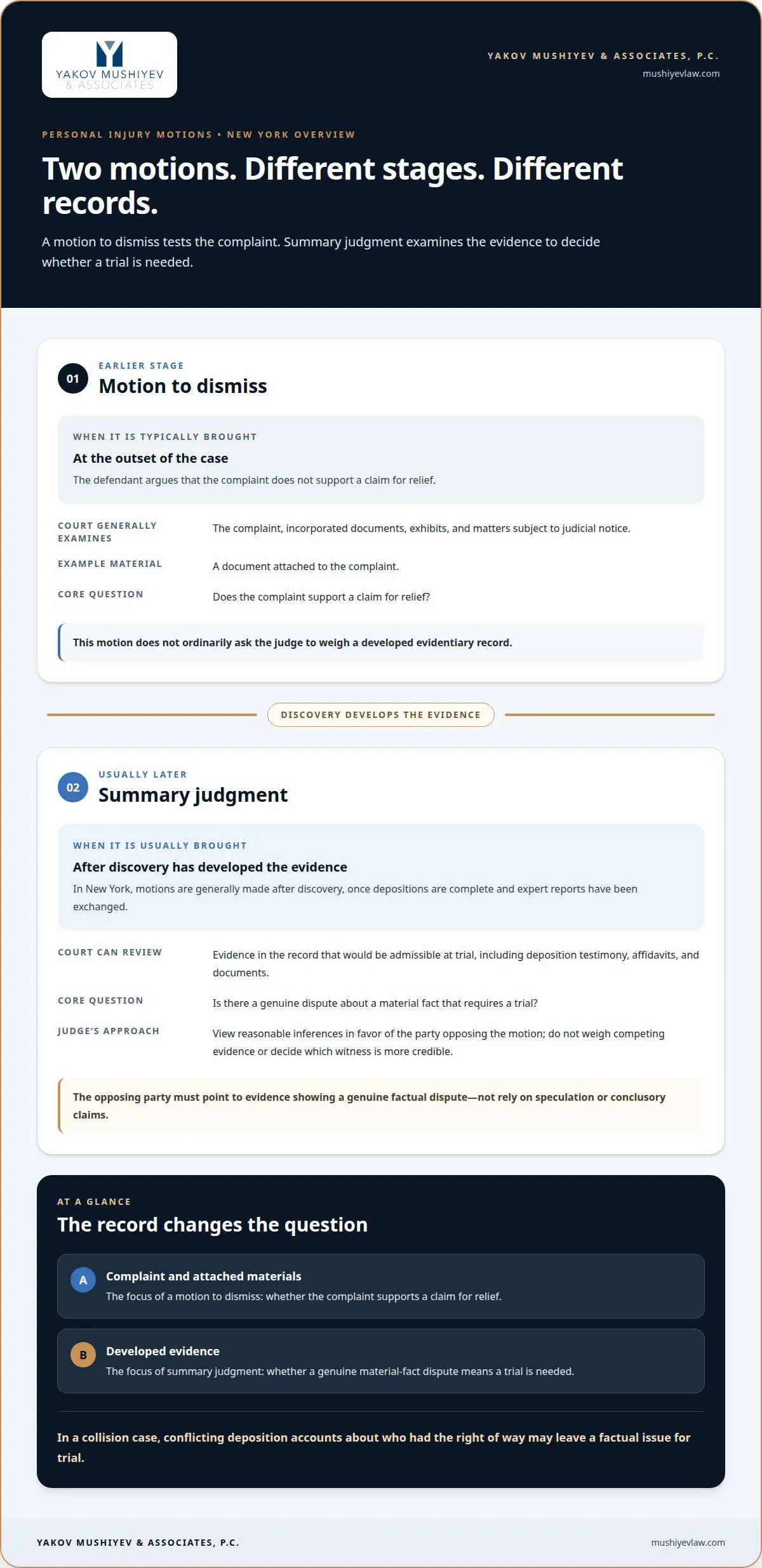
A motion to dismiss and a summary judgment motion challenge an injury case at different stages and based on different records. In New York, defendants typically seek dismissal at the outset, arguing that the complaint does not support a claim for relief. The court generally examines the complaint, along with incorporated documents, exhibits, and matters subject to judicial notice. For example, it may consider a document attached to the complaint.
Summary judgment usually comes later, after discovery has developed the evidence. The court can review materials such as deposition testimony, affidavits, and documents, including relevant reports. The question is whether a genuine dispute about a material fact requires a trial. In a collision case, conflicting deposition accounts about who had the right of way may leave a factual issue for trial.
The difference matters because a motion to dismiss does not ordinarily ask the judge to weigh a developed evidentiary record. Summary judgment does. A complaint might allege that a property owner failed to address a dangerous condition. Later, depositions and incident records could reveal whether the condition existed, who knew about it, and whether the evidence is genuinely disputed. Those records shape the summary judgment analysis.
There is also a procedural boundary. If a party presents material outside the pleadings on a motion to dismiss and the court does not exclude it, the motion should be converted to one for summary judgment. This gives both sides a chance to respond to the outside evidence under the applicable procedure. A plaintiff facing a motion should identify whether the defendant relies only on the complaint or also cites evidence gathered during discovery. That distinction can affect what materials matter and how the plaintiff responds.
How summary judgment can end an injury case
A summary judgment motion can stop an injury lawsuit before trial when the record leaves no genuine dispute requiring a factfinder. The moving party asks the judge to apply the law to established facts. If the defendant wins on every claim, the court can resolve the case in the defendant’s favor, and the plaintiff will not present those claims to a jury.
Timing shapes a motion’s impact. In New York, parties generally file after discovery, when depositions, documents, and expert reports have developed the record. A defendant might argue that the evidence cannot establish a required part of the plaintiff’s claim. If the judge agrees that the defendant is entitled to judgment as a matter of law, the motion can end the case without a trial.
But the outcome may be narrower. If the court resolves only one claim or legal issue, the lawsuit continues on matters left undecided. For example, a ruling may remove one defendant while claims against another remain. The decision determines what the parties must still prove, what evidence remains relevant, and whether a trial is needed.
A denial also affects the case’s direction. The judge has found that the record does not justify ending the claim at that stage, so unresolved issues continue in the trial court. The plaintiff and defendant must prepare around the remaining disputes, rather than treating the motion as a final decision on liability.
Can a summary judgment ruling be appealed in a personal injury lawsuit? Whether an appeal is available depends on the ruling and applicable appellate procedure. A denial does not, by itself, end the lawsuit.
If a motion threatens to end your injury claim, get legal guidance about responding to a summary judgment motion and protecting the issues that remain for trial.
Yakov Mushiyev & Associates, P.C.
Yakov Mushiyev & Associates, P.C. represents people injured in accidents, including clients facing a summary judgment motion that could narrow or end their claims. The firm handles car, truck, and motorcycle accident cases, as well as slip and fall claims, for injured people in Rosedale, Rochdale, Queens, and across its New York service area.
Consider speaking with an attorney when the opposing party argues that the evidence cannot support your claim or when you need to understand which issues may still proceed. Reviewing the motion alongside the case record can clarify the arguments, the evidence relied on, and the factual disputes that may matter to the court.
Contact Yakov Mushiyev & Associates, P.C. to discuss your injury case and the motion affecting it.
Take the Next Step With a Clear Plan
Understanding what a summary judgment motion in an injury case means is a starting point, not a strategy. The next step is to connect the motion’s arguments to the evidence and issues in your claim. A focused review can clarify what is being challenged, what remains unresolved, and which decisions require prompt attention.
If a motion has been filed against you, keep the court papers and related case documents together so the issues can be discussed clearly. You don’t have to sort through legal arguments alone. An attorney can explain how the filing relates to your injury claim and help you consider a response.
Contact Yakov Mushiyev & Associates, P.C. to discuss your situation and possible next steps. You can move forward with a clearer understanding of the challenge and the path ahead.
Frequently Asked Questions
These answers are general information, not legal advice about your specific case. Consult a lawyer for case-specific guidance.
What is a summary judgment motion in a personal injury case?
A summary judgment motion in an injury case asks the judge to decide a claim or issue before trial based on the case record. For example, after a deposition, one side may argue that the testimony leaves no factual dispute requiring a jury. The judge considers the applicable law and evidence, rather than conducting a trial or hearing live testimony from every witness.
What legal standard must a party meet to obtain summary judgment in a personal injury lawsuit?
The moving party must show there is no genuine dispute over a material fact and that the law entitles it to judgment. In New York, a party seeking summary judgment under CPLR §3212 must establish that no material factual issue requires trial. The judge views reasonable inferences in favor of the opposing party, so conflicting accounts can prevent judgment before trial.
What are common grounds for summary judgment in personal injury cases?
Common arguments include that the evidence cannot establish negligence, causation, or another legally required element of the injury claim. A defendant might argue that the available records do not connect an alleged hazard to a fall. In Rosedale, Rochdale, Queens, as elsewhere, the judge examines the case evidence and applicable law. Unsupported allegations alone do not establish a genuine factual dispute.
How does summary judgment differ from a motion to dismiss or a trial?
A motion to dismiss typically challenges whether the complaint states a legally supportable claim, often before discovery develops the evidence. Summary judgment considers a developed record, such as deposition testimony and documents. At trial, the factfinder can hear evidence and resolve disputed facts. For example, a conflict between two witnesses about an accident may require a trial rather than a pretrial ruling.
What happens if summary judgment is granted or denied in an injury case?
If granted on every claim, summary judgment can end the lawsuit without a trial. A ruling limited to one claim or issue leaves the remaining parts to continue. If the judge denies the motion, unresolved claims proceed through the case, potentially toward trial. The order’s scope matters: it identifies which claims, defenses, or issues remain active and what the parties must address next.