
Silence can change what remains disputed in a New York lawsuit. If you don’t respond to a Notice to Admit on time, the matters it asks about may be deemed admitted. If you’re asking what a notice to admit in a lawsuit is, it’s a written request under CPLR § 3123 asking another party to admit specified facts, the genuineness of documents, or the correctness of photographs.
It’s understandable to wonder whether a notice is just paperwork or whether ignoring it could affect your case. The consequences can be serious: an admission may narrow the issues the parties need to prove. This article explains what a Notice to Admit can cover, why it has limits, and how it differs from deposition testimony or interrogatory responses. You’ll also see why a request about an undisputed detail is different from one aimed at resolving the central dispute.
Key Takeaways
- Assess whether each request concerns a straightforward, admissible fact or document, rather than a disputed issue or legal conclusion.
- Understand why an admission can carry a different effect from testimony in a deposition or an answer to an interrogatory.
- See how narrowing undisputed facts can shape what remains to be proven at trial or in later motions.
- Learn which details about facts, documents, photographs, and signatures a Notice to Admit may ask the other party to address.
Limits on requests involving legal conclusions or disputed facts
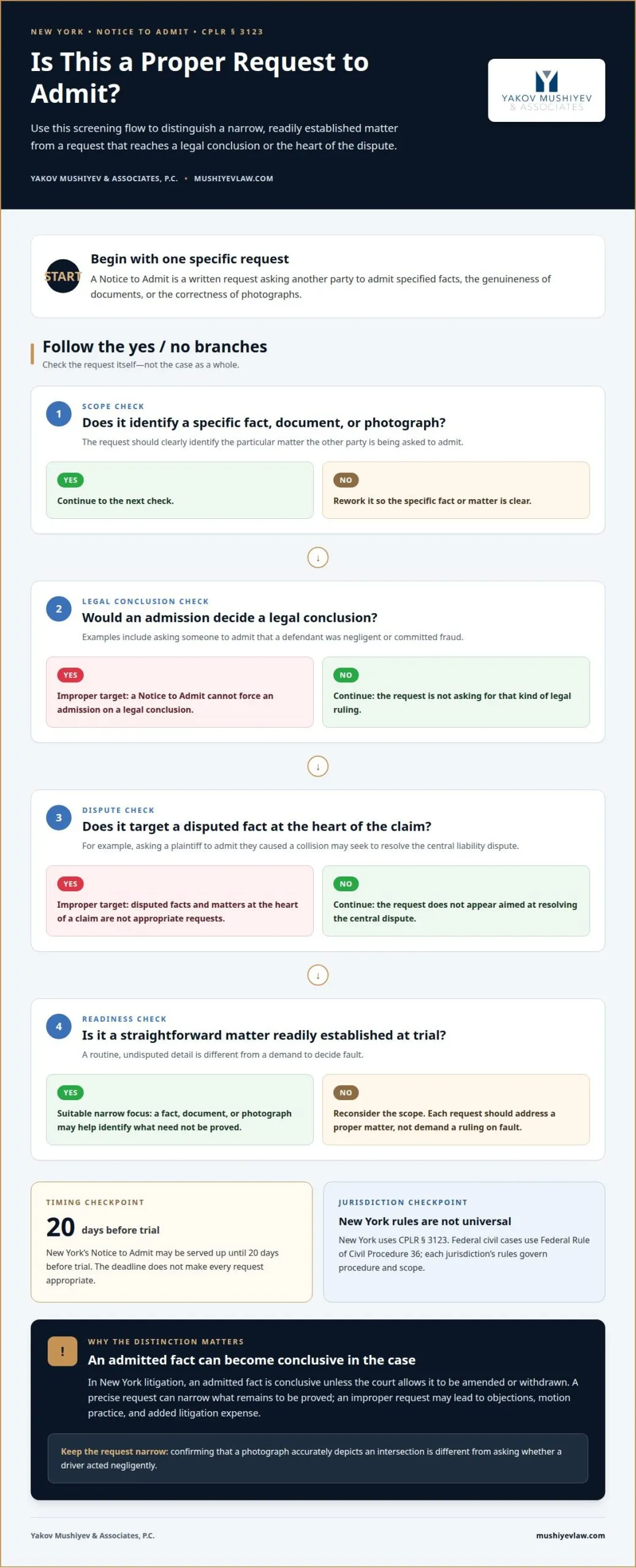
New York’s Notice to Admit process is for narrowing issues, not deciding the lawsuit. Under CPLR § 3123, a request cannot force an admission on a legal conclusion, such as whether a defendant was negligent or committed fraud. Those conclusions depend on applying law to evidence, not simply confirming a detail.
Disputed facts and matters at the heart of a claim are also improper targets. For example, asking a plaintiff to admit they caused a collision may seek to resolve the central liability dispute. A request about a routine, undisputed detail is different. The distinction matters because an admission can affect what remains contested.
New York State Legislature states that a Notice to Admit may be served up until 20 days before trial. That deadline does not make every request appropriate. Each item still needs to address a proper matter, such as a fact readily established at trial, rather than demand a ruling on fault.
Federal Rule of Civil Procedure 36 governs requests for admission in federal civil cases. It allows a party to ask another party to admit matters relevant to the case, including facts or document authenticity; the receiving party must respond under the rule’s process.
Improper requests can lead to objections, motion practice, and added litigation expense. In New York, a party may seek expenses, including attorney’s fees, for disputing a document’s genuineness if it is later found to be genuine. Those expenses may be recoverable even if the requesting party does not prevail on the lawsuit’s merits.
Before serving a request, separate each factual proposition from any conclusion about legal responsibility. For example, asking whether a photograph accurately depicts an intersection is different from asking whether a driver acted negligently. That distinction keeps the notice focused and reduces avoidable disputes.
Effect of admissions compared with deposition and interrogatory statements
A Notice to Admit can have a more direct effect than other discovery responses. In New York litigation, an admitted fact is conclusive in the case unless the court allows it to be amended or withdrawn. By contrast, a deposition answer or interrogatory response records what a witness or party said during discovery. The formats serve different purposes.
A deposition lets attorneys ask questions and follow up on answers. The testimony can develop details about an event, such as what a driver saw before a collision. New York’s 2021 updates to the CPLR and NYCRR limit a deposition of a party or witness to 7 hours, absent good cause. An interrogatory uses written questions and answers; the 2021 updates limit interrogatories to 25 per party.
A Notice to Admit focuses on specific matters rather than broad questioning. For example, the parties might establish that a particular photograph depicts an intersection. If admitted, that fact is conclusive in the action unless the court permits a change. New York admissions apply only in the action for which the notice was served and cannot support a later res judicata motion.
Can a party object to or withdraw an admission? A party can dispute an improper request, and an admission may be amended or withdrawn if the court allows it. Until then, a conclusive admission can constrain that party’s position in the case.
Keep the distinctions clear: deposition testimony records oral answers, interrogatories capture written responses, and an admission can remove a fact from dispute. Their consequences depend on the record and the case. In an accident lawsuit, separating an established detail from contested responsibility can help clarify what evidence still matters. For guidance about New York accident-related legal issues, consider how each discovery response affects the claims and defenses.
Using notices to admit to establish undisputed facts
A Notice to Admit can streamline a New York case by isolating facts that should not require proof. CPLR 3123 provides the mechanism. For example, parties in a collision case might agree that a photograph shows a particular intersection, leaving the circumstances of the crash for evidence and argument.
Admissions can also establish a foundation for evidence. A party might be asked to admit one step in an item’s chain of custody, helping clarify how it was handled. The request should focus on a fact that can readily be admitted, not try to prove a disputed claim or determine who is legally responsible.
Once admitted, a fact can be used at trial, on summary judgment, or on a motion to dismiss. This can shape the case: if document authenticity is admitted, the parties may not need to spend trial time proving that point. A notice helps identify what evidence remains necessary; it does not replace evidence about contested issues.
How do state rules for notices to admit vary by jurisdiction? Each jurisdiction’s rules govern the procedure and permitted scope, so New York’s CPLR 3123 should not be assumed to apply elsewhere. In a federal case, Federal Rule of Civil Procedure 36 provides a separate framework.
How do you serve and format a notice to admit? In New York, it is a written request under CPLR 3123, with each requested admission clearly identifying a specific fact or matter. Organizing requests as separate, numbered statements can make it easier to distinguish, for example, a request about a photograph from one about a document’s authenticity. Service must follow the procedures applicable to the case.
Careful drafting keeps the purpose narrow: remove genuinely undisputed points from the proof burden while preserving contested questions for trial. A precise request about a records-handling step can clarify evidence. A broad demand about fault risks turning a tool for streamlining the case into a fight over the central dispute.
What facts or documents can a notice to admit cover?
In a New York civil action, a Notice to Admit can ask another party to admit specified facts, the genuineness of a document, or the correctness of a photograph. Each request should identify one clear proposition. For example, a request might ask whether a dated image accurately shows a particular location, rather than asking the other party to accept a broad account of an accident.
Document requests can address authenticity and accuracy. A party may be asked to admit that a document is authentic, that a copy accurately reproduces the original, or that a signature is genuine. For example, a request could identify a specific report and ask whether the attached copy matches the original. Precise identification helps prevent confusion about which record the request concerns.
Photographs can also be addressed. A request might ask whether a particular image depicts a vehicle at an identified intersection. That admission concerns what the photograph shows, not whether a driver caused a collision. Keeping those issues separate preserves the distinction between confirming an item and proving disputed responsibility.
Specified facts may include straightforward details connected to the evidence. In an accident case, a request could ask whether a document bears a particular date or a photograph shows a marked crosswalk. A request should not disguise an argument as a fact, ask the other party to concede negligence, or require expert analysis to answer.
Before responding, identify the exact statement, record, image, or signature named in each item. Then distinguish what you can admit from what is inaccurate, uncertain, or genuinely disputed. A precise response addresses the request without conceding a different proposition. A failure to respond on time can have consequences, so both the wording and deadline matter.
If an accident-related notice raises questions about a photograph, record, or other evidence, get legal guidance on your accident claim before an admission shapes the case.
Yakov Mushiyev & Associates, P.C
Yakov Mushiyev & Associates, P.C. represents people injured in accidents, including clients facing discovery requests in personal injury lawsuits. A Notice to Admit can affect which facts remain contested, so its wording and response deserve careful attention as part of the broader case.
If your lawsuit involves a car, truck, or motorcycle accident, or a slip and fall, legal representation can help you understand how a request relates to your claims and evidence. The same applies when an admission request concerns records, photographs, or other details connected to an injury. Seek legal guidance promptly if you receive a notice or need to assess its potential effect; missing a response deadline can change the issues in dispute.
For guidance about an accident-related case, contact Yakov Mushiyev & Associates, P.C.
Protect Your Position as the Case Moves Forward
Understanding what a notice to admit in a lawsuit can mean is only part of protecting your position. Next, consider how the request relates to the evidence, the claims, and the response deadline in your case. A careful review can help you avoid treating a consequential legal document as routine paperwork.
Yakov Mushiyev & Associates, P.C. provides legal representation for car, truck, and motorcycle accidents, as well as slip and fall cases. The appropriate response depends on the specific requests and the circumstances of your injury claim. If you’ve received a notice connected to an accident or fall, consider discussing its effect with a lawyer before responding.
Contact Yakov Mushiyev & Associates, P.C to discuss your case and determine a practical next step. You can move forward with a clearer understanding of the issues before you.
Frequently Asked Questions
What is a notice to admit in a lawsuit?
A notice to admit in a lawsuit is a formal written request asking another party to confirm specific facts or evidence. In a New York injury case, for example, a request might ask whether a record identifies a particular date. It is not a request to decide who caused an injury. For claims arising in Rosedale, Rochdale, or Queens, New York procedure applies.
What is the deadline to respond to a notice to admit?
The response deadline depends on the procedural rules governing the case and how and when the notice was served. Don’t confuse the deadline to respond with the deadline for serving a notice before trial. Review the notice, note when and how it was served, and promptly determine the applicable response date. Missing the deadline can affect which matters remain disputed.
What happens if a party does not respond or denies a request?
In New York, matters may be deemed admitted if a party does not respond on time. A denial, by contrast, leaves the requested matter disputed rather than admitted. For example, denying that a record is authentic may leave its authenticity to be addressed through other evidence or court proceedings. Read each request separately: a response to one item does not automatically resolve another.
How does a notice to admit differ from interrogatories and requests for production?
A Notice to Admit seeks confirmation of particular matters. Interrogatories ask written questions that require answers, while requests for production seek documents or other materials. For example, a party could request a maintenance log through document discovery, ask who inspected a site through interrogatories, and seek an admission that a specific log is authentic. These tools gather different kinds of information.
Can a notice to admit be used to prove facts at trial?
Yes. In New York, facts admitted in response to a notice, including matters deemed admitted after no timely response, may be used at trial. An admission may help establish a point without separate proof, but it does not establish every element of a claim. These FAQ answers are general information, not legal advice about your specific case. Consult a lawyer for guidance tailored to your circumstances.
How do state rules for notices to admit vary by jurisdiction?
Each jurisdiction’s rules govern the procedure and permitted scope of notices to admit, so New York’s CPLR 3123 should not be assumed to apply elsewhere.