
What if a rushed or incomplete answer gives the defense a reason to challenge your account of an injury? If you’re wondering how to answer interrogatories from the defense lawyer, take the questions seriously and work with your lawyer. These written questions are part of discovery, and your answers can shape the record in your personal injury case.
It’s understandable to feel unsure when questions ask about prior injuries, medical treatment, witnesses, or losses you’ve experienced. In New York, answers are generally due within 20 days after service, with five additional days when served by mail. Your specific deadline and response requirements may depend on your case. Review the papers promptly, note how and when they were served, and don’t guess, leave questions unanswered, or sign responses you haven’t reviewed carefully.
This guide explains what interrogatories are, how to organize clear and truthful answers, and why your injury counsel should review the responses, documents, and any potential objections. With guidance from a New York personal injury lawyer, you can respond carefully and help keep the case record accurate.
Key Takeaways
- Learn how to answer interrogatories from the defense lawyer by organizing truthful, complete responses with your attorney’s guidance.
- Use a practical workflow to review the questions, gather relevant records, prepare a draft, and verify each response before it’s served.
- Identify useful information to collect about the accident, witnesses, medical history, treatment, work effects, and claimed losses.
- Check responses for missing subparts, inconsistencies, and supporting records, and confirm the required format and verification before finalizing.
- Understand how a New York injury lawyer can clarify questions, assess potential objections, and shape discovery responses around your case.
What Are Defense Interrogatories in a New York Injury Lawsuit?
After a New York personal injury lawsuit begins, the defense may serve written questions as part of discovery. These questions are called interrogatories. They are directed to a party in the case, not asked in a live interview, and seek information relevant to the claims and defenses. In short: Interrogatories are written discovery questions answered in writing; a deposition is oral testimony given in response to questions.
Answers generally need to be careful and truthful. Depending on the applicable rules and case requirements, a party may also need to verify responses, often by signing a statement confirming they are true. The general Interrogatory overview explains that these questions are used in civil litigation and responses are typically given under oath. The precise response format and verification requirements should be checked against current New York rules and any orders in the case.
How interrogatories fit into personal-injury discovery
Discovery gives each side a structured way to investigate what happened, what injuries are claimed, and what evidence supports or challenges those claims. Interrogatories can ask you to explain your account of an accident, identify witnesses, describe medical treatment, or state the losses you attribute to the incident. In a car, construction, or slip-and-fall case, consider each question in light of the specific facts and disputed issues.
Other discovery tools serve different purposes. A document request seeks materials such as records or photographs. A request for admission asks a party to admit or deny a particular statement. A deposition involves spoken questions and answers, typically recorded as testimony. New York practice has its own rules: in negligence actions, interrogatories and a demand for a bill of particulars generally may not both be served on the same party without court permission. Bills of particulars and depositions are more commonly used in these cases, so the discovery plan and any court order matter.
What the defense may ask after an accident
Questions may cover the accident’s location and circumstances, what you saw or did, and the names of people who witnessed it. They may also ask about prior injuries, medical providers, treatment, missed work, and the losses you say resulted from the accident. These topics can feel personal. Their relevance depends on the case, and a question that seems broad or confusing should be reviewed with your lawyer before you respond.
Receiving a long set of questions doesn’t decide who was at fault or what compensation may be available. It means the defense is seeking information for the lawsuit. First, identify what each question asks and how it relates to your case. Don’t treat the questions as an informal conversation or guess at details. A New York injury lawyer can help assess the requests, identify the information needed, and prepare responses that accurately reflect your knowledge.
How to Prepare Accurate Answers to Interrogatories
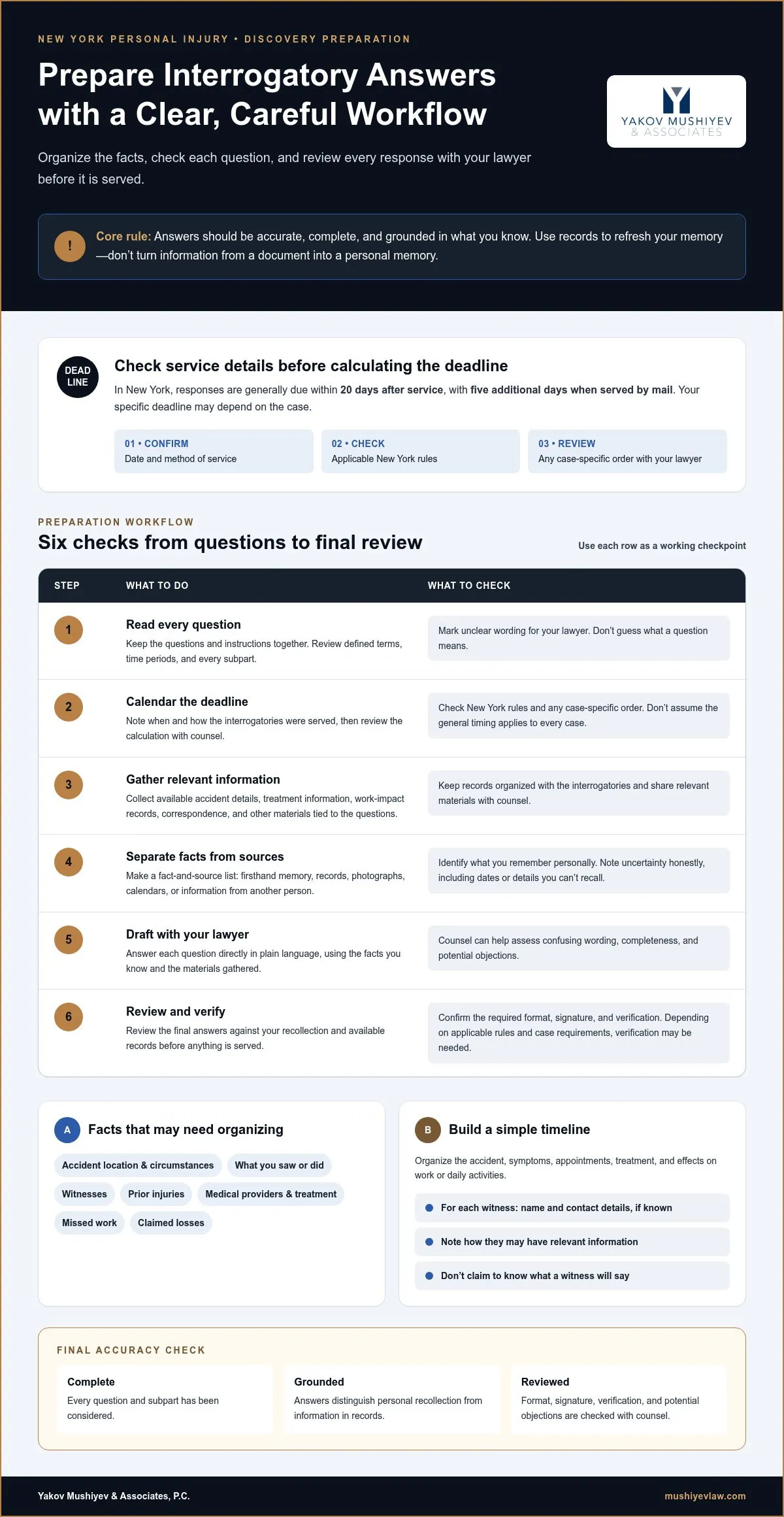
A reliable response starts before you draft. Keep the questions and instructions together, and work with your lawyer to organize the facts rather than relying on memory alone. Interrogatory answers should be accurate, complete, and grounded in what you know. Records can help refresh your recollection, but don’t present something you learned from a document as a personal memory.
Use this workflow to prepare:
- Read every question and instruction. Note defined terms, time periods, and subparts. Mark language you don’t understand instead of guessing what it means.
- Calendar the response deadline. Check the date and method of service, the applicable New York rules, and any case-specific order with your lawyer. New York responses are generally due within 20 days after service, with five additional days when served by mail. Don’t assume that calculation applies to every case.
- Gather relevant information. Collect available accident details, treatment information, work-impact records, correspondence, and other materials tied to the questions. Keep the interrogatories and share relevant records with counsel.
- Make a fact-and-source list. Separate what you remember firsthand from what a medical record, calendar, photograph, or another person indicates. Note uncertainty honestly, including dates or details you can’t recall.
- Prepare a draft with your lawyer. Answer each question directly in plain language. Counsel can help address confusing wording, completeness, and any potential objections.
- Review and verify the final responses. Check every answer against your recollection and available records. Confirm the required response format, signature, and verification before anything is served.
Gather facts, records, and names before drafting
For an injury claim, organize a simple timeline of the accident, symptoms, appointments, treatment, and effects on work or daily activities. For each possible witness, note their name, contact details if known, and how they may have relevant information, such as seeing the incident or observing your condition afterward. Don’t claim to know what a witness will say. Use records to refresh your memory, and mark details that remain uncertain for discussion with your lawyer.
Write clear answers without speculation
Respond to what the question asks, with enough detail to make the answer understandable. If you can’t recall an exact date, don’t invent one. Explain the limits of your recollection and let counsel help phrase the response. If a question seems confusing, overly broad, or difficult to answer, raise it before preparing a final response. Your lawyer can review the wording and confirm whether the answer is complete and whether verification is required.
If you’re unsure how to answer interrogatories from the defense lawyer, don’t try to solve every issue alone. A New York injury lawyer can help organize the facts around your case and review your draft before it becomes part of the litigation record. Injured New Yorkers can learn about personal injury legal guidance while preparing a careful response.
How to Handle Difficult Interrogatories About Injuries, Witnesses, and Prior Conditions
Questions about your health, work, and personal history can feel intrusive, especially when you’re still dealing with an injury. Answer carefully, not defensively. Describe a relevant prior condition truthfully, but remember that it doesn’t automatically explain away a new injury. Your lawyer can help put the facts in context and assess whether a question calls for an objection or another response under the rules.
Use the table to organize information before drafting. The questions’ relevance depends on the issues in your particular case.
| Question topic | Information to gather | Drafting caution |
|---|---|---|
| Accident facts | Your location, what you observed, the sequence of events, and relevant photos or notes. | Separate what you personally remember from what you learned later. Don’t fill gaps with assumptions. |
| Witnesses | Names and contact information for people who saw the incident or observed your condition afterward. | Explain what each person may know, but don’t guess what they’ll say. |
| Prior injuries or conditions | Relevant earlier injuries, symptoms, providers, and available medical records. | Don’t minimize or exaggerate. Distinguish the earlier condition from any changes after this accident. |
| Medical care and treatment | Provider names, appointment history, treatment, and records that may help establish dates. | Keep the response consistent with records while accurately describing your own recollection. |
| Work effects | Time missed, changes in duties, and related communications or records. | Be precise about the impact you experienced. Don’t attribute losses to the accident unless that is accurate. |
| Claimed losses | Expenses, property loss, and ways the injury affected daily activities. | Describe the losses being claimed without estimating or adding unsupported amounts. |
Questions about witnesses, prior injuries, and medical care
Not every useful witness saw the accident. A family member, coworker, or friend may have observed changes in your mobility, routine, or ability to work afterward. Identify people with relevant knowledge and describe what you understand they observed. For prior injuries, be candid about what happened and when. Compare your recollection with medical records and the account you’ve already given your lawyer. Flag differences rather than trying to reconcile them by guessing.
When a question seems unclear, intrusive, or impossible to answer
Mark the specific wording that concerns you and discuss it with your attorney. A question may seem overly broad, unclear, or impossible to answer from memory, but that doesn’t make it safe to ignore. Your lawyer can assess whether an objection is appropriate and determine how to respond under the governing rules. Don’t leave a question blank, refuse on your own, or make an unsupported assumption just to complete the response.
If you’re unsure how to answer interrogatories from the defense lawyer, bring the exact question and any relevant records to your New York injury lawyer. Careful review can help keep your answers accurate and consistent, while leaving legal objections to counsel.
How to Review and Finalize Interrogatory Responses Before They Are Served
A draft isn’t ready to serve just because every question appears to have an answer. The final review is your chance to catch omissions, correct mistakes, and make sure the responses reflect what you actually know. Have your lawyer review the complete set before service. An unanswered subpart or careless inconsistency can create confusion later in the case.
A practical final-review checklist
Review the responses alongside the original questions, not from memory. Check each question and every subpart. If a response includes an objection or limitation, make sure your lawyer has reviewed it. Compare the final draft with relevant records and the information already shared with counsel. Flag differences for discussion rather than silently changing facts to make them seem consistent.
- Completeness: Confirm every question and subpart has a response or a lawyer-reviewed objection. Check that cross-references point to the right answer.
- Accuracy: Verify names, dates, provider information, treatment descriptions, and other concrete details against available records.
- Consistency: Look for differences between the answers and earlier statements or records. A difference may have an explanation, but raise it with counsel.
- Clarity: Remove speculation and wording that could be misunderstood. Make sure each response addresses what was asked without adding unsupported detail.
- Final copy: Confirm you’re reviewing the complete, final version, including any attachments or referenced materials counsel intends to provide.
Don’t make last-minute edits to a lawyer-reviewed draft without telling your attorney. Even a small change can affect the meaning of an answer or create a new inconsistency. If you spot an error, identify the exact response and explain what needs attention so counsel can decide how to revise it.
Verification, service, and keeping a record
Verification generally means confirming that the answers are true, often by signing a statement. The required wording, signature, and response format depend on the applicable New York rules and any case-specific orders. Follow your lawyer’s instructions for reviewing, signing, and returning the final responses. Don’t sign a version you haven’t read or one that contains information you believe is inaccurate.
After the responses are served, keep a copy of the exact version sent, along with the original questions and related correspondence. This record helps you and your lawyer refer to the same answers if questions arise later. Ask counsel how the completed responses and related documents will be preserved in your case file.
Careful final review is a practical safeguard, not a guarantee of a particular case result. If you’re uncertain how to answer interrogatories from the defense lawyer or whether a final response is ready to sign, get legal guidance on interrogatory responses from a New York injury lawyer before it’s served.
How a New York Injury Lawyer Can Help You Respond to Defense Interrogatories
Interrogatory answers should reflect the facts of your case, not a generic sample from a different lawsuit or state. A New York injury lawyer can connect each question to the issues in your claim, identify information that needs clarification, and review whether a response or objection is appropriate under the rules governing your case. That guidance matters when a question touches on medical history, the cause of an injury, or losses that may continue to change.
What case-specific legal guidance can address
Your lawyer can explain what a question is asking and help determine which facts and records are relevant. For example, a question about your physical limitations may need to be considered alongside your treatment history and the specific effects you’ve reported. Counsel can also compare your proposed answers with information already provided in the litigation, flag inconsistencies for discussion, and assess whether a question is unclear, overly broad, or calls for a legal objection.
This is not about shaping facts to make a claim look stronger. It’s about giving accurate responses that address the actual issues in the case. Your lawyer can help distinguish what you know firsthand from information established by records and make sure a response doesn’t rely on unsupported assumptions. The New York personal injury claim process can involve different steps depending on the facts and procedural posture of a lawsuit, so discovery responses should be handled with that case-specific context in mind.
If you’re working out how to answer interrogatories from the defense lawyer, bring questions or uncertainties to counsel before you sign or serve anything. Your attorney can review the final language, explain any lawyer-reviewed objection, and help ensure the answers fit the claims and defenses being litigated. No review can promise a particular ruling, settlement, or verdict. Its purpose is to help you respond carefully and protect the accuracy of the case record.
Taking the next step in Queens
Act promptly after receiving interrogatories. Bring the complete set of questions, any instructions or service information, and relevant case papers to your lawyer. If you were injured in a crash, the Queens car accident legal guide offers context for people dealing with an accident claim in the borough.
Yakov Mushiyev & Associates, P.C. represents injured people in New York, including clients in Queens, Rosedale, and Rochdale. The firm’s personal-injury work includes motor vehicle, construction, and slip-and-fall cases. If you need help understanding discovery in your injury lawsuit, gather your papers and request an initial assessment. A lawyer can discuss your circumstances and the next steps that may apply to your case.
Move Forward With Guidance That Fits Your Case
Discovery can feel like another burden while you’re recovering, but you don’t have to make strategic decisions about your injury claim without support. A conversation about your specific questions, concerns, and the path ahead can help you understand your options without assuming every case follows the same course.
If you’re still uncertain about how to answer interrogatories from the defense lawyer, bring your questions to counsel before responding. Yakov Mushiyev & Associates, P.C. represents accident victims in New York personal-injury matters, including clients in Rosedale, Rochdale, and Queens. Guidance should be grounded in the facts of your situation.
Frequently Asked Questions
How long do I have to answer interrogatories in a New York injury case?
The deadline depends on the method of service, applicable New York rules, any court order, and agreements between the parties. Don’t rely on a general deadline or a date mentioned informally. Check the papers as soon as they arrive, note any stated response date, and ask your lawyer to confirm what controls in your case. If you’re waiting for records or need more time, raise that promptly so counsel can assess whether an extension is appropriate.
What if I do not remember the answer to an interrogatory?
Don’t guess. Check whether a calendar, appointment reminder, email, or other record may help clarify the detail, then tell your lawyer what you do and don’t recall. For example, you may remember a treatment visit occurred in the spring but not its exact date. Counsel can consider whether more investigation is useful and how to explain the limits of your memory accurately under the requirements that apply to your case.
Can I use my medical records instead of answering an interrogatory?
Usually, providing a record doesn’t by itself answer a written question. If asked to identify treatment providers, for example, your response may need to state the information requested, even if records contain it too. Follow your lawyer’s instructions about whether to identify or produce documents separately. Don’t assume that attaching a large file addresses every part of an interrogatory, or send records without confirming how they relate to the request.
What can happen if interrogatory answers are late?
A missed discovery deadline can disrupt the case and may prompt the other side to ask the court to intervene. What happens next depends on the circumstances, including any court orders, agreements, and the reason for the delay. If you realize you may not respond on time, tell your lawyer immediately. Share the deadline notice and explain what is holding up the response, so counsel can assess possible next steps under current New York procedure.
Can I change an interrogatory answer after I send it?
A response may need to be corrected or supplemented if you discover a meaningful error, missing information, or a change in circumstances. Don’t edit your personal copy and assume the other side has been notified. Tell your lawyer what the original answer said, what needs updating, and when you learned the new information. Counsel can decide whether a revised response is needed and how to provide it under the rules and orders in your case.
Do interrogatory answers become part of the court record?
Written discovery responses are exchanged between the parties, but they aren’t necessarily filed with the court automatically. They could still become relevant if a discovery dispute or another court proceeding arises. Ask your lawyer how the responses will be handled in your lawsuit, including whether any part may be submitted later. Keep the final served answers, the questions, and correspondence together so you can refer to the exact version exchanged.
Should I answer interrogatories without a lawyer?
If a lawyer represents you in the injury case, coordinate your responses with that attorney before signing or serving them. If you’re representing yourself, read the instructions closely and check the rules and deadlines that apply to your court and case. Generic examples can’t account for your facts or procedural requirements. If you’re unsure how to answer interrogatories from the defense lawyer, seek case-specific guidance before sending a response that may affect the litigation.
Request an initial assessment of your injury case from Yakov Mushiyev & Associates, P.C. to discuss your interrogatories and next steps.