
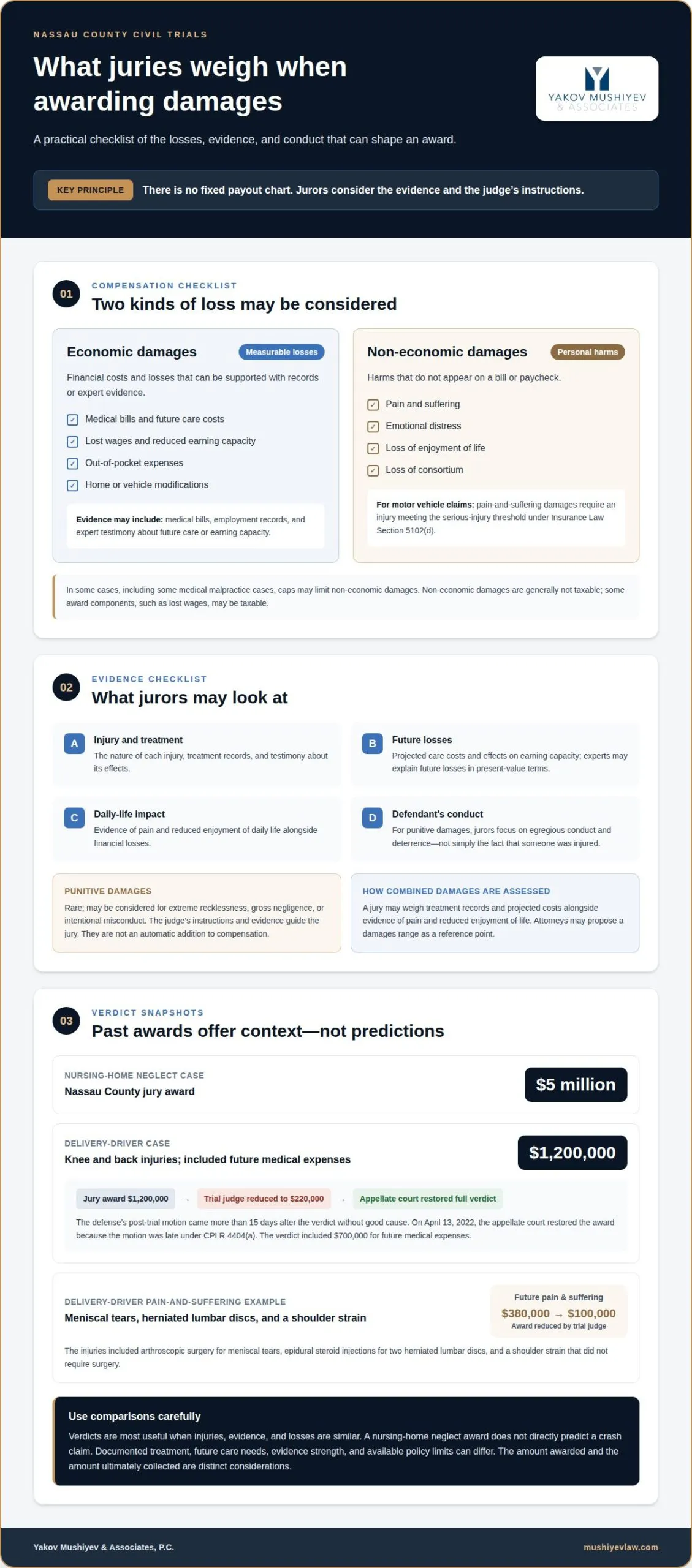
How are damages awarded by a jury in Nassau County, and what does this mean for residents of Rosedale, Rochdale, and Queens seeking justice locally? Jurors weigh the evidence and the judge’s instructions, then assess economic losses, such as medical expenses and lost wages, alongside non-economic harm, such as pain and suffering. There’s no fixed payout chart: a Nassau County jury awarded $5 million in a nursing-home neglect case, while another awarded a delivery driver $1,200,000 for knee and back injuries.
Past verdicts offer a point of comparison, not a prediction for another case. Injuries, evidence of future losses, and the defendant’s conduct can all affect the result. At Yakov Mushiyev & Associates, P.C., we help clients understand how juries assess economic and non-economic damages, when punitive damages may be considered, and why Nassau and Suffolk County verdicts can differ.
Key Takeaways
- Learn which personal harms jurors may consider as non-economic damages and when New York’s serious-injury threshold matters in motor vehicle cases.
- Understand why punitive damages are reserved for egregious conduct and what jurors assess when considering whether they’re warranted.
- Use Nassau and Suffolk County verdicts as comparisons, while weighing how injury evidence and future losses can shape each award.
- See how fault allocation can affect recovery, including the rule for motor vehicle cases commenced on or after May 26, 2026.
Non-economic damages
In a Nassau County civil trial, jurors may award non-economic damages for pain and suffering, emotional distress, loss of enjoyment of life, and loss of consortium. These damages address personal harms that do not appear on a bill or paycheck. The judge instructs jurors on the damage categories available, and they consider the testimony and evidence before deciding an amount.
Are there caps or limits on jury damages awards in New York? In some cases, including some medical malpractice cases, caps may limit non-economic damages. For motor vehicle claims, a person seeking pain-and-suffering damages must show that the injury meets the serious-injury threshold under Insurance Law Section 5102(d).
A Nassau County delivery-driver verdict illustrates how an award can change after trial. The jury awarded $380,000 for future pain and suffering, but the trial judge reduced that amount to $100,000. The driver had meniscal tears requiring arthroscopic surgery and two herniated lumbar discs treated with epidural steroid injections. He also suffered a shoulder strain that didn’t require surgery. The example shows why the nature and evidence of each injury matter.
Economic damages cover measurable financial losses. Jurors may consider medical bills, lost wages, future care costs, reduced earning capacity, out-of-pocket expenses, and home or vehicle modifications. Medical bills and employment records can document past losses. Expert testimony may help explain future care needs or effects on earning capacity.
A civil case can involve both types of damages. For example, a jury assessing a serious injury may weigh treatment records and projected care costs alongside evidence of pain and reduced enjoyment of daily life. Economists and life care planners can explain future losses in present-value terms. Attorneys may also propose a damages range as a reference point. Non-economic damages are generally not taxable, while some components of a personal injury award, such as lost wages, may be taxable.
Punitive damages
Punitive damages serve a different purpose from compensation for an injured person’s losses. In a Nassau County civil trial, jurors may consider them when a defendant’s conduct is egregious. These damages are rare and associated with extreme recklessness, gross negligence, or intentional misconduct. The focus is on conduct that may warrant punishment and deterrence, rather than the plaintiff’s losses alone.
The judge’s instructions guide the jury’s evaluation. Jurors consider the defendant’s conduct and whether an award is warranted to deter similar actions. Punitive damages are not an automatic addition to compensation for medical bills or pain. The decision must follow the judge’s instructions and the evidence.
For example, evidence that a defendant knowingly disregarded a serious risk could lead jurors to examine the conduct closely. That fact alone does not establish that punitive damages are warranted. Jurors assess the evidence presented and apply the judge’s instructions. The central issue is extreme misconduct, not simply that someone was injured.
Expert testimony may also be relevant. A court has held that a jury could credit plaintiffs’ expert evidence and award punitive damages to deter conduct when warranted. The jury still weighs that testimony alongside the other evidence. An expert may help explain the conduct or its implications, but the jury decides whether punitive damages are appropriate.
For an injured person, the distinction matters: compensatory damages address losses, while punitive damages focus on the defendant’s conduct and deterrence. A case may support compensation without involving the kind of conduct associated with punitive damages. The evidence must support treating the defendant’s actions as a separate issue.
If an accident has left you facing disputed facts about the defendant’s conduct, legal guidance after an accident can help you understand how that evidence relates to your claim.
Comparable Nassau and Suffolk County jury verdicts
Past verdicts provide context, not a fixed schedule for future cases. A Nassau County jury awarded $5 million in a nursing home neglect case involving South Shore Rehabilitation and Nursing Center. In another Nassau County case, jurors awarded a delivery driver $1,200,000 for knee and back injuries, including $700,000 for future medical expenses.
The delivery driver’s verdict also shows why the trial award may not be the final amount. The trial judge reduced the $1,200,000 verdict to $220,000. Under CPLR 4404(a), the defense’s post-trial motion came more than 15 days after the verdict, without good cause for the delay. On April 13, 2022, the appellate court restored the full verdict because the motion was late.
How does a judge review or reduce a jury damages award in Nassau County? A judge may review a post-trial challenge, as the delivery-driver case demonstrates. Here, the appellate court restored the original award because the defense motion missed the deadline under CPLR 4404(a).
Nassau and Suffolk County verdicts can help frame a damages demand, but comparisons are useful only when the injuries, evidence, and losses are similar. A demand may draw on comparable jury verdicts in both counties and available policy limits. A nursing home neglect award, for example, does not directly predict the value of a crash claim. Even crash cases can differ in documented treatment, future care needs, and the strength of the evidence.
What is the process for collecting a damages judgment after a Nassau County jury verdict? The verdict establishes the jury’s award; collection involves obtaining payment on the judgment. Available policy limits can affect the funds available, so the amount awarded and the amount ultimately collected are distinct considerations.
Use comparable verdicts to identify relevant patterns, not to assume an identical result. The $5 million South Shore Rehabilitation and Nursing Center award and the delivery-driver verdict arose from different harms and evidence. Matching the comparison to the injury and documented losses makes the reference more meaningful.
How do New York comparative negligence rules affect a jury’s damages award?
Fault can change whether a damages award is recoverable in a New York motor vehicle case. For cases commenced on or after May 26, 2026, a claimant cannot recover if their share of fault is greater than the other side’s. The comparison is between the claimant’s assigned share and the opposing side’s share. The rule makes the jury’s fault findings consequential, not merely descriptive.
Jurors evaluate evidence about how a collision occurred and apply the relevant fault rule. They may consider testimony, records, and competing accounts of each party’s actions. If, for example, the evidence conflicts about a driver’s conduct before impact, jurors assess which account is supported. Their findings on fault affect whether the claimant can recover in cases where that rule applies.
The stated cutoff applies to motor vehicle cases commenced on or after May 26, 2026. It is the date the case is commenced, not simply the date of the crash, that appears in this rule. That distinction makes the procedural timeline important. A claimant and counsel should identify when the case was commenced and compare that date with the rule’s effective cutoff before assessing how fault may affect recovery.
Comparative fault also makes evidence about the claimant’s own actions relevant. A jury’s view of the claimant’s conduct can become decisive if the assigned share exceeds the other side’s. The central question is not only what the defendant did, but how the evidence supports each party’s responsibility. Clear records and consistent testimony can help jurors evaluate those competing accounts.
This rule concerns motor vehicle cases commenced on or after May 26, 2026. It shouldn’t be treated as a universal formula for every New York injury claim. The case type, commencement date, and jury’s allocation of fault all matter. If an accident claim involves disputed responsibility, discuss your car accident claim with counsel to understand how fault evidence may affect recovery.
Yakov Mushiyev & Associates, P.C: Car Accident Legal Representation
Yakov Mushiyev & Associates, P.C. represents people injured in car accidents. If fault is disputed or injuries have disrupted daily life, the firm can help assess the evidence supporting a claim. This includes relating medical records and documented losses to the circumstances of the crash and the damages sought. A clear record matters when the opposing side disputes responsibility or the extent of an injury.
Legal representation can help you present a car accident claim and address arguments about fault or damages. Yakov Mushiyev & Associates, P.C. also represents people injured in truck, motorcycle, and pedestrian accidents, as well as slip and fall and construction accidents.
Contact Yakov Mushiyev & Associates, P.C., or visit mushiyevlaw.com to discuss your accident claim.
Take the Next Step With a Clear Claim Strategy
Understanding how damages are awarded by a jury in Nassau County is only part of preparing for a personal injury claim. The next step is building a clear record of how the injury affects your health, work, and daily life, while addressing disputed facts that could shape responsibility. Preserve relevant records and keep a consistent account of how the injury has changed your routines. A focused review can help identify which evidence supports your position and what questions need attention before the case moves forward.
Each case turns on its evidence and circumstances. If an accident has left you facing medical, financial, or practical burdens, Yakov Mushiyev & Associates, P.C can help you assess the legal issues and consider a path forward. Contact Yakov Mushiyev & Associates, P.C to discuss your situation. A clear next step can help you move forward with greater confidence.
Frequently Asked Questions
How Does a Jury Decide its Verdict?
A jury reaches its verdict by weighing admitted evidence against the judge’s instructions. During deliberations, jurors can revisit testimony, compare notes, and examine assumptions about what happened. For example, they may consider whether medical records support a witness’s account of an injury. Their decision must reflect the evidence and legal questions presented, not speculation.
How Much Is My Personal Injury Case Worth on Long Island?
There is no single dollar amount for a Long Island injury claim. Its value depends on the evidence of the injury, its effects on work and daily activities, expected future needs, responsibility for the incident, and available policy limits. An early settlement offer is a starting position, not a valuation. Have a lawyer review the evidence and offer before deciding how to proceed.
How is pain and suffering calculated in New York?
New York doesn’t use a standard formula that converts pain into a fixed amount. Jurors assess evidence such as treatment records, the duration of symptoms, limits on ordinary activities, and testimony about the injury’s continuing effects. For motor vehicle claims, recovery for pain and suffering also requires meeting the serious-injury threshold under Insurance Law Section 5102(d). The injury evidence helps frame the jury’s assessment.
How does a jury determine damages in a Nassau County, New York civil case?
In a Nassau County civil case, jurors follow the judge’s instructions and evaluate the evidence for each claimed loss. They may compare bills and employment records with testimony about how an injury changed someone’s routine. To understand how damages are awarded by a jury in Nassau County, focus on how documented losses connect to the incident and the evidence presented at trial.
What types of damages can a Nassau County jury award?
A Nassau County jury may award compensatory damages for proven financial losses and personal harms, such as medical expenses, lost income, and the effects of an injury on daily life. Punitive damages are a separate possibility tied to egregious conduct and deterrence, not an automatic addition to compensation. The judge instructs jurors on the damage categories available in the civil case.
How are compensatory damages calculated under New York law?
Compensatory damages reflect losses supported by the evidence, not a preset award. Records can help establish past medical spending or missed work, while projections and expert testimony may explain future care needs or effects on income. Jurors assess each claimed loss against the proof presented. These answers provide general information, not legal advice for a specific case.