
You can fire your personal injury lawyer in New York at any time, but coordinate the change to protect your case. Switching attorneys does not automatically mean paying your new lawyer an additional fee. Your former lawyer may claim compensation from a future recovery for work already performed, and you may owe case-related expenses under your retainer agreement.
It’s understandable to worry that changing lawyers could cost you money or put your claim at risk. Before ending the relationship, review your retainer agreement, discuss your concerns with your current attorney if appropriate, and speak with prospective replacement counsel. This guide explains how to evaluate the relationship, give written notice, transfer your case file, and understand how fees and expenses may be handled. Legal deadlines continue to apply while you change lawyers, so keep them in view throughout the transition.
Key Takeaways
- Consult replacement counsel before ending the relationship, and discuss how the transition can protect your case from avoidable delays.
- In a New York personal injury case, lawyers may divide the one-third contingency fee or ask a court to resolve the division.
- Review your retainer agreement and account for the former lawyer’s claim for fees from a recovery and possible reimbursement of case expenses.
- Raise your concerns, put your decision in writing, and arrange for your case file to reach your new attorney.
If You Fire Your Personal Injury Attorney Will It Cost You More Money?
You can end the attorney-client relationship, but plan the transition first. In a New York injury case, your former attorney’s potential fee claim and case expenses may affect any eventual recovery.
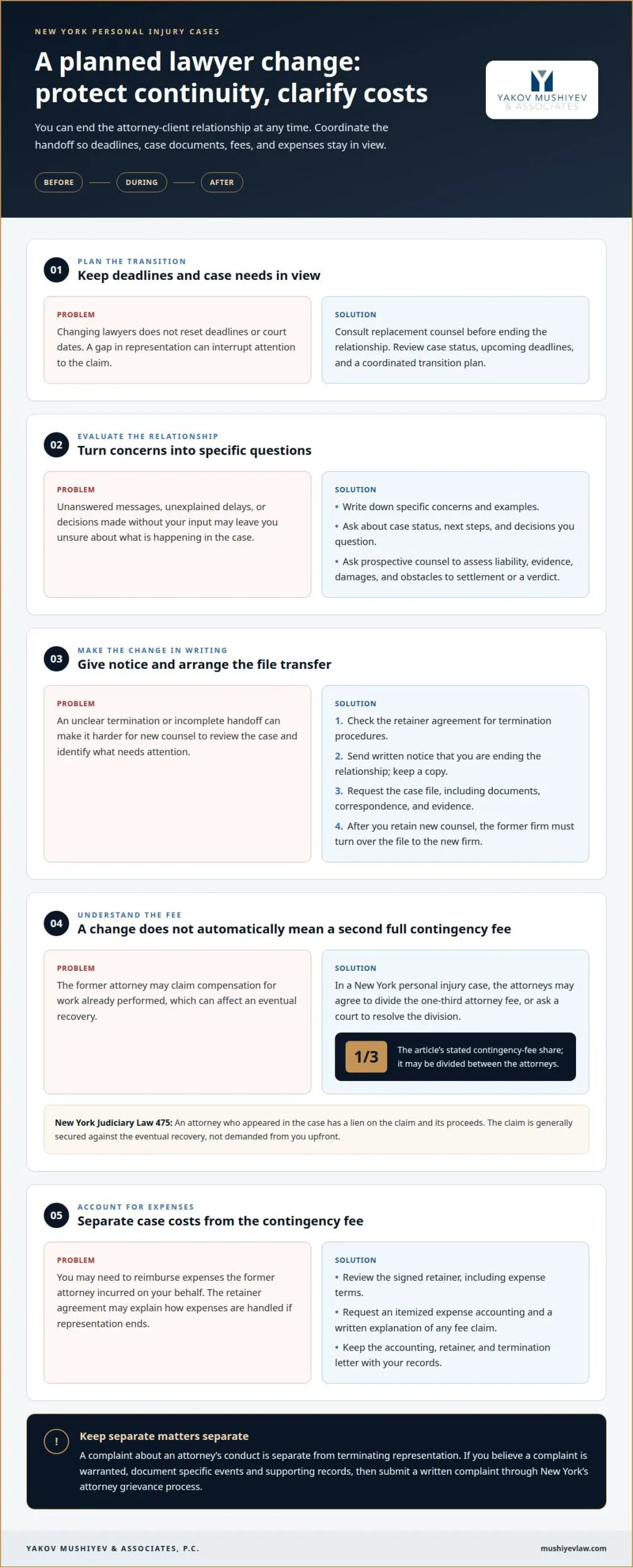
- Line up replacement counsel before ending the relationship. Consult a new attorney about the case status, upcoming deadlines, and transition plan. Changing lawyers doesn’t reset deadlines or court dates. A coordinated handoff can reduce avoidable interruptions in handling your claim and keep attention on its outcome.
- Send written notice and request your file. Review your retainer agreement for any termination procedure, then write to your current attorney stating that you’re ending the relationship. Request that the attorney forward the case file, including important documents, correspondence, and evidence, to you or your new lawyer. Keep a copy of the notice. After you retain new counsel, the former law firm must turn over the file to the new firm. If the attorney resists, document your requests and ask replacement counsel to address the transfer in writing.
- Clarify how the contingency fee will be divided. Changing attorneys doesn’t automatically mean paying a second contingency fee to replacement counsel. In a New York personal injury case, the attorneys may agree to divide the one-third attorney fee, or ask a court to resolve the division. The former attorney may claim a fee based on the value of the work performed. Under Judiciary Law 475, an attorney who appeared in the case has a lien on the claim and its proceeds. That claim is generally secured against the eventual recovery, not demanded from you up front. The effect of changing lawyers on any eventual settlement can depend on the circumstances of the case.
- Ask for an expense accounting and keep records. You may need to reimburse expenses the former attorney incurred on your behalf. Request an itemized accounting and retain it with your retainer agreement and termination letter. If you believe the lawyer’s conduct warrants a complaint, document specific events and supporting records, then submit a written complaint through New York’s attorney grievance process. A complaint is separate from terminating representation.
Evaluating concerns and consulting replacement counsel
Before ending the relationship, identify what isn’t working and discuss your injury case with prospective replacement counsel. A planned review can help you make a considered decision while keeping deadlines and case needs in view.
- Write down your concerns and raise them directly. Note specific examples, such as unanswered messages, unexplained delays, or decisions made without your input. Ask your attorney to explain the case status, next steps, and any action you question. Knowing which problems remain unresolved is a practical first step in deciding how to fire your personal injury lawyer in New York.
-
Choose Replacement Counsel
Look for an injury attorney who handles your type of accident and can explain the issues in your claim. During a consultation, ask how the attorney would assess liability, evidence, damages, and obstacles to settlement or a verdict. Discuss communication expectations and who will handle your case. Don’t choose based only on promises; look for an approach tied to the facts of your case.
-
Hire Replacement Counsel
Before terminating your current attorney, discuss your case with prospective replacement counsel and ask what is needed to begin representation. Review the proposed retainer, including the contingency-fee arrangement, responsibility for expenses, and transition plan. Clarify what the consultation covers and the terms of hiring counsel before making a decision.
- Prepare for a focused case review. Gather your retainer agreement, recent correspondence, accident information, and available documents. Explain your concerns, what you’ve asked your current attorney, and the responses you received. Ask which tasks need attention soon and how the transition can keep the case moving. Before deciding how to fire your personal injury lawyer in New York, give prospective counsel enough context to assess your situation, rather than relying on general assurances.
Potential fees owed to the first lawyer
- Review the fee and expense terms in your agreement. Separate the contingency fee from expenses advanced for your personal injury case. The agreement may explain how expenses are handled if representation ends. For example, look for terms addressing investigation costs or obtaining records. Keep the signed agreement available when discussing the transition with replacement counsel. Understanding how to fire your personal injury lawyer in New York includes knowing which financial terms apply after you end the relationship.
- Request a written explanation of any fee claim. A former attorney may claim compensation from a later recovery for services performed before termination. Ask the firm to describe the work supporting its claim, such as investigating the accident, gathering evidence, or communicating with insurers. This gives replacement counsel concrete information to review. A claimed fee isn’t automatically the same as charging you a second full contingency fee.
- Clarify how a contingency fee may be divided. Payment in a personal injury case is generally tied to a recovery. The former and replacement attorneys may agree how to divide the one-third attorney fee, or ask a court to resolve the division. Under New York Judiciary Law 475, an attorney who appeared in the case has a lien on the claim and its proceeds. The lien is secured against the eventual recovery, rather than demanded upfront.
- Get an itemized expense accounting. Ask the former firm to identify expenses it incurred on your behalf and explain any reimbursement requested. Compare each item with your agreement and case records. If the firm lists a records expense, for example, request its supporting documentation. Keep the accounting and related correspondence together so replacement counsel can distinguish expenses from attorney compensation.
- Address any dispute before recovery is distributed. Tell replacement counsel if the former attorney disputes the fee division or expense total. The attorneys may resolve the issue by agreement, or a court may address the division. A practical plan for how to fire your personal injury lawyer in New York should account for these claims without treating an initial demand as a final calculation of your share.
Reasons to consider replacing a lawyer
- Track communication problems with specific examples. Record when you contacted your attorney, what you asked, and whether you received a useful response. One missed call may be a misunderstanding; a repeated pattern that leaves you unable to make informed choices is more serious. Bring your notes to a direct conversation and ask for a clear update on your injury claim.
- Ask for an explanation of the case strategy. Your advocate should be able to explain the evidence, disputed issues, and next steps in plain language. For example, ask how witness accounts, medical records, or accident documentation affect the claim. If explanations remain vague after you raise the concern, write down what remains unanswered before deciding whether the relationship can continue.
- Examine pressure to accept a settlement. Ask the attorney to explain how a proposed settlement addresses your documented losses and the risks of continuing. A recommendation should include reasons, not pressure or a demand for an immediate decision. If you don’t understand the proposal, request time to review it and a written explanation of its effect on your injury claim.
- Address errors or unexplained delays promptly. Note any missing records, conflicting information, or case tasks that appear stalled. Ask who is handling each issue and what action is planned. If a deadline or court date is approaching, raise it directly and request a status update. Persistent uncertainty about case progress can justify consulting replacement counsel before ending representation.
- Decide whether the relationship supports your goals. Compare the answers you receive with the concerns you recorded. A difference of opinion alone may not require a change, but unresolved communication or strategy problems can undermine trust. If you need another perspective on your accident claim, discuss your injury case with an attorney before taking the next step.
Yakov Mushiyev & Associates, P.C
Yakov Mushiyev & Associates, P.C. represents people injured in car, truck, and motorcycle accidents, as well as slip and fall incidents. If communication or case handling has broken down and you’re considering a change, the firm can represent you in these accident-related claims. Bring your questions about your current representation and the transition to discuss your situation and possible next steps. Contact Yakov Mushiyev & Associates, P.C. to discuss your injury case.
Choose Your Next Step With Confidence
Deciding how to fire your personal injury lawyer in New York means more than ending representation. It’s also a chance to clarify what you need from a lawyer and whether replacement counsel can address those needs. Before acting, consider your priorities and how a change can be made without losing sight of your claim.
Yakov Mushiyev & Associates, P.C represents people in car accident, truck accident, and slip and fall cases. If one of these injuries is part of your situation and you’re weighing a change, the firm can discuss your case and the transition ahead. You deserve clear information before making a decision about your claim.
Contact Yakov Mushiyev & Associates, P.C to discuss your situation and consider your next step. You can move forward with care and purpose.
Frequently Asked Questions
Do I Have To Pay My Attorney if I Fired Them?
Firing your attorney does not necessarily require an immediate fee payment. In a contingency-fee injury case, payment is generally tied to a recovery, while the former attorney may later claim compensation for work performed. Case expenses may be handled separately under your retainer agreement. Review its terms and ask questions about any proposed charges. This general information isn’t legal advice for your specific case.
Will You Owe Your First Lawyer Money?
Depending on your agreement and the expenses incurred, you may owe reimbursement for case costs paid on your behalf. A former attorney may also claim a fee from a future recovery for services provided. Request an itemized expense accounting and a written explanation of any fee claim. This general information isn’t legal advice for your specific case.
Can I fire my personal injury lawyer at any time in New York?
Yes, you may end the attorney-client relationship at any time. But ending it doesn’t stop a deadline from running. For example, a no-fault application after a motor vehicle accident has a 30-day window, and a notice of claim against a public entity is generally due within 90 days. Changing lawyers doesn’t restart either period. This general information isn’t legal advice for your specific case.
Will I owe attorney fees or expenses if I fire my personal injury lawyer in New York?
Your former attorney may seek a fee from a later recovery for work already completed, and you may owe case expenses. Check your retainer agreement for how expenses are handled when representation ends. Request an accounting that separates expenses from attorney compensation, then share it with replacement counsel. This general information isn’t legal advice for your specific case.
How are attorney liens and contingency fees handled when changing personal injury lawyers in New York?
Under New York Judiciary Law 475, an attorney who appeared in your case has a lien on your cause of action and its proceeds. The former attorney’s lien is secured against the eventual recovery, rather than demanded upfront. Attorneys may agree how to divide the one-third fee, or a court may resolve the division. This general information isn’t legal advice for your specific case.
How do I hire a new personal injury lawyer and transfer my case in New York?
First, discuss your case with prospective replacement counsel before ending the current relationship. Review the new retainer and ask how the transition, existing deadlines, and file transfer will be handled. Once you retain new counsel, give your former attorney written notice and request that the file be sent to the new firm. This general information isn’t legal advice for your specific case.