
What if I was injured by a defective product on a construction site, but the equipment failure is being treated as just another workplace accident? A broken tool, malfunctioning lift, or faulty safety device can raise a separate question: whether the product itself contributed to your injuries, apart from unsafe site conditions. Sometimes both played a role.
It’s understandable to feel uncertain about where one cause ends and another begins, especially if your employer or an insurer is guiding the process. Start with your health, then focus on preserving details about the equipment and incident. This article explains who may be responsible and how a product liability claim may relate to a construction accident or workers’ compensation claim.
The answer may depend on how the equipment failed and who designed, made, sold, supplied, or maintained it. A New York attorney can investigate those questions and assess how potential claims fit together. The sections ahead explain how to preserve the product, photos, and records, and what details may help clarify what happened.
Key Takeaways
- If you’re asking, “what if I was injured by a defective product on a construction site,” start by getting medical care and following your provider’s instructions.
- A suspected defect may involve product design, manufacturing, or warnings. The cause needs to be investigated rather than assumed.
- Responsibility may depend on both the product’s path to the site and what happened with site conditions, maintenance, or work practices.
- Workers’ compensation, a possible product claim, and site-safety issues raise different questions. More than one route may warrant assessment, depending on the facts.
- Preserve available evidence safely and document what happened. A New York construction injury lawyer can assess records, the product, and potentially responsible parties.
Injured by a Defective Product on a Construction Site? Start With What Failed
A job-site injury involving failed equipment deserves careful investigation. If you’re asking, “what if I was injured by a defective product on a construction site,” a tool breaking or malfunctioning doesn’t, by itself, prove a product defect or establish who is legally responsible. The details matter: what the item was supposed to do, how it failed, its condition before the incident, and what was happening around it.
A tool, ladder, power equipment, or safety device may be part of the investigation. Failure alone does not automatically make an item defective. The question is whether evidence points to a problem with its design, manufacture, or warnings, and whether that problem contributed to the injury. A separate issue is whether job-site conditions or work practices also played a role. For example, an equipment failure and the way the work area was set up may both need investigation.
This video offers a general overview of what to do after a product-related injury:
What counts as a possible construction product defect?
Investigators may examine several kinds of alleged defects. A design defect concerns the product’s design itself. A manufacturing defect may arise when a particular item differs from its intended design because something went wrong during production. A warning or instruction issue may involve information users needed to understand a hazard or use the product safely. These are possible lines of inquiry, not conclusions about any particular tool or injury. Product liability laws cover legal concepts associated with allegedly defective products, but how those concepts apply depends on the facts and governing law.
The product and failure mechanism need close examination. Did a component fracture? Did a guard fail to protect the user? Did the equipment behave unexpectedly during ordinary use? Records, photographs, product labels, maintenance history, and the item itself may help answer those questions. If it is safe to do so, note the product’s identifying information and photograph the item and surrounding area without moving or altering anything. Don’t repair, discard, or alter equipment that may be relevant if it can be left safely undisturbed. An accident alone cannot show whether the cause was a defect, wear, misuse, damage, or another factor.
How is product failure different from an unsafe job-site condition?
A product investigation asks whether the equipment itself may have been defective. A site-safety investigation looks at different circumstances, such as where equipment was placed, whether the work area was properly set up, or how the task was supervised. The same event may raise both questions. A ladder could fail because of an issue with the product, while its placement or the surrounding work conditions may also warrant examination.
Separating these possibilities can help clarify who may have contributed to the injury without assuming responsibility in advance. The broader process for evaluating a workplace injury may also involve questions beyond the product itself. For context, learn about New York construction accident rights and how an injury claim may be assessed.
Who May Be Responsible for a Defective Construction-Site Product?
Responsibility isn’t automatic just because equipment failed and someone was hurt. The investigation must trace the product’s history and examine the circumstances of the incident. A manufacturer, seller, or distributor may warrant scrutiny depending on what they did and how the product allegedly caused harm. At the same time, site-level decisions about selecting, maintaining, or using equipment may raise separate questions.
A product defect claim asks how the product failed and who, if anyone, may be legally responsible for that failure. That inquiry is distinct from deciding who controlled the work area or directed the task. The facts may point to one issue, the other, or more than one contributing factor. A careful investigation avoids naming parties before the evidence supports it.
When might a manufacturer, seller, or distributor enter the investigation?
The product’s path from design to job site can reveal different leads. Investigators may examine whether the alleged problem concerns the original design, a manufacturing error affecting a particular item, or warnings and instructions. Records can also help identify who sold or distributed the equipment and what role each party played. A seller or distributor isn’t automatically responsible simply because the product passed through its hands.
Identification matters. A model number, serial number, label, purchase record, or equipment log may help connect the item to a maker or seller. The item’s condition and the precise way it failed can also guide further review. Depending on the evidence, technical or expert analysis may help determine whether the failure is consistent with a product issue, damage after sale, or another cause. The conclusion depends on the facts and applicable New York law.
How can site conditions or maintenance also matter?
Equipment doesn’t operate in isolation. The investigation may ask who selected or supplied it, who inspected or repaired it, and whether it was used as intended. A power tool that stops working, for example, could involve an alleged product flaw, damage from earlier use, an improper repair, or another circumstance. Those possibilities need evidence. A malfunction alone does not resolve them.
Site setup and work practices can matter too. The location of equipment, the condition of the work area, or how a task was organized may have contributed to an incident even if a product issue is also under review. Construction injury prevention is a focus of the CDC’s National Institute for Occupational Safety and Health, which provides construction safety information and research. That broader context reinforces why an investigation should look beyond a single explanation.
If you’re wondering, “what if I was injured by a defective product on a construction site,” tracing the equipment’s history alongside site decisions can help clarify which parties may need to be examined. Yakov Mushiyev & Associates, P.C. represents people injured in construction accidents in Rosedale, Rochdale, Queens, and surrounding communities. An assessment of a construction injury claim can help identify questions to investigate. Responsibility and available claims depend on the specific facts.
Product Liability, Workers’ Compensation, or Both? Compare the Possible Routes
A workplace injury may raise more than one legal question. Workers’ compensation generally addresses benefits connected to an on-the-job injury, while a possible product claim asks whether a defective product caused or contributed to the harm and whether another party may be legally responsible. Site-safety concerns focus on how the work area or task was managed. One route doesn’t automatically resolve the others.
| Possible route | Central question | What it generally addresses |
|---|---|---|
| Workers’ compensation | Did the injury arise in the course of work? | Workplace injury benefits, subject to applicable rules and the facts. |
| Possible product claim | Did a product defect contribute to the injury, and is another party legally responsible? | A potential claim involving a product’s design, manufacture, warnings, or other legally relevant issues. |
| Possible site-safety claim | Did a hazard involving the work area, equipment setup, or work practices contribute? | Potential responsibility related to site conditions or how the work was organized. |
Available claims depend on the injury facts, potentially responsible parties, and applicable New York law. The table is a starting point, not a determination that a particular claim applies. Evidence may support one route, more than one, or none beyond an applicable benefits claim.
What does a workers’ compensation claim address?
New York workers’ compensation is broadly a benefits system for employees injured in connection with work. An injured worker generally does not need to prove that a product was defective to seek applicable workers’ compensation benefits. The benefits process and a product-liability investigation ask different questions. Whether benefits apply, and what they may cover, depends on the circumstances and governing rules.
That distinction matters if an employer or insurer focuses only on the workplace injury process. A workers’ compensation claim does not, by itself, determine whether a manufacturer, seller, or another third party may have responsibility for a product-related injury. Nor does the possibility of a separate claim guarantee that one is available.
When might a separate product or third-party claim be considered?
A separate claim may be considered if evidence supports both a product defect and a legal basis for holding a party outside the employer-employee benefits relationship responsible. The investigation must connect the alleged defect to the injury and evaluate each party’s role. It is separate from workers’ compensation, and its requirements and potential outcomes differ.
Site hazards can raise a different issue. A worker injured because of an unsafe walking surface, for instance, faces a premises-condition question rather than necessarily a product-failure question. Those issues can sometimes overlap, but they shouldn’t be treated as interchangeable. Guidance on Queens slip-and-fall claims addresses premises hazards, while a defective-equipment investigation examines the product and its failure. Reviewing the routes together can help clarify which questions the evidence must answer.
What to Do After a Construction-Site Product Injury
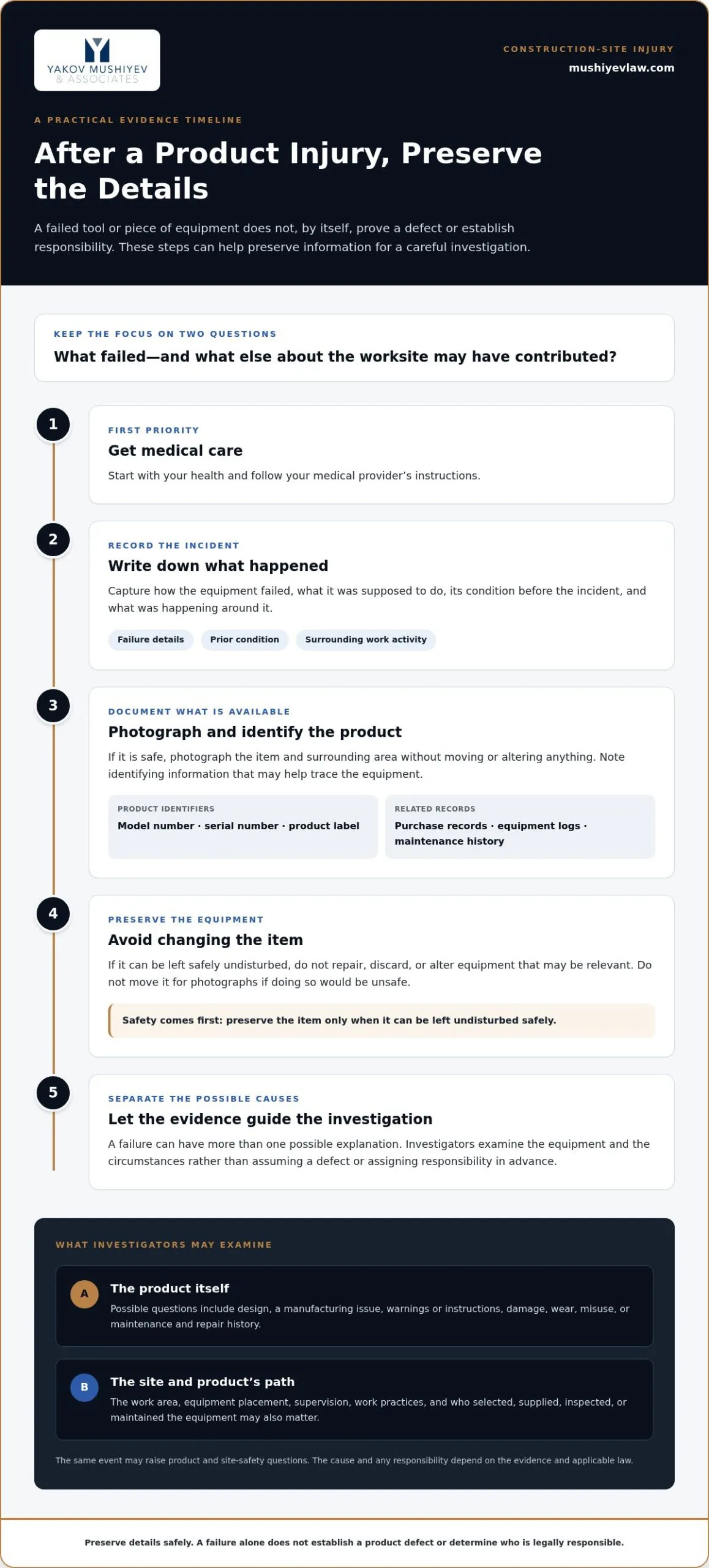
Your health comes first. If you’re seriously hurt, seek emergency care. Follow medical instructions before trying to examine equipment or gather information. If you’re asking, “what if I was injured by a defective product on a construction site,” focus on safe, factual steps that protect your well-being and help preserve what may later matter.
Once you’re able, take these steps in order where circumstances allow:
- Report the incident. Notify the appropriate supervisor or employer promptly, following workplace reporting procedures. Describe what happened as accurately as you can, including the equipment involved and any known witnesses.
- Record identifying details. If you can do so safely, note the product name, model, serial number, manufacturer, and any visible damage or unusual condition. Don’t put yourself at risk to inspect a tool or device.
- Preserve the item safely. Don’t repair, discard, or alter equipment that may be relevant if it can be left undisturbed lawfully and without compromising site safety. Don’t interfere with a hazard response, block access, or disobey workplace safety instructions.
- Save records and contact information. Keep copies of incident reports and relevant communications. Note witness names and contact details, and preserve any photographs or records you already have.
- Document your recovery. Keep medical records, treatment instructions, work restrictions, and documentation of related expenses together. Write down the incident timeline while details are fresh.
Which evidence may help explain how the product failed?
Photographs may document the equipment’s appearance, its location, and the surrounding area, but only take them if doing so is safe and permitted. Product labels, purchase records, equipment logs, and maintenance or repair records may help identify the item and its history. Witness accounts can also clarify what happened immediately before and after the failure. Don’t remove an item or access records you’re not authorized to handle.
What should you document about the injury and its aftermath?
Keep a clear timeline of the incident, symptoms, medical visits, and instructions you receive. Save relevant messages, notices, and other communications. Stick to what you observed when making a report; avoid guessing about the cause or publicly assigning blame. A careful, accurate record can help a legal review distinguish what’s known from what still needs investigation.
Evidence can be moved, repaired, or lost, while deadlines and preservation needs vary with the claim and circumstances. Prompt legal review can help identify what should be preserved and how the available records fit together. If you were injured in Queens or nearby, contact Yakov Mushiyev & Associates, P.C. about your construction injury. The firm handles construction injury claims and can assess potential product and workplace issues based on the facts.
How a New York Construction Injury Lawyer Can Assess a Product-Failure Claim
After an equipment-related injury, it can be difficult to know whether the issue involves a product defect, workplace conditions, or both. A New York construction injury lawyer can examine the available evidence, assess how the incident occurred, and identify parties whose roles may need closer review. For workers in Rosedale, Rochdale, and Queens, that assessment should consider how any potential product claim relates to the workplace injury process.
What questions help assess the circumstances?
The review starts with practical questions, not assumptions. What product was involved? How was it being used, and what happened immediately before the injury? Did the item appear damaged, altered, or recently repaired? Who owned, supplied, selected, inspected, or maintained it? Who controlled the work area or directed the task?
Counsel can compare your account with available product information, incident records, photographs, witness statements, and medical documentation. The goal is to understand what the evidence supports, what remains uncertain, and which parties may warrant further investigation. Depending on the circumstances, a qualified expert may be asked to examine the product or assess the failure mechanism. Expert review can be a useful investigative step, but whether it is appropriate depends on the specific case.
If you’re asking, “what if I was injured by a defective product on a construction site,” the answer depends on more than the fact that equipment failed. An assessment considers the connection between the alleged failure and your injury, the roles of potential parties, and the evidence available. It also takes applicable New York law into account.
What happens after you speak with the firm?
Yakov Mushiyev & Associates, P.C. represents people injured in construction accidents and can review the incident facts and discuss potential legal options with you. That may include examining how a possible product-related claim interacts with a workplace injury claim, and whether additional records or investigation may help clarify responsibility. The next steps and case strategy depend on the individual circumstances, not a one-size-fits-all checklist.
Deadlines and legal requirements can vary based on the type of claim and the facts. A prompt, case-specific review can help identify issues that shouldn’t be overlooked, including the condition of the product, available records, and any applicable time limits. No assessment can promise a particular result or establish eligibility without considering the evidence and law.
If you were injured on a Queens job site, you don’t have to sort through these questions alone. Request a case assessment to discuss what happened with a New York construction injury firm. The firm can review your circumstances and explain potential options based on the facts.
Take the Next Step Toward Clarity
After an unexpected job-site injury, it’s reasonable to wonder, “what if I was injured by a defective product on a construction site?” You don’t have to decide on your own whether the product, the worksite, or both contributed. A focused legal review can help you understand what questions to pursue and what options may fit your circumstances.
Yakov Mushiyev & Associates, P.C. represents people injured in construction accidents in Rosedale, Rochdale, and Queens. The firm can assess the available facts and explain potential next steps. No outcome or eligibility can be promised, but informed guidance can help you understand the issues to consider.
Request a case assessment with Yakov Mushiyev & Associates, P.C. to discuss your construction injury and understand your potential options.
Frequently Asked Questions
Can I sue a manufacturer if a tool breaks and injures me at work?
You may have a claim if evidence shows a product defect contributed to your injury and the manufacturer may be legally responsible. A tool breaking alone doesn’t establish either point. Investigators may examine whether the product was used as intended, whether it had been changed or repaired, and whether the alleged problem existed before it reached the job site. The specific facts and applicable New York law determine whether a claim may proceed.
Can I file a product liability claim and a workers’ compensation claim in New York?
Potentially, yes. Workers’ compensation and a product claim involve different legal questions: one concerns benefits for a work-related injury, while the other may examine whether a third party is responsible for a defective product. A product claim requires its own supporting evidence and legal basis. If both routes may apply, their interaction should be assessed together, including how the particular facts and applicable New York rules affect the claims.
Who may be responsible if defective construction equipment injures a worker?
Potentially responsible parties may include a product manufacturer or another business in the product’s distribution or sale, depending on its role and the evidence. A site owner, contractor, or party involved in equipment selection, repair, or worksite control may also warrant investigation if its actions contributed. These parties aren’t automatically liable. In a Queens or elsewhere-in-New-York incident, determining responsibility requires connecting each party’s conduct or product role to the injury.
What evidence should I preserve after a product injures me on a construction site?
Preserve original photographs and videos, not just cropped or edited copies, and keep any messages or notices about the incident in their original form. Write down what you remember separately from what others told you, so firsthand observations remain clear. If a witness is willing, record their preferred contact information. Don’t access private company records or put yourself at risk to gather evidence. Medical paperwork can also help document the injury’s progression.
Does a product have to be recalled before I can bring an injury claim?
No, a recall isn’t necessarily required to investigate or pursue a product injury claim. A recall may provide relevant context, but its absence doesn’t by itself establish that a product was safe or that no defect existed. The claim’s assessment focuses on the product, the alleged failure, the injury, and applicable legal requirements. Preserve any recall notice or safety communication you find, but don’t treat it as a decision about your individual claim.
How long do I have to file a defective product injury claim in New York?
Generally, New York allows three years from the injury date to file a product liability lawsuit. For latent harm that wasn’t discovered immediately, the deadline may run from when the injury was, or reasonably should have been, discovered. The rule can depend on the claim and circumstances, so don’t rely on a general timeframe to calculate your own deadline. Prompt legal review can help identify which deadline applies to your situation.
What if my employer says the equipment failed because I used it incorrectly?
An employer’s statement doesn’t by itself resolve why the equipment failed or determine whether a product claim is available. The investigation can compare the account with the product’s instructions, training materials, equipment condition, repair history, and witness observations. Be accurate in any incident report, and don’t guess about a cause you didn’t observe. If you’re unsure what happened, say so. A case-specific review can assess how product use and other possible causes affect the claim.