
Start with the floor, not the fall. In the seconds after a shopper goes down in a supermarket aisle, the evidence that decides the case is lying right there: the color and spread of the liquid, the grape skins ground into the tile, the cart tracks running through a puddle, the dry edges that show how long it sat. A grocery store slip and fall lawyer works the scene the way a claims investigator would, from the moment of impact backward, asking one question above all others: how long was that hazard on the floor before you stepped on it?

This guide walks through that reconstruction. It covers the places in a Queens, Brooklyn or Nassau food store where falls tend to happen, the legal rules New York courts generally apply to them, and the records that can prove or sink a claim. It applies to large supermarkets, corner bodegas, specialty markets and big-box stores with full grocery sections alike.
What the Floor Will Tell You
Every spill has a clock attached to it. The goal of an investigation is to read that clock as accurately as possible, because New York premises law cares a great deal about time.
Physical clues often say more than anyone’s memory:
- Footprints and cart tracks. Prints or wheel lines through a liquid suggest other people passed through it before you did. That tends to mean it was there for a while.
- Drying edges. A puddle with a tacky ring or a dried outer border was probably not spilled seconds earlier.
- Dirt mixed into the substance. Crushed produce that is gray, flattened and tracked across several tiles has usually been walked on repeatedly.
- The source. A leaking freezer case, a dripping misting nozzle or a cracked jar on a shelf points to where the hazard came from and whether staff should have seen it.
- What is missing. No cone, no “wet floor” sign, no mop bucket nearby. Absence of a warning is evidence too.
If you are able to, photograph all of this before anyone cleans it. Shoot from floor level, standing height and the end of the aisle.
The Legal Question: Who Knew, and When
A fall in a store is not automatically the store’s fault. Under New York law, the injured shopper generally must show one of three things: the store created the dangerous condition, the store had actual notice of it, or the store had constructive notice of it.
Creation is the simplest. If an employee mopped the aisle and put out no sign, or a stocker dropped a case of olive oil and walked away, the store made the hazard itself and notice is usually not the fight.
Actual notice means someone at the store knew. A customer told a cashier about broken glass in aisle six, or a manager radioed for a cleanup that never came.
Constructive notice is where the clock matters most. The leading case, Gordon v. American Museum of Natural History, sets the test: the hazard had to be visible and apparent, and it had to sit there long enough before the fall for staff to find it and fix it. A clear puddle in a dim corner for ninety seconds may not qualify. A smeared trail of yogurt in a main aisle for forty minutes may well.
Two refinements shape many supermarket cases:
- Recurring conditions. When a store knows a specific hazard keeps coming back in the same spot, such as a freezer case that has leaked for weeks, that history can matter to notice.
- General awareness is often not enough. Courts have generally held that a store’s broad knowledge that spills happen in grocery stores does not, by itself, amount to constructive notice of the particular spill that caused your fall.
Our article on how notice works in Queens slip and fall cases goes deeper into these doctrines across different kinds of property.
An Aisle-by-Aisle Hazard Map
Food stores have a geography of risk. A grocery store slip and fall lawyer learns to look first where the store’s own operations put water, ice, oil and debris on the floor.
- Entrance and vestibule. On rainy or snowy days, shoppers carry water in on their shoes and umbrellas. Mats that are saturated, curled at the corners or too short to cover the wet zone are a frequent factor.
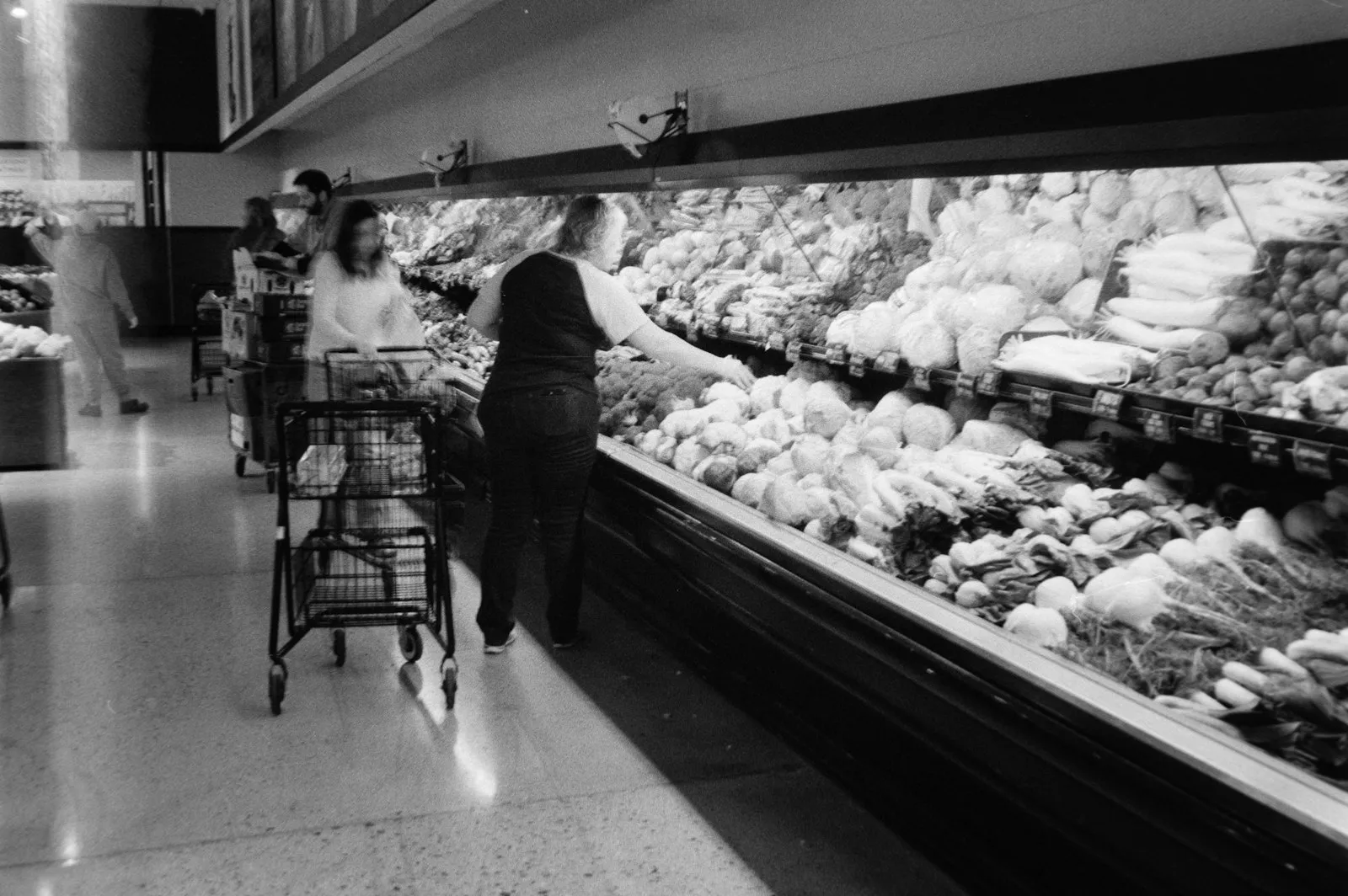
- Produce section. Grapes, cherries, lettuce leaves, green bean ends and onion skins fall from displays constantly. Overhead misting systems can leave the floor beneath them slick, especially near the edges of the cases.
- Freezer aisle. Condensation forms on glass doors and runs down. Defrost cycles and failing seals can leave pools at the base of cases, and ice can drop from frozen goods as they are pulled out.
- Dairy and meat cases. Leaking milk containers, punctured packages and drip trays that overflow.
- Center aisles. Broken jars of sauce or pickles, burst soda bottles, spilled detergent and cooking oil.
- Deli and prepared foods. Grease, dropped food and water from cleaning behind the counter that migrates onto the sales floor.
- Checkout lanes. Items that roll off belts, spilled drinks and loose bags.
- Floor-cleaning zones. Areas freshly mopped or run over by a scrubber without cones, often during business hours.
- Parking lot and sidewalk. Abandoned carts, potholes, broken curbs and ice. If a car was involved, our page on parking lot crashes in Queens covers that side.
A Sample Timeline: Reconstructing One Fall
The following is a hypothetical, built to show how evidence lines up against the clock. It is not a real case.
| Time | Event | Where the proof comes from |
|---|---|---|
| 2:05 p.m. | Employee completes a floor walk of the produce area and initials the sweep log. | Inspection or sweep log |
| 2:20 p.m. | A bag of grapes splits near the end cap; a shopper rolls a cart through the spill. | Ceiling camera footage |
| 2:35 p.m. | Another customer mentions the mess to a stock clerk. | Witness statement; employee testimony |
| 2:52 p.m. | Claimant steps on flattened grapes and falls. | Footage; incident report; photos |
| 2:55 p.m. | Porter arrives with a mop and bucket. | Footage; employee schedule |
| 3:10 p.m. | Manager writes the incident report. | Incident report |
In this scenario, the grapes sat for about thirty-two minutes, a customer flagged them, and the next scheduled walk had not happened. Those three facts point toward both actual and constructive notice. Change the timeline so the spill appears two minutes before the fall with no warning to anyone, and the analysis can shift sharply against the shopper.
Records That Decide These Cases
Much of the evidence in a supermarket fall belongs to the store. That is why speed matters on the legal side as well as the medical side.
Inspection and sweep logs
Many stores keep sheets or electronic records of floor walks. They can show when the area was last checked, or reveal that no checks were done at all. A log that says “all clear” ten minutes before a fall through a dried, tracked puddle raises its own questions.
Surveillance video
Ceiling cameras often catch the spill being created and the traffic that followed. Systems frequently record over themselves after a set period. Our write-up on pulling store camera video covers preservation letters and why that demand belongs in the first days.
Incident reports
Ask the manager to write one and ask for a copy. Stores do not always hand it over, but the request itself is worth noting with the time and the manager’s name.
Employee schedules and cleaning procedures
Who was assigned to the area, what the store’s written policy required, and whether that policy was followed. The federal OSHA walking-working surfaces standards are aimed at workers, but stores’ own housekeeping procedures often borrow from the same principles of keeping floors clean and dry.
Your Evidence Checklist
The store has a head start. These are the items a shopper can gather before the trail goes cold:
- Photos of the substance itself, close and wide, including any footprints, cart tracks or drying edges.
- Photos of the shoes you were wearing, soles included, and keep the shoes as they are.
- Your receipt, or a card statement showing the time of purchase, which places you in the store.
- Names and phone numbers of any witnesses, including other shoppers.
- The names of employees you spoke with, and the manager on duty.
- Whether a “wet floor” sign or cone was present, and where it stood relative to the spill.
- A note of the aisle number, nearby displays and lighting.
Then see a doctor, even if the pain seems manageable. Falls on hard store flooring commonly produce wrist and hip fractures, knee damage and head injuries, and some symptoms build over days. Our posts on hip fracture and replacement claims and ankle sprains and fractures describe how those injuries are documented. Older shoppers face particular risk; the CDC’s older adult fall data shows how serious these injuries can become.
When Employees Create the Hazard
Some of the strongest supermarket claims involve staff activity rather than a customer’s spill. Stocking carts left in aisles, pallets with shrink-wrap trailing on the floor, a stocker’s box cutter slicing open a leaking case, or a porter mopping during peak hours without cones. When the store’s own people made the condition, the notice question usually fades and the focus moves to whether reasonable care was taken.
Merchandise is another category. Cans toppling from an overstacked end cap or a case of water sliding off a top shelf can strike a shopper without any fall at all. Our article on falling merchandise in stores covers those claims, and in some situations courts may allow an inference of negligence where an object ordinarily would not fall without carelessness and was under the store’s exclusive control.
A grocery store slip and fall lawyer will also ask whether the store hired an outside cleaning or maintenance contractor, since that company may share responsibility. Food service settings raise similar issues, and our post on restaurant slip and fall claims looks at grease and kitchen spills specifically.

Fault, Thresholds and Filing Windows
Store defense lawyers nearly always say the shopper should have looked down. Under the pure comparative rule in CPLR § 1411, a jury that finds you partly careless, say for reading a shopping list on your phone, trims your award by your percentage rather than wiping it out. Someone held 25 percent responsible keeps 75 percent of the damages. Our comparative negligence explainer has more.
Unlike car crash claims, a premises case in a store carries no “serious injury” threshold. The no-fault rules and the Insurance Law categories that limit pain and suffering after a motor vehicle accident do not apply to a fall over spilled detergent.
Filing runs on its own clock. Against a privately owned market, a shopper generally has three years after the fall to file suit (CPLR § 214). A fall on a city sidewalk or other government property changes the math: the claimant generally gets only 90 days to serve a notice of claim under GML § 50-e.
Bringing the Investigation to a Lawyer
Shoppers hurt in food stores anywhere in the five boroughs or Nassau County can bring their timeline to Yakov Mushiyev & Associates, whose Rosedale office at 1 Cross Island Plaza sits beside the Cross Island Parkway. Staff speak Russian and Spanish as well as English, and meetings can take place in your living room, beside a hospital bed or by video. The first conversation costs nothing, a fee is owed only after a recovery, and the firm’s results for its clients total more than $80 million.
The firm’s slip and fall practice and broader premises liability work begin with the same step this guide describes: lock down the store’s records and rebuild the timeline. Use the firm’s contact form or phone 718.775.3110 to begin.
Grocery Store Fall Questions
Does a grocery store have to pay if I slipped on a spill?
Not automatically. You generally must show the store created the spill, knew about it, or should have found it because it was visible and present long enough. Evidence about timing usually decides that.
What if the store says the spill happened seconds before I fell?
That is a common defense. Footage, footprints or cart tracks through the substance, drying edges and witness accounts can contradict it. A grocery store slip and fall lawyer will often request the video right away to test that claim.
Can I bring a claim if I fell in the freezer aisle from condensation?
Possibly. Water pooling near a freezer case that leaks repeatedly may point to a recurring condition the store knew about. Maintenance records and prior complaints about that case become important.
Should I give a recorded statement to the store’s insurer?
It is usually wise to speak with a lawyer first. Insurers may use casual comments, such as admitting you did not look down, to argue comparative fault.
How long do I have to sue a supermarket in New York?
Generally three years from the fall for a privately owned store. Falls on public property can require a notice of claim in about 90 days, so the location matters.
Visit Yakov Mushiyev & Associates
Our office is at 1 Cross Island Plaza, Suite 325, Rosedale, NY 11422, just off the Cross Island Parkway on the Queens–Nassau border. If you can’t come to us, we’ll come to you: at home, in the hospital or by video.

Talk to a Queens grocery store slip and fall lawyer today
Yakov Mushiyev & Associates has recovered over $80 million for injured New Yorkers across the five boroughs and Nassau County. Consultations are free, available in English, Russian and Spanish, and there is no fee unless we win.
Call 718.775.3110 or contact us online for a free case review.
This article is general information, not legal advice. Every case is different. Attorney Advertising.