
The key difference in mediation versus arbitration for your case is who decides the outcome. In mediation, a neutral mediator helps the parties work toward an agreement, but they must accept it voluntarily. In arbitration, the parties present their evidence and arguments to an arbitrator, who decides the dispute. Whether that decision is binding depends on the arbitration agreement.
It’s understandable to want to resolve a dispute without the uncertainty and strain of a courtroom fight. But mediation and arbitration aren’t interchangeable: mediation leaves the decision with the parties, while arbitration gives that role to an arbitrator.
This guide explains how arbitration works, how it compares with mediation, and what to consider when choosing a path for your dispute. Control over the outcome, formality, privacy, and the terms of an agreement can all shape that decision.
Key Takeaways
- Choose mediation when you want to keep control of the outcome and believe an agreement may be possible.
- Before arbitration, understand whether the arbitrator’s decision will be binding and what that means for your options.
- Consider how formality, privacy, timing, and the dispute’s terms may affect which process fits your situation.
- If your dispute involves an accident injury, legal representation can help you assess the resolution process and protect your interests.
What factors should parties consider when choosing between mediation and arbitration?
Compare who controls the outcome, whether participation is required, and how much structure the dispute needs. Mediation centers on reaching an agreement; arbitration gives an arbitrator authority to decide.
Matching the Process to the Dispute
Mediation may suit disputes where both parties are willing to negotiate toward an acceptable resolution. A mediator facilitates discussion but cannot impose a result, so each party retains control over whether to agree. It is generally less expensive than trial and may be completed sooner than litigation or arbitration. Arbitration may be an option when cooperation seems unlikely and the parties want a decision without a court trial.
Contract or Court-Ordered Participation
Review the contract and any court order before choosing a process. Arbitration is often required by contract or statute, though parties can agree to arbitrate after a conflict begins. Court rules may also require participation in mediation in some cases. Required participation does not mean accepting a proposed resolution: participants decide voluntarily whether to agree. The specific terms and applicable rules determine which process is required.
Choosing When to Arbitrate
Consider arbitration when the dispute needs a decision-maker and the parties want a process outside a court trial. Before selecting an arbitration company or administrator, review its procedural rules and how the arbitrator is chosen. Relevant expertise can matter: arbitrator qualifications and training standards differ by state or court, and some states require certification for certain case types.
| Option | Decision-maker | Participation | Consider when |
|---|---|---|---|
| Mediation | Parties decide | Agreement is voluntary | Negotiation may produce an acceptable resolution |
| Binding arbitration | Arbitrator decides | May be required by contract or statute | A decision outside a court trial is sought |
| Nonbinding arbitration | Arbitrator recommends or decides | Parties may request trial if they reject the decision | A nonfinal decision may help assess the dispute |
First check for any contract or court requirement, then consider who should control the outcome.
Mediation vs Arbitration: What’s the Actual Difference?
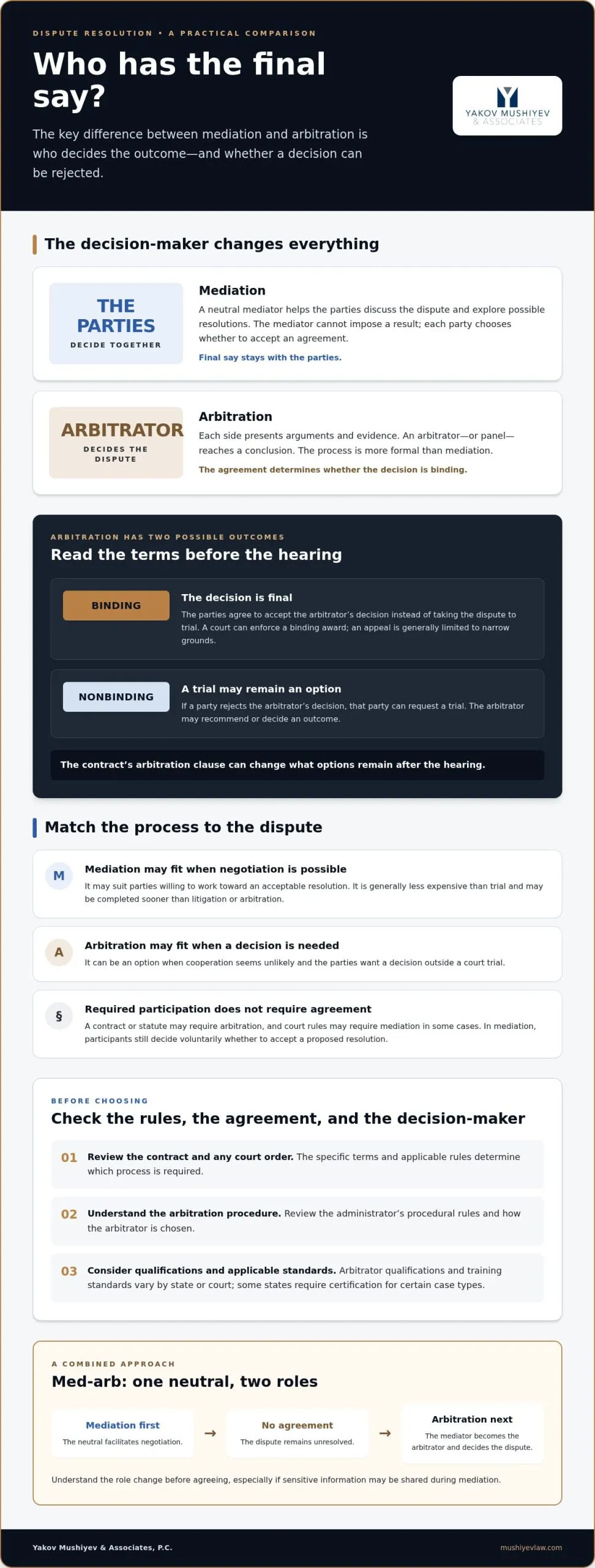
The central difference is who controls the final outcome. In mediation, the parties decide whether to accept an agreement. In arbitration, an arbitrator issues a decision.
Who Makes the Final Decision
In mediation, a neutral mediator helps the parties discuss the conflict and explore possible resolutions. The mediator cannot force an agreement, so either party can reject a proposal. Mediation may help preserve a relationship when both sides are willing to negotiate. An attorney can help assess proposals and explain their effect before a party agrees.
Arbitration shifts decision-making authority to an arbitrator or panel. Each side presents arguments and evidence, and the arbitrator reaches a conclusion. The process is more formal than mediation, where the neutral facilitates communication rather than deciding the dispute. The arbitration agreement determines whether the decision is binding or nonbinding.
Arbitration’s Formal, Binding Process
In binding arbitration, the parties agree to accept the arbitrator’s decision as final instead of taking the dispute to trial. The arbitrator considers both sides’ presentations and issues an award. A court can enforce a binding award, while an appeal is generally limited to narrow grounds. Unlike mediation, the parties don’t retain the final say after presenting their case.
In nonbinding arbitration, a party who rejects the arbitrator’s decision can request a trial. Read the contract’s arbitration terms closely, including whether the process is binding, before presenting evidence. This distinction can change your options after the hearing. A lawyer can review the clause and the dispute before you commit to a position.
For example, parties seeking a negotiated resolution may prefer mediation’s shared control. If they need a decision despite an unresolved conflict, arbitration provides a formal path to an award. The right choice depends on the agreement and the outcome each party seeks. For an injury-related dispute, legal guidance on your claim can help clarify the options.
Can the same person mediate and arbitrate the same dispute?
Yes. In med-arb, the parties try mediation first. If they don’t reach an agreement, the mediator becomes the arbitrator and decides the dispute. This alternative dispute resolution process shifts the neutral person’s role from facilitating negotiation to determining the outcome. Understand that change before agreeing, especially if the parties may share sensitive information during mediation.
Civil litigation takes place in court, while mediation and arbitration offer alternative ways to resolve disputes outside a trial. In mediation, the neutral helps the parties communicate; in arbitration, the arbitrator considers their presentations and decides. The process and available options depend on the dispute, governing agreement, and applicable rules. Because the arbitrator’s role is decisive, understand the process before choosing it.
Rules vary by state, court, and dispute type. Arbitrator qualifications, standards, and required training vary, and some states require certification for certain cases. Family law matters may also have their own procedures, including mediation or arbitration requirements. Identify the case type and applicable rules early, since they can determine which process is available and whether participation is required.
For a home inspection dispute, review the pre-inspection agreement before signing. Lawsuits have been dismissed when an inspector’s agreement included an arbitration clause. Contract terms can affect how a dispute may be resolved.
Mediation may suit family members, neighbors, business associates, or divorcing parents who want to preserve an ongoing relationship. Arbitration can resolve a conflict when negotiation fails, but the arbitrator controls the decision. Consider whether continued contact matters, whether the parties can negotiate, and whether they accept an arbitrator deciding the dispute. These factors help distinguish a collaborative process from a decision made by a neutral.
How arbitration and mediation differ
Alternative dispute resolution (ADR) can resolve a conflict outside a courtroom, but each method structures participation differently. The U.S. Bureau of Labor Statistics describes both processes as involving a neutral third party. That person oversees the process and helps participants find common ground. The shared neutral role can obscure the key distinction: one facilitates discussion, while the other evaluates a case.
In mediation, a neutral third party helps participants identify obstacles, communicate, and explore solutions. The American Bar Association describes mediators as impartial intermediaries who facilitate that work. Participation is voluntary, and any agreement depends on the parties’ acceptance. In arbitration, by contrast, the neutral weighs evidence and arguments before deciding. The parties’ control over the result therefore differs substantially.
The evidence process also differs. In mediation, information exchange is voluntary and often limited, so the parties may focus on the facts needed to negotiate. FINRA arbitration requires discovery, while FINRA mediation requires both parties to agree to participate. That distinction matters in a financial dispute when one side needs records to assess a proposed resolution.
Privacy deserves separate consideration. Mediation is generally described as confidential and typically offers greater privacy than arbitration. Both processes are private, but confidentiality protections can vary by rules and agreement. Before choosing, identify what information you may need to disclose, who may access it, and whether the process makes records or outcomes public.
Use a practical test: if you need a neutral to help the parties communicate and voluntarily negotiate, consider mediation. If you need a neutral decision-maker to assess evidence through a more structured process, arbitration may fit better. An attorney can review the governing agreement and explain how its terms affect your options. For an accident-related conflict, speak with an injury lawyer about protecting your claim.
Yakov Mushiyev & Associates, P.C: Car Accident Legal Representation
Yakov Mushiyev & Associates, P.C. represents people injured in car accidents when questions arise about resolving an injury claim. If you’re weighing negotiation, mediation, or another path after a crash in Rosedale, Rochdale, Queens, legal representation can help you understand the dispute and protect your interests.
The firm also represents people injured in truck and motorcycle accidents, as well as slip and fall incidents. Every claim has its own facts, evidence, and negotiations. Understanding those details can help you consider resolution options with greater confidence.
If an accident has left you injured and facing a dispute, contact Yakov Mushiyev & Associates, P.C. to discuss your situation.
Take the Next Step With a Clear Strategy
Before committing to a resolution process, gather the agreement or contract connected to the dispute, relevant correspondence, and records that support your position. These materials can clarify which process applies and what issues need attention. If you’re asking how mediation versus arbitration could affect your case, focus on the decision you need to make now, not just the process name.
For an injury-related dispute, the next step depends on the facts, available evidence, and any applicable agreement. Yakov Mushiyev & Associates, P.C. can help you assess your legal position and understand the choices ahead.
Contact Yakov Mushiyev & Associates, P.C. to discuss your situation. A clear, informed next step can help you move forward with greater confidence.
Frequently Asked Questions
What is arbitration?
Arbitration is a dispute-resolution process in which an arbitrator hears each side and decides the issue. For example, parties in a contract dispute may present relevant documents and arguments for the arbitrator to consider. Before the hearing, review the arbitration agreement to understand the procedure and whether the decision is binding. Those terms shape what happens after the arbitrator issues an award.
What is mediation?
Mediation is a structured conversation led by a neutral mediator, who helps the parties discuss the conflict and consider possible solutions. The mediator doesn’t choose the outcome. For example, neighbors disputing property repairs can use mediation to explore terms they can both accept. The process depends on the parties’ willingness to participate and decide whether a proposed resolution works for them.
What is the difference between mediation and arbitration?
The central difference is who decides the dispute: the parties decide whether to agree in mediation, while an arbitrator decides in arbitration. That distinction affects how you prepare. For mediation, identify acceptable terms and the issues you’re willing to negotiate. For arbitration, organize the evidence and arguments that support your position. If you’re asking what mediation versus arbitration means for your case, start with the decision-making role you prefer.
Is mediation or arbitration binding in the United States?
Mediation doesn’t require the parties to accept a proposal, while arbitration may be binding or nonbinding under the governing agreement. A court can enforce a binding arbitration award, and appeals are limited to narrow grounds. In nonbinding arbitration, a party who rejects the decision may request a trial. Read the relevant agreement carefully to understand which process applies and what options remain afterward.
How do I decide whether mediation or arbitration is better for my case?
Start by reviewing any contract or court order, then consider whether the parties can negotiate and who should decide the result. If continued communication matters, for example, mediation may be worth considering; if the parties need a decision-maker, arbitration may fit better. Compare the process rules and the evidence each method requires. This general information isn’t legal advice for your specific case.
What types of disputes are suitable for mediation versus arbitration?
Mediation may help with family, custody, landlord-tenant, neighbor, or business disagreements where the parties want to reach terms together. Arbitration may suit a complex dispute when the parties want a decision outside a trial. A car accident claim in Rosedale, Rochdale, Queens, or elsewhere in Queens may require a separate review of its contract terms, evidence, and resolution options.