
A rollover is the one crash where the vehicle itself becomes the hazard. The bumpers, crumple zones and frontal airbags that carry most of a car’s safety engineering are designed for a hit from the front or the rear; once a vehicle goes onto its side and then its roof, the occupants depend on parts that rarely get tested in daily driving: the roof pillars, the seat belt, the door latches and the side curtain airbags. For anyone thinking about calling a rollover accident lawyer, that is the first idea to hold onto. A rollover case is usually two questions stacked on top of each other: what made the vehicle roll, and why the cabin did not protect the people inside once it did.
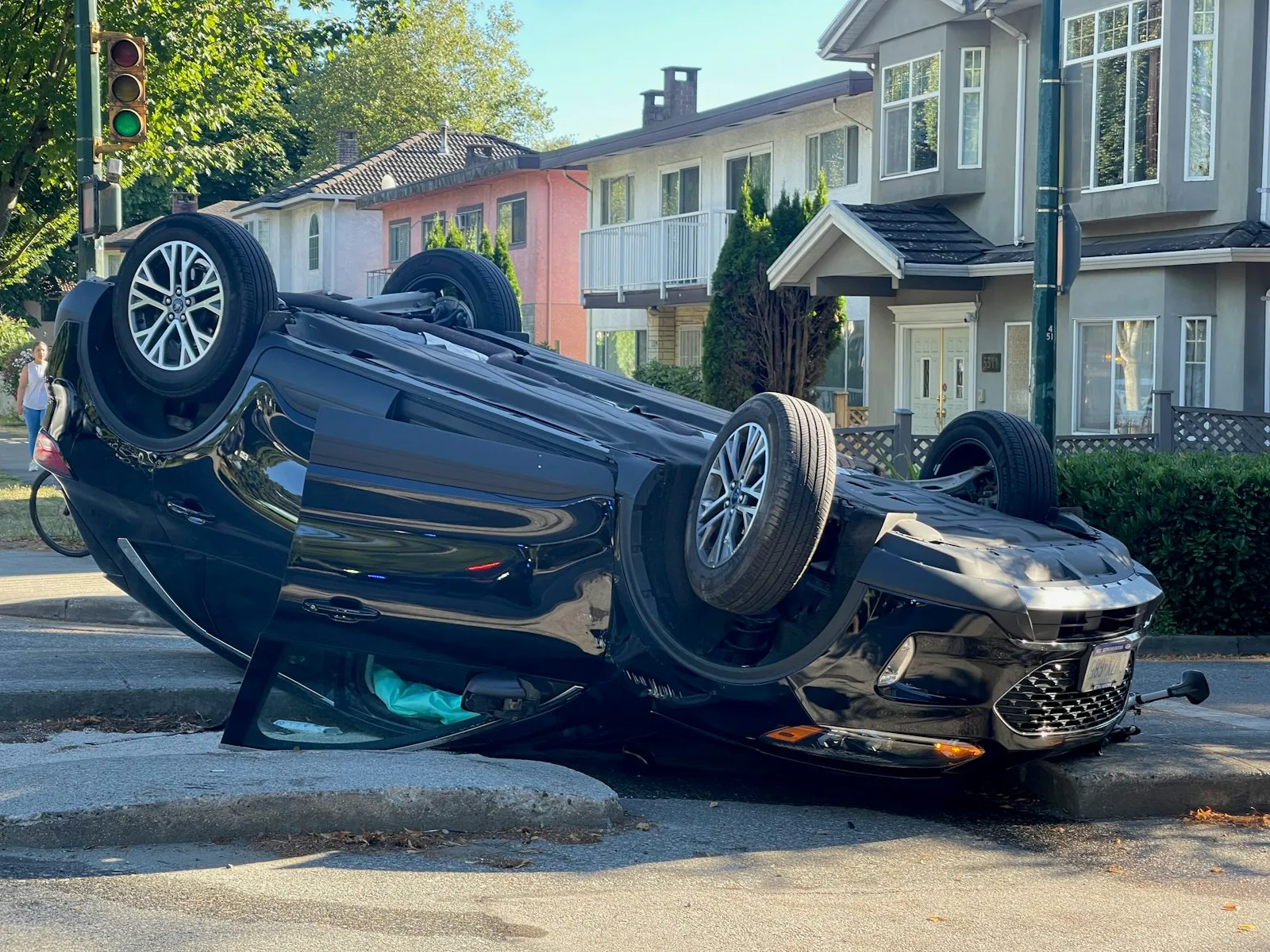
Why Tall Vehicles Tip: The Physics in Plain English
Picture a cereal box and a brick standing side by side on a table. Push both near the top and the box falls over while the brick only slides. The difference is the relationship between how high the weight sits and how wide the base is. Engineers describe it as center of gravity versus track width, and it explains why SUVs, passenger vans and pickups are more prone to rolling than low sedans. Their mass rides higher above the pavement, while their wheels are not proportionally farther apart.
In a turn, sideways force acts at the center of gravity and pivots the body around the outside tires. A low car usually slides before that leverage can lift the inside wheels; in a taller vehicle, the leverage can win first.
Federal regulators measure this. The NHTSA vehicle safety ratings include a rollover resistance rating alongside the frontal and side crash scores, and it is worth looking up for the exact make and model involved. A low score proves nothing alone, but it is worth collecting early.
What Trips a Vehicle: Common Triggers on New York Roads
Most rollovers are “tripped.” The vehicle is sliding sideways and its tires strike something that stops them abruptly, while the upper body keeps moving. It is the same motion as a person who catches a toe on a curb while walking fast: the feet stop, the torso does not. Typical tripping mechanisms include:
- Curbs and medians. A vehicle sliding laterally into a raised curb can be levered over by its own momentum.
- Guardrails. A low rail can act as a ramp under the wheels rather than a barrier, especially at an angle.
- Soft shoulders and grass. Wheels that drop off the pavement edge dig into dirt, which grips far harder than asphalt and can pull the vehicle over.
- Tire blowouts and tread separation. A sudden loss of a tire changes the handling instantly and can send the vehicle sideways.
- Overcorrection. A driver who drifts, then yanks the wheel back, can start a pendulum swing that the suspension cannot settle.
- Side impacts. A vehicle struck in the side, often at an intersection, can be shoved laterally into a curb or simply pushed past its tipping point by the force of the hit.
In and around Queens and Nassau, the setting for many of these crashes is predictable: tight, curving ramps on the Long Island Expressway, the Cross Island Parkway and the Southern State Parkway, where a vehicle carrying too much speed into the curve meets a curb or rail at the outside edge.
The Four Phases of a Rollover
Reconstructionists tend to break a rollover into a sequence, because each stage leaves its own evidence and each one matters to a different part of the claim.
- Pre-trip. Something puts the vehicle into a sideways slide: a swerve, a blowout, a collision, an overcorrection.
- Trip. The tires hit the curb, rail or soft ground and the vehicle begins to rotate.
- Airborne and roof contact. The vehicle rolls onto its side and then its roof, sometimes several times. Each roof strike loads the pillars that hold the roof up. This is where roof crush happens, and where an unrestrained occupant can be thrown around the cabin or out of a window or door.
- Rest. The vehicle stops, on its roof, side or wheels.
Phase one is about fault for the crash. Phases three and four are about crashworthiness: whether the vehicle did what it should have done once the roll began.
Claim One: The Driver Who Caused the Roll
When another motorist triggers the chain, the first claim runs against that driver. Common examples are a driver who runs a light and strikes an SUV broadside, a driver who cuts across a lane on a ramp and forces a swerve, or a driver who sideswipes a van and pushes it into a guardrail. Breaking a traffic rule without a valid excuse is generally treated as negligence in New York, so a blown light or an unsafe lane change carries real weight. Head-on and crossover impacts can also tip a vehicle, which our article on wrong-way and crossover crashes covers in more detail.
If the at-fault vehicle was a commercial van or truck, the owner can generally be held responsible for a permissive driver’s negligence, and an employer generally answers for an employee’s negligence on the job. Our truck accident practice handles that kind of layered liability regularly.
Single-vehicle rollovers and passengers
Many rollovers involve only one vehicle. A passenger in that situation is often surprised to learn that the claim may run against the driver of the car they were riding in, even a friend or relative. The passenger did not steer the vehicle, so fault usually centers on the driver’s speed, attention and handling. Our car accident team handles passenger claims on that basis.
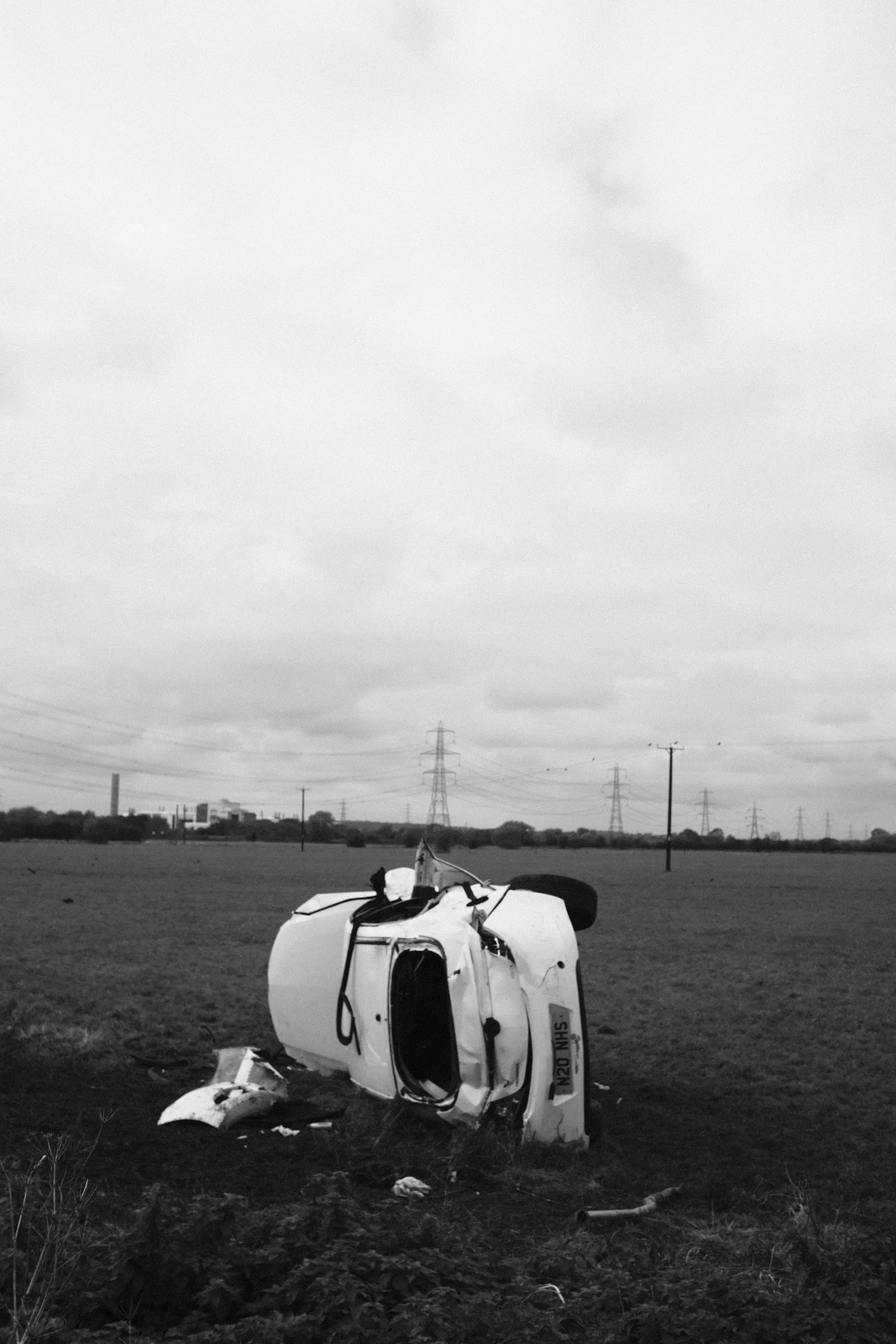
Claim Two: When the Vehicle Fails to Protect You
The second category is a product liability or crashworthiness claim against the manufacturer of the vehicle or one of its components. The theory is not that the manufacturer caused the rollover. It is that the vehicle should have kept its occupants reasonably safe during one, and a defect made the injuries worse than they otherwise would have been. Think of a roll cage at a racetrack: the car may flip, but the driver walks away because the structure around them held its shape.
The failure points that come up most often in rollover crashworthiness cases include:
- Roof crush. If the roof pillars buckle and the roof collapses into the cabin, the space around an occupant’s head and neck disappears. Head, neck and spinal injuries can follow.
- Seat belt or latch failure. A buckle that releases under load, a retractor that spools out webbing, or a belt geometry that lets the occupant slide out from under it.
- Side curtain airbags that do not deploy, or deploy and deflate before the roll is over, leaving windows open to ejection.
- Door latches that open during the tumble, creating another escape path for an occupant who should have stayed inside.
- Tire tread separation, where the tread peels away from the tire body and starts the whole sequence.
Ejection deserves its own mention. When ejection happens through an open door, a failed belt or an undeployed curtain airbag, that failure can become the center of the case.
Preserve the vehicle before it disappears
Crashworthiness claims rise or fall on physical evidence, and the single most important piece is the vehicle. After a rollover, an insurer will often declare the car a total loss and send it to a salvage auction, where it can be crushed, parted out or shipped away within a short time. That is why a rollover accident lawyer will usually move quickly to locate the vehicle, put the tow yard and insurer on notice, and arrange for it to be held for inspection. The same goes for the failed tire, if one was involved.
The Seat Belt Question
Insurers raise seat belt use in nearly every rollover claim, and New York has a specific rule for it. Under Vehicle and Traffic Law § 1229-c(8), failing to wear a seat belt is not admissible on the question of liability. It may, however, be introduced in mitigation of damages, meaning the defense can argue that some of the injuries would have been avoided or reduced with a belt on. The defense generally carries the burden of proving that, which usually requires expert evidence tying the non-use to specific injuries rather than a general assertion.
If a belt was worn and the occupant still struck the roof or was ejected, that points the investigation toward the belt hardware and the roof structure.
Injuries, No-Fault and the Serious Injury Threshold
Rollovers generate a recognizable injury pattern because of the way bodies move inside a tumbling cabin: fractures of the arms, legs, ribs and collarbone; spinal injuries, sometimes severe, especially where roof crush has occurred; and head injuries, from concussion to more serious traumatic brain injury. Even a person who climbs out of the wreck feeling fine should see a doctor and follow up, since some injuries become clear only later. Our guide to concussion claims after a car accident explains why that follow-up matters.
The first layer of payment is New York no-fault insurance, which generally pays medical bills and a portion of lost income no matter who was at fault. Expect to file the application within about 30 days; and our no-fault claims guide walks through the process.
To pursue pain and suffering from an at-fault driver, an injured person generally has to meet the “serious injury” definition in Insurance Law § 5102(d). The categories include a fracture, significant disfigurement, permanent loss of use of a body member or function, a permanent consequential or significant limitation, and an injury that prevents substantially all usual activities for 90 of the first 180 days, among others. If the at-fault driver’s coverage is too small for the harm, supplementary uninsured/underinsured motorist (SUM) coverage on your own policy may help close the gap.
Shared Fault and How It Changes the Math
Defense lawyers in rollover cases often argue that the injured driver was going too fast for the ramp, steered too sharply, or drove on worn tires. Pure comparative fault, codified at CPLR § 1411, shrinks a recovery by the injured person’s percentage of blame instead of wiping it out. Someone found partly responsible for the slide can still recover for the rest, and a manufacturer whose roof collapsed is not excused because the driver took a curve too fast. For a fuller explanation, see our article on comparative negligence in New York.
Deadlines and the Steps That Protect a Claim
Time limits in New York depend on who is being sued. Suits against a negligent driver or a manufacturer generally carry a three-year clock under CPLR § 214. When a rollover was caused by a city vehicle or a municipal defect, the municipality generally must receive a notice of claim inside 90 days, and the lawsuit generally follows within a year and 90 days. A family that loses someone in a rollover generally has two years from the date of death to bring a wrongful death claim.
Practical steps after the crash usually include:
- Getting medical care and keeping every record and bill.
- Filing the DMV Form MV-104 within 10 days, since a rollover with any injury or more than $1,000 in damage requires one from each driver.
- Finding out where the vehicle was towed and asking that it not be sold or destroyed.
- Holding off on recorded statements to insurers until the facts are clearer.
Yakov Mushiyev & Associates works out of 1 Cross Island Plaza in Rosedale, a few minutes from the parkway ramps where many of these crashes begin, and takes rollover cases from Queens, the five boroughs and Nassau County. The firm has recovered over $80 million for injured New Yorkers, charges nothing up front, collects no fee unless it wins, and will sit down with you in a hospital room, your living room or a video call, in English, Russian or Spanish. To have the facts reviewed, reach out through our contact page or call 718.775.3110.
Rollover Crash Questions We Hear Often
Can I sue the car maker if someone else caused the rollover?
Possibly. The driver who caused the roll and the manufacturer whose vehicle failed to protect you can both be responsible for different parts of the harm. A rollover accident lawyer will often investigate both at once, because the evidence for a crashworthiness claim, especially the vehicle, can be lost quickly.
I was not wearing a seat belt. Do I still have a case?
Often, yes. New York does not allow seat belt non-use to be used against you on the question of who caused the crash. The defense may raise it to argue your damages should be reduced, but it generally has to prove the missing belt actually made specific injuries worse.
My vehicle rolled over with no other car involved. Who pays?
No-fault generally covers medical bills and part of lost wages for everyone in the vehicle. Passengers may have a claim against the driver’s policy, and anyone injured may have a product claim if a tire, roof, belt, latch or airbag failed.
How soon should I contact a rollover accident lawyer?
As soon as medical care is under way. The tightest practical deadline in many rollover cases is not legal at all: it is how long the wrecked vehicle sits in a tow yard before it is auctioned. Getting it preserved early keeps every possible claim available.
Visit Yakov Mushiyev & Associates
Our office is at 1 Cross Island Plaza, Suite 325, Rosedale, NY 11422, just off the Cross Island Parkway on the Queens–Nassau border. If you can’t come to us, we’ll come to you: at home, in the hospital or by video.

Talk to a New York rollover accident lawyer today
Yakov Mushiyev & Associates has recovered over $80 million for injured New Yorkers across the five boroughs and Nassau County. Consultations are free, available in English, Russian and Spanish, and there is no fee unless we win.
Call 718.775.3110 or contact us online for a free case review.
This article is general information, not legal advice. Every case is different. Attorney Advertising.