
Commercial truck-driving limits depend on whether a trip is local to our service areas or interstate. Local commercial drivers operating in areas like Rosedale, Rochdale, and Queens must navigate specific state and regional transport rules. For interstate property-carrying drivers, the Federal Motor Carrier Safety Administration (FMCSA) allows up to 11 hours of driving after 10 consecutive hours off duty and bars driving beyond the 14th consecutive hour after coming on duty following 10 consecutive hours off duty. That distinction is central to understanding what the hours of service regulations for truck drivers require for commercial operations.
It’s reasonable to expect the same limits to apply to every commercial driver, but the rules depend on the type of operation and vehicle, and exceptions can affect which requirements apply. At Yakov Mushiyev & Associates, P.C., we know that a missed break or mistaken assumption about a driver’s status can put a trip outside the applicable limits.
This guide explains local and federal driving windows, weekly on-duty caps, break planning, and exceptions such as short-haul operations and adverse driving conditions. It also clarifies which commercial motor vehicle drivers generally fall under hours-of-service rules, helping you understand the standards that govern a truck’s time behind the wheel.
Key Takeaways
- Learn how qualifying breaks can fit into a driving schedule and when the break requirement is triggered.
- Understand why adverse road conditions may affect driving limits, and what the emergency exceptions address.
- See which commercial vehicles and operations generally fall under federal HOS rules, including how vehicle use matters.
- Find out when truck accident legal representation may help after a collision involving a commercial truck.
How Many Hours Can a Texas Truck Driver Drive?
Texas intrastate limits differ from federal limits for interstate trips. The driver’s operation determines which driving window and rest period apply.
Intrastate Driving and On-Duty Limits
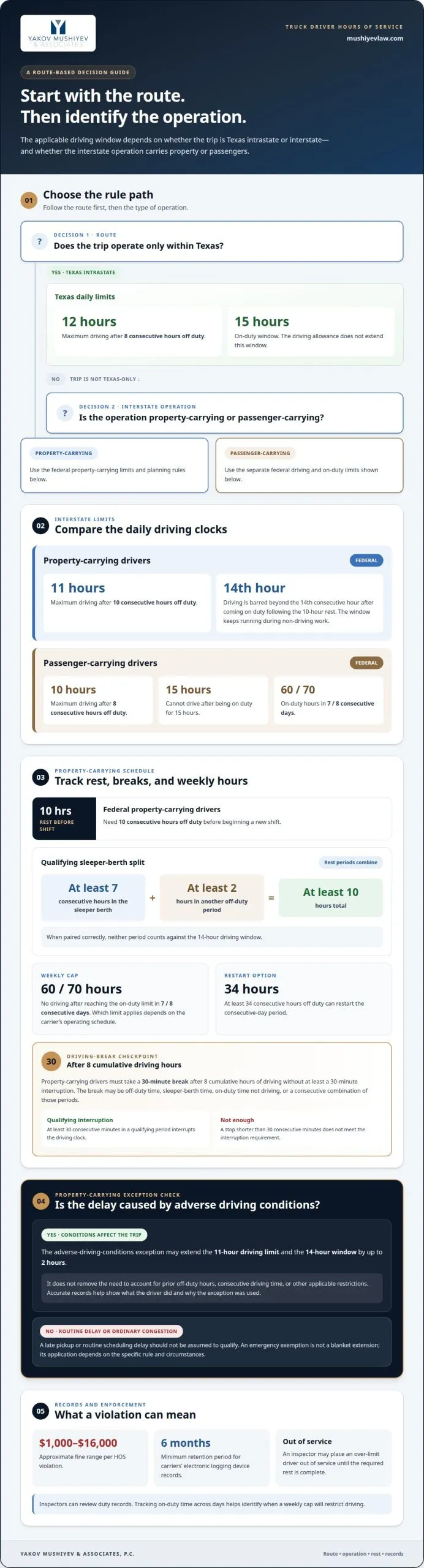
Texas intrastate truck drivers may drive up to 12 hours after 8 consecutive hours off duty, within a 15-hour on-duty window. These limits matter because a trip operating only within Texas may follow different daily limits than interstate driving. A driver’s route and operation determine which framework applies. For a Texas-only shift, the driving allowance does not extend the 15-hour duty window.
Daily Driving and On-Duty Windows
For interstate property-carrying drivers, the Federal Motor Carrier Safety Administration allows up to 11 hours of driving after 10 consecutive hours off duty. The same agency bars driving beyond the 14th consecutive hour after coming on duty following that rest. The 14-hour window continues to run even during non-driving work. Passenger-carrying drivers may drive up to 10 hours after 8 consecutive hours off duty, but cannot drive after being on duty for 15 hours. Their limit is also 60/70 hours on duty in 7/8 consecutive days.
Off-Duty Rest and Sleeper-Berth Splits
Federal property-carrying drivers need 10 consecutive hours off duty before beginning a new shift. A qualifying sleeper-berth split pairs at least 7 consecutive hours in the sleeper berth with another off-duty period of at least 2 hours. Together, the periods must total at least 10 hours. When paired correctly, neither period counts against the 14-hour driving window. Rest periods matter because fatigue can impair safe driving, even when a driver has remaining hours.
Weekly Limits and the Restart
Federal property-carrying drivers may not drive after reaching 60/70 hours on duty in 7/8 consecutive days, according to the Federal Motor Carrier Safety Administration. A driver may restart the consecutive-day period after at least 34 consecutive hours off duty. The applicable limit depends on the carrier’s operating schedule. Tracking on-duty time across days helps reveal when the weekly cap will restrict driving.
HOS violations may bring fines ranging from around $1,000 to roughly $16,000 per violation. Inspectors can review duty records, and carriers must retain electronic logging device records for at least 6 months. An inspector who finds a driver over the limit can place that driver out of service until the required rest is complete.
Adverse driving conditions and emergency exemptions
Unexpected conditions can disrupt a transportation schedule, but they don’t erase hours-of-service limits. For property-carrying drivers, the adverse-driving-conditions exception may extend the 11-hour driving limit and 14-hour window by up to 2 hours.
The adverse-driving-conditions exception covers conditions that affect a trip, not a routine scheduling cushion. A motor carrier cannot treat every delay as permission to operate beyond the usual limits. An emergency exemption is not a blanket extension either. Its application depends on the specific rule and circumstances, so ordinary congestion or a late pickup should not be assumed to qualify.
Consider a property-carrying driver facing an unexpected road condition that slows progress. The exception may permit up to 2 additional hours within the stated driving limit and window. It doesn’t remove the need to account for prior hours off duty, consecutive driving time, or other applicable restrictions. Accurate records help show what the driver did and why an exception was used.
The 30-minute driving break requirement remains a separate planning issue. According to the Federal Motor Carrier Safety Administration, property-carrying drivers must take a 30-minute break after 8 cumulative hours of driving without at least a 30-minute interruption. The qualifying break may include off-duty time, sleeper-berth time, on-duty time not driving, or a consecutive combination of those periods.
That means the break clock tracks cumulative driving, not simply hours since the shift began. A driver who pauses driving for qualifying non-driving work may satisfy the interruption requirement; a short stop that doesn’t reach 30 consecutive minutes won’t. Plan the break before reaching 8 cumulative driving hours, rather than relying on an exception to resolve fatigue or a missed stop. HOS violations can still arise when the exception’s conditions aren’t met or records don’t support its use.
If a truck collision raises questions about a driver’s hours or exception records, truck accident legal representation can help address the injury claim.
Planning schedules and managing breaks
A workable schedule plans qualifying rest breaks before driving limits become an issue. Distinguishing cumulative driving time from consecutive hours on duty helps drivers and carriers plan accurately.
Planning Schedules Around Rest Breaks
Build a route around driving blocks, loading tasks, and a planned break rather than treating rest as leftover time. The Federal Motor Carrier Safety Administration measures cumulative driving without a qualifying interruption, so schedules should track total driving time, not simply the time since work began.
For example, two 4-hour driving periods separated by a 30-minute break create a clear planning structure. That break interrupts the driving period, while loading or other work may affect the driver’s duty schedule differently. Drivers must also account for the maximum daily and weekly limits governing their operation. A plan that ignores loading delays can leave too little room for a required stop.
Taking Thirty-Minute Rest Breaks
According to the Federal Motor Carrier Safety Administration, U.S. property-carrying drivers must take a 30-minute break after driving for 8 cumulative hours without at least a 30-minute interruption. The rule is based on driving time, not simply eight consecutive hours on the clock. A qualifying interruption may consist of off-duty time, sleeper-berth time, on-duty time not driving, or a consecutive combination of those periods.
That distinction matters when a trip includes inspections, loading, or passenger-related work. A stop counts only if it provides the required qualifying interruption; a brief pause does not meet the 30-minute threshold. For instance, a driver tracking 7 cumulative driving hours should identify a compliant stopping point before driving resumes and the threshold is crossed. Recordkeeping should reflect the activity and duration, so the schedule and duty record tell the same story.
Break planning does not replace the separate 70-hour limit that may govern a carrier’s operating cycle. Treat each required rest period as part of the route plan, not as extra time beyond applicable HOS limits.
Which commercial motor vehicle drivers must follow HOS rules
HOS coverage depends on a vehicle’s characteristics and how it’s used, not just the driver’s job title. In general, commercial motor vehicle carriers and drivers operating in the United States must comply with hours-of-service regulations in 49 CFR 395, according to the Office of the Federal Register.
Federal criteria generally include vehicles weighing 10,001 pounds or more, alone or combined with a trailer. A vehicle transporting hazardous materials in a quantity requiring placards is also covered. Passenger transportation counts too: a vehicle designed or used to transport more than 8 passengers, including the driver, for compensation falls within the federal criteria. Without compensation, the threshold is more than 15 passengers, including the driver.
These criteria explain why hours-of-service rules can apply beyond tractor-trailers. A work vehicle pulling a trailer may meet the weight threshold through its combined rating, while a passenger vehicle may qualify because of its capacity and use. The specific vehicle and transportation purpose matter.
Interstate operation is another key distinction. Federal hours-of-service rules generally govern commercial driving in interstate commerce, while applicable state rules govern intrastate operations. A route that stays within Texas may therefore be subject to Texas intrastate limits, while a trip crossing state lines falls under federal requirements. Drivers who sometimes handle interstate trips must also account for the rules governing that work.
- Check vehicle type: consider its weight, trailer combination, passenger capacity, and hazardous-material cargo.
- Identify how it’s used: passenger compensation and the route’s interstate or intrastate status can affect coverage.
For example, a qualifying truck does not fall outside HOS rules simply because it makes a local delivery. The vehicle thresholds and the nature of its operation still matter. Carriers and drivers should identify which framework governs each operation before applying limits, including a 14-hour duty period where federal property-carrying rules apply.
Yakov Mushiyev & Associates, P.C: Truck Accident Legal Representation
Yakov Mushiyev & Associates, P.C. represents people injured in collisions involving commercial trucks. If a crash raises questions about driver fatigue, duty records, or hours-of-service compliance, legal guidance can help you understand how those issues relate to an injury claim. A violation alone does not establish who caused a collision, but the circumstances surrounding the truck’s operation may matter when assessing responsibility.
After a serious crash, injuries and unanswered questions can feel overwhelming. Legal representation can help you address the claim while you focus on recovery. Contact Yakov Mushiyev & Associates, P.C. to discuss a truck accident in Rosedale, Rochdale, Queens, or elsewhere in the firm’s service area.
Take the Next Step After a Truck Crash
Understanding what hours-of-service regulations for truck drivers require can put a crash investigation into context. But a possible rule violation and responsibility for a collision are separate questions. Focus on the circumstances surrounding the crash, including the route, road conditions, and events before impact. Keep your account factual, preserve relevant documents and messages already in your possession, and avoid guessing about details you do not clearly remember.
The significance of an hours-of-service issue depends on the evidence and circumstances of the collision. If you were injured in a truck crash, legal counsel can help assess how those circumstances relate to your claim and explain your options. Yakov Mushiyev & Associates, P.C. represents people injured in truck accidents in Rosedale, Rochdale, Queens, and throughout its service area.
Contact Yakov Mushiyev & Associates, P.C to discuss your situation. Taking a clear, informed next step can help you move forward with greater confidence.
Frequently Asked Questions
What are DOT Hours of Service?
DOT Hours of Service are rules that limit commercial drivers’ driving and on-duty time and require rest periods. The question “what are hours of service regulations for truck drivers?” asks which limits apply to a particular operation. In general, commercial motor vehicle carriers and drivers operating in the United States must comply with 49 CFR 395, according to the Office of the Federal Register. This general information isn’t legal advice for a specific case.
What is the 34-hour restart rule for truck drivers?
The 34-hour restart lets eligible property-carrying drivers reset their consecutive-day on-duty period after taking at least 34 consecutive hours off duty. It affects the weekly calculation, not the separate daily driving window. A passenger-carrying driver cannot use this restart to reset the weekly driving limit. For example, a property-carrying driver’s schedule may begin a new weekly calculation after the required uninterrupted time off.
What has changed?
Federal HOS provisions were revised in 2020. FMCSA revised four provisions on June 1, 2020, and motor carriers were required to comply with the revised regulations starting September 29, 2020. The dates distinguish the revision from its required compliance date. For a particular trip, the applicable limits still depend on factors such as whether the operation is interstate or intrastate and whether it carries property or passengers.
Who Must Comply?
HOS requirements generally cover commercial motor vehicles based on their weight, cargo, passenger capacity, and use. Examples include vehicles weighing 10,001 pounds or more, vehicles transporting placard-required hazardous materials, and passenger vehicles above the applicable capacity threshold. A vehicle designed for more than 8 passengers, including the driver, is covered when transporting passengers for compensation; without compensation, the threshold is more than 15 passengers.
Who Must Follow The FMCSA’s 14-Hour Rule?
The federal 14-hour rule applies to property-carrying drivers operating under the federal HOS framework. According to the Federal Motor Carrier Safety Administration, these drivers may not drive beyond the 14th consecutive hour after coming on duty following 10 consecutive hours off duty. It is a driving-window restriction, not a rule that every commercial driver has the same daily schedule. Passenger carriers have separate duty and driving limits.
Who do the HOS rules apply to?
Hours-of-service rules apply to covered commercial motor vehicle drivers and carriers, with the governing framework depending partly on the trip. If you’re asking, “what are hours of service regulations for truck drivers?” the answer depends on the vehicle and whether its operation is interstate or intrastate. A truck’s weight, trailer combination, passenger use, and hazardous-material cargo can determine whether it meets vehicle criteria. A local delivery alone does not necessarily determine whether federal requirements apply.