
Can you sue the trucking company directly when their commercial driver causes your crash? When catastrophic trauma and mounting medical debt rapidly exceed an individual driver’s auto coverage, understanding what is vicarious liability in a truck accident case becomes the decisive factor in your financial recovery.
You already know how ruthless corporate insurers can be. Within days of a collision, aggressive adjusters push for undervalued settlement releases while risk managers insist the at-fault driver was merely an independent contractor. It feels like an uphill fight against a massive logistics conglomerate built to protect its bottom line. But under New York law and federal carrier safety mandates, trucking companies cannot simply hide behind subcontracted drivers. This guide explains how corporate liability holds motor carriers accountable, unlocking commercial insurance policies from $750,000 to upwards of $5,000,000 to cover your care.
Ahead, we break down the respondeat superior doctrine, show you how to defeat corporate liability shields, and provide a clear roadmap to preserve critical black box evidence before the carrier destroys it.
Key Takeaways
- Clarifying what is vicarious liability in a truck accident case allows injured victims to hold corporate motor carriers responsible for their drivers’ negligence under the legal doctrine of respondeat superior.
- Carriers face legal liability when a crash occurs within the driver’s scope of employment, drawing a decisive boundary between minor work-related detours and personal frolics.
- Combining vicarious liability with direct corporate negligence claims exposes systemic company failures in hiring, training, and vehicle maintenance.
- Federal statutory employee rules under 49 CFR § 390.5 block trucking companies from hiding behind independent contractor designations to evade financial accountability.
- Issuing immediate spoliation notices protects critical black box telematics, electronic logging device data, and driver qualification files before federal retention schedules expire.
Defining Vicarious Liability: How Respondeat Superior Applies to Commercial Trucks
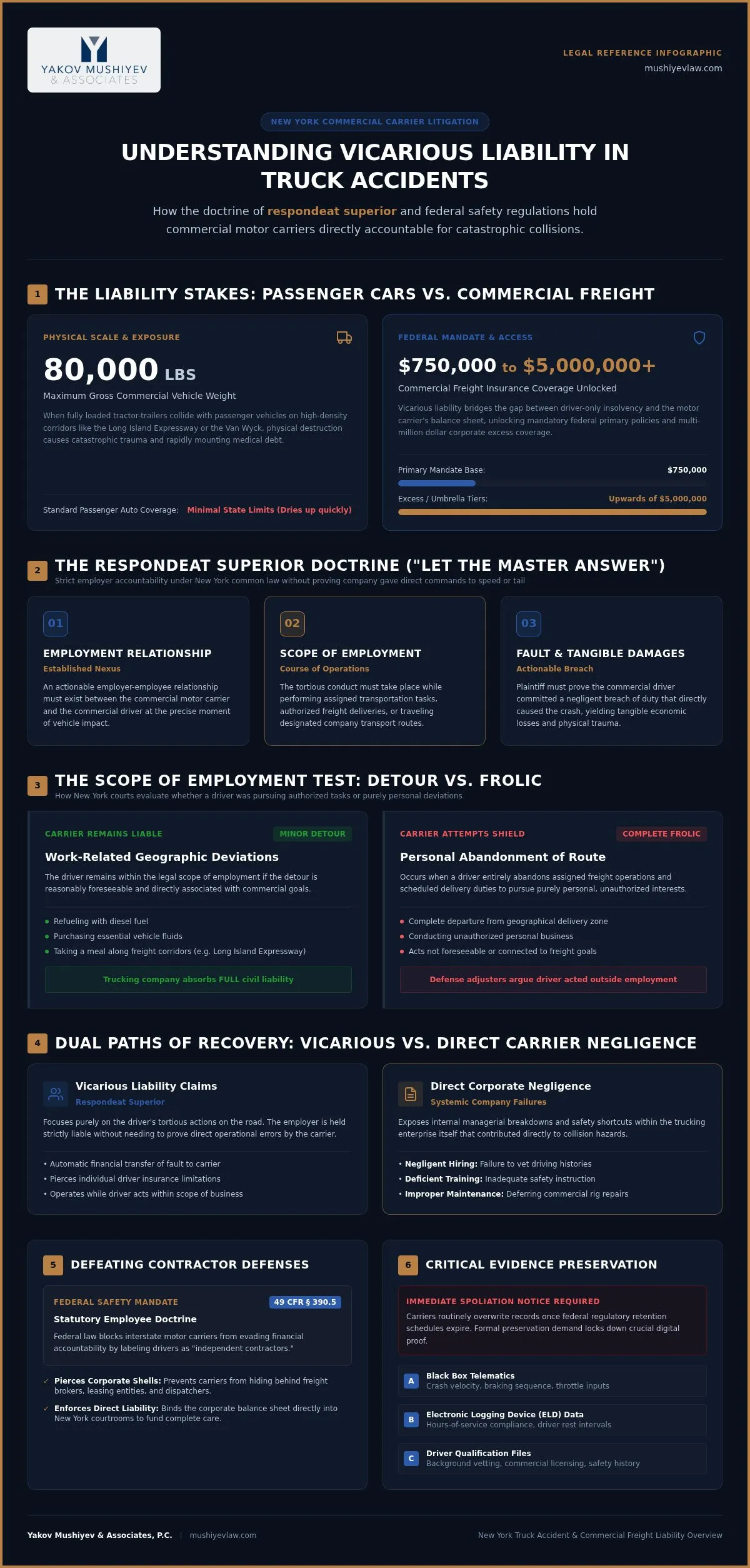
When an 80,000-pound tractor-trailer collides with a passenger car on the Long Island Expressway or the Van Wyck, the physical destruction is catastrophic. Victims confronting devastating injuries often ask: what is vicarious liability in a truck accident case, and how does it protect crash survivors? Under New York law, vicarious liability is an established legal mechanism that holds an employer strictly accountable for the wrongful, negligent acts of its employees.
This principle is anchored in the common-law doctrine of respondeat superior, which translates to “let the master answer.” You do not need to prove that the trucking company directly instructed its driver to speed, tailgated, or violated safety protocols. If the collision occurred while the trucker was acting on behalf of the motor carrier, the company itself absorbs full civil liability. Because commercial operations deploy massive vehicles that pose catastrophic hazards to ordinary motorists, the law imposes this direct financial exposure on the entities profiting from those freight runs.
The Core Legal Elements of Respondeat Superior in New York
Establishing vicarious liability against a commercial motor carrier in New York requires meeting three distinct legal standards:
- An established employment relationship: An actionable employer-employee relationship must exist between the carrier and the driver at the moment of impact.
- Conduct within the course of employment: The trucker’s tortious actions must take place while performing company-assigned transportation tasks, deliveries, or designated travel routes.
- Actionable driver fault and tangible damages: The plaintiff must prove that the driver’s breach of duty directly caused the collision and resulting economic and physical losses.
Why Commercial Truck Cases Differ Radically from Typical Passenger Car Crashes
Understanding what is vicarious liability in a truck accident case reveals why these claims require an aggressive legal strategy compared to everyday auto claims. Passenger car collisions generally hinge on individual drivers carrying minimal state-mandated personal liability coverage. These individual limits dry up almost instantly during catastrophic emergency room visits and intensive surgeries.
Commercial freight carriers, by contrast, must carry substantial primary policies starting at $750,000 under federal mandates, frequently backed by multi-million dollar excess coverage. Enforcing vicarious liability pierces through complex corporate shells involving separate freight brokers, leasing entities, and dispatchers. It guarantees that the corporate balance sheet backing the commercial rig is brought directly into the courtroom to pay for your complete recovery.
The Scope of Employment Test: Determining When Trucking Companies Are Liable
Motor carrier defense teams routinely attempt to dodge financial responsibility by claiming their driver was off-duty or acting outside their assigned job tasks. In answering what is vicarious liability in a truck accident case, New York courts apply the scope of employment test. This standard evaluates whether the commercial driver was carrying out authorized transportation duties or pursuing purely personal interests when the collision occurred. Under state law, an employer remains accountable if the operator’s actions were reasonably foreseeable and directly related to the carrier’s commercial goals.
The Legal Distinction Between Minor Detour and Complete Frolic
Corporate defense adjusters frequently exploit the difference between a detour and a frolic to escape liability:
- A minor detour: Making a brief geographic deviation for diesel, vehicle fluids, or a meal along the Long Island Expressway corridor remains within the legal scope of employment. The motor carrier remains completely liable for any crash that happens during this time.
- A complete frolic: If a trucker entirely abandons freight routes to pursue independent personal matters miles off schedule, courts may view that conduct as a frolic, potentially shielding the carrier from indirect fault.
Trucking companies often mischaracterize necessary driver rest breaks as unauthorized frolics. Hard telematics data, bill of lading waypoints, and real-time GPS tracking disprove these bad-faith assertions.
Hours-of-Service Violations and Corporate Coercion
When tight logistics deadlines clash with federal safety baselines, motor carriers often push operators beyond their physical limits. If an exhausted trucker violates federal Hours-of-Service regulations to deliver cargo on time, the carrier cannot claim the driver went rogue. In evaluating what is vicarious liability in a truck accident case, safety violations committed in furtherance of the company’s business fall squarely within the carrier’s civil exposure.
Dispatch communications, text exchanges, and Electronic Logging Device (ELD) timestamps routinely reveal whether management coerced a driver to skip statutory rest breaks. Partnering with seasoned truck accident legal representation allows crash victims to issue formal legal demands that seize these internal corporate communications before the carrier wipes its servers.
Direct Carrier Negligence vs. Vicarious Liability: Pursuing Every Available Recovery
Holding a motor carrier accountable requires attacking its legal defenses from multiple angles. While defining what is vicarious liability in a truck accident case centers on imputing the operator’s errors directly to the employer, direct corporate negligence takes a different path. It targets the systemic management failures of the trucking company itself.
Under the doctrine of respondeat superior, a carrier is secondary-liable for its driver’s momentary lapses on the road without any independent corporate fault. Direct negligence, however, accuses the company of organizational wrongdoing. When litigation teams assert both claims, corporate insurers face maximum financial pressure to settle catastrophic injury matters.
Common Claims of Direct Corporate Negligence in Trucking
Motor carriers frequently sacrifice highway safety to protect their shipping margins. Direct negligence claims uncover these institutional shortcuts, targeting several distinct failures:
- Negligent hiring: Failing to conduct thorough background checks, review past motor vehicle records, or verify prior drug screening violations through the federal Clearinghouse before putting a driver behind the wheel.
- Negligent retention: Keeping an operator on active freight routes despite recurring hours-of-service infractions, internal safety write-ups, or preventable crashes.
- Inadequate vehicle maintenance: Deferring mandated safety inspections or cutting corners on brake lines, worn steering linkages, and balding tires to save operating capital.
If you were injured in Queens, an experienced personal injury lawyer in Rosedale, Queens investigates carrier safety histories, subpoenas driver qualification files, and uncovers internal audit trails that prove the company knew its fleet was dangerous long before the impact.
How Joint Liability Operates Under New York Civil Practice Law
Maximizing financial recovery requires understanding how state statutory rules allocate debt. New York Civil Practice Law and Rules (CPLR) Article 16 establishes specific parameters for apportioning economic and non-economic damages among tortfeasors. While Article 16 generally protects defendants found 50 percent or less liable from paying the full share of non-economic losses like pain and suffering, vicarious liability removes this barrier.
Because the employer stands in the shoes of its negligent operator, the carrier remains 100 percent liable for all economic losses caused by the crash. When a case involves third-party logistics brokers, cargo loading contractors, and equipment leasing entities, skilled counsel coordinates joint liability arguments. This ensures that every responsible corporate entity contributes to paying for life-altering medical rehabilitation and permanent disability.
Defeating the ‘Independent Contractor’ Defense: Federal and New York Standards
The first maneuver a motor carrier attempts after a catastrophic wreck is disclaiming the trucker entirely. Insurance adjusters will assert that because the driver carried a 1099 tax classification, the company bears zero legal exposure. This argument collapses under federal scrutiny. For crash victims seeking to understand what is vicarious liability in a truck accident case, federal safety regulations strip away this corporate defense.
Under 49 CFR § 390.5 of the Federal Motor Carrier Safety Regulations, an employee is broadly defined to include any driver operating a commercial motor vehicle, specifically including independent contractors while behind the wheel. If a carrier leases a rig or authorizes an owner-operator to pull freight under its Department of Transportation (DOT) operating authority, that driver becomes a “statutory employee” as a matter of law. New York courts look directly past tax paperwork to assess the operational control the carrier exercised over that driver.
Evidence That Proves an Employer-Employee Relationship
Piercing an independent contractor shield requires building a detailed evidentiary record of carrier control. Critical proof includes:
- Equipment leases and rig ownership: Operating agreements where the carrier retains ownership, supplies maintenance funds, or dictates the mechanical upkeep of the tractor and chassis.
- Mandatory routing and scheduling: Strict delivery windows, mandatory dispatch routes, and carrier-installed telematics monitors controlling the driver’s day.
- Exclusivity clauses: Service contracts forbidding the trucker from hauling loads for any other freight distributor.
Holding Third-Party Logistics Brokers and Cargo Shippers Accountable
Commercial freight lines frequently hide behind multi-layered logistics webs involving brokers, third-party logistics firms, and separate shipping facilities. Real accountability requires evaluating the entire supply chain. A freight broker who contracts a trucking company with a pattern of failed safety inspections faces direct liability for negligent selection. Similarly, cargo warehouses that overload flatbeds or improperly secure intermodal containers can be held liable when shifted loads trigger rollover collisions.
If you were hurt in an impact with a commercial rig, work with a proven car accident lawyer on Jamaica Avenue who thoroughly inspects bills of lading, corporate contracts, and broker safety files to target every culpable entity. When you need to establish what is vicarious liability in a truck accident case and hold multi-million dollar freight conglomerates responsible, take action today and secure truck accident legal representation to protect your claim.
Critical Evidence Required to Prove Vicarious Liability in a Truck Crash Claim
Commercial motor carriers do not wait to defend themselves. Minutes after a catastrophic collision on New York freight corridors like the Cross Bronx Expressway or the Long Island Expressway, carriers deploy rapid-response legal teams and accident reconstructionists. Their immediate objective is controlling the narrative and minimizing corporate exposure. Establishing what is vicarious liability in a truck accident case requires an equally swift, aggressive legal countermeasure to seize and preserve vital records before they vanish.
Crucial digital and mechanical proof faces routine destruction under standard corporate document retention schedules. Heavy-vehicle Event Data Recorders (EDRs) often overwrite deceleration data within 30 days or after routine engine ignition cycles. Federal regulations permit carriers to purge Electronic Logging Device records after six months under 49 CFR § 395.8. To stop this spoliation, your legal counsel must issue comprehensive formal spoliation letters within 24 to 72 hours of the crash, putting the carrier on formal notice that destroying telematics will trigger severe evidentiary sanctions in court.
High-Priority Records to Demand from the Motor Carrier
Subpoena powers and formal discovery demands must compel the motor carrier to produce several foundational categories of operational records:
- Electronic Control Module (ECM) and black box logs: Time-stamped data showing vehicle speed, hard braking events, throttle position, and automated collision mitigation warnings.
- Driver Qualification Files (DQFs): Mandated under 49 CFR § 391.51, these files hold pre-employment road test certifications, annual driving records, commercial driver’s license validations, and medical examiner certificates.
- Vehicle inspection and shop work orders: Pre-trip and post-trip Driver Vehicle Inspection Reports (DVIRs), recurring mechanic work invoices, and roadside out-of-service citations documenting pre-existing mechanical failures.
Why Relentless Legal Advocacy Is Essential Against Commercial Insurers
Commercial trucking insurers utilize formidable defense law firms whose singular mission is delaying claims, obscuring corporate parentage, and driving down settlement figures. Uncovering what is vicarious liability in a truck accident case transforms an uneven dispute into a trial-ready legal battle. Subpoenas targeting corporate safety audits, dispatch audio files, and telematics reveal the administrative negligence that corporate adjusters try to hide.
Victims suffering severe trauma need an unwavering shield against these corporate freight conglomerates. You can contact a dedicated personal injury lawyer in Rosedale, NY who knows how to hold commercial insurers fully accountable, preserving decisive evidence and forcing corporate defendants to settle catastrophic injury claims fairly.
Take Decisive Action to Hold Negligent Motor Carriers Accountable
After a catastrophic commercial collision, knowing what is vicarious liability in a truck accident case turns the tables on evasive logistics corporations. It eliminates independent contractor loopholes, ties direct corporate failures to driver misconduct, and unlocks the high-limit commercial insurance policies required to cover your lifelong medical costs.
You don’t have to face corporate defense teams alone. Backed by over two decades of relentless advocacy against major insurance companies across Queens and the greater New York City metropolitan area, Yakov Mushiyev & Associates, P.C. acts as an unyielding shield for collision survivors. We operate on a strict no-win, no-fee contingency structure, guaranteeing you face zero upfront costs or legal fees unless we successfully win your case. Time is running out before the carrier overwrites essential black box logs. Schedule a free case review with Yakov Mushiyev & Associates, P.C. today, and let our trial-ready team demand the full financial justice you are owed.
Frequently Asked Questions
What does vicarious liability mean in a commercial truck accident lawsuit?
Vicarious liability is a legal doctrine holding a motor carrier financially accountable for the negligence of its drivers. In answering what is vicarious liability in a truck accident case, New York law applies the principle of respondeat superior. If a commercial driver causes a crash while moving freight, the employer absorbs full legal responsibility. Victims don’t need to prove independent corporate fault to access the motor carrier’s substantial commercial insurance coverage.
Can a trucking company avoid liability by claiming the driver was an independent contractor?
No, trucking companies cannot evade liability simply by issuing a 1099 tax form. Federal Motor Carrier Safety Regulation 49 CFR § 390.5 defines commercial drivers as statutory employees regardless of independent contractor agreements. If an owner-operator drives under a carrier’s Department of Transportation operating authority, that motor carrier remains legally responsible for the driver’s conduct on New York roadways, defeating corporate attempts to bypass financial accountability.
What is the difference between direct carrier negligence and vicarious liability?
Vicarious liability holds a motor carrier strictly responsible for its driver’s negligent actions behind the wheel without requiring proof of administrative misconduct. Direct carrier negligence targets the company’s internal organizational wrongdoing. This includes negligent hiring, failing to verify driving records through the federal Clearinghouse, skipping mandated brake repairs, or coercing fatigued operators to violate hours-of-service rules. Skilled attorneys plead both legal claims to maximize total settlement leverage.
What happens if the truck driver was off-duty or taking a personal detour during the crash?
Carrier exposure depends on whether the driver made a minor detour or embarked on a complete frolic. Under New York law, minor geographic deviations for diesel, food, or mandatory rest breaks along Queens freight corridors remain within the legal scope of employment. If the driver completely abandoned shipping duties for purely personal reasons, the carrier might dispute vicarious liability. Electronic logs and GPS waypoints prove whether the trip served company purposes.
How much commercial insurance coverage is available in a vicarious liability truck accident case?
Federal regulations mandate commercial policy limits far exceeding standard private auto policies. Under 49 CFR § 387.9, commercial carriers hauling non-hazardous freight must maintain a minimum of $750,000 in public liability coverage. Hazardous material carriers must maintain between $1,000,000 and $5,000,000. Large logistics operations regularly carry multi-million dollar umbrella coverage. Establishing vicarious liability gives injured victims access to these high-limit policies to pay for catastrophic care.
Why is issuing a legal spoliation letter critical immediately after a truck accident in New York?
Motor carriers routinely overwrite essential digital crash data during standard operations. Heavy-vehicle black boxes often overwrite event data within 30 days or after routine engine ignition cycles, while federal regulations permit carriers to purge electronic logbooks after six months. A formal legal spoliation letter puts the carrier on notice to preserve black box telemetry, dispatch communications, and driver qualification files, preventing the destruction of vital trial evidence.
How long do I have to file a vicarious liability truck crash claim in New York?
Under New York Civil Practice Law and Rules § 214(5), injured plaintiffs generally have three years from the date of the crash to file a personal injury lawsuit against a private commercial carrier. If a collision results in a fatality, New York law gives families two years from the date of death to file. When a crash involves a municipal government vehicle, you must file a Notice of Claim within 90 days.