
What if I fell because of a code violation in Rosedale? A violation may help explain why a dangerous condition existed, but it doesn’t automatically prove negligence or guarantee compensation. The key is connecting the specific condition to your fall and establishing who was responsible for maintaining or addressing it. That can be difficult if repairs begin quickly or records and evidence disappear.
If you’re hurt and unsure what happened, that uncertainty is understandable. Photos of the hazard, witness details, incident reports, inspection or repair records, and information about who controlled the property may help clarify the facts. This article explains how a code violation may fit into a New York slip-and-fall claim, what evidence could connect the hazard to your injuries, and why responsibility may involve more than one party. Yakov Mushiyev & Associates, P.C. represents people injured in premises-liability and slip-and-fall incidents in Rosedale and across Queens. Taking practical steps early can help preserve important evidence while the circumstances of your fall are investigated.
Key Takeaways
- If you’re asking, “what if I fell because of a code violation in Rosedale,” a violation may support a claim, but it doesn’t establish liability by itself.
- Connecting the alleged safety requirement to the specific hazard and your injury is central to understanding what happened.
- Photos, witness information, incident reports, and maintenance records may help preserve important details about the fall.
- Responsibility may depend on who controlled or maintained the area, not simply who owned the property.
- Recording the time, location, weather, and condition you observed soon after the fall can help preserve useful details.
Fell Because of a Code Violation in Rosedale? Start With What the Violation Proves
A fall can leave you hurt, shaken, and unsure whether anyone could have prevented it. If you’re asking, “what if I fell because of a code violation in Rosedale,” a violation may support a claim, but it doesn’t decide the case on its own. The key questions are whether a specific safety requirement applied, whether it was violated, and whether the condition contributed to your fall and injury.
A premises-related code violation involves a potentially relevant safety requirement for a property or condition. Building codes generally establish safety standards for buildings, but the requirement that matters depends on the property, its location, the condition involved, and the facts of the incident. A visible defect can raise questions, but a photo alone won’t establish which rule applies or whether it was violated. The requirement must be identified and evaluated in context.
A general overview of the purpose of a Building code can help explain why these requirements exist. The video below discusses building-code issues and how they may relate to fall claims:
What counts as a property-code violation?
It depends on the applicable requirement and the facts. A hazardous stair condition, for example, could raise questions about the stair’s design, condition, or maintenance. But a damaged step doesn’t by itself prove that a particular requirement governed that stair or that someone failed to follow it. The property type and the condition at the time of the fall matter. Records and other evidence may help show how the hazard developed and whether a rule applied.
Does a violation automatically mean the owner is liable?
No. The requirement must apply to the specific condition and circumstances, and evidence must connect that condition to the fall and injury. A violation may be important evidence, but it doesn’t independently establish every fact needed to assign legal responsibility.
Legal responsibility depends on the violation’s connection to the injury, not simply on whether a defect was visible. Investigators may need to determine who controlled or maintained the area, whether a responsible party knew or should have learned about the condition, and whether it contributed to the fall. A photograph alone can’t answer those questions.
Those details matter in Rosedale, where responsibility for a property or a specific area may involve more than one party. The facts must be examined rather than assumed. Yakov Mushiyev & Associates, P.C. represents people injured in slip-and-fall and premises-liability matters in Rosedale and Queens.
How Rosedale Fall Claims Connect a Code Violation to the Injury
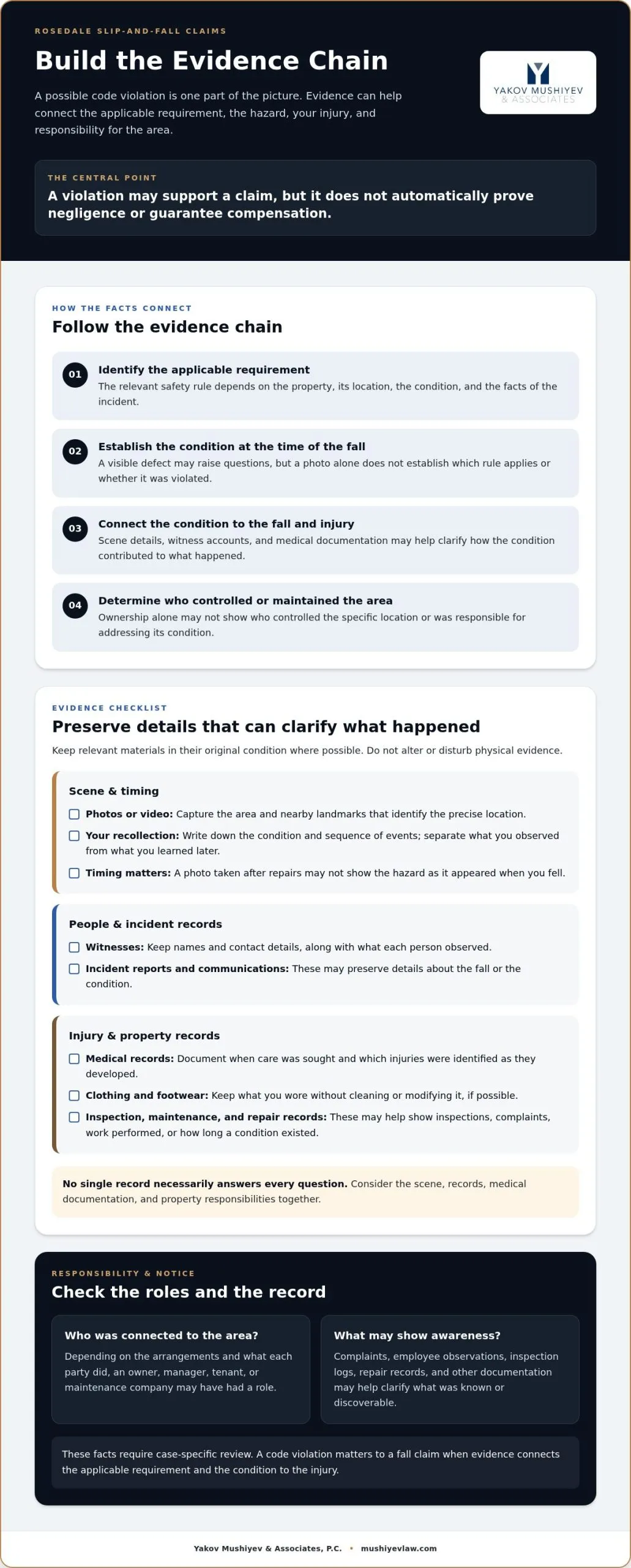
A possible code violation is only one part of a fall claim. The evidence needs to establish what condition existed, whether a safety requirement applied, and how the condition contributed to the fall and resulting injury. If you’re asking, “what if I fell because of a code violation in Rosedale,” preserving specific details can help an investigation test that connection instead of relying on assumptions.
Timing and location can shape what the evidence shows. A photo taken after a repair may not capture the hazard as it appeared when you fell. A witness who saw the area before the incident may help clarify its condition. Medical records can document when you sought care and what injuries were identified, while incident reports or maintenance records may provide information about inspections, complaints, or work performed. No single record necessarily answers every question.
What evidence can help establish the connection?
Preserve relevant materials in their original condition where possible. Don’t alter or disturb physical evidence. These details may help clarify what happened:
- Photos or video of the area and nearby landmarks that identify the precise location.
- Witness names and contact details, along with what each person observed.
- Incident reports and communications about the fall or the condition.
- Medical records and documentation of how the injury developed over time.
- The clothing and footwear worn during the fall, kept without cleaning or modification if possible.
Write down what you remember about the condition and sequence of events. Distinguish your own observations from details you learned afterward. A slip-and-fall claim review can help assess which available evidence may be relevant and what additional records could answer unresolved questions.
Why property control and notice matter
Different parties may have different roles at a property. An owner, manager, tenant, or maintenance company could each have some connection to the area, depending on the arrangements and what each party actually did. Ownership alone doesn’t establish who controlled the specific location or was responsible for addressing its condition.
Notice also has to be evaluated through evidence. A complaint or an employee’s observation could be relevant to whether someone knew about a hazard. Inspection logs, repair records, and other documentation may help show how long a condition existed and whether it might have been discovered. These facts require case-specific review and shouldn’t be presumed.
A code violation matters to a fall claim only when evidence connects the applicable requirement and the condition to the injury. Reviewing the scene, records, medical documentation, and property responsibilities together can help clarify whether that connection is supported and what questions remain.
Who May Be Responsible for a Code-Related Fall in Rosedale?
After a fall, it’s natural to look to the property owner for answers. But ownership alone doesn’t establish who controlled the precise area, handled repairs, or had a role in addressing the hazard. If you’re asking, “what if I fell because of a code violation in Rosedale,” identifying potentially responsible parties means examining what each person or entity actually did and what responsibilities applied.
A building’s owner may have retained a manager, assigned upkeep to a tenant, or hired a maintenance contractor. More than one party could have had a role, depending on the location and arrangements. None should be presumed liable before the facts are examined.
Owner, manager, tenant, or maintenance contractor?
Each party’s connection to the condition may differ. An owner may oversee the property generally, while a manager handles day-to-day operations. A tenant may maintain the space it occupies, and a contractor may perform specific repairs or inspections. These are possibilities, not conclusions about any particular property in Rosedale.
Written agreements can help show how responsibilities were assigned, but the documents may not tell the whole story. Investigators may also examine the parties’ actual conduct: who arranged repairs, received complaints, inspected the area, or could authorize work. For example, a maintenance agreement might cover certain shared areas but leave other spaces to a tenant or manager. Both the agreement’s scope and how it was followed can matter.
Responsibility turns on evidence of control over the area and the duty connected to the condition. A legal review can compare ownership and management records with the location of the fall and the work each party performed. This helps prevent assumptions from replacing evidence, especially when several parties had overlapping roles.
How the injured person’s actions may be considered
The property’s conduct isn’t the only issue that may be examined. New York comparative-fault principles may allow a person’s actions to be considered when evaluating a claim. A defense might argue that the injured person could have noticed or avoided the condition. That allegation does not, by itself, settle who was responsible or resolve the claim.
The specific circumstances matter. A person may not have seen a hazard because it was obscured, poorly lit, or encountered unexpectedly. Those details need to be assessed alongside the condition, the applicable safety requirement, and each party’s connection to the area. Don’t assume that an accusation of carelessness automatically defeats a claim, and don’t rely on a general description of the fall to predict the outcome.
If an owner, manager, tenant, or contractor points blame elsewhere, the response should be grounded in documents and facts, not guesswork. Yakov Mushiyev & Associates, P.C. represents people in slip-and-fall and premises-liability matters in Rosedale and Queens. A careful investigation can help clarify who controlled the area and how the evidence bears on responsibility.
What to Do After a Suspected Code-Violation Fall in Rosedale
A painful fall can make it hard to think about evidence or paperwork. Focus first on your health, then preserve what you can without putting yourself at risk. If you’re wondering, “what if I fell because of a code violation in Rosedale,” these practical steps can help keep important details from being lost while the facts are investigated.
- Get medical care. Address urgent symptoms promptly and follow the advice of your medical providers. Tell them how and when the fall happened, and keep records of visits, treatment instructions, appointments, and expenses.
- Document the scene if it’s safe. Photograph or record the condition and surrounding area before they change, if you can do so safely. Include the exact location, lighting, nearby warning signs, and enough context to show where the hazard was. Don’t return to an unsafe area or disturb the condition to get a better picture.
- Write down what you remember. Record the date and time, precise location, weather, what you observed, and how the fall occurred. Note what you were doing and any details about visibility or warnings. Fresh notes can help separate what you remember firsthand from what you learned later.
- Identify witnesses and preserve communications. Save names and contact details for anyone who saw the fall or the condition. Keep texts, emails, and other communications about the incident. If an incident report was made, ask how to obtain a copy when appropriate. You don’t need to confront property personnel.
- Keep potentially relevant items and records. Set aside the clothing and footwear you wore, and avoid cleaning or altering them. Keep medical paperwork and a simple record of how the injury affects daily activities, such as work, mobility, or routine tasks.
Preserve evidence before the condition changes
Repairs, cleanup, weather, or ordinary use can change the scene. Take photos from different angles when safe, and preserve original files rather than relying only on edited versions. Avoid posting detailed commentary about the incident or a potential claim publicly. Don’t discard items that could help show what happened.
Keep medical and incident records organized
Store documents in one place and note the date and substance of conversations with property representatives, insurers, or others involved. A clear timeline can help a lawyer compare your account with available incident and maintenance records. For related local information, see this Rosedale and Rochdale slip-and-fall guide.
These steps can help preserve details, but they can’t determine on their own whether a code requirement applied or who may be responsible. Yakov Mushiyev & Associates, P.C. represents people injured in slip-and-fall matters in Rosedale and Queens. To discuss how the evidence may relate to your situation, discuss your Rosedale slip-and-fall concerns.
How a Rosedale Slip-and-Fall Lawyer Can Investigate a Code Violation
If you’re asking, “what if I fell because of a code violation in Rosedale,” a lawyer can help examine the evidence behind that concern. The investigation is not just about spotting a defect. It involves assessing what happened, whether a particular safety requirement applied to the property and condition, who had responsibility for the area, and whether the condition contributed to your injuries.
At Yakov Mushiyev & Associates, P.C., a slip-and-fall matter can be reviewed to bring these questions into focus. The firm represents injured people in premises-liability claims in Rosedale and Queens. Any conclusion depends on the case-specific evidence and current New York law. A suspected violation alone doesn’t establish liability or guarantee compensation.
Questions an attorney may examine
A focused investigation may start by organizing the details of the fall and identifying what evidence could answer the central questions. Counsel may assess whether the available records and observations support a connection between the condition and the injury.
- What condition caused the fall? Photos, witness accounts, incident reports, and medical records may help document the scene, the sequence of events, and the resulting injury.
- Which safety requirement may apply? The property type, location, condition, and incident facts matter. A lawyer can research potentially relevant requirements and assess whether they govern the circumstances, rather than assuming a visible defect proves a violation.
- Who controlled the area? Ownership records, management or maintenance arrangements, and the parties’ conduct may help show who was responsible for the location or had a role in addressing its condition.
- What evidence may show prior awareness? Available complaints, inspection notes, repair records, or communications may help evaluate whether a responsible party knew or should have known about the condition. Their significance depends on the facts and applicable law.
These strands must be considered together. For example, a record of prior work may help explain when a condition developed, but it does not by itself prove that the condition caused a particular fall. Legal analysis must also account for evidence that supports or weakens the proposed connection. The New York personal-injury claim process in Rosedale can involve several fact-specific steps, and understanding how they fit together can help you make informed decisions.
Get a focused legal assessment
Consider discussing the incident with a lawyer promptly. Relevant records or physical conditions may change, and legal deadlines can be time-sensitive. A lawyer can review what you have, identify evidence that may need to be preserved, and evaluate potential claims without promising that a violation, liability, or recovery will be established.
You don’t have to determine on your own which rule applies or who may be responsible. A careful assessment can help clarify what the evidence supports and what questions remain. To discuss your fall with Yakov Mushiyev & Associates, P.C., contact the firm about your fall.
Take the Next Step Toward Clarity
After a serious fall, it can be tempting to wait until every detail is clear before seeking guidance. You don’t have to solve the legal questions alone. If you’re still asking, “what if I fell because of a code violation in Rosedale,” a focused review can help you understand what the available evidence may show and what questions remain. No single detail determines the outcome, and a careful assessment should account for the facts of your incident and applicable New York law.
Keep your records together and write down anything else you remember. Then consider discussing the circumstances with counsel before important evidence becomes harder to locate or evaluate. Yakov Mushiyev & Associates, P.C. represents people injured in slip-and-fall and premises-liability matters. Taking that first step can help you understand your options.
Discuss your Rosedale fall with Yakov Mushiyev & Associates. You deserve a thoughtful review and a clear path forward.
Frequently Asked Questions
Can I sue if I fell because a property violated a building code?
You may have grounds to pursue a premises-liability claim, but a possible code violation alone doesn’t determine whether you can recover. If you’re asking, “what if I fell because of a code violation in Rosedale,” a lawyer can assess whether the requirement applied and whether the evidence links the condition to your injuries. Preserve photographs and paperwork, and note any changes to the scene since the fall.
Does a building-code violation automatically prove negligence in New York?
No. A code issue is a lead for investigation, not an automatic finding of negligence. A lawyer may need to verify the rule’s application to that particular property and incident, then evaluate the condition, the parties’ roles, and the available evidence. For example, a citation concerning one part of a building may not govern a different area or explain how a fall occurred.
What evidence should I keep after a fall in Rosedale?
Keep original photo and video files, not just screenshots or edited copies, and back them up somewhere secure. Save appointment summaries, discharge instructions, and messages about missed work or changed daily plans. If you receive an incident report or insurer letter, preserve the entire document, including attachments and envelopes. A dated folder or simple timeline can help keep the records organized for legal review.
Who may be responsible for a fall caused by an unsafe property condition?
Responsibility depends on the location and the parties’ roles. For instance, a shared entryway and a shop leased within a building may have different management or maintenance arrangements. A lawyer may examine lease provisions, service agreements, and records showing who handled the relevant area. Don’t assume the owner alone was responsible, or that a contractor’s involvement automatically makes that contractor liable.
Can I still have a claim if I was partly responsible for my fall?
Possibly. New York comparative-fault principles may affect how responsibility is assessed, but a claim shouldn’t be dismissed based only on an accusation that you were careless. Details such as what you could see, whether a warning was present, and how the hazard was positioned may matter. Share your complete recollection with a lawyer, including facts that might seem unfavorable, so it can be evaluated in context.
How long do I have to bring a code-violation fall claim in New York?
There isn’t one deadline that safely answers every situation. The time limit and any required notice may depend on whom you may bring a claim against and the circumstances of the fall. Claims involving a public entity can raise separate notice issues. Don’t rely on a general timeline or wait for your treatment to end before seeking legal guidance about the incident date and potential parties.