
Could you challenge a disappointing verdict without putting your injury case through another trial? If you’re asking what is an appeal in a personal injury case, the key point is that an appeal asks a higher court to review whether legal errors affected the result. It isn’t a chance to present new evidence or simply ask another jury to weigh the facts differently.
It’s understandable to feel that an outcome was unfair, especially after an injury has disrupted your life. But an appeal must rest on specific legal grounds, and strict deadlines can limit your options. In New York, the appellate court generally reviews the record from the original case, including transcripts and evidence, rather than hearing the case again.
This guide explains how appellate review works in New York, what an appellate court can and cannot change, and why the trial record and timing matter. You’ll also learn what documents and details to gather when discussing next steps with counsel. If you received an unfavorable decision in a New York personal injury case, understanding the process can help you assess your options more clearly.
Key Takeaways
- Learn what is an appeal in a personal injury case and why it focuses on alleged legal errors, not a fresh decision on the facts.
- Understand how a New York appeal may proceed to the appropriate Appellate Division and why the correct court depends on the case.
- See why dissatisfaction with a verdict alone may not be enough, and what kinds of legal or procedural issues may warrant review.
- After an unfavorable decision, gather the judgment or order, service details, court filings, transcripts, and exhibits for legal review.
- Explore possible appellate outcomes, including affirmance, reversal, modification, or a return to the lower court for further proceedings.
What Is an Appeal in a Personal Injury Case?
If a personal injury decision went against you, it’s natural to wonder whether another court can take a fresh look. The answer depends on what happened in the case and the rules that apply. An appeal asks a higher court to review specified legal rulings made by a lower court. Either side may have appellate rights, depending on the decision and whether the applicable rules permit review.
In New York, an appeal generally asks the appellate court to examine the existing case record, including relevant filings, trial transcripts, and admitted exhibits. It isn’t an opportunity to add evidence that wasn’t presented in the trial court. For a general explanation of the process, see What is an Appeal?
For a general discussion of appeals in injury cases, watch this video:
So, what is an appeal in a personal injury case in practical terms? It’s a request for legal review, not a promise of a better result. Filing an appeal doesn’t guarantee reversal, a new trial, or additional compensation. Depending on the issue and governing law, the appellate court may uphold the decision, change part of it, reverse it, or send an issue back for further proceedings.
How an appeal differs from a new trial
At trial, the parties present evidence and witnesses, and the judge or jury resolves factual disputes. On appeal, the court reviews what happened in the trial court and considers whether particular rulings or procedures justify relief. The parties generally don’t present witnesses or introduce new evidence. The possible outcome depends on the alleged error, the record, and the law that governs it.
Which personal injury decisions may be appealed?
A final judgment may be appealable, but some orders made before final judgment may also be reviewed. Whether an order can be appealed immediately depends on its nature, the case’s procedural posture, and applicable rules. Some issues may need to wait until a final judgment. Don’t assume every unfavorable ruling can be challenged at once. The right to appeal and the steps required depend on the decision.
Because appealability and deadlines can turn on the exact wording and service of an order or judgment, keep those documents and related notices together. A careful review of the record can help clarify what decision is reviewable and what options may remain.
How Does a New York Personal Injury Appeal Work?
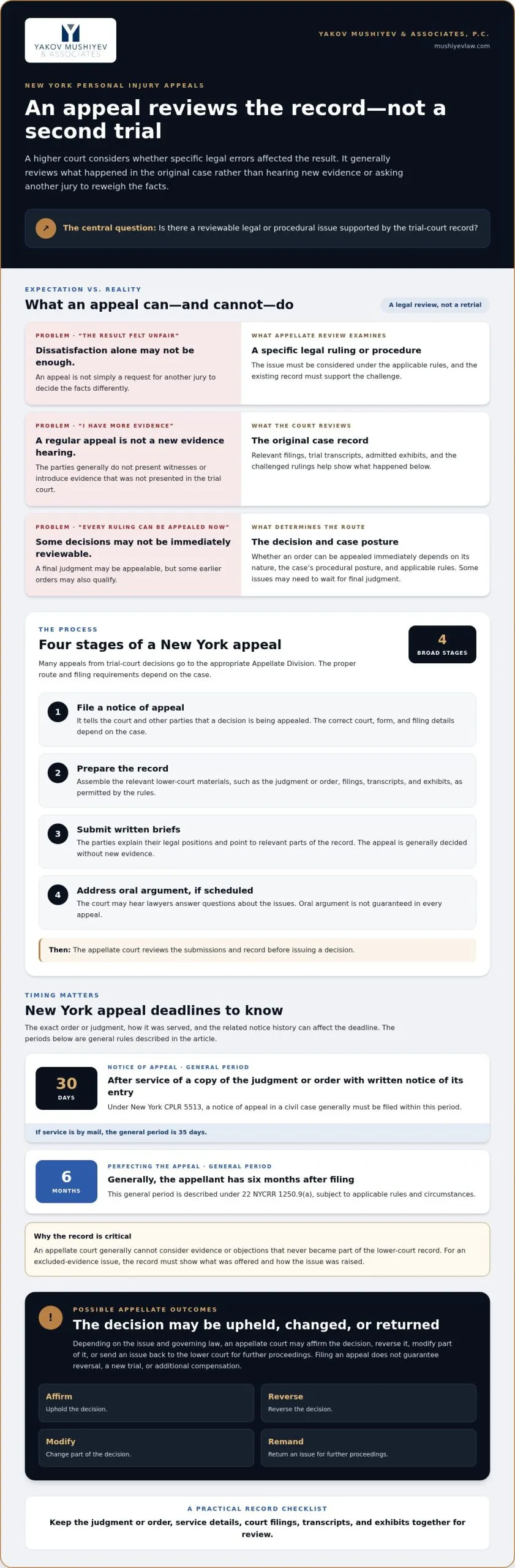
The steps in a New York appeal depend on the court, the type of decision, and the rules that apply. Many appeals from trial-court decisions go to the appropriate Appellate Division, but the proper route is case-specific. This overview is general information, not a determination of which steps or deadlines apply to a particular case.
What happens after an appeal is filed?
In broad terms, the process moves through several stages. The record and written submissions provide the appellate court with the materials it needs to review the challenged ruling.
- File a notice of appeal. This document tells the court and other parties that a decision is being appealed. The correct court, required form, and filing details depend on the case.
- Prepare the record. The record on appeal brings together relevant materials from the lower-court proceedings, such as the order or judgment, filings, transcripts, and exhibits, as permitted by the applicable rules.
- Submit written briefs. The parties explain their legal positions and identify relevant parts of the record. The appeal is generally decided on the existing record, not on new evidence.
- Address oral argument, if scheduled. The court may hear lawyers answer questions about the issues. Oral argument isn’t guaranteed in every appeal.
After reviewing the submissions and record, the appellate court issues a decision. Requirements for assembling and filing materials vary, so the specific court’s rules and schedule matter.
Why the trial record and New York deadlines matter
An appellate court generally can’t consider evidence or objections that never became part of the lower-court record. For example, if a party believes the trial judge wrongly excluded evidence, the record must show what evidence was offered and how the issue was raised. That’s why transcripts, exhibits, filed papers, and written rulings can be critical to legal review.
Timing matters just as much. Under New York CPLR 5513, a notice of appeal in a civil case generally must be filed within 30 days after service of a copy of the judgment or order with written notice of its entry. If service is by mail, the period is generally 35 days. These rules have specific requirements, and a missed deadline can threaten the right to appeal. Don’t calculate the deadline from memory. Have counsel review the exact order or judgment, how and when it was served, and the related notice history.
After filing, an appellant generally has six months to perfect the appeal under 22 NYCRR 1250.9(a), subject to applicable rules and circumstances. If you’re weighing options after an adverse decision, you can discuss your New York personal injury matter with Yakov Mushiyev & Associates, P.C.
What Can You Appeal in a Personal Injury Case, and What Is Not Enough?
A possible appeal issue is more than a feeling that the result was unfair. The question is whether a particular legal ruling or procedure can be challenged under the applicable rules, and whether the existing record supports that challenge. The standard of review varies by issue and ruling, so the same argument may not be assessed the same way in every case.
This comparison can help distinguish a potential legal issue from disappointment with the outcome. It’s a starting point, not a prediction that an appeal will succeed.
| Potential legal or procedural issue | Disagreement with the verdict alone |
|---|---|
| The court may have applied the wrong legal rule or improperly admitted or excluded evidence. | “The jury should have believed my account instead of the other witness’s.” |
| A jury instruction may have misstated the law in a way that affected the case. | “The jury awarded less than I expected because my injuries are serious.” |
| A procedural error may have interfered with a party’s ability to present or defend the case, if the issue was properly raised and preserved. | “The judge or jury should have weighed the facts differently.” |
Examples of issues an appellate lawyer may examine
Potential issues include whether a judge used an incorrect legal standard, made an evidentiary ruling that affected the trial, gave an improper jury instruction, or committed a procedural error. These examples are fact-dependent, not automatic grounds for reversal. The record must support the claimed error, and the relevant appellate standard must allow the court to grant relief.
Preservation matters. A party may need to object or raise an argument in the trial court so the judge has a chance to address it and the record reflects the issue. An argument raised for the first time on appeal may face limits. The transcript, filings, exhibits, and rulings help show what happened and whether the issue was preserved.
Why an unfavorable verdict alone may not be enough
Appellate courts generally don’t retry factual disputes or simply reweigh witness credibility. If a jury believed one witness over another, disagreeing with that choice alone usually doesn’t establish legal error. The court reviews the record under the standard that applies to the particular ruling.
A severe injury or disappointing damages award can make the result especially hard to accept. But the seriousness of an injury, by itself, doesn’t establish a basis for appeal. A challenge to damages must rest on a legally reviewable issue and the evidence and arguments in the record. If you’re asking what is an appeal in a personal injury case, this distinction is central: appellate review focuses on an eligible legal error, not merely on whether the verdict feels inadequate.
What Should You Do After an Unfavorable Personal Injury Decision?
A disappointing decision can leave you frustrated and unsure what comes next. Act promptly. Appeal deadlines may be strict, and waiting to see whether the other side takes action can put available options at risk. The deadline depends on the specific judgment or order and how and when notice was served, so don’t rely on assumptions or a date you recall from court.
Gather the case documents and have a New York injury attorney review them. The goal is to identify what decision was entered, when the relevant notices were served, and whether a potential issue appears in the record. Knowing what is an appeal in a personal injury case can help frame the conversation, but only a case-specific review can assess whether an appeal may be available.
Documents and details to organize
Start with the documents that show what the court decided and when the appeal period may have begun. Keep originals where possible and gather copies of:
- The entered judgment or order, notice of entry, and any related court notices.
- Available trial transcripts, motions, exhibits, and written decisions or rulings.
- Proof of service, including how documents were delivered and the dates they were received.
- A simple timeline of important court dates, filings, rulings, and communications about service.
If a transcript or exhibit isn’t in your possession, note that rather than delaying a review. Even a partial file can help counsel identify which records may need to be obtained and which issues deserve closer attention.
Questions to discuss with a New York injury attorney
Bring focused questions to the discussion. Ask which specific ruling or preserved issue might support appellate review, what standard may apply, and whether the record contains the materials needed to evaluate it. Discuss possible outcomes and procedural risks, including the deadline tied to the particular order or judgment. An appeal isn’t guaranteed, and a review may conclude that another next step is more appropriate.
Understanding how the case reached its current stage can also put the decision in context. Read about the New York personal injury claim process for broader background on injury cases.
If you’ve received an unfavorable decision in a New York accident case, Yakov Mushiyev & Associates, P.C. represents people injured in personal injury matters. Learn about the firm’s personal injury representation and bring the judgment or order and service information to a conversation about your case.
What Outcomes Can a Personal Injury Appeal Produce?
An appeal doesn’t lead to one automatic result. The appellate court reviews the issue raised, the record from the lower court, and the governing law. It may leave the decision in place, change it, or send some part of the case back for additional proceedings. The result depends on the legal analysis, not how strongly either side believes the original outcome was wrong.
What affirmance, reversal, modification, and remand mean
In plain terms, appellate decisions may include:
- Affirmance: The appellate court upholds the lower court’s decision. The appealed ruling remains in effect.
- Reversal: The court overturns all or part of the decision it reviewed. What happens next depends on the ruling and the appellate court’s directions.
- Modification: The court changes part of the decision while leaving other parts intact. For example, it may alter a particular portion of a judgment if the law and record support that result.
- Remand: The court sends an issue or case back to the lower court for further proceedings consistent with its decision.
These outcomes can overlap. A court may modify a decision and remand part of the case, for example. A remand doesn’t necessarily mean the entire case will be tried again. Further proceedings might concern only a specific issue, and the precise effect depends on the appellate ruling and applicable law.
In understanding what is an appeal in a personal injury case, keep expectations grounded: an appeal is a request for review, not a guarantee of a new trial or increased compensation. The appellate court’s decision turns on the record and legal issues properly before it. Confidence in an argument cannot replace the required legal basis.
How to take the next step in Queens or elsewhere in New York
If you receive an appellate decision, or are considering challenging a trial-court ruling, keep the judgment or order and all related service information together. Review the dates and notices promptly with counsel. The applicable deadline and available options depend on the specific decision and procedural history, so delay can put important choices at risk.
For broader context about injury cases in Queens, read this Queens personal injury claim guide. Yakov Mushiyev & Associates, P.C. represents injured people in New York personal injury matters, including cases involving car, truck, motorcycle, and pedestrian accidents, construction accidents, and slip and falls. If an unfavorable decision has left you uncertain about what comes next, learn about the firm’s personal injury representation. Bring the decision and service records so the discussion can focus on your case and possible next steps.
Take the Next Step With a Clear Review
Understanding what is an appeal in a personal injury case starts with recognizing its limits: an appeal reviews specific legal issues in the existing record, rather than giving the parties a fresh trial. The appellate court may affirm, reverse, modify, or remand a decision, but no outcome is guaranteed. The strength of a potential appeal depends on the ruling, the record, and the law that applies.
After an unfavorable decision, organize the judgment or order, service information, transcripts, and key filings promptly. Strict deadlines may apply, and a timely review can help clarify what options remain. A focused discussion with counsel can put the procedural details in context and help you decide how to move forward.
Yakov Mushiyev & Associates, P.C. represents people injured in New York accident and premises-liability cases, including those in Rosedale, Rochdale, and Queens. If you’re weighing your next step, contact Yakov Mushiyev & Associates, P.C. about your personal injury case.
Frequently Asked Questions
Can you appeal a personal injury case in New York?
Yes, if the decision is appealable and the party seeking review has a valid basis under the applicable rules. An appeal generally challenges a legal ruling or procedure, not simply an outcome someone dislikes. If you’re asking what is an appeal in a personal injury case, it’s a request for a higher court to review the lower court’s decision based on the case record. The specific options depend on the judgment or order and the case’s procedural posture.
Does an appeal mean you get a new trial?
No. An appeal is not automatically a new trial. The appellate court typically reviews the existing record, including relevant filings, transcripts, exhibits, and rulings, to assess the issues raised. It generally doesn’t hear witnesses again or receive new evidence. Depending on its decision, the court may uphold the result, change part of it, or send an issue back for further proceedings. A remand doesn’t necessarily mean the entire case will be retried.
How long do you have to appeal a personal injury case in New York?
In many New York civil cases, CPLR 5513 generally allows 30 days after service of a copy of the judgment or order with written notice of its entry to file a notice of appeal. If service is made by mail, the period is generally 35 days. The exact deadline depends on the decision and how and when it was served. Have counsel review the judgment, notice, and service history promptly.
What can be appealed in a personal injury case?
A party may be able to challenge a legal ruling, an evidentiary decision, an incorrect jury instruction, or a procedural error, depending on the record and applicable law. Some issues must first be raised in the trial court to preserve them for review. An appellate court generally won’t reconsider factual disagreements just because a party believes the jury weighed the evidence incorrectly. Whether an issue supports an appeal requires case-specific review.
Can you introduce new evidence during a personal injury appeal?
Generally, no. An appeal is usually decided on the record created in the lower court, rather than on new evidence presented for the first time. That record may include transcripts, admitted exhibits, court filings, and written rulings, subject to applicable rules. If a document or objection wasn’t included or raised during the original proceedings, that may limit how it can be considered on appeal. The record’s contents are important to evaluating possible arguments.
What happens if you win an appeal in a personal injury case?
Winning an appeal doesn’t always mean the court awards additional compensation or orders a new trial. The appellate court may reverse or modify the decision, or remand an issue to the lower court for further proceedings. The next step depends on the court’s written decision and what it directs the parties or lower court to do. Review the ruling with counsel to understand its practical effect and any further deadlines or procedures.
Can either side appeal a personal injury verdict?
Either side may have the right to appeal a decision that adversely affects them, if the decision is appealable and procedural requirements are met. For example, a plaintiff or defendant may challenge a legal ruling or a part of a judgment, but dissatisfaction alone isn’t enough. Appeal rights and timing depend on the case. Injured people in Rosedale, Rochdale, and Queens can discuss an adverse personal injury decision with Yakov Mushiyev & Associates, P.C.