
A UM claim doesn’t automatically mean your insurance rates will go up. If you’re asking whether your insurance rates will go up if you file a UM claim, the answer depends largely on fault and your state’s rules. Filing after an accident does not, by itself, guarantee a premium increase.
It’s understandable to worry that using your coverage could cost more later. Whether a UM claim affects your rates can depend on state rules, the accident’s severity, your driving and claims history, and the amount paid. Knowing what insurers may consider can help you understand why a claim alone doesn’t determine your premium.
Key Takeaways
- Find out how your state treats not-at-fault accidents before drawing conclusions about a possible premium change.
- Learn why comprehensive claims may affect premiums differently from accidents involving driver fault.
- Understand how insurers weigh accident severity, claims history, and driving record when setting rates.
- See when legal representation for a car accident can help address the injury claim behind a UM dispute.
How Much Does Car Insurance Increase After an Accident?
An accident doesn’t automatically raise your premium, but fault and claim type matter. After an at-fault accident, U.S. rates may rise from 0% to 50% or more.
Comprehensive Claims and Premium Effects
A comprehensive claim covers certain vehicle damage outside a collision, and it can affect auto insurance premiums. The increase may be smaller than after an at-fault accident, but the claim still adds to your claims history. A glass, theft, or weather-related repair may therefore be treated differently from damage caused by a crash you caused. Your insurer’s rating rules determine how the claim affects your premium.
Not-at-Fault Accident Premium Changes in Georgia
A not-at-fault accident is one in which you weren’t responsible, and Georgia law limits certain premium penalties. Georgia law, O.C.G.A. § 33-9-40, prohibits insurers from surcharging a premium or canceling a motor vehicle policy because an insured person was involved in a multivehicle accident when that person wasn’t at fault. This rule matters when an insurer reviews a crash involving several vehicles. It doesn’t mean every claim or every renewal decision follows the same rule.
UM/UIM Claim Premium Effects
A UM/UIM claim uses your coverage after an uninsured or underinsured driver causes an accident. Filing one doesn’t automatically raise your premium, but an insurer may consider your overall claims history and driving record. Review your policy’s UM/UIM limits, exclusions, deductible, and reporting terms. Check for accident-forgiveness provisions, too. Some insurers offer forgiveness for certain accidents, subject to eligibility and policy terms.
Claim handling can also affect auto and home insurance differently. In Texas, insurers can’t charge more for a claim they didn’t pay, including one denied because the policy excludes the damage. Texas rules also cover some home claims: weather-damage claims can’t lead to higher charges, while appliance-related water damage has an exception involving multiple claims within a specified period. Before deciding how to proceed, ask how a claim may affect your renewal or discounts.
State rules on rate increases after not-at-fault accidents
State law can limit how insurers treat a not-at-fault car accident or UM claim. Accident-forgiveness terms and driving-record rules can also affect your renewal.
State Rules for UM Claim Rate Increases
State rules set boundaries on premium changes and policy nonrenewals after certain accidents. In Georgia, O.C.G.A. § 33-24-45 permits nonrenewal only after more than two specified incidents in 36 months, including not-at-fault accidents and UM/UIM claims. This rule matters because an insurer’s ability to decline renewal is separate from whether it can raise an insurance rate. Other states have different protections.
Rate Changes After Not-at-Fault Accidents
A not-at-fault accident may still affect your rate in some states, though the impact may be smaller than for an at-fault accident. Some states prohibit increases for not-at-fault crashes; others let insurers consider them. Ask your agent whether a claim could change your premium or coverage at renewal. Some insurers offer accident forgiveness for certain accidents, subject to eligibility and policy terms. Programs may require a clean driving record for a period of time.
Accidents on Driving Records
An accident’s rating period and its appearance on a driving record are related but distinct. New York allows insurers to consider an accident for three years, while California limits renewal ratings to no more than 36 months of driving history. The period can vary by state and insurer. Ask your agent how the crash is recorded and how long it may affect your insurance rate.
Disputing a UM Claim Rate Increase
To challenge a rate increase after filing a UM claim, request the insurer’s written explanation and the policy provision used to calculate your renewal premium. Check the fault classification and claim history against your accident records, then submit corrections with supporting documents. Ask whether accident forgiveness applies and whether your deductible or coverage changed. Keep copies of the renewal notice and the insurer’s responses.
If an injury crash and the insurer’s handling raise legal concerns, car accident legal guidance can help you understand your options.
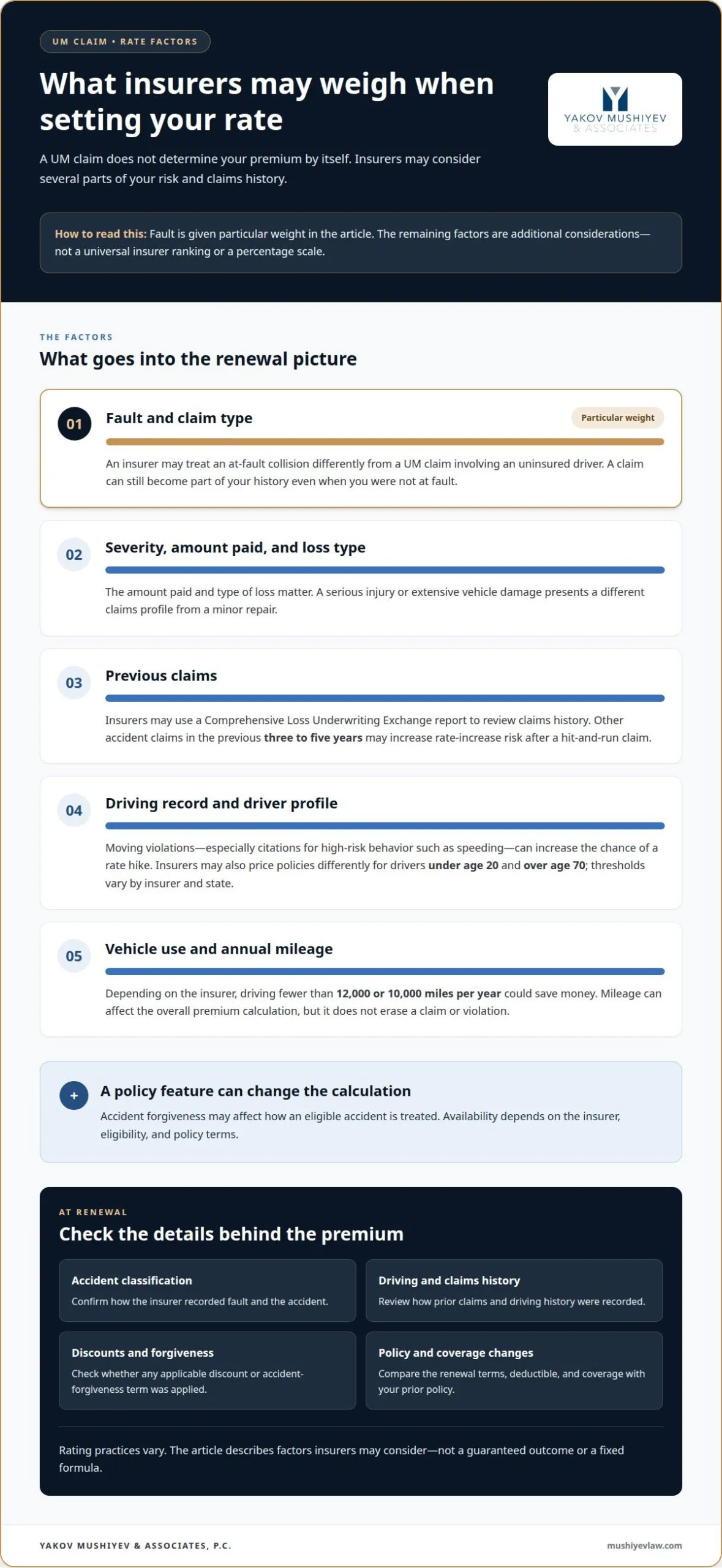
Factors insurers consider when setting rates
An insurer doesn’t assess a UM claim in isolation. It may consider fault, your driving record, the claim’s severity, and other details related to the risk of insuring your vehicle. Rating practices vary, so two drivers in similar accidents may receive different renewal premiums.
Fault can carry particular weight after a car accident. An insurer may treat an at-fault collision differently from a UM claim involving an uninsured driver, but the claim can still become part of your history. The amount paid and type of loss matter, too. A serious injury or extensive vehicle damage presents a different claims profile from a minor repair.
Your prior claims can influence how a new filing is assessed. Most insurance companies obtain a Comprehensive Loss Underwriting Exchange report to review a customer’s claims history. A UM claim may appear alongside earlier accidents, even when fault differs. A driver with other accident claims in the previous three to five years may face greater rate-increase risk after a hit-and-run claim.
Driving history adds another layer. Moving violations, especially citations for high-risk behavior such as speeding, can increase the chance of a rate hike after a hit-and-run claim. Insurers may also price policies differently for drivers under age 20 and over age 70, with thresholds varying by insurer and state. Accident forgiveness can change the calculation for eligible drivers and certain accidents.
Vehicle use and annual mileage may also shape a car insurance rate. Depending on the insurer, driving fewer than 12,000 or 10,000 miles per year could save money. That factor doesn’t erase a claim or a violation, but it can affect the overall premium calculation. At renewal, review how the insurer classified the accident, recorded your driving history, and applied any discounts or forgiveness terms. Those details help explain why filing alone doesn’t determine the final rate.
How do state laws regulate rate increases for UM claims?
State law can limit how insurers treat a UM claim, a not-at-fault crash, or a policy renewal. Rules differ across the United States, so the same claim can have different consequences depending on where the policy was issued. Separate rules may address premium surcharges, nonrenewal, or claims an insurer did not pay.
Georgia law provides two distinct protections to understand. O.C.G.A. § 33-9-40 prohibits an insurer from surcharging a premium or canceling a motor vehicle policy because an insured person was involved in a multivehicle accident when that person wasn’t at fault. O.C.G.A. § 33-24-45 permits nonrenewal only after more than two specified incidents in 36 months, including not-at-fault accidents and UM/UIM claims. These statutes address different insurer actions.
That distinction matters at renewal. A restriction on premium surcharges doesn’t necessarily determine whether a policy can be nonrenewed under a separate rule. If you receive a notice after a UM/UIM claim, identify whether it changes your premium, alters your coverage, or declines renewal. Compare the insurer’s stated reason with the rule that applies in your state.
Texas law addresses a different situation: insurers can’t charge policyholders more for claims they didn’t pay, including claims denied because the policy doesn’t cover the damage. This applies to unpaid claims, not necessarily every paid UM claim. The claim’s payment status and the stated reason for a renewal change are important.
For a practical review, keep the renewal notice, claim decision, and relevant policy language together. Ask the insurer to explain any change in writing and identify the state rule or policy term it relied on. Compare the explanation with the accident’s fault finding and whether the UM/UIM claim was paid. State protections can limit an insurer, but the exact rule depends on your state and the action taken.
Yakov Mushiyev & Associates, P.C.
Yakov Mushiyev & Associates, P.C. represents people injured in accidents, including drivers dealing with uninsured or underinsured motorist claims. For injured people in Rosedale, Rochdale, and Queens, the firm can help clarify how an accident, insurance coverage, and the insurer’s position relate to a potential injury claim. Its legal representation includes car, truck, motorcycle, and slip and fall accidents. Consider speaking with an attorney if fault is disputed, you’ve been injured, or the insurer’s handling of your claim raises concerns. Legal guidance can help you understand the issues and consider your next steps without assuming that filing a UM claim automatically raises your premium. For help with an accident claim, contact Yakov Mushiyev & Associates, P.C.
Take the Next Step With a Clear Plan
If you’re still asking whether your insurance rates will go up if you file a UM claim, consider what the insurer’s decision means for your injury claim and potential recovery. A premium concern shouldn’t leave you uncertain about the accident itself. Keep your policy documents, claim correspondence, and records of your losses together so you can explain the situation clearly.
Whether a rate change is justified depends on your policy, the claim, and applicable state rules. If the accident caused injuries or you’re concerned about the insurer’s handling, legal guidance can help you understand the issues and decide how to proceed. Yakov Mushiyev & Associates, P.C. represents people injured in car accidents in New York, including Rosedale, Rochdale, and Queens.
Contact Yakov Mushiyev & Associates, P.C. to discuss your accident claim and possible next steps. A clear plan can help you move forward with greater confidence.
Frequently Asked Questions
Should you file a claim for an accident or pay out of pocket?
Before deciding how to handle vehicle damage, compare the likely repair cost with your deductible and consider whether anyone was injured. A minor repair presents a different decision from a crash involving injuries or substantial damage. Report the accident as soon as it’s safe, and review your policy’s reporting terms. Paying for repairs yourself doesn’t resolve questions about fault or injury losses.
How much does auto insurance go up after a claim?
After an at-fault accident, U.S. car insurance rates may increase from 0% to 50% or more. Whether your insurance rates will go up if you file a UM claim depends on how the claim is classified and the insurer’s rating rules. A percentage alone can’t predict your new premium. Compare the renewal notice with your prior policy to identify what changed.
What factors can impact my rate after filing an accident claim?
Insurers may consider fault, claim severity, prior claims, and driving violations. They may review claims history through a Comprehensive Loss Underwriting Exchange report. Consumers can obtain a free copy of their claims history report each year. Reviewing it can help you spot an inaccurate accident entry and raise it with the reporting organization or insurer.
Does my insurance go up if I hit someone or if someone hits me?
An at-fault accident is more likely to affect your rate than a crash caused by another driver. A not-at-fault accident can still affect rates in some states, depending on state rules and insurer practices. For example, an insurer may treat a hit-and-run claim differently from a collision where the other driver is identified. Keep the claim classification and renewal explanation for your records.
What About Nonrenewal Risks?
Nonrenewal means the insurer declines to continue your policy at renewal; it isn’t the same as a premium increase. If you receive a nonrenewal notice after a UM claim, ask the insurer to explain its reason and identify the incidents it considered. Compare the notice with your claim records and applicable state rules, and address any factual errors promptly.
What Should You Do?
Report an accident promptly once it’s safe, keep claim correspondence, and read the insurer’s decision carefully. If a renewal change or claim dispute follows an injury crash, organize your policy, notices, and accident documents before seeking legal guidance. Yakov Mushiyev & Associates, P.C. represents people injured in car accidents. Contact the firm for a free consultation. This FAQ offers general information, not legal advice for your specific case.