
What if the hardest part of recovering from an accident is an injury no one else can see? If you’re asking, “can I get compensation for PTSD after an accident,” the answer depends on how the condition relates to the accident, the evidence supporting it, and the New York rules that apply to your claim.
PTSD can affect sleep, work, relationships, and everyday travel. Those effects are real, but insurers may scrutinize psychological injuries closely. A prompt evaluation and consistent treatment records can help document your symptoms and how they affect daily life.
This article explains how PTSD may factor into an accident claim, what records can help document the diagnosis and its effects, and why New York rules require careful review. For motor vehicle claims, the serious-injury threshold may also matter, and deadlines can depend on the circumstances. If you’re in Rosedale, Rochdale, or elsewhere in Queens, the sections ahead offer practical guidance for understanding the issues without assuming that any particular claim will qualify or guarantee a result.
Key Takeaways
- Whether you can get compensation for PTSD after an accident depends on how the condition relates to the incident and the New York rules that apply to your claim.
- No-fault benefits and the serious-injury threshold may affect motor vehicle claims in different ways.
- Medical records, treatment history, and documentation of changes in everyday functioning may help show the diagnosis, its connection to the accident, and its impact.
- Potential losses may include treatment expenses, income effects, and non-economic harm, but recovery depends on applicable law and supporting evidence.
- Seek prompt care, keep relevant records, track changes in symptoms, and get a timely review of the deadlines that may apply.
Can PTSD After an Accident Support a Compensation Claim in New York?
The accident may be over, but its effects can follow you into your sleep, work, relationships, and everyday travel. If you’re wondering, “can I get compensation for PTSD after an accident,” the answer may depend on whether reliable evidence connects the condition and its effects to the accident, as well as the New York rules governing the claim. A psychological injury deserves serious attention, even when it leaves no visible mark.
PTSD is a recognized mental health condition that can develop after experiencing or witnessing a traumatic event. Distress after an accident does not, by itself, establish PTSD, and this article can’t diagnose you. A qualified mental health professional can evaluate your symptoms, how long they have lasted, and how they affect your life. For general background, see Understanding Post-Traumatic Stress Disorder.
This video discusses psychological evidence in personal injury cases, including PTSD claims in New York:
What does accident-related PTSD mean?
After trauma, a person might have recurring memories or nightmares, avoid reminders of the event, feel constantly on edge, or have difficulty concentrating or sleeping. Symptoms vary, and experiencing one or more does not establish a diagnosis. A mental health professional can evaluate the symptoms and how long they have lasted, then determine what care may be appropriate.
If symptoms appear or begin interfering with daily life, seek prompt evaluation. Tell the professional what changed after the accident and how those changes affect ordinary activities. Getting care matters for your well-being, whether or not you later pursue a legal claim.
Can emotional harm count when injuries are not visible?
Yes. Psychological harm can be serious even when there is no obvious external injury. However, distress alone does not establish that a legal claim qualifies for compensation. Medical evaluation and records can help document what you’re experiencing. The legal analysis must separately consider the accident, the evidence, and the rules that apply.
A possible claim does not guarantee eligibility or compensation. The evidence may need to show more than a person’s account of distress or the existence of a diagnosis. It may also need to explain how the condition relates to the accident, affects functioning, or creates losses. This can be especially important in New York, where the legal treatment of psychological injuries depends on the type of accident and claim. Getting care supports your health; whether compensation may be pursued is a separate question that requires a case-specific review.
How New York Rules Can Affect PTSD Accident Claims
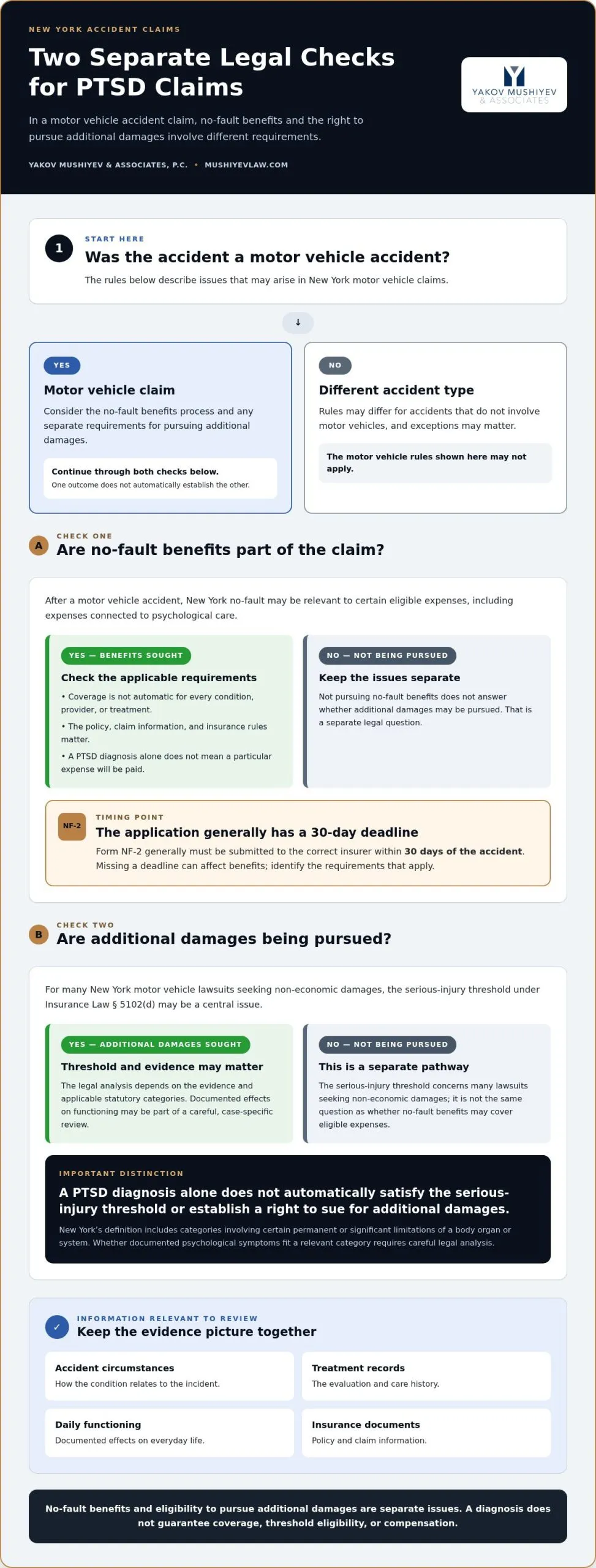
A New York motor vehicle accident claim may raise two separate questions: whether no-fault benefits can help with eligible accident-related expenses, and whether you can pursue additional damages from another party. Each has different legal requirements. If you’re asking, “can I get compensation for PTSD after an accident,” the answer depends on the type of claim, the evidence, and the law that applies to your circumstances.
No-fault benefits and eligibility to pursue additional damages are separate issues. Receiving one does not automatically establish a right to recover the other. That distinction matters when psychological treatment, lost income, and non-economic harm are part of the claim.
How can New York no-fault benefits relate to PTSD care?
After a motor vehicle accident, New York’s no-fault system may be relevant to certain treatment expenses, including expenses connected to psychological care. Coverage is not automatic for every condition, provider, or treatment. The policy, claim information, and insurance rules matter, so a diagnosis alone does not mean a particular expense will be paid.
Timing matters. An application for No-Fault benefits, Form NF-2, generally must be submitted to the correct insurer within 30 days of the accident. Missing a deadline can affect benefits, so promptly identify the applicable requirements. A lawyer can assess how the benefits process relates to the broader accident claim.
Why might the serious-injury threshold matter?
For many New York motor vehicle lawsuits seeking non-economic damages, the serious-injury threshold under Insurance Law § 5102(d) may be a central issue. A PTSD diagnosis alone does not automatically satisfy that threshold or establish a right to sue for additional damages. The legal analysis depends on the evidence and the statutory categories that apply.
New York’s serious-injury definition includes categories involving certain permanent or significant limitations of a body organ or system. Whether psychological symptoms and their documented effects fit a relevant category requires careful, case-specific legal analysis. Don’t assume that a condition qualifies or fails to qualify based on its name alone.
Keep the issues distinct: no-fault benefits may address eligible economic losses, while pursuing additional damages can involve a separate threshold and proof. A careful review can consider the accident circumstances, treatment records, effects on daily functioning, and insurance documents. Rules may differ for accidents that do not involve motor vehicles, and exceptions may matter.
If you need help understanding how these New York rules fit together, speak with a New York accident-claim lawyer about the facts and deadlines that may apply. A legal assessment can identify issues to examine without promising eligibility or a particular result.
What Evidence Can Help Connect PTSD to an Accident?
Useful evidence can help explain four related questions: whether a mental health professional evaluated the condition, how it relates to the accident, what care followed, and how symptoms affect daily functioning. No single document guarantees that an insurer or court will accept a claim. A clear, accurate record of what happened and how its effects developed can help show the full picture.
Consistent clinical records can help show how symptoms and treatment changed over time, but they do not guarantee a legal outcome. Preserve records as they are. Don’t alter notes or exaggerate symptoms to strengthen a claim. If you’re asking, “can I get compensation for PTSD after an accident,” reliable documentation can help an attorney assess the evidence alongside the law that applies.
Which treatment records may document PTSD?
Seek prompt evaluation when symptoms appear or interfere with daily life. A clinician’s records may include evaluation notes, a diagnosis, treatment recommendations, follow-up visits, attendance, and changes you report during care. Mental health professionals may also document their clinical observations. Together, these records can help trace symptoms, care, and progress. No one appointment determines the legal outcome.
Be open with your provider about the accident, when symptoms began, and what you’re experiencing. If sleep problems, distress in vehicles, or difficulty concentrating affect you, describe those effects in specific, everyday terms. Accurate details support your care and create a more dependable record than guessing what an insurer wants to hear or trying to use legal language.
How can records show the accident’s impact on daily life?
Clinical notes are one part of the picture. A simple, factual timeline can help you recall when symptoms began and how routines changed. Record dates when possible, what happened, and the effect, without speculating about causes beyond your experience.
- Note changes in sleep, travel, work tasks, or social and family activities.
- Keep relevant employment records that show absences, schedule changes, or difficulty performing your usual duties.
- Preserve messages or statements from people who personally noticed changes in your day-to-day life.
For example, note if you began avoiding your regular commute after the accident and describe what happens when you try to travel. A dated, specific account is more useful than a broad conclusion such as “everything is worse.”
Be honest about prior mental health history. It does not automatically resolve whether an accident caused or worsened symptoms, or determine the value of a claim. Relevant records may help a professional and legal team assess the timeline and distinguish earlier experiences from later changes. Share accurate information with your provider and preserve existing records. A New York attorney can then evaluate how the documentation fits the broader claim.
What Compensation and Claim Challenges Should You Understand?
A PTSD claim may involve several kinds of losses, but documenting a loss does not guarantee that it will be covered or recovered. Records should help show what you paid, how your ability to work changed, and how the condition affected your life. What may be pursued in New York depends on the evidence, the type of accident, the applicable legal rules, and the specific facts of the claim.
Which kinds of losses may be considered?
Potential losses generally fall into three categories. Treatment-related expenses may include documented mental health care, but payment or reimbursement depends on applicable coverage and law. Income-related losses may involve missed work or changes in job duties; records can help explain and support the claimed impact. Non-economic harm refers to the personal effects of an injury, such as distress and disruption to ordinary activities. Whether that harm is legally recoverable depends on the rules that apply, including rules relevant to certain New York motor vehicle claims.
This comparison can help organize your information. It does not guarantee that a particular item will be accepted or paid.
| Loss category | Examples of supporting records | Key limitation |
|---|---|---|
| Treatment-related expenses | Invoices, receipts, and treatment records | Coverage and recovery depend on applicable insurance and law. |
| Income effects | Pay records, attendance information, and employer documentation | Records should support the claimed work impact and losses. |
| Non-economic harm | Clinical notes and records describing effects on daily activities | Legal recovery depends on the claim type and applicable New York rules. |
Why can a PTSD claim be disputed?
An insurer may question whether the diagnosis is supported, whether symptoms relate to the accident, how severe or persistent they are, or how they affect daily functioning. These are issues that may require careful review, not assumptions about how an insurer or court will decide.
Consistent treatment records and a clear timeline can help address gaps. For example, a treatment note documenting travel difficulties alongside records of missed work may provide context about how symptoms affect daily life. Keep records accurate and preserve relevant documents rather than trying to shape them around a claim.
An early settlement offer is a starting position, not a reliable valuation of the full claim. Before accepting, have a New York lawyer review the offer, supporting evidence, and any relevant limits on recovery. A settlement can affect your ability to seek further compensation, so understand what it resolves before deciding.
For a case-specific assessment of documented losses and New York claim issues, discuss your accident claim with a New York lawyer. No outcome is automatic, but a careful review can clarify which evidence and legal questions matter.
How to Take the Next Steps After Accident-Related PTSD Symptoms
Take practical steps that support your health and preserve useful information. You don’t need to decide whether you have a legal claim before seeking care. If you’re asking, “can I get compensation for PTSD after an accident,” prompt evaluation and a timely review of New York claim rules can help clarify your options.
- Seek care promptly. Tell a qualified professional what symptoms you’re experiencing and when they began.
- Keep relevant records. Save treatment information, insurance correspondence, accident documents, and records of related expenses.
- Note changes over time. Keep a factual timeline of symptoms and their effects on work, sleep, relationships, or travel.
- Get New York claim guidance. Deadlines vary by claim and defendant, so promptly find out which dates and requirements may apply to your circumstances.
For a clearer picture of the steps involved, the New York personal injury claim process can provide helpful context. If the accident involved a car, the Queens car accident guide offers information focused on that type of claim. General information and a diagnosis cannot determine the outcome of an individual case.
What should you prepare for a legal consultation?
Bring what you have: accident details, available medical records, treatment information, insurer correspondence, and your symptom timeline. Explain in your own words how symptoms affect everyday life. You don’t need to prove a legal conclusion or have every document in hand. A consultation can help you discuss the facts and possible options, but it cannot guarantee that a claim qualifies or result in compensation.
How can a New York lawyer help assess the claim?
A lawyer can review how the evidence connects the condition to the accident, which records may be relevant, what insurance issues arise, and which deadlines or damages may need analysis. Counsel can also assess how New York rules apply to the specific accident instead of assuming every PTSD claim is treated the same way.
Yakov Mushiyev & Associates, P.C. represents injured people in New York City’s five boroughs and Nassau County, including people in Rosedale, Rochdale, and Queens. The firm handles accident-related injury claims, including motor vehicle, construction accident, and slip and fall cases. Consultations are free and available 24/7 in English, Russian, and Spanish. They can take place by video or at your home or hospital. The firm works on a contingency basis: No fee unless we win.
If you’re ready to discuss your circumstances, schedule a free consultation about your New York accident claim. A careful review can help you understand possible next steps without promising a particular outcome.
Take a Clear Next Step Toward Understanding Your Options
It can take courage to put a difficult experience into words, especially when the effects aren’t visible to others. You don’t have to resolve every legal question on your own before seeking guidance. If you’re still wondering, “can I get compensation for PTSD after an accident,” an individual review can help clarify what the evidence may show and which New York rules could affect your options. No lawyer can promise a particular result, but a careful assessment can help identify a practical path forward.
Yakov Mushiyev’s Avvo rating is 10.0, described as Superb. That recognition does not predict the outcome of an individual claim, but it is one professional credential readers may consider when seeking legal guidance.
Yakov Mushiyev & Associates, P.C. offers free consultations 24/7 in English, Russian, and Spanish. To discuss an accident claim in Rosedale, Rochdale, Queens, or elsewhere in the firm’s service area, schedule a consultation with Yakov Mushiyev & Associates.
Frequently Asked Questions
Can PTSD symptoms appear after a delay following an accident?
Yes. Symptoms may not feel clear immediately after a traumatic event, and their timing can vary. If distress, sleep problems, intrusive memories, or avoidance appear or worsen, seek prompt evaluation from a qualified health professional. Note when you first noticed each change and whether it affects particular situations, such as riding in a car or returning to work. This FAQ provides general information, not legal advice for your specific case.
Does a PTSD diagnosis automatically qualify me for compensation in New York?
No. A diagnosis alone does not guarantee compensation. Whether you can get compensation for PTSD after an accident depends on facts such as the connection between the condition and the accident, documented losses, and applicable New York rules. Motor vehicle claims can raise additional insurance and legal-threshold questions. A health professional evaluates your condition; a lawyer can assess legal issues. This FAQ is general information, not legal advice for your specific case.
Can I seek compensation for PTSD if I had anxiety before the accident?
A history of anxiety does not automatically answer whether an accident caused or worsened later symptoms. The timing of changes, your clinical evaluation, treatment records, and other facts may help clarify the picture. Tell your healthcare provider about prior and current symptoms, including any changes in intensity or daily effects. Complete information supports an accurate evaluation. This FAQ offers general information, not legal advice for a specific case or a prediction about any claim.
Does New York no-fault insurance pay for PTSD treatment after a car accident?
No-fault coverage may be relevant to treatment after a motor vehicle accident, but payment depends on current rules, policy details, and the circumstances. An application for No-Fault benefits generally must be submitted within 30 days of the accident. Seek care promptly, keep appointment and billing records, and promptly identify the requirements that apply to your claim. This FAQ is general information, not legal advice for a specific case; a lawyer can review the relevant facts.
Can I pursue a PTSD claim if I had no physical injury?
The absence of a visible injury does not, by itself, determine whether a claim may be pursued. New York motor vehicle cases can involve legal requirements, including potential threshold issues, that call for review of the specific facts. Records may help explain the condition and its relationship to the accident. Don’t assume either that an invisible injury prevents a claim or that it establishes eligibility. This FAQ is not legal advice for a specific case or a guarantee.
How can I protect my privacy when getting mental health treatment after an accident?
Ask your healthcare provider how treatment records are stored, shared, and accessed, and raise any privacy concerns before providing information. Keep your own copies of relevant appointment and treatment documents in a secure place. Don’t post about the accident, injuries, health, or case on social media. Set your accounts to private and ask friends not to tag you. Don’t delete existing posts, since destroying evidence can create a larger problem. If a claim is involved, discuss with a lawyer how medical information may relate to it. This FAQ is general information, not legal advice for a specific case.
Do I have to accept an early insurance offer for PTSD-related harm?
An early offer is not a reliable valuation of your claim. Before accepting or signing a release, understand which claims it resolves and whether it could affect future treatment-related claims. Settlement terms can have lasting consequences, and the significance of an offer depends on the evidence and applicable rules. Have a lawyer review it before deciding. This FAQ is general information, not legal advice for a specific case.