
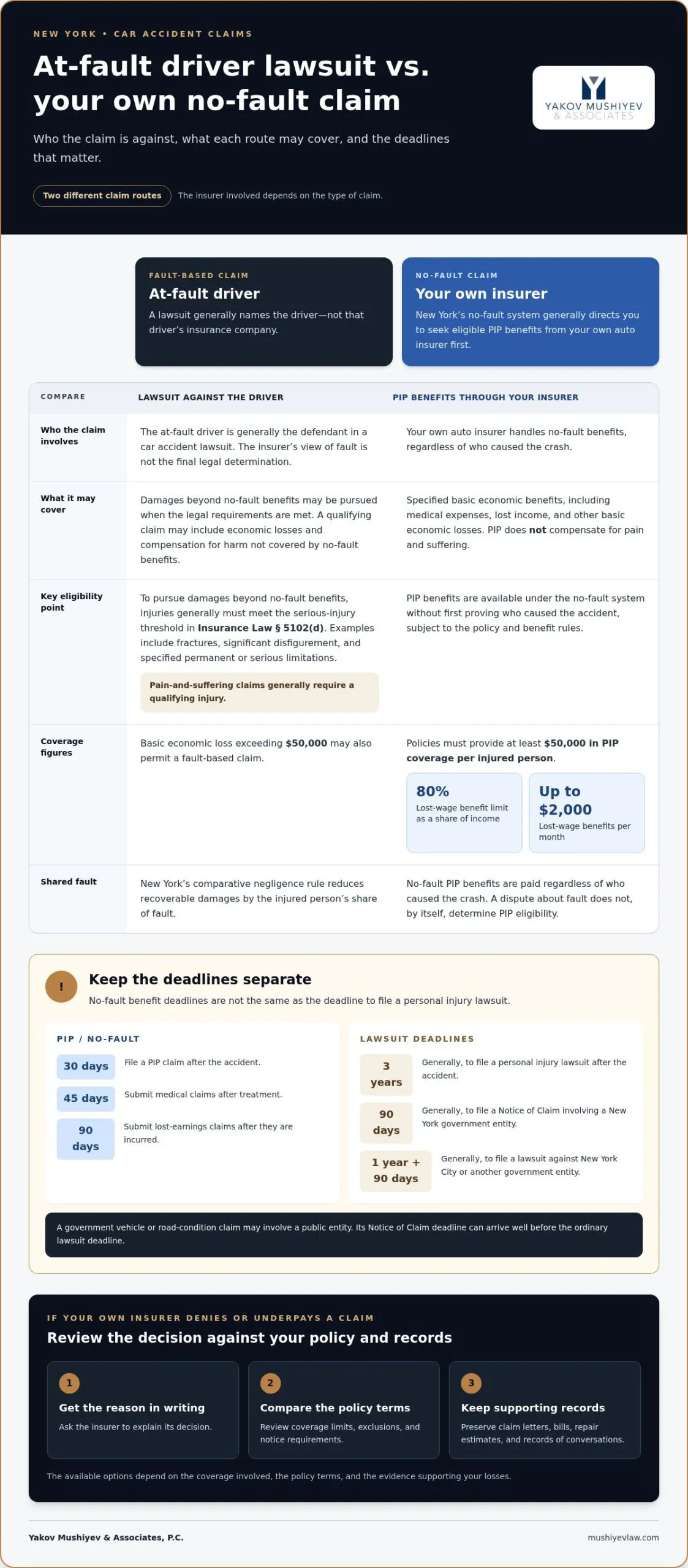
Whether you can sue an insurance company after a car accident in NY depends on whose insurer it is and the type of claim. A lawsuit generally names the at-fault driver, not that driver’s insurance company, while New York’s no-fault system generally requires you to seek eligible benefits from your own insurer first. To pursue damages beyond no-fault benefits, your injuries generally must meet the serious-injury threshold in Insurance Law § 5102(d).
It’s understandable to look to the insurer for answers when medical bills, missed work, and lasting injuries put pressure on your life. But the amount and types of compensation at stake depend on the losses you can claim, the evidence, and whether your injuries meet the legal threshold.
This article explains who may be liable after a New York crash, the deadlines that can affect a lawsuit, and the damages you may be able to pursue beyond basic no-fault benefits. It also covers options when your own insurer denies or underpays a claim.
Key Takeaways
- A car accident lawsuit generally names the at-fault driver, not the driver’s insurer. According to the New York State Senate, injuries must meet the serious injury threshold in Insurance Law § 5102(d) to pursue damages beyond no-fault benefits.
- Mark the filing deadline early: the New York State Senate says personal injury lawsuits generally must be filed within three years after an accident, but claims involving government entities can have shorter deadlines.
- If your own insurer denies or underpays a claim, review the written reason, your policy terms, and the records documenting your losses before considering a dispute.
- Look beyond immediate medical bills: a qualifying claim may include economic losses and compensation for harm not covered by no-fault benefits.
Who Do I Sue After a Car Accident – The Driver or the Insurance Company?
If you’re asking whether you can sue an insurance company after a car accident in NY, the answer usually depends on which insurer and claim are involved. A lawsuit generally names the at-fault driver, while your own insurer handles no-fault benefits first.
Serious Injury Threshold
According to the New York State Senate, injuries must meet the serious injury threshold defined in Insurance Law § 5102(d) for an injured person to sue an at-fault driver for damages beyond no-fault benefits. According to the New York State Senate, injuries must meet the threshold defined in Insurance Law § 5102(d) to sue an at-fault driver for those damages. Qualifying categories include fractures, significant disfigurement, and specified permanent or serious limitations. The threshold matters because pain and suffering claims generally require a qualifying injury.
No-Fault Insurance and PIP Benefits
New York’s no-fault system, also called personal injury protection or PIP, pays specified benefits through your own auto insurer regardless of fault. Policies must provide at least $50,000 in PIP coverage per injured person for medical expenses, lost income, and other basic economic losses. Lost-wage benefits are limited to 80% of income, up to $2,000 per month. PIP does not compensate for pain and suffering, so a fault-based claim may matter when injuries qualify.
Shared blame doesn’t automatically erase a claim. New York’s comparative negligence rule reduces recoverable damages by the injured person’s share of fault. For lawsuits filed on or after May 26, 2026, a plaintiff found more than 50% at fault recovers nothing. The insurer’s view of fault is not the final legal determination.
Deadlines apply to both benefits and lawsuits. File a PIP claim within 30 days after the accident; submit medical claims within 45 days of treatment and lost-earnings claims within 90 days of when incurred. The New York State Senate says a personal injury lawsuit generally must be filed within three years after an accident.
Yakov Mushiyev & Associates, P.C. handles car accident claims on a contingency basis: no fee unless the firm wins. The written fee agreement explains the percentage and how expenses are handled. Review those terms before signing.
New York car accident personal injury lawsuit deadline
New York generally allows three years after a car accident to file a personal injury lawsuit. According to the New York State Senate, that deadline applies to lawsuits seeking compensation for injuries. Filing late can cost you the right to pursue damages, even when medical bills and evidence support your claim. This is the lawsuit deadline, not the separate deadline for applying for no-fault benefits.
Claims involving government entities move faster. A person generally must file a Notice of Claim within 90 days of an accident involving a New York government entity. A lawsuit against New York City or another government entity generally must be filed within one year and 90 days after the accident. A poorly maintained road or traffic signal may involve a public entity, so identify potential defendants early.
You can sue for pain and suffering when your injury meets New York’s serious-injury threshold. Insurance Law § 5102(d) includes categories such as fractures, significant disfigurement, and specified permanent or serious limitations. Basic economic loss exceeding $50,000 may also permit a fault-based claim. The prior 90/180 rule treated certain non-permanent injuries as serious when they restricted substantially all usual activities for at least 90 days during the first 180 days after a crash. The rules for applying this threshold may depend on the circumstances of the case.
New York’s no-fault coverage pays eligible benefits regardless of who caused the crash, but it doesn’t pay pain-and-suffering damages. Florida uses its own PIP system: coverage can pay up to 80% of medical expenses, regardless of fault. Florida’s rule does not determine a New York claim; the location of the accident and applicable law matter.
Preserve medical records, bills, and evidence of missed work while deadlines approach. For an accident involving a government vehicle or road condition, the 90-day Notice of Claim deadline can arrive well before the ordinary lawsuit deadline. An injured minor’s filing period may be paused until age 18, while temporary incapacity may also affect timing. These exceptions depend on the circumstances, so don’t assume they extend a deadline.
Suing your own insurer for a denied or underpaid claim
You may dispute your own insurer’s decision if it denies benefits or pays less than your policy provides. The options depend on the coverage involved, the policy terms, and the evidence supporting your losses.
Denied or Underpaid Claims
A denied or underpaid claim is a dispute about benefits you believe your policy covers. Ask the insurer to explain its decision in writing, then compare the reasons with your policy’s coverage limits, exclusions, and notice requirements. Keep claim letters, bills, repair estimates, and records of conversations. These documents can help clarify whether the dispute concerns coverage, liability, or the value of your losses.
UM/UIM and Other Coverage Claims
Uninsured and underinsured motorist coverage, known as UM/UIM, may apply when the other driver lacks sufficient liability insurance. New York Insurance Law § 3420(f) requires insurers to offer supplemental UM/UIM coverage. Minimum coverage for non-fatal injury is $25,000 per person and $50,000 per accident; for fatal injury, it is $50,000 per person and $100,000 per accident. Your policy’s limits shape what you may recover.
Insurance Claim and Lawsuit Deadlines
Policy notice requirements and legal filing deadlines are separate obligations. A New York personal injury lawsuit generally must be filed within three years after the accident, while an insurance policy may set its own claim-notification steps and deadlines. Keep the accident date, insurer notices, and claim correspondence together. Starting an insurance claim does not waive your right to sue later.
A claim against the other driver’s insurer works differently: the driver is generally the defendant in a lawsuit, and the insurer handles the defense under the policy. Before accepting a settlement, review the release carefully. Signing one generally ends your ability to seek additional money under that settlement, even if later medical bills or other losses exceed your expectations.
Damages available after a New York car accident
New York car accident damages can include financial losses and, when the serious-injury threshold is met, pain and suffering. No-fault benefits cover specified basic economic losses, but not pain and suffering. When the injury qualifies, a fault-based lawsuit may seek damages beyond those benefits. Each claimed loss needs evidence connecting it to the crash.
Economic damages may include medical expenses, lost earnings, and other necessary costs. Keep bills, treatment records, wage documentation, and receipts in one file. New York’s basic economic loss definition caps certain reasonable and necessary expenses at $25 per day for one year after the accident. That limit applies to those specified expenses, not every category of damages in a lawsuit.
A qualifying claim may also seek compensation for pain and suffering, which addresses the injury’s physical and personal effects. Medical records can document the diagnosis, treatment, restrictions, and continuing symptoms. A fracture, for example, is one of the serious-injury categories identified under New York law. When assessing damages, an attorney considers how the injury affects daily activities, work, and ongoing care, along with the available records.
New York places no overall statutory limit on the amount a person can pursue in a car accident lawsuit. However, the evidence must support the losses claimed, and comparative negligence can reduce recovery by the injured person’s share of fault. Punitive damages have no statutory cap in New York, but they are distinct from compensation for ordinary losses. A lawyer can assess whether the facts support including them.
Organize medical expenses, missed-work records, and proof of continuing limitations before evaluating a settlement. For help assessing the losses connected to your crash, discuss your car accident damages.
Yakov Mushiyev & Associates, P.C: Car Accident Legal Representation
Yakov Mushiyev & Associates, P.C. represents people with car accident injuries, disputed liability, or insurance delays. The firm can help explain who may be responsible, how no-fault benefits interact with a lawsuit, and what evidence may support your damages.
The firm can review the accident details, injury records, insurance correspondence, and deadlines relevant to your claim. This can help clarify the legal issues and possible next steps. The firm also represents clients in truck and motorcycle accident cases, as well as slip and fall matters.
If an accident has left you weighing a claim or an insurer’s decision, contact Yakov Mushiyev & Associates, P.C to discuss your situation.
Choose Your Next Step With Confidence
If you’re still weighing whether you can sue an insurance company after a car accident in NY, focus on preserving your options. Keep insurer letters, treatment records, and notes on how the crash affects your daily life together. A clear record can help you discuss the dispute and your goals while keeping your recovery and financial stability in view.
Yakov Mushiyev & Associates, P.C. can help you assess a car accident claim and understand the legal path forward. You don’t need to sort through an insurer’s position alone. Share the facts, ask direct questions, and make an informed decision about what comes next.
Contact Yakov Mushiyev & Associates, P.C. to discuss your car accident matter. Take the next step at your pace, with a clearer view of your options.
Frequently Asked Questions
Who Can I Sue After a Car Accident in New York?
Usually, you sue the driver whose negligence caused the crash, not that driver’s insurance company. Depending on the facts, a vehicle owner who permitted the driver to use the car, or an employer whose worker was driving for work, may also face liability. A dispute over benefits under your own policy is different. For people in Rosedale, Rochdale, and Queens, identifying potentially responsible parties can shape the claim.
Can I Sue After a Car Accident if I’m Not at Fault?
Yes. If another driver caused the collision, you may pursue a fault-based claim when New York’s legal requirements are met. A qualifying serious injury or basic economic loss exceeding no-fault benefits may open that route. Keep photographs, witness details, repair records, and medical documents together. These materials can help show how the crash happened and connect your losses to the other driver’s conduct.
How Much Can Someone Sue for After a Car Accident?
New York has no general statutory cap on the compensation a person may pursue in a car accident lawsuit. The amount depends on supported losses, such as medical expenses, lost earnings, and pain and suffering when the injury qualifies. Available insurance limits can affect what may be collected from a policy, but they don’t define the driver’s legal responsibility for your losses.
How long after an accident can you sue for personal injury in NY?
Generally, you have three years after the accident to file a personal injury lawsuit, according to the New York State Senate. Claims involving government entities require earlier action: a Notice of Claim is generally due within 90 days, and the lawsuit generally within one year and 90 days. A wrongful death lawsuit generally has a separate two-year deadline from the date of death.
Can I Still Receive Compensation if I’m Partially at Fault?
Yes. New York reduces compensation according to your share of fault. For example, if total damages are $100,000 and you’re found 20% responsible, the reduction leaves $80,000 before other applicable issues. For lawsuits filed on or after May 26, 2026, a plaintiff found more than 50% at fault recovers nothing. Evidence about each driver’s actions can affect the fault assessment.
Can I Sue After a Car Accident if I Was a Passenger?
Yes. A passenger may seek available no-fault benefits and pursue a fault-based claim against a negligent driver when legal requirements are met. Potentially responsible drivers can include the person operating the vehicle you rode in or another motorist. For example, a passenger in a two-car collision may have a claim involving either driver, depending on the evidence and how the crash occurred.
These answers provide general information and are not legal advice for your specific case.