
Think of your knee as a hinge held together by four ropes. When one of those ropes frays or snaps, or the cartilage cushion inside the hinge tears, everything you do on two legs gets harder: stairs, squats, the walk to the bus stop, kneeling to tie a kid’s shoe. If a crash, a fall or a jobsite accident did that to your knee anywhere from Astoria to Hempstead, this guide walks through how the joint gets hurt, what the insurance company tends to argue, and what a knee injury lawyer looks for in your records to answer back.
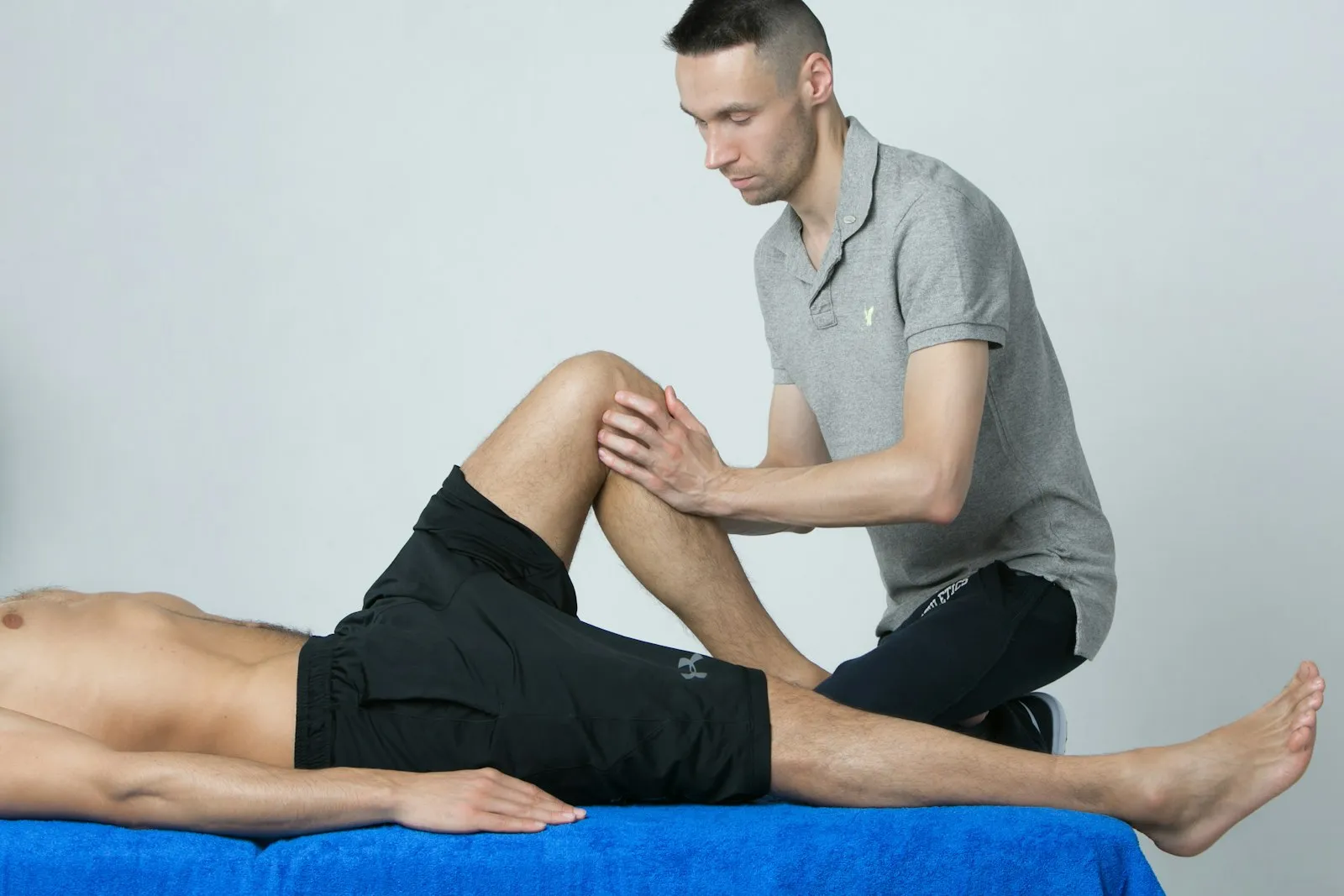
The Hinge and the Four Ropes
Here is the coaching version of knee anatomy. The thighbone sits on top of the shinbone, and the kneecap (the patella) rides in a groove at the front. Four main ligaments hold the hinge in line:
- ACL (anterior cruciate ligament): runs through the middle of the joint and stops the shin from sliding forward. Sudden pivots and awkward landings are its enemy.
- PCL (posterior cruciate ligament): the ACL’s partner, stopping the shin from sliding backward. A hard blow to the front of a bent knee is the classic way to hurt it.
- MCL (medial collateral ligament): on the inside of the knee, resisting a push from the outside in.
- LCL (lateral collateral ligament): on the outside, resisting the opposite push.
Between the two big bones sit two C-shaped pads of cartilage, each called a meniscus. They absorb shock and help the joint glide. A twist with your foot planted can pinch and tear one. Then there are the bones themselves: the kneecap can crack when it hits something solid, and the top of the shinbone (the tibial plateau) can fracture when force drives the thighbone down into it.
Your doctors decide what is torn, what is broken and what to do about it. A knee injury lawyer works from their findings. Our job is different: translating those findings into a claim that holds up.
Three Ways Knees Get Hurt Here
Example one: the T-bone and the dashboard
Picture yourself in the passenger seat when a driver runs a light on Hillside Avenue and hits your side of the car. Your body lurches, your bent knee drives into the dashboard, and the shin gets shoved backward. Doctors call this pattern “dashboard knee.” It can crack the kneecap, tear the PCL, or both. Side-impact crashes come with their own fault questions, which we cover in our piece on T-bone collisions in Queens.
Example two: the subway stairs
Now picture yourself heading down slick station steps with a broken tread edge. Your heel catches, your body keeps going, and you land on one kneecap while the other leg twists underneath you. That single fall can bruise or fracture the patella and tear a meniscus on the opposite side. Claims against the transit system have tight notice rules, explained in our guide to suing the MTA over a station fall.
Example three: the scaffold step
Last scenario: you are stepping off a scaffold platform that was never secured, it shifts, and you drop several feet onto a concrete slab. You land stiff-legged. The force can split the tibial plateau or rupture the ACL. Height-related accidents like this one bring special New York statutes into play, discussed below.
Car Crash Knees: No-Fault First, Then the Threshold
When a motor vehicle is involved, New York runs two tracks. Track one is no-fault coverage. Think of it as the team’s first-aid kit: your own auto policy (or, for a pedestrian, the striking car’s policy) covers treatment and a slice of missed paychecks, and blame never enters the picture. Insurers generally want that application on their desk inside a month of the collision, so file it early. Our no-fault claims guide explains the forms.
The second track is a lawsuit against the careless driver for pain and suffering. Before that door opens, your knee generally has to fit one of the injury categories listed in Insurance Law § 5102(d), the so-called serious injury threshold. For knee cases, three categories come up most:
- Fracture. A broken kneecap or tibial plateau fracture generally clears the threshold by itself. We go deeper on bone injuries in our fracture claims article.
- Permanent consequential or significant limitation. Ligament and cartilage tears usually travel this road. Courts want objective proof, such as range-of-motion numbers measured in degrees and compared to normal, not just a note saying “decreased motion.”
- The 90/180 category. Doctors confirm the knee sidelined you from nearly everything in your normal routine for at least three months out of the first six post-crash.
Expect the insurer to send you to an independent medical exam, and expect that doctor to be skeptical. Know what to expect before you walk in by reading our explainer on IMEs in New York. For the bigger picture on vehicle cases, see our car accident practice page.
Falls: Notice Matters, Threshold Does Not
Slip, trip and stair cases follow different rules. There is no serious injury threshold outside of vehicle claims, so a torn meniscus from a fall in a supermarket or an apartment lobby does not have to meet the § 5102(d) list. The hurdle here is notice. Either the owner caused the puddle, the loose tread or the torn mat, or the owner was told about it, or the problem sat out in plain view for a stretch long enough that a reasonable crew would have spotted and repaired it. Lawyers call that third route constructive notice.
Knees take a beating in falls because people instinctively drop onto them or twist while trying to catch themselves. Photos of the spot, incident reports, witness names and video all help prove the condition and how long it sat there. Ankles often get hurt in the same fall, and our companion post on ankle sprains, fractures and sidewalk falls covers that side. More on property claims lives on our slip and fall page.
Jobsite Knees: The Ladder and Scaffold Rules
Workers hurt on a New York construction site generally collect workers’ compensation from their own employer, and Workers’ Compensation Law § 11 generally makes comp the exclusive remedy against that employer. But the employer is rarely the only party on site.
Labor Law § 240(1) puts duties on property owners and general contractors to protect workers from elevation-related hazards, like the scaffold in example three. Labor Law § 241(6) lets a worker sue owners and contractors when a specific state construction safety rule was broken. Those third-party claims can pay for pain and suffering that comp never covers. Our page on construction accident claims lays out who can be named.
What the Insurer Will Say vs. What the Records Can Show
Every knee case has a playbook on the defense side. Here is how the common plays line up against the evidence that answers them.
| What the insurer will say | What the records can show |
|---|---|
| “That meniscus tear is degenerative. It was there before the accident.” | Prior medical records with no knee complaints, plus a timeline showing pain started right after the event. |
| “The MRI reads as wear and tear.” | The treating surgeon’s operative report, which describes what the surgeon actually saw inside the joint, such as fresh tear edges or bleeding. |
| “There was a gap in treatment, so you must have healed.” | Reasons for the gap (insurance denials, child care, a waiting list for surgery) and a symptom diary kept during that stretch. |
| “It was only arthroscopic surgery. Small incisions, small injury.” | Physical therapy notes with measured range-of-motion losses, work restrictions and follow-up visits showing the knee did not bounce back. |
| “You had arthritis already.” | Evidence that the accident made a quiet condition painful or disabling, which New York law generally treats as compensable aggravation. |
That last row deserves a closer look. The law does not let a careless party demand a pristine victim. If your knee had some age-related wear but you were working, climbing stairs and playing with your grandkids without trouble, and after the crash you could not, the worsening is part of the claim. Insurers like to frame a pre-existing condition as the end of the conversation. It usually is not.
The arthroscopic argument also misses the point. Arthroscopic repair means the surgeon worked through small openings with a camera. It says nothing about how badly the cartilage or ligament was damaged, how long rehab took or whether the knee will stay stable.
Building the Evidence File
A good trainer tracks reps. A strong knee claim tracks proof. These are the items we look for first:
- Imaging: X-rays for fractures, MRI for soft tissue, and any comparison films from before the accident.
- The operative report: if you had surgery, this document is often the single most persuasive record in the file.
- Physical therapy notes: session-by-session measurements of flexion, extension and strength show progress, or the lack of it.
- Your own words: a daily log of pain, swelling, sleep, missed work and activities you gave up. Need a template? Start with our symptom journal walkthrough.
- Scene proof: photos, police or incident reports, and names of witnesses.
Follow up with your doctors and go to your appointments. Missed visits hand the other side its favorite talking point.
Looking Down the Road: Future Knee Care
Some knee injuries keep costing money after the case closes: more therapy, injections, bracing, and in some cases a later knee replacement. A claim can include those future costs, but only when a doctor supports them with a reasoned opinion. A guess from anyone else, including a lawyer, will not carry weight. Read how those numbers are built in our article on calculating future medical expenses. Clients with knee problems often have back or neck injuries from the same event too, and our herniated disc settlement guide covers that piece.
Shared Blame and the Clock
Maybe you were looking at your phone on those subway steps, or crossing mid-block when the car hit you. That does not end the game. Under CPLR § 1411, a jury slices off your percentage and you collect the rest, even if your slice is large. A person found 30 percent responsible keeps the other 70 percent.
Now the game clock. Against a private driver, store or contractor, you generally get three years to file, per CPLR § 214. Against a public body, such as the city, a Nassau town or a transit agency, the first whistle blows much sooner: a formal notice of claim is generally due roughly three months out, as set by General Municipal Law § 50-e, with the lawsuit itself generally following within fifteen months. Three months disappears quickly when you are learning to walk on crutches.
Working With Yakov Mushiyev & Associates
Bad knee, long commute? Not a problem. Attorney Yakov Mushiyev and his staff will meet you at your kitchen table, bedside in the hospital, or by video, and the Rosedale base at 1 Cross Island Plaza is minutes from the parkway that shares its name. Conversations happen in English, Russian or Spanish. The opening consultation costs nothing, and the firm collects a fee only if it wins your case. Over $80 million has been recovered on behalf of injured clients so far. Ready to have a knee injury lawyer go through your MRI and therapy notes? Reach our team online or dial 718.775.3110.
Knee Injury Questions We Hear Often
Is a torn meniscus enough for a car accident lawsuit in New York?
It can be, but a tear alone is not automatically a “serious injury” under the no-fault law. The question is usually whether objective testing shows a significant or permanent limitation in how the knee moves, or whether the injury kept you from your normal routine for 90 of the first 180 days. Measured range-of-motion findings from your treating doctors carry the most weight.
The insurer says my knee problem is just age. What now?
Gather your earlier medical history. If it shows no knee treatment, or only occasional mild complaints, that contrast helps. Even when some degeneration existed, New York generally allows recovery for making a pre-existing condition worse. A knee injury lawyer will often ask your surgeon to explain the difference between old wear and new damage.
Can my knee case succeed without an operation?
Yes. Plenty of people recover through therapy, bracing and injections. Surgery can strengthen the proof because the operative report documents what was inside the joint, but a claim does not depend on it. Your treatment should be driven by your doctor’s advice, never by the case.
I hurt my knee falling on a construction site. Can I sue my boss?
Generally not. Workers’ comp is usually the only remedy against your own employer. You may, however, have a separate claim against the property owner, general contractor or another company on site under the Labor Law, especially if you fell from a height or a safety rule was broken. Our Labor Law 240 and 241 guide goes into detail.
My hip hurts too after the same fall. Should I mention it?
Yes. Tell every doctor about every symptom, even ones that seem minor. Knee and hip injuries often happen together in falls, and an injury left out of early records is harder to connect to the accident later. See our post on hip fracture and replacement claims for more.
Visit Yakov Mushiyev & Associates
Our office is at 1 Cross Island Plaza, Suite 325, Rosedale, NY 11422, just off the Cross Island Parkway on the Queens–Nassau border. If you can’t come to us, we’ll come to you: at home, in the hospital or by video.

Talk to a Queens knee injury lawyer today
Yakov Mushiyev & Associates has recovered over $80 million for injured New Yorkers across the five boroughs and Nassau County. Consultations are free, available in English, Russian and Spanish, and there is no fee unless we win.
Call 718.775.3110 or contact us online for a free case review.
This article is general information, not legal advice. Every case is different. Attorney Advertising.