
Yes, you can still seek compensation if you weren’t wearing a helmet in Nassau County. New York’s pure comparative negligence rule does not automatically bar a claim against a negligent driver, although your damages may be reduced if your own conduct contributed to the crash. Whether helmet use affected an injury may be considered when assessing damages.
New York requires motorcycle operators and passengers to wear approved helmets, so riding without one may raise legal and insurance issues. But not wearing a helmet does not, by itself, establish that you caused the collision or that every injury resulted from helmet nonuse.
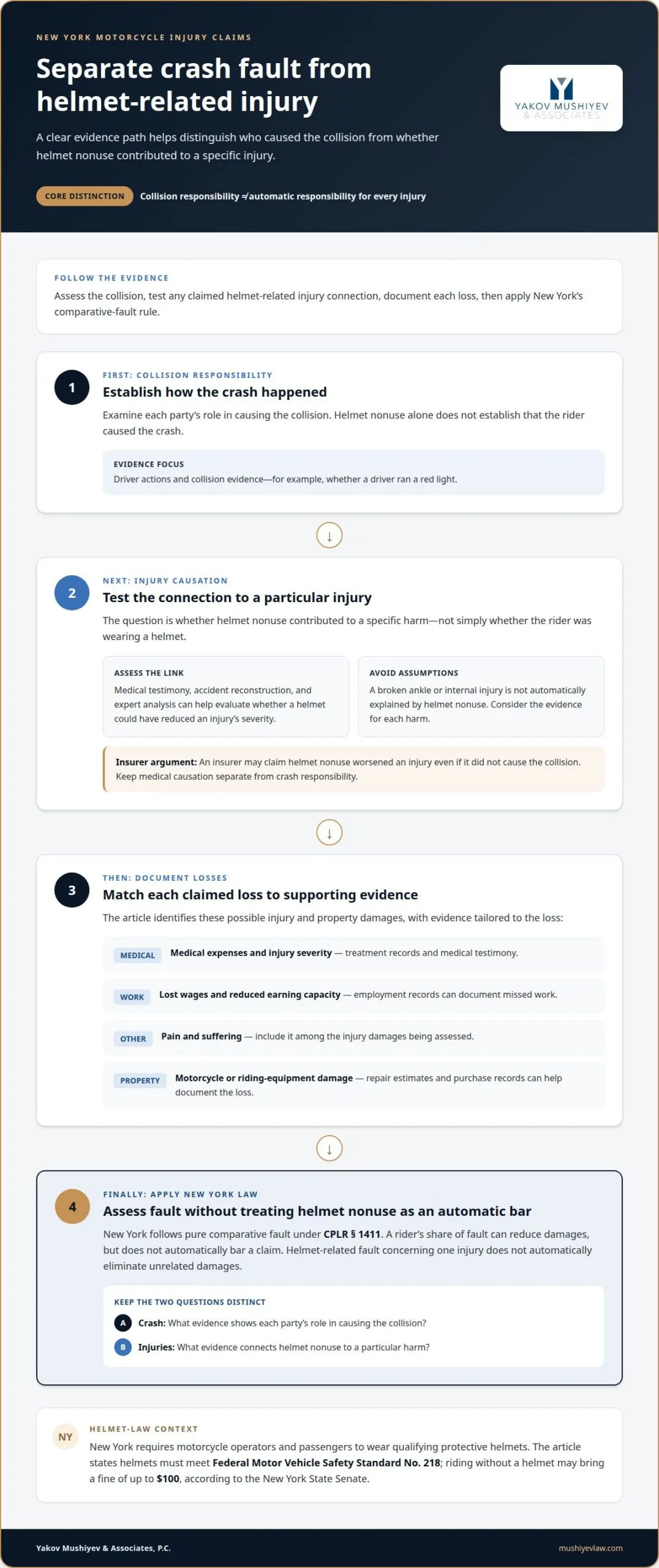
The key distinction is between what caused the crash and what caused or worsened your injuries. This article explains how New York’s helmet law applies, when not wearing a helmet may affect injury damages, and what evidence can help establish the difference.
Key Takeaways
- New York requires motorcycle operators and passengers to wear approved helmets, and the New York State Senate says riding without one may bring a fine of up to $100.
- Helmet use can be relevant to assessing injury damages, and evidence about the injuries may help clarify whether helmet use would have affected them.
- Separate the evidence about how the crash happened from evidence about how your injuries occurred and what losses followed.
- Motorcycle accident legal representation can help address disputed fault, injury evidence, and the insurer’s arguments about your claim.
Can I Still Get Compensation If I Wasn’t Wearing a Helmet in My Motorcycle Crash?
Yes. In New York, not wearing a helmet does not automatically prevent you from seeking compensation after a motorcycle crash. When handling these claims for clients throughout Rosedale, Rochdale, Queens, and neighboring regions handling Nassau County matters, Yakov Mushiyev & Associates, P.C. focuses on the central questions of how responsibility for the collision is established and whether helmet nonuse contributed to any specific injuries.
Crash Responsibility and Comparative Fault
Comparative negligence assigns responsibility for a crash according to each party’s contribution to causing it. That distinction matters because a rider’s helmet use and a driver’s conduct raise separate questions. If a driver ran a red light and struck a motorcyclist, the missing helmet alone doesn’t establish that the rider caused the collision. Evidence about the driver’s actions helps assess crash responsibility and the rider’s rights.
Fault Thresholds and Compensation
A fault threshold determines whether a person can recover compensation based on their share of responsibility. New York follows pure comparative fault under CPLR § 1411, so a rider’s share of fault can reduce damages without automatically barring a claim. Other jurisdictions use different rules—such as barring recovery if a claimant is more than 50% at fault—but those standards do not apply under New York law.
Helmet Use as Negligence Evidence
Not wearing a helmet does not by itself establish that a rider caused a crash. Helmet nonuse may affect compensation for injuries it contributed to. For example, evidence that a helmet could have lessened a head injury concerns the injury claim, not necessarily who caused the collision. The distinction helps prevent helmet nonuse from being treated as proof of fault for every loss.
Comparative Fault in Nassau County Cases
Courts handling Nassau County cases apply New York’s comparative fault framework. The court considers evidence of each party’s role in causing the collision and, where relevant, whether helmet nonuse contributed to specific injuries. That means a driver’s actions and the medical evidence about the rider’s injuries address different issues. Keeping those issues distinct helps explain how fault affects the ability to recover compensation and the amount of damages.
How helmet use may affect injury damages
Helmet nonuse may be considered when assessing whether it affected the rider’s injuries. That question is separate from determining how the motorcycle crash happened.
Proving Helmet-Related Injury Effects
Evidence must connect helmet nonuse to a particular injury and address whether a helmet could have reduced it. Medical testimony, accident reconstruction, and expert analysis can help assess that connection. For example, experts can evaluate whether a helmet might have reduced the severity of head trauma. For economic damages, the insurer may argue that helmet nonuse contributed to the claimed injury.
Insurance Arguments About Helmet Use
An insurer may argue that not wearing a helmet worsened your injuries, even if it did not cause the collision. A focused response separates medical causation from responsibility for the crash. Records describing a broken ankle or internal injury can help show whether helmet nonuse contributed to that harm. If a driver ran a red light, helmet nonuse alone does not establish that the rider caused the crash.
Injury Damages and Potential Compensation
Injury damages may include medical expenses, lost wages, reduced earning capacity, pain and suffering, and damage to the motorcycle or riding equipment. Evidence should be matched to each claimed loss: medical testimony may address injury severity, while employment records can document missed work. Comparative negligence related to one injury does not automatically eliminate unrelated damages. Treatment records and wage documentation can help explain your losses during a legal consultation. Repair estimates and purchase records can help document equipment damage.
The Scope of Helmet-Related Damages
No, the effect is not limited to head injuries. The key question is whether helmet nonuse contributed to the particular harm, not simply which body part was injured. The connection must be supported by evidence: a missing helmet would not explain broken legs or internal bleeding caused by a driver’s red-light violation. Separating those injuries from any helmet-related harm keeps the damages assessment tied to the evidence.
What are New York’s Motorcycle Helmet Laws?
New York requires motorcycle operators and passengers to wear qualifying protective helmets. The rule applies in Nassau County, so helmet compliance matters both while riding and after an accident.
According to the New York State Senate, anyone operating or riding a motorcycle must wear a qualifying protective helmet. New York requires helmets to meet Federal Motor Vehicle Safety Standard No. 218, according to the National Highway Traffic Safety Administration. A helmet that doesn’t meet that standard may not satisfy the legal requirement. Riders should also know that the helmet rule concerns motorcycle operation, not simply the vehicle’s speed or the length of the trip.
A person caught riding a motorcycle without a helmet in New York may be fined up to $100, according to the New York State Senate. Does New York helmet law require helmets for motorcycles, bicycles, or e-bikes in Nassau County? The requirement described here applies to motorcycles and their operators and passengers. It doesn’t establish helmet rules for bicycles or e-bikes.
Helmet nonuse may affect optional benefits under a rider’s own insurance policy if the rider was violating the law when injured. Whether a benefit applies depends on the policy’s terms and limits. Review the policy language for provisions addressing medical-payment or uninsured-motorist benefits. An insurer’s decision can affect how bills and other losses are handled after a motorcycle accident.
A motorcycle accident lawyer can assess how helmet compliance, injury evidence, and insurance provisions interact in a personal injury claim. This review can distinguish a traffic-law issue from questions about crash responsibility and injury damages. For example, if an insurer argues that a helmet-law violation limits optional benefits, the policy terms and evidence about the injuries become central. Legal representation can also help organize accident records and address disputed insurance arguments. Seek legal advice promptly if an insurer relies on helmet nonuse to challenge your claim.
Whether helmet nonuse bars a compensation claim
No. In New York, riding without a helmet does not automatically bar a motorcycle crash claim against a negligent driver. CPLR § 1411 applies pure comparative fault, so a rider can pursue damages even when the rider shares responsibility for causing the crash. The important distinction is whether helmet nonuse contributed to the collision, a particular injury, or both.
An insurance company may argue that the missing helmet worsened the rider’s injuries, even if it did not cause the crash. That argument requires a connection between helmet nonuse and the specific harm. An insurer may dispute whether helmet nonuse contributed to particular injuries, and that question depends on the evidence. Medical testimony and injury records can help assess whether a helmet would have changed the outcome.
Consider a driver who turns across a motorcycle’s path. The rider’s lack of a helmet does not automatically make the rider responsible for the collision. If medical evidence links helmet nonuse to additional head trauma, that issue may affect damages tied to that injury. It does not establish that the helmet caused a broken leg or other unrelated harm. Each claimed loss should be assessed against the evidence of its cause.
New York’s rule differs from those in states that use a fault threshold capable of barring recovery. In Nassau County, a rider’s share of responsibility can reduce damages when the rider’s conduct contributed to causing the crash. Helmet-related arguments about injuries require a separate causal analysis. An insurance company may argue for a reduction, but its assertion alone does not establish that helmet nonuse caused the injury or the collision.
Preserve medical records and describe each injury accurately during treatment. Those records can help distinguish harm linked to helmet nonuse from losses caused by the driver’s actions. An attorney can assess the evidence and challenge unsupported insurer arguments. Discuss your motorcycle crash claim to address disputed fault and helmet-related damages.
Yakov Mushiyev & Associates, P.C: Motorcycle Accident Legal Representation
Yakov Mushiyev & Associates, P.C. represents people injured in motorcycle accidents when helmet use, crash responsibility, or injury causation is disputed. The firm can assess how the evidence relates to your claim, including whether the other driver caused the collision and whether helmet nonuse contributed to specific injuries.
If an insurance company uses the absence of a helmet to challenge your damages, legal representation can help address that argument and distinguish crash responsibility from injury evidence. This can be useful when medical records, accident details, and the insurer’s position need to be considered together.
Contact Yakov Mushiyev & Associates, P.C to discuss your motorcycle crash claim.
Take the Next Step With Confidence
If you’re still wondering whether you can get compensation after not wearing a helmet in Nassau County, focus on making an informed decision about your claim. A crash can leave you dealing with pain, uncertainty, and pressure from an insurance company. You do not have to sort through every issue alone or let one disputed detail define your entire case.
Before deciding how to respond to an insurer, consider what you need from legal guidance: a clear review of the evidence, an explanation of the issues affecting your claim, and a steady point of contact as you weigh your options. The next step should give you room to understand your position and make decisions carefully.
Contact Yakov Mushiyev & Associates, P.C. to discuss your situation and possible next steps. You can move forward with clarity, one decision at a time.
Frequently Asked Questions
How Does Not Wearing a Helmet Affect Your Injury Claim?
Helmet nonuse may affect the assessment of injuries if evidence connects it to specific harm. Keep records showing how the crash affected you, including treatment notes, medical bills, and documentation of missed work. These details help describe the injuries and losses you are claiming. This FAQ provides general information, not legal advice for your specific case.
What If the Other Driver Was Clearly at Fault for a Motorcycle Crash?
You can still pursue a claim, but an apparent admission by the other driver does not establish every important fact. It may not explain how the collision occurred, the full extent of your injuries, or your resulting losses. Preserve relevant records and give an accurate account of what happened. Evidence supporting each part of the claim matters, even when the other driver accepts blame.
Does riding without a helmet make the accident my fault?
No. Riding without a helmet does not by itself prove you caused the collision. For example, if another driver failed to yield and struck your motorcycle, that driver’s actions remain central to determining responsibility for the crash. Helmet nonuse can raise a separate question about injuries, but it does not automatically make you responsible for the other driver’s conduct or the entire accident.
How Could Comparative Negligence Affect My Claim?
New York’s comparative negligence rule can reduce damages according to a rider’s share of responsibility for causing the crash. It does not automatically prevent recovery because you were partly at fault. Evidence about what each person did before impact helps assess responsibility. For riders in Rosedale, Rochdale, or Queens, the evidence from the specific collision matters more than general assumptions about motorcycle crashes.
How Will Insurance Companies Use Comparative Negligence Against Me?
An insurance company may argue that your conduct contributed to the crash or increased your injuries, then seek to reduce what it pays. Ask what evidence supports each argument, and keep communications and claim documents together. A dispute about helmet-related harm is not, by itself, proof that you caused the collision. Separate arguments about responsibility for the crash from arguments about injury causation.
Can an injured person recover compensation in New York if they were not wearing a helmet?
Yes. New York law does not automatically bar an injured motorcyclist from seeking compensation because they rode without a helmet. A claim may still depend on evidence of the other party’s responsibility, the injuries, and the resulting losses. Helmet nonuse may affect particular damages if linked to specific harm, but it does not erase every claim arising from the crash.