
What if I need surgery a year after my accident in Jamaica Queens? A long gap can make you worry that an insurer will argue your injury came from something else or that you waited too long to seek care. Delayed surgery doesn’t automatically erase an accident claim, but the medical connection between the crash and the procedure matters.
If conservative treatment came first, symptoms worsened, or a doctor only recently recommended surgery, your records may help explain the timeline. A surgeon’s notes, imaging, earlier treatment records, and documentation of changes in your symptoms can all provide useful context. An insurer may scrutinize the gap, so a clear medical explanation matters.
This guide explains how delayed surgery may affect your medical evidence and accident claim, what information can help show why treatment happened when it did, and which New York deadlines may need prompt attention. No single timeline determines every case. A case-specific review can help clarify issues such as medical bills, missed work, and insurance before important opportunities pass.
Key Takeaways
- Surgery a year after a crash does not, by timing alone, prove or disprove that the injury is accident-related.
- If you’re asking “what if I need surgery a year after my accident in Jamaica Queens,” medical records may help show how symptoms, diagnoses, and treatment developed over time.
- Imaging, referrals, treatment notes, and the surgeon’s explanation can help clarify why surgery was recommended when it was.
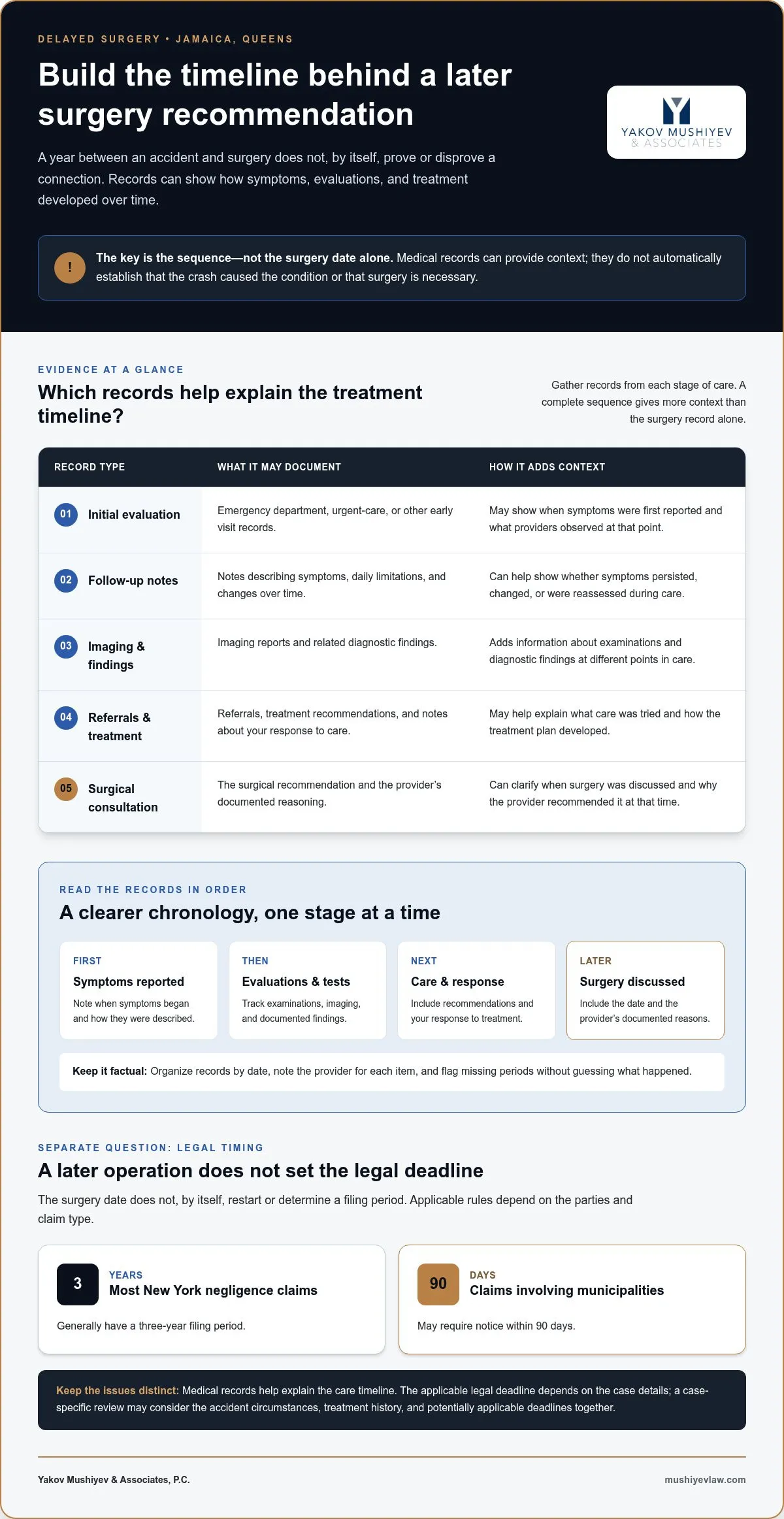
- A late operation does not restart or determine a legal deadline. Most New York negligence claims generally have a three-year filing period, while claims involving municipalities may require notice within 90 days.
- Seek prompt medical evaluation when symptoms appear, and consider a case-specific legal review before making decisions about a claim or settlement.
Need Surgery a Year After an Accident in Jamaica, Queens? Start With What the Timing Means
A surgical recommendation a year after a crash can be frightening. You may worry that the gap will make your injury look unrelated or give an insurer a reason to challenge your claim. But timing alone doesn’t establish causation in either direction. The question “what if I need surgery a year after my accident in Jamaica Queens” can’t be answered just by counting the months. A qualified medical provider must assess your condition and treatment needs. The records and facts help show how the injury developed.
It helps to separate the milestones in your medical history. Symptoms may begin at the scene, emerge later, or change over time. Medical evaluations, diagnoses, treatment attempts, and a surgical recommendation each happen at particular points. Those dates tell a fuller story than the surgery date alone. For example, records might show that you reported pain after the crash, tried non-surgical care, and later had further evaluation after symptoms persisted. That chronology may help explain the delay, but it doesn’t automatically prove the cause or establish that surgery is necessary.
Why might surgery be recommended months after a crash?
Medical care can unfold in stages. A provider may first evaluate symptoms, order diagnostic tests, or recommend conservative treatment. If the condition changes, symptoms continue, or new findings emerge, the provider may reassess and discuss other options, including surgery. The reason for a later recommendation depends on the patient and clinical evidence. Not every delayed procedure is connected to a crash, and a later recommendation doesn’t by itself establish medical necessity.
As care progresses, keep track of the dates and providers involved. Records may include:
- When symptoms were first reported and how they changed.
- Dates and findings from examinations or diagnostic imaging.
- Treatment recommendations and your response to them.
- When surgery was discussed and the provider’s documented reasons.
This is a way to organize the timeline, not a substitute for medical judgment. Direct questions about treatment to your qualified medical provider. If your concern is whether a provider’s care was negligent, that is a separate issue from whether an accident caused an injury. Medical malpractice offers a general overview, not a case-specific assessment.
Does needing surgery later automatically end an accident claim?
No. A one-year interval doesn’t automatically decide whether an accident claim can proceed. The medical timeline and legal deadlines are separate questions: the surgery date does not, by itself, determine when a filing period begins or whether it has passed. The applicable rules can depend on the parties and claim type, so the accident date and other details matter. Medical records may clarify the sequence, but they can’t predict a legal result on their own.
That distinction matters in Jamaica and throughout Queens, including Rosedale and Rochdale. A delayed recommendation deserves careful attention, not an automatic conclusion that the injury is unrelated or that a claim is over. A case-specific review can consider the accident circumstances, treatment history, and potentially applicable deadlines together.
How Medical Records Can Connect Delayed Surgery to a Jamaica Accident
A useful medical record is more than a diagnosis on a page. Read together, records may show when you first reported symptoms, what providers observed, how they evaluated the condition, and what treatment followed. For delayed surgery, the chronology can help explain why care changed over time. It doesn’t, by itself, establish that the crash caused the condition. Medical providers address medical questions. Legal causation and the strength of a claim require a separate, case-specific review.
A clear medical timeline helps show what happened, when it happened, and how care developed. That’s the practical goal when gathering documents. If you’re asking, “what if I need surgery a year after my accident in Jamaica Queens,” organize records by date and keep copies of documents you already have. Don’t try to fill gaps by guessing. What was recorded at each visit is more useful than a reconstructed timeline that blurs when symptoms or recommendations changed.
Which records may help explain the treatment timeline?
Collect documents from each stage of care, including the initial evaluation, later appointments, and the surgical consultation. Records may show what symptoms were reported, what tests were performed, and why the treatment plan changed. No single document guarantees a claim’s outcome, but a complete sequence gives reviewers more context than the surgery record alone.
- Emergency department, urgent-care, or other initial evaluation records.
- Follow-up notes describing symptoms, daily limitations, and changes over time.
- Imaging reports and related diagnostic findings.
- Referrals, treatment recommendations, and notes about response to care.
- The surgical recommendation and the provider’s documented reasoning.
Where possible, note the provider and date for each item, and flag missing periods without assuming what happened during them. Your providers can explain medical findings and treatment decisions. An attorney can assess how the records may relate to a legal claim.
How can an insurer question a surgery recommended a year later?
An insurer may ask when symptoms began, whether they were reported consistently, whether another event occurred, whether a prior condition is documented, or why there was a gap in treatment. Those questions aren’t proof that the injury is unrelated. Records showing the reason for a pause, a change in symptoms, a referral, or a later reassessment may provide context. The answer depends on the evidence, not assumptions about your diagnosis.
If the concern involves possible negligence in medical care, that is a separate legal issue from whether a crash caused an injury. The New York Medical Malpractice Statute of Limitations explains that deadlines may apply to such claims. The rules depend on the facts. For help reviewing an accident-related treatment timeline, you can also seek a case-specific car accident claim review.
Could a Year-Delayed Surgery Affect Your New York Claim or Deadline?
Surgery recommended a year after a crash may affect how the injury and treatment are evaluated, but the operation’s date does not itself restart or set a legal filing deadline. These are separate questions: medical evidence concerns the injury and care, while deadlines depend on the claim and who may be legally responsible. If you’re asking, “what if I need surgery a year after my accident in Jamaica Queens,” don’t assume the later procedure gives you more time to act.
For most New York personal injury claims based on negligence, a lawsuit generally must be filed within three years of the injury. A claim involving a city, the MTA, or another municipal entity may follow different procedures, including a Notice of Claim that generally must be filed within 90 days. A lawsuit deadline may also apply after that notice. These are general rules, not a deadline calculation for your case. The defendant, claim type, and circumstances can change which requirements apply, so review potentially relevant deadlines promptly.
What deadlines may matter after a New York car accident?
Different processes can have different time limits. A general negligence lawsuit deadline is not the same as a municipal notice requirement, and a claim against a public entity may involve shorter steps. No-Fault benefits are another separate process: an application generally must be submitted to your own insurer within 30 days of the accident. A later surgical recommendation does not reset that application period. The applicable rules and any exceptions require a case-specific review.
Keep the accident date, insurance correspondence, and documents identifying potentially involved parties together. If a public vehicle or agency may be involved, don’t assume the general three-year period is the only deadline to consider. A case-specific legal review can help identify which dates and procedures may matter before time passes.
Does a later operation automatically increase compensation?
No. Surgery may affect documented medical expenses and how a claim is evaluated, but it does not automatically increase compensation or establish the value of a case. Questions may include whether the procedure was medically recommended, whether the records connect the condition to the crash, and how the rest of the evidence supports the claim. The treatment timeline is one part of a broader assessment, not a guaranteed measure of the outcome.
An insurer’s early offer is a starting position, not a valuation of the claim. Before accepting, consider having a lawyer review the offer alongside the medical records, expected treatment, lost-work information, and deadlines. A settlement may involve decisions about future claims, so the timing of surgery can make careful review especially important. No general rule can determine whether a particular offer is fair without examining the specific facts.
This overview is general information, not legal advice for your situation. Surgery timing and legal deadlines answer different questions, so prompt review of the medical timeline and potentially applicable rules can help clarify what steps remain available.
What to Do If Your Doctor Recommends Surgery a Year Later
A late recommendation can bring new medical decisions and fresh questions about your accident claim. Put your health first: arrange a prompt evaluation when symptoms appear, and discuss the proposed treatment directly with your qualified medical provider. Don’t postpone care while trying to resolve insurance or legal questions. The steps below are general information, not individualized medical or legal instructions.
Follow your provider’s care plan, organize your records, and review potentially applicable deadlines promptly. A clear, accurate timeline can help you and your advisors understand what happened without relying on memory alone.
How to organize the accident and treatment timeline
Start with a dated sequence, even if some dates are approximate. Note the crash, when symptoms began or changed, appointments, diagnoses, tests, treatment, and when surgery was recommended. Mark uncertain dates as uncertain. Don’t fill gaps with assumptions or alter details to make the sequence appear more consistent.
Gather records and communications you already have. A simple folder arranged by date can make the material easier to review:
- Medical visit notes, referrals, imaging reports, and treatment recommendations.
- Medical bills and records of missed work or changes to your work duties.
- Insurance letters, claim information, and relevant communications about treatment.
- Your own dated notes about questions or changes you want to discuss with your provider.
Keep original documents and copies of messages. If a record seems missing, note that it may be missing rather than trying to recreate what it said. Ask your treating provider to explain medical questions, including the reason for a recommendation and what the next steps involve.
What should you avoid while the claim is unresolved?
Don’t accept an early settlement offer without having a lawyer review it. An offer is a starting position, not a valuation of your claim. A decision made before you understand your treatment and claim may have lasting consequences.
Don’t post about the crash, your injuries, your health, treatment, or the claim on social media. Set your accounts to private and ask friends not to tag you in related posts. If posts already exist, preserve them; don’t delete or alter them. A lawyer can help assess questions about existing material without risking the destruction of potential evidence.
For a Jamaica or Queens car accident, Yakov Mushiyev & Associates, P.C. can review the accident information, treatment timeline, and potentially applicable deadlines. The firm offers free initial consultations 24/7 in English, Russian, and Spanish, with meetings available at home, in the hospital, or by video. Request a car accident claim review before making decisions about a settlement or next steps.
Get a Jamaica, Queens Legal Review Before Making Decisions About Surgery or Settlement
A surgery recommendation a year after a crash can raise two urgent concerns: what it means for your medical history and whether a legal deadline is approaching. Yakov Mushiyev & Associates, P.C. represents injured people in car accident matters in New York City, including Jamaica and Queens. A case-specific review can examine the accident date, who may be involved, your treatment timeline, available records, and deadlines that may apply.
If you’re wondering, "what if I need surgery a year after my accident in Jamaica Queens," a lawyer can help assess how the records and timing relate to a potential claim. That review is separate from your medical decisions. Discuss whether surgery is appropriate, its risks, and your treatment options with your qualified medical provider.
What can a case-specific review help clarify?
A lawyer can look at the sequence of care, from early symptom reports and evaluations to later testing, referrals, and the surgical recommendation. The review may identify records that could add context, such as a gap in treatment, a change in symptoms, or the provider’s explanation for recommending surgery at this stage. It can also consider the accident date and relevant insurance communications.
The identity of the potentially responsible party matters, too. If a city, the MTA, or another municipal entity may be involved, different notice procedures and deadlines could apply. A review can help identify which rules may be relevant and what needs further verification. It can’t promise that a claim will succeed or determine medical causation. It also doesn’t replace advice from your treating provider.
How can an injured person speak with the firm?
Waiting for surgery or managing pain can make travel difficult. Yakov Mushiyev & Associates, P.C. offers free initial consultations 24/7 in English, Russian, and Spanish, with meetings available at home, in the hospital, or by video. You can prepare by gathering the accident date, names of involved parties if known, treatment records, and any settlement or insurance communications. You don’t need to resolve every question before discussing the situation.
The firm works on a contingency basis: No fee unless we win. That arrangement does not guarantee a result or a particular recovery. The fee depends on recovery. For a focused discussion of your accident, medical timeline, and potentially applicable deadlines, request a free consultation with Yakov Mushiyev & Associates, P.C.
Take the Next Step With a Clear Plan
A late surgical recommendation can make the road ahead feel uncertain, but you don’t have to make claim decisions alone. If you’re asking, “what if I need surgery a year after my accident in Jamaica Queens,” focus on getting the care your doctor recommends and understanding how your treatment timeline and legal options fit together. A timely review can help you make informed choices before responding to an insurer or signing a settlement.
Yakov Mushiyev & Associates reports recovering over $80 million for clients. Past results don’t guarantee a similar outcome, and every case depends on its own facts. The firm can review your situation and explain potential next steps.
Request a free consultation with Yakov Mushiyev & Associates, or call 718-775-3110 for a free case review. Take the next step with support and move forward with greater clarity.
Frequently Asked Questions
These answers are general information, not legal advice for a specific case. Deadlines, insurance decisions, and available options depend on the facts.
Can I still file a car accident claim if I need surgery a year later?
Possibly. Needing surgery a year after a crash does not, by itself, prevent you from pursuing a claim. If you’re asking, “what if I need surgery a year after my accident in Jamaica Queens,” the next step is to assess the accident date, claim status, and parties involved. Don’t assume the surgery date gives you extra time. A lawyer can review whether a claim has already been filed and what deadlines may still apply.
Does surgery a year after a crash prove the injury came from the accident?
No. Surgery alone doesn’t establish what caused an injury. A medical provider evaluates your condition, while legal causation depends on the relevant evidence and circumstances. A reviewer may consider whether earlier records mention the same symptoms and whether other events or prior conditions appear in the history. Be candid with your providers about your symptoms and medical history. A legal assessment requires the actual records, not assumptions based on the procedure date.
Can an insurance company deny a claim because surgery was delayed?
An insurer may question a treatment gap or dispute whether the surgery relates to the crash, but a delay alone doesn’t prove its position is correct. The insurer may review the medical history, symptom reports, and reasons care changed. If you receive a denial or request for documents, keep the notice and note any response deadline stated in it. The policy, claim type, and available evidence affect what options may be available.
What medical records should I gather before surgery after an accident?
Gather records that help a reviewer understand your care, such as visit summaries, diagnostic imaging reports, referrals, treatment plans, and the surgeon’s explanation of the recommendation. Keep appointment dates, billing statements, and relevant insurance notices together. If you received care from different providers, note their names and approximate visit dates. Don’t edit records or try to fill gaps from memory. Ask the providers’ offices about obtaining copies of your own records.
How long do I have to bring a New York car accident claim?
For most New York negligence claims, the general lawsuit deadline is three years from the injury. A claim involving a municipality, such as the City or MTA, may require a Notice of Claim within 90 days. These time limits don’t apply identically to every case, and additional procedures may matter. The defendant and claim type are important. Have the specific deadlines reviewed promptly, especially if a public entity may be involved.
Can I accept an insurance settlement before my doctor recommends surgery?
Be cautious about accepting a settlement before understanding your medical situation. A settlement may require you to resolve or release claims, and later treatment could raise questions about what the agreement covers. An early offer is a starting position, not a valuation. Before signing or accepting, have a lawyer review the proposed release and explain its potential effect. Continue discussing medical decisions with your provider, not the insurer.
Does New York no-fault insurance cover surgery recommended a year after a crash?
Coverage isn’t automatic just because a provider recommends surgery. New York generally requires a No-Fault application to be submitted to your own insurer within 30 days of the accident; a later recommendation doesn’t reset that deadline. Whether a particular expense may be covered can depend on the claim’s status, applicable insurance rules, and supporting medical information. Keep insurer notices and have a lawyer review the specific coverage issue.