
Let me begin the way I would begin a first-year seminar: with a puzzle. Two cars back out of facing spaces at a shopping center on Queens Boulevard and meet bumper to bumper. Nobody was speeding. Nobody ran a light, because there are no lights. Nobody was on a public street. Who was negligent, what insurance pays, and does the Vehicle and Traffic Law even apply? If you have been hurt and are searching for a parking lot accident lawyer in Queens, you are standing inside that puzzle, and the good news is that it has answers. They simply require a vocabulary that most people never had a reason to learn.
This article is written as a short course. Each section introduces a legal term, defines it in plain English, and then applies it to the kinds of parking lots people actually use in Queens: supermarket lots, big-box retail centers, hospital and college lots, and the long surface lots along our busiest corridors. By the end you should be able to follow the reasoning a lawyer at Yakov Mushiyev & Associates, P.C. would use to evaluate your case.
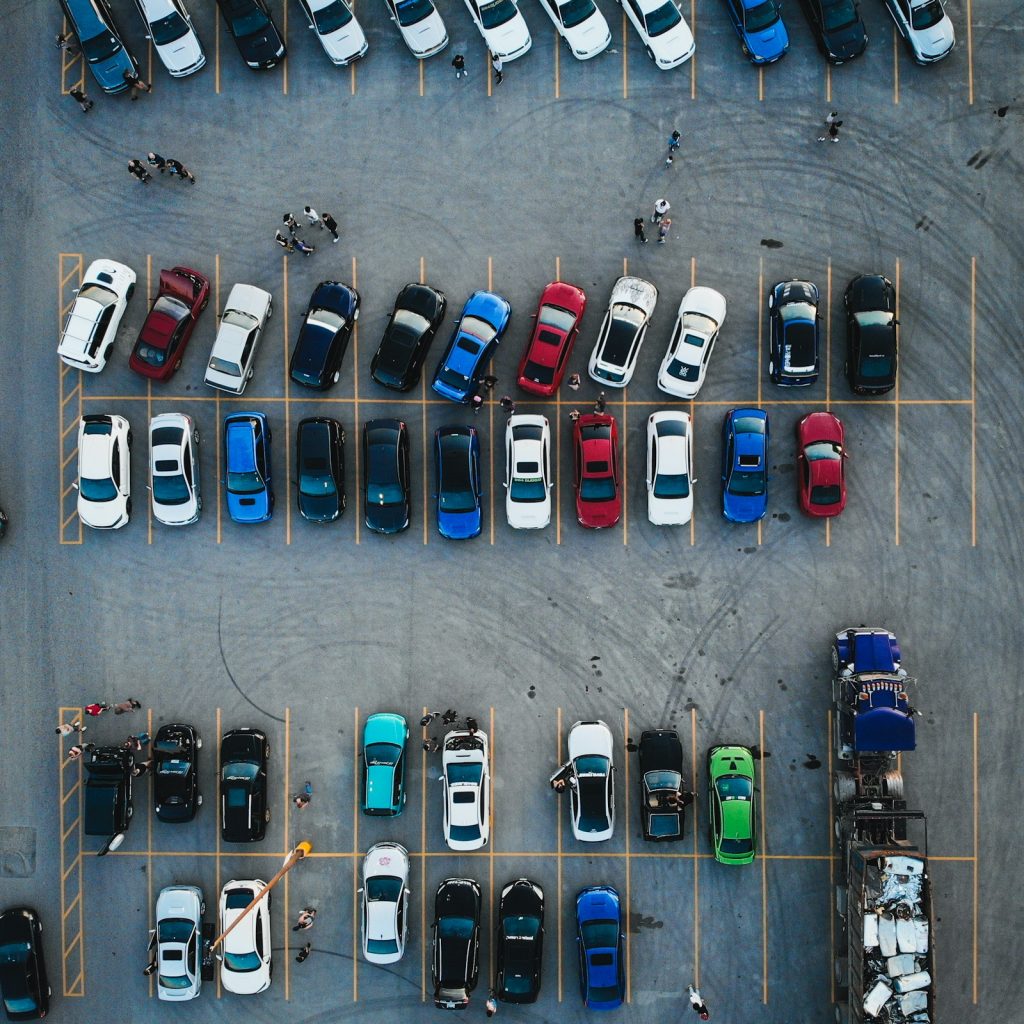
Lesson One: Negligence, the Word Behind Every Parking Lot Accident Case
Negligence means failing to use the care a reasonably careful person would use in the same situation. It has four parts that a claimant must prove: a duty (an obligation to act carefully toward others), a breach (falling short of that obligation), causation (the breach actually caused the harm), and damages (real losses, such as medical bills, lost pay, and pain).
The useful insight for parking lots is that negligence does not depend on a specific traffic rule. Even where no stop sign, painted arrow, or statute addresses a situation, every driver owes everyone else in the lot a duty of reasonable care. That includes keeping a proper lookout, moving at a speed suited to tight aisles and pedestrians, and checking mirrors and cameras before reversing. A driver who backs out without looking has breached that duty whether or not a sign told them to look.
Does the Vehicle and Traffic Law Apply in a Private Lot?
This is the question students always ask next. Many Vehicle and Traffic Law provisions are written for public highways, and how they apply on private property can be a debated point. In practice, it matters less than people think. Courts still evaluate the conduct of drivers in lots under ordinary negligence principles, and the traffic statutes can still inform what “reasonable” looks like. The duty to exercise due care to avoid pedestrians, reflected in VTL §1146, expresses a principle that applies just as forcefully between parked cars at a supermarket as it does in a crosswalk.
Lesson Two: Right of Way Without Road Signs
Right of way is the legal priority one road user has over another. On public streets it is set by statute and signals. In parking lots it is usually set by layout and common sense: traffic in a main through-lane, sometimes called a feeder lane, generally has priority over cars leaving individual parking aisles or spaces, and a vehicle pulling out of a space must yield to vehicles already moving past it.
Typical parking lot collisions follow a handful of patterns, and each one has a predictable starting point for the fault analysis:
- Backing collisions. A reversing driver generally must make sure the path is clear. When two cars reverse into each other, fault is often shared.
- Feeder-lane collisions. A car leaving an aisle that pulls into the path of a car traveling the main lane usually bears most of the responsibility.
- Space races. Two drivers competing for the same open spot each have to watch for the other; these often become shared-fault cases.
- Pedestrian strikes. Drivers must watch for people walking between cars, pushing carts, or loading trunks. Pedestrians have duties too, but drivers are operating the machine that causes the harm.
- Rear-end impacts at exits. A car that strikes another waiting to turn onto the street raises the same presumptions that apply on public roads.
That last category brings us to a term worth defining carefully.
The Rear-End Presumption
A presumption is a conclusion the law draws unless someone offers evidence to the contrary. In New York rear-end collisions, courts generally presume the rear driver was negligent, because VTL §1129 requires drivers not to follow more closely than is reasonable and prudent. The rear driver can rebut the presumption with a non-negligent explanation, such as a sudden, unexpected stop, but the burden shifts to them. That matters in lots along Northern Boulevard or Woodhaven Boulevard, where cars line up at exit driveways waiting for a gap in traffic.
Lesson Three: No-Fault and the Serious Injury Threshold
No-fault insurance is New York’s system for paying basic economic losses after a car accident without first deciding who caused it. A collision in a parking lot is still a motor-vehicle accident, so no-fault generally applies. It covers up to $50,000 per person in basic economic loss: necessary medical expenses, 80 percent of lost earnings up to $2,000 per month, and up to $25 per day for other reasonable expenses. The application is generally due within 30 days of the accident, a deadline that people injured in “minor” lot collisions often miss because they assume no claim is needed.
If you were a pedestrian struck while walking through the lot, you generally claim no-fault through the insurer of the car that hit you. If you were a driver or passenger, you generally claim through the policy covering the vehicle you were in.
The serious injury threshold is the gatekeeper that comes next. To sue another driver for pain and suffering after a car accident in New York, you must show a “serious injury” as defined in Insurance Law §5102(d), such as a fracture, significant disfigurement, permanent loss of use of a body part, or a permanent consequential or significant limitation of use of a body organ or member. Economic losses above what no-fault pays can be pursued regardless of the threshold.
Parking lot collisions often happen at low speed, and insurers like to argue that low speed means minor injury. Medicine does not follow that logic so neatly. An occupant twisted in a seat while reversing, or a pedestrian knocked onto asphalt, can sustain fractures, torn ligaments, or spinal injuries. The threshold is about the injury, not the speedometer.
2026 update: For motor-vehicle personal-injury actions commenced on or after May 26, 2026, New York made two changes. First, the “90/180-day” category was removed from the serious-injury definition in Insurance Law §5102(d), so claimants rely on the remaining categories. Second, CPLR 1411 now bars recovery in these motor-vehicle cases when the claimant’s fault is greater than the defendants’ combined fault; at 50 percent or less, recovery is reduced by the claimant’s share. A collision between vehicles, or a pedestrian struck by a car in a lot, falls under these rules. A trip over a pothole in the same lot is a premises case and remains under pure comparative fault.
Lesson Four: Comparative Fault, or Splitting the Blame
Comparative fault is the method New York uses when more than one person contributed to an accident. Instead of an all-or-nothing verdict, the fact-finder assigns percentages. Parking lots are fertile ground for this analysis because both drivers are usually moving slowly and both usually had some ability to see the other.
Consider an illustrative example, not drawn from any real case: Driver A reverses from a space without checking a rear camera. Driver B, cutting diagonally across empty spaces to reach the exit, is traveling a little too fast. A jury might assign 70 percent of the fault to Driver A and 30 percent to Driver B. Under the 2026 rule for motor-vehicle cases, Driver B could still recover, reduced by 30 percent, while Driver A, being more than 50 percent at fault, would be barred from recovering against B in an action commenced after the effective date. Under the older pure comparative approach that still governs premises claims, the math would simply reduce each party’s recovery by their own share.
The text of the rule is in CPLR 1411. The practical lesson is that the evidence of who did what in the few seconds before impact can now decide not only how much you recover but whether you recover at all.
Lesson Five: Vicarious Liability and the Vehicle Owner
Vicarious liability means one person is held legally responsible for another person’s negligence because of their relationship, not because of anything they did themselves. New York’s best-known example is VTL §388, which generally makes a vehicle’s owner liable for the negligence of anyone driving it with permission.
Why does that matter in a parking lot? Because lots are full of borrowed and business vehicles: a teenager driving a parent’s SUV to the mall, an employee moving a company van, a rideshare driver picking up a passenger outside a shopping center. If the driver who hit you has limited coverage, the owner’s policy and, in some cases, an employer’s coverage may also come into play. Collisions involving app-based drivers raise their own coverage layers, which we discuss in our overview of Uber accident claims in Queens.
Lesson Six: Premises Liability and the Lot Itself
Premises liability is the body of law that makes property owners and those who control property responsible for keeping it reasonably safe. A parking lot is property. Its owner, and sometimes a management company or tenant responsible for maintenance, must address hazards they created or knew about, or would have known about with reasonable inspection.
Two more terms belong here. Actual notice means the owner knew of the hazard, perhaps from a customer complaint or a maintenance report. Constructive notice means the hazard was visible and had existed long enough that a reasonable owner would have found and fixed it. In parking lots, claims based on the lot’s condition commonly involve:
- Potholes and broken asphalt, especially after freeze-thaw cycles.
- Unmarked or crumbling wheel stops and raised curbs around islands.
- Inadequate lighting in the evening, which affects both drivers and pedestrians.
- Snow and ice left unplowed or plowed into piles that block sightlines.
- Poor design, such as blind corners or confusing traffic flow, where the owner had reason to know of repeated problems.
The same reasoning extends to structured parking, which has its own hazards, from ramps and stairwells to low clearances and dim levels. We explain those separately in our guide for parking garage injuries in Queens.
Lesson Seven: Evidence, and Why the First Week Matters
Spoliation is the destruction or loss of evidence. In parking lot cases, the most valuable evidence is also the most perishable: surveillance video from the store, the lot operator, or neighboring businesses. Many systems record over themselves on a rolling basis. A prompt written request to preserve footage, sometimes called a preservation letter, can make the difference between a provable case and a swearing contest.
Other evidence worth securing early includes:
- Photographs of both vehicles, their final positions, and the aisle markings.
- Names and contact information for witnesses, including store employees who came outside.
- Any incident report prepared by the store or property manager.
- Dashcam footage from your own vehicle or others nearby.
- Medical records beginning with the first visit after the collision.
Drivers involved in a crash where anyone is injured, or property damage exceeds $1,000, must also file a DMV form MV-104 within 10 days. People often skip this step after a lot collision because no police officer came. The obligation does not disappear simply because the crash happened off the street.
Lesson Eight: Applying It All as a Parking Lot Accident Lawyer in Queens Would
When a parking lot accident lawyer in Queens evaluates a new case, the analysis typically follows this sequence. First, classify the event: vehicle collision, pedestrian strike, or a fall caused by the lot’s condition. Second, identify every potentially responsible party: drivers, vehicle owners, employers, the lot owner, and any maintenance contractor. Third, determine which insurance responds first, usually no-fault for vehicle events. Fourth, assess whether the injuries meet the serious injury threshold if it applies. Fifth, gather the evidence that will determine comparative fault, and do it before video is lost.
Readers who want the general background on our firm can read more about Yakov Mushiyev & Associates, and our general personal injury FAQ covers questions that apply across all accident types. For clients closer to the Nassau line, our Bellerose parking lot accident page addresses the same issues for that neighborhood.
Field Study: Three Queens Landmarks and the Lots Around Them
Every good course includes a field trip. These three Queens institutions draw steady visitors, and each one illustrates a different parking environment.
York College in Jamaica
York College is a senior college of the City University of New York located in the heart of Jamaica, a short walk from the Jamaica Center subway station and the busy Jamaica Avenue shopping district. Students and staff arrive by subway, bus, LIRR, and car, which means the surrounding streets and lots mix commuters, delivery vehicles, and pedestrians hurrying to class. Lots in a dense downtown area like this tend to have tight aisles and constant turnover. That is exactly the setting in which backing collisions and pedestrian strikes occur, and where surveillance video from nearby businesses can be critical evidence.
The Queens Museum
The Queens Museum occupies the New York City Building in Flushing Meadows-Corona Park, a structure built for the 1939 World’s Fair that later served as an early home of the United Nations General Assembly. The museum is best known for the Panorama of the City of New York, an enormous scale model of the five boroughs. Visitors reach it from the Grand Central Parkway and Van Wyck Expressway, and on event days at nearby Citi Field and the tennis center, park-area parking fills fast. Crowded lots, families with strollers, and drivers unfamiliar with the layout are a classic recipe for low-speed collisions.
The Lewis Latimer House
The Lewis Latimer House in Flushing preserves the home of Lewis Howard Latimer, the African American inventor and draftsman who worked on electric lighting and drafted patent drawings for the telephone. Today it operates as a museum and community space celebrating his life and encouraging young people in science and the arts. Visitors usually park on nearby residential streets or in commercial lots along the busy Northern Boulevard corridor in downtown Flushing, where lots are small and turnover is constant. Short trips into tight lots are when drivers tend to rush and pedestrians tend to cut between cars.
Directions to Our Rosedale Office from York College
From York College in Jamaica, head southeast on Merrick Boulevard through Springfield Gardens and Laurelton. Continue toward Rosedale and follow local signs for the Belt Parkway and Cross Island Parkway area near Brookville Boulevard. Our office is at 1 Cross Island Plaza, Suite 325. If you prefer highways, the Van Wyck Expressway south to the Belt Parkway east is a reliable alternative.
Review Session: Parking Lot Accident Questions
Does no-fault insurance cover a parking lot accident?
Generally, yes. A collision involving the use or operation of a motor vehicle in a parking lot is still a motor-vehicle accident under New York’s no-fault system. No-fault pays basic economic loss up to $50,000 per person, including medical bills and 80 percent of lost earnings up to $2,000 a month. The application is generally due within 30 days of the accident, so file promptly even if the crash seemed minor.
Who is at fault when two cars back into each other?
Often both drivers share responsibility, because each had a duty to make sure the path was clear before reversing. The percentages depend on details such as who started moving first, who was more visible, and whether either driver was distracted. Surveillance video and the vehicles’ damage patterns are frequently the deciding evidence in these cases.
I was hit while walking to my car. What insurance pays?
A pedestrian struck by a car generally claims no-fault benefits through the insurer of the vehicle that hit them. Those benefits cover medical bills and a portion of lost wages up to the no-fault limits. If your injuries meet the serious injury threshold, you may also pursue the driver for pain and suffering, and the vehicle owner may be vicariously liable under VTL §388.
Can I sue the store if I tripped in its parking lot?
Possibly. If a pothole, broken curb, poor lighting, or uncleared ice caused your fall, the party that owns or maintains the lot may be liable if it created the hazard or had actual or constructive notice of it. These are premises claims rather than motor-vehicle claims, so no-fault does not apply, and pure comparative fault still governs.
Do I need a police report for a parking lot accident?
Police may not respond to a minor lot collision, but you should still call if anyone is hurt. Separately, New York requires drivers to file DMV form MV-104 within 10 days if anyone is injured or killed or property damage exceeds $1,000. A record made close to the event also helps your no-fault and injury claims.
How does the 2026 comparative fault change affect my case?
For motor-vehicle personal-injury actions commenced on or after May 26, 2026, a claimant more than 50 percent at fault recovers nothing, and one at 50 percent or less has recovery reduced by their share. Because lot collisions often involve shared fault, evidence about each driver’s conduct is more important than ever. Premises claims about the lot’s condition are not affected.
How long do I have to bring a parking lot injury claim?
The general deadline for personal injury lawsuits in New York is three years under CPLR 214(5). Shorter deadlines can apply. If a City vehicle or City-owned lot is involved, a Notice of Claim is generally due within 90 days. The no-fault application deadline is generally 30 days. Waiting is the most common way people lose rights they otherwise had.
What if the other driver drove off?
Leaving the scene of an accident involving injury violates VTL §600. Report it to police immediately and write down anything you remember about the vehicle. If the driver cannot be identified, your own policy’s uninsured motorist coverage or MVAIC may apply, but both have strict notice requirements, so act as soon as possible.
Is a low-speed parking lot crash worth pursuing?
It depends on the injury, not the speed. Low-speed impacts can still cause fractures, disc injuries, and ligament tears, particularly when occupants are turned in their seats or pedestrians fall onto pavement. A lawyer can review your medical records and explain whether the injury meets the serious injury threshold and what losses may be recoverable.
Can surveillance video still be obtained weeks later?
Sometimes, but not reliably. Many commercial camera systems overwrite footage on a rolling cycle. That is why a preservation request should go to the store, lot operator, and nearby businesses as soon as possible. If video has already been lost, other evidence such as witness statements, vehicle damage, and photographs becomes even more important.
Related: For a full overview of how our firm handles these claims, visit our Parking Lot Accident Lawyer in Queens page.
Office Hours with a Parking Lot Accident Lawyer in Queens
You now know the vocabulary: negligence, right of way, no-fault, serious injury, comparative fault, vicarious liability, premises liability, and spoliation. Applying it to your own facts is where a parking lot accident lawyer in Queens earns their keep. Call Yakov Mushiyev & Associates, P.C. at 718.775.3110 or send our Rosedale team a message to talk through what happened. We are located at 1 Cross Island Plaza, Suite 325, Rosedale, NY 11422.
General information, not legal advice. Attorney Advertising. Prior results do not guarantee a similar outcome.