
When people sit down with a yellow cab accident lawyer in Bellerose, the conversation almost always starts the same way: with questions. Who do I even make a claim against? Does it matter that the cab was taking me home from the airport? Why is the cab company’s insurer already calling me? Yellow taxis are some of the most heavily regulated vehicles on New York’s roads, and that regulation creates both protections and paperwork that most people have never had to think about.
Below we have collected the questions we hear most often from eastern Queens residents and answered them the way we would across the table at a consultation. Every case turns on its own facts, so treat this as a starting point rather than a substitute for advice on your situation.

“Why Does It Matter That It Was a Yellow Cab?”
Q: I’ve been in car accidents before. Why is a yellow cab crash any different?
Because a yellow taxi is not just a car with a driver. It is a medallion vehicle licensed by the New York City Taxi and Limousine Commission, and the TLC sets its own rules for drivers, vehicles and insurance that go beyond what an ordinary private driver must carry. The cab may be owned by one company, managed by a second, and driven by a third person who leases it for a shift. Each of those relationships can matter when we figure out who is responsible and which insurance policy pays.
It is also different from an app-based ride. A yellow cab picks you up from a street hail or a taxi stand, its fare is metered, and its trip is recorded through the taxi’s onboard technology system. An Uber or Lyft trip involves a rideshare company’s policies instead. If you are not sure which kind of ride you were in, our separate guide for the rideshare accident lawyer in Bellerose explains that side.
“Who Actually Owns a Yellow Cab, and Who Do We Make a Claim Against?”
Q: The driver told me the cab “belongs to a garage.” Who am I dealing with?
Possibly several parties. The chart below shows the usual cast of characters. Not every cab has all of them; some drivers own their own medallion and vehicle outright.
| Party | Who they are | Why they matter |
|---|---|---|
| Medallion owner | The person or company that holds the medallion attached to the cab | Often the registered owner of the vehicle; New York’s owner-liability law (VTL §388) can make a vehicle owner responsible for a permitted driver’s negligence |
| Fleet or agent | A garage or management company that operates medallions on owners’ behalf | May control maintenance, scheduling, dispatch records and in-cab equipment |
| Lease driver | A TLC-licensed driver who leases the cab by the shift or week | Usually the person whose driving caused the crash |
| Insurer | The company that issued the cab’s policy | Handles no-fault and liability claims; often the first to call you |
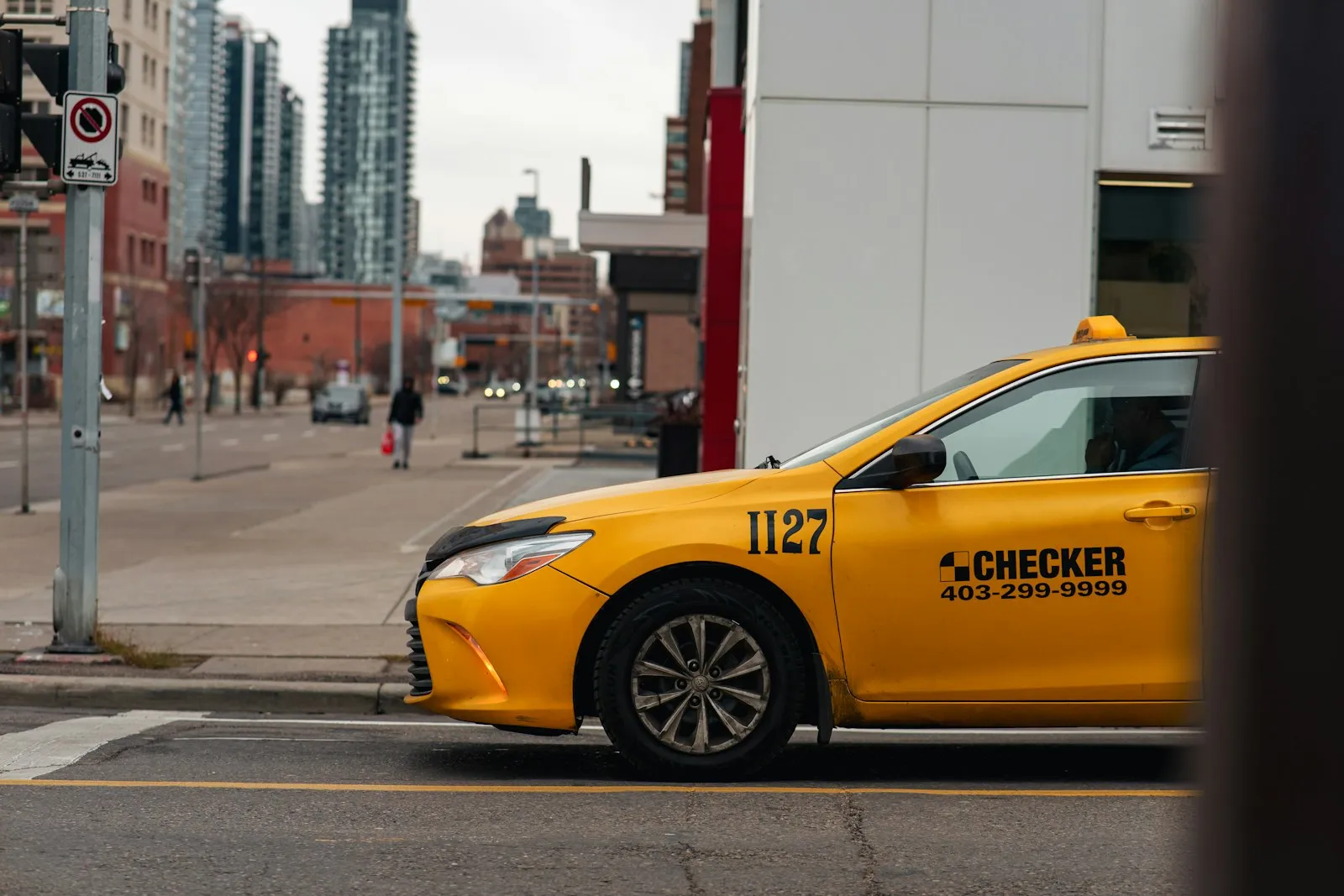
The practical point: you do not have to untangle these relationships on your own at the roadside. Photograph the medallion number, which appears on the roof light, the hood and the rear of the cab, and the driver’s TLC license displayed inside. If you paid by card, your receipt or app record is another good source. With those identifiers we can trace ownership and insurance.
“I Was Coming Home from JFK. Does an Airport Trip Change Anything?”
Q: My cab crashed on the Cross Island Parkway on the way home from Kennedy Airport. Is that a Queens case or something else?
A large share of the yellow cab rides that end in Bellerose start at JFK or LaGuardia, and many of them come home along the Belt and Cross Island Parkways or the Grand Central Parkway. A trip that begins at a New York City airport begins in New York City, so TLC insurance rules apply even if the crash happens close to the Nassau line.
Parkway crashes do have their own wrinkles. Speeds are higher, so injuries tend to be more serious. There are often multiple vehicles involved in chain-reaction collisions. And there may be a question about road conditions, lighting or construction work zones. If the cab dropped you near the border and the crash happened on a Nassau road, the location can affect where a lawsuit is filed, but it does not usually change which insurance is responsible.
“What Insurance Does a Yellow Cab Carry, and What Will It Pay?”
Q: Is a taxi’s insurance any better than a regular driver’s?
TLC-licensed vehicles must carry liability coverage of at least $100,000 per person and $300,000 per accident, considerably more than the minimum for a private car in New York. They also carry no-fault coverage, which under Insurance Law §5102 pays reasonable medical bills and a portion of lost wages regardless of who was at fault.
What no-fault does not cover is pain and suffering. To pursue that, an injured person must show a “serious injury” as the statute defines it, such as a fracture, a permanent consequential limitation, or a significant limitation of use of a body function or system. That is where medical documentation becomes the backbone of the case.
Update for 2026: Two changes affect yellow cab claims. First, since March 1, 2026, TLC-licensed vehicles must carry at least $100,000 per person in no-fault (PIP) coverage, double the $50,000 basic level for private cars. Second, motor-vehicle tort reform signed in late May 2026 applies to motor-vehicle lawsuits filed on or after that date (not death cases): the 90/180-day serious-injury category was eliminated, juries now decide fault before serious injury, a plaintiff more than 50% at fault recovers nothing under CPLR 1411(b), and pain-and-suffering is capped at $100,000 for plaintiffs who were driving uninsured, convicted of impaired driving, or committing a felony. Passengers who did nothing to cause a crash are rarely affected by the fault rule, but objective medical proof matters more than ever.
“I Wasn’t in the Cab. It Hit Me.”
Q: A yellow cab ran into me while I was crossing Hillside Avenue. Am I covered?
Yes, though the path is a little different. A pedestrian or cyclist struck by a motor vehicle is generally covered by that vehicle’s no-fault insurance for medical bills and lost wages, so the cab’s policy is usually where those benefits start. Your claim for pain and suffering then goes against the cab driver and, often, the owner.
If you were driving your own car and the cab hit you, your own auto policy’s no-fault coverage usually pays your medical bills first, and the claim for everything else goes against the cab. Either way, the no-fault application has a 30-day deadline that catches a lot of people off guard. The City’s Vision Zero program publishes information on street safety, but it will not file your claim for you.
“What Evidence Does a Yellow Cab Leave Behind?”
Q: The other side says it is my word against the driver’s. Is that true?
Rarely. Yellow cabs generate more records than most vehicles on the road. Depending on the cab and the trip, we look for:
- Trip data from the taxi’s onboard system, including pickup and drop-off times and locations, which can help establish route and timing.
- Payment records such as your card receipt, which typically identifies the cab.
- Camera footage from any in-cab or dash camera, and from businesses and homes along the route.
- The police accident report and the names of responding officers. In Bellerose, the NYPD’s 105th Precinct typically responds.
- The driver’s TLC history, including license status and any prior issues, which may be relevant once a lawsuit is filed.
- Phone records, since New York prohibits handheld phone use while driving.
Much of this disappears quickly. Video loops are often overwritten in days. That is why one of the first things we do is send preservation letters to the owner, the fleet and the insurer.
“What Should I Say When the Cab’s Insurer Calls?”
Q: An adjuster asked me for a recorded statement and a medical authorization. Should I sign?
Be polite, and be careful. You are required to cooperate with your no-fault claim, but you are not required to give the at-fault party’s insurer a recorded statement about how the crash happened or how you feel. Early statements, made while you are on medication and before your diagnosis is clear, are often used later to minimize injuries. A broad medical authorization can open your entire history to review. Once you have a lawyer, those calls come to us.

“How Long Do I Have, and What Does It Cost to Hire You?”
Q: Is there a deadline, and can I afford a lawyer?
Most New York injury claims must be filed within three years under CPLR 214, and wrongful death claims generally within two years of the death. The no-fault application is due within 30 days, which is the deadline people miss most often. If a city vehicle was also involved, a Notice of Claim must usually be served within 90 days.
As for cost, Yakov Mushiyev & Associates, P.C. offers a free consultation and charges no fee unless we win. We meet clients in English, Russian and Spanish, and we can come to your home, the hospital, or meet by video.
“What Do You Actually Do for Me?”
Q: If I hire you, what happens next?
In a typical yellow cab case, we:
- Confirm the no-fault application is filed on time with the right carrier.
- Identify the medallion owner, fleet, driver and every available insurance policy, including your own underinsured motorist coverage.
- Preserve video, trip data and other records before they are lost.
- Coordinate with your doctors so the medical record reflects the full extent of your injuries.
- Handle every insurer conversation and, if a fair settlement is not offered, file suit, typically in Queens County Supreme Court on Sutphin Boulevard.
You can learn more about our car accident practice, read about attorney Yakov Mushiyev, or start at our Bellerose personal injury lawyer page for an overview of local cases. If you were in a green Boro Taxi or a local car service rather than a medallion cab, our walk-through for the taxi accident lawyer in Bellerose follows one hypothetical ride from crash to claim.
Getting to Our Office from Bellerose
We are at 1 Cross Island Plaza, Suite 325, Rosedale, NY 11422, open Monday through Friday, 9 a.m. to 6 p.m. From Bellerose, take the Cross Island Parkway south toward the Belt Parkway; our building sits right off the Cross Island in Rosedale, roughly a 15 to 20 minute drive depending on traffic. If you are hurt and cannot drive, we will come to you.
Ready to talk to a yellow cab accident lawyer in bellerose? Call 718.775.3110 or contact us online. You can also browse our frequently asked questions page first.

Frequently Asked Questions
Can I sue a yellow cab company or only the driver?
Often both. The driver is responsible for his own negligence, and New York’s owner-liability rules can make the vehicle’s registered owner responsible as well. Which companies are involved depends on how the medallion and vehicle are owned and operated.
Do yellow cabs pick up in Bellerose?
Yellow cabs may accept street hails anywhere in the five boroughs, though in eastern Queens most yellow cab trips are drop-offs from the airports or Manhattan. Green Boro Taxis, car services and app-based rides are more common for local trips.
I wasn’t wearing a seat belt in the back seat. Can I still recover?
Generally yes. A missing seat belt does not cause a crash. The defense may argue it made some injuries worse, which can affect damages, so it should be addressed with medical evidence rather than ignored.
Where will my case be heard if it goes to court?
A case arising from a Queens crash is commonly filed in Queens County Supreme Court at 88-11 Sutphin Boulevard in Jamaica. Other venues are possible depending on where the parties live and where the crash happened.
What if the cab driver left the scene?
Leaving the scene of an injury crash is a violation of VTL §600. If you have the medallion number, the cab can usually be identified. If you do not, there may still be options through your own coverage or MVAIC, depending on your circumstances.
This article is general information, not legal advice. Attorney Advertising. Prior results do not guarantee a similar outcome.