
What if protecting your privacy during an injury claim means being careful about what you share, not hiding evidence? If you’re wondering how to protect your privacy during a personal injury claim, that distinction matters. Insurers and opposing counsel may request information they believe is relevant, and private social media settings don’t necessarily shield relevant content from disclosure.
It’s understandable to worry that a claim could expose your medical history, private messages, or online activity. You shouldn’t have to guess what to hand over, and you shouldn’t delete posts or conceal evidence. Those steps can create problems of their own. The goal is to limit unnecessary exposure while preserving information connected to your claim.
This article explains what may be relevant, how to reduce avoidable digital and document-handling risks, and what to consider before responding to a sensitive request. If you’re pursuing a claim in New York, an injury lawyer can review the request and help you understand your options before you act.
Key Takeaways
- Learn how to protect your privacy during a personal injury claim by limiting unnecessary exposure while preserving relevant evidence.
- Reduce social media risks by pausing posts about your accident, injuries, health, or claim, and asking friends not to tag you.
- Understand why relevant medical information may be requested without assuming every part of your medical history must be disclosed.
- Use a practical checklist to secure documents, keep originals, and review sensitive requests before responding.
- A New York injury lawyer can help evaluate information requests and protect relevant evidence. Yakov Mushiyev & Associates, P.C. serves New York City’s five boroughs and Nassau County, including clients in Rosedale and Rochdale, Queens.
How to Protect Your Privacy During a Personal Injury Claim in New York
Pursuing compensation after an injury can feel like exposing personal details while you’re dealing with pain, treatment, and disruption. It’s reasonable to want control over who sees information about your health and daily life. A claim may require relevant evidence, but that doesn’t mean every detail about you is automatically open for review.
So, how do you protect your privacy during a personal injury claim? Limit unnecessary access while preserving and addressing evidence that relates to the issues in your case. Privacy protection means drawing sensible boundaries, not hiding evidence. Online privacy settings can reduce public exposure, but they can’t guarantee that relevant information will stay outside a claim.
For an overview of how privacy protections vary across different areas of U.S. law, see Privacy laws of the United States. For a closer look at health records and injury claims, watch this video:
What information may be relevant to an injury claim?
Information about your medical condition, treatment, and the effects of your injuries may matter when those issues are disputed. For example, if you’re claiming an injury limits your ability to walk, treatment notes or other records related to that limitation could help show what happened and how it affects you. The connection between the information and the claim matters.
Sharing information with your legal team so they can understand and prepare your case is different from providing records to an insurer or another party. Your lawyer can assess what a request seeks and how it relates to your claim. A request doesn’t automatically mean that every medical record, private message, or detail of your personal life must be turned over.
Why privacy is not all-or-nothing
Choosing not to share details publicly is different from responding to a formal request made during a claim. You can limit unnecessary exposure, such as avoiding public discussion of treatment or personal circumstances, while preserving relevant records and addressing requests appropriately. Don’t assume information is protected from scrutiny simply because an account is private or a message was sent privately.
The proper scope of a request depends on the claim and its circumstances. If a request seems broad or intrusive, have it reviewed rather than automatically refusing or immediately disclosing everything. The same caution applies to health information: privacy protections exist, but they don’t necessarily prevent relevant information from being sought in a legal claim.
If you’re unsure what to provide, don’t guess, alter records, or ignore the request. Ask a New York injury lawyer to review it and explain your options based on your circumstances. Careful guidance can help you protect personal boundaries while preserving complete, relevant evidence.
Protect Your Social Media and Digital Footprint Without Deleting Evidence
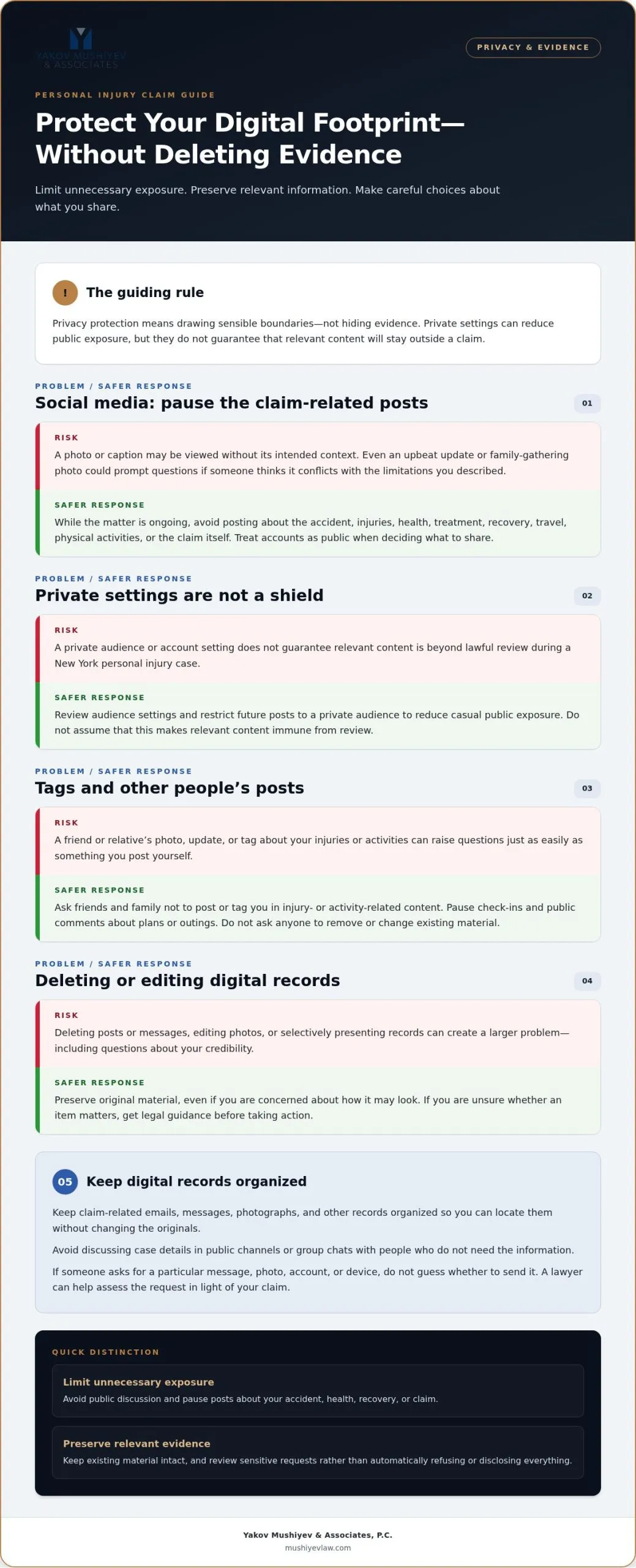
Social media captures everyday moments, but a photo or caption can be viewed without the context you intended. During an injury claim, avoid posting about the accident, your injuries, health, treatment, recovery, travel, physical activities, or the claim itself. Even an upbeat update or a picture from a family gathering could prompt questions if someone believes it conflicts with the limitations you’ve described.
Privacy settings limit public visibility, but they don’t guarantee that relevant content is beyond lawful review. Relevant private social media content may still be sought during a New York personal injury case. Treat your accounts as public when deciding what to share, and make careful choices without trying to erase the past.
What to change on social media during a claim
Review the audience settings on each account and restrict future posts to a private audience. This can reduce casual public exposure, but it does not make relevant content immune from review. The safest approach is to stop posting about the accident, your physical condition, medical care, recovery, or legal claim while the matter is ongoing.
Ask friends and family not to post or tag you in photos or updates related to your injuries or activities. A well-meaning relative’s post can raise questions just as easily as something you publish yourself. You can also pause check-ins and public comments about plans or outings. Don’t ask anyone to remove or change existing material on your behalf.
Texts, emails, photos, and other digital records
Don’t delete existing posts or messages, edit photos, or selectively present digital records. Destroying or altering potentially relevant evidence can create a larger problem than the original content, including questions about your credibility. Preserve the original material, even if you’re concerned about how it might look. If you’re unsure whether an item matters, get legal guidance before taking action.
Keep claim-related emails, messages, photographs, and other records organized so you can locate them without changing the originals. Avoid discussing case details in public channels or group chats with people who don’t need the information. If someone asks you to provide a particular message, photo, account, or device, don’t guess whether to send it. A lawyer can help assess the request in light of your claim.
Questions about medical privacy often arise alongside digital evidence. The U.S. Department of Health and Human Services provides HIPAA Guidance for Individuals, including information about health privacy. HIPAA does not mean every record is automatically shielded in an injury claim, so don’t assume it answers whether a specific record must be shared.
If a post, message, or photo is causing concern, don’t delete or change it. A New York injury lawyer can help you understand how to preserve the material and respond to questions about it. You can discuss a sensitive evidence request with a lawyer before deciding what to do.
Medical Records, Insurer Requests, and What Privacy Does Not Shield
Medical information can be deeply personal, and an insurer’s request for records may leave you wondering how much you’re expected to share. In a New York injury claim, information about treatment, symptoms, or prior conditions may be relevant if it helps clarify an issue in dispute. That doesn’t mean every record is automatically available or that your entire medical history must be disclosed.
Understanding how to protect your privacy during a personal injury claim means looking closely at what’s being requested and why. A record related to the injuries you’re claiming may serve a different purpose from one that appears unrelated. The boundaries depend on the specific claim and circumstances, so don’t assume a request is automatically proper or improper.
How to handle requests for medical or employment records
Before providing records or signing an authorization, identify who sent the request, what documents or time period it covers, and the reason given. Medical records may relate to your condition, treatment, or claimed limitations. Employment information may relate to missed work or an asserted loss of income. A request that reaches well beyond those issues deserves careful review, but unrelated records cannot always be withheld as a blanket rule.
Read any authorization closely. Consider what information it permits someone to obtain, from whom, and for what stated purpose. Don’t sign a broad or unclear form simply because it arrived with an insurance claim. Keep a copy of the request and authorization, and ask a lawyer to review them if you’re unsure what you would be allowing or whether the requested scope fits your claim.
Insurance questions and recorded communications
An insurer may ask questions or request a recorded statement. There isn’t one answer that fits every situation. The appropriate response can depend on who is asking, the type of claim, and the circumstances. Don’t volunteer sensitive details that weren’t requested, speculate about your condition, or guess at facts you can’t recall. If you don’t understand a question, ask for clarification rather than filling gaps with assumptions.
Before agreeing to a recorded conversation or signing a medical or employment authorization, ask your lawyer how to handle that specific request. A careful review can help you understand what information is relevant and what the request would permit. Avoid treating silence, immediate cooperation, or outright refusal as a universal strategy. Each can have consequences depending on the circumstances.
Keep the request, any forms, and related communications together, and note when they arrived. If a deadline or follow-up is mentioned, raise it promptly with your lawyer rather than ignoring it. A measured response is stronger than an impulsive one: protect sensitive information where appropriate, but preserve and address evidence connected to your claim.
A Practical Privacy Checklist for Every Stage of Your Claim
Privacy protection works best as a routine, not a last-minute reaction to an insurer’s letter or an unexpected message. Use this checklist to limit avoidable exposure while preserving information that may matter to your claim. For a broader overview of the New York personal injury claim process, consider how careful information handling fits into each stage.
- Pause public sharing. Don’t post about the accident, your injuries, health, treatment, or claim. Review account privacy settings and ask friends not to post or tag you in related content.
- Preserve records. Keep original documents, messages, photos, and other potentially relevant evidence. Don’t delete, edit, crop, or selectively present material because you’re concerned about how it may appear.
- Secure documents. Store medical and claim records somewhere private, with access limited to people who need them. Take care before sending sensitive files through email, messaging apps, or devices other people use.
- Assess requests. Note who contacted you, what they want, why they say they need it, and any response date. Don’t sign an authorization or send sensitive records until you understand what the request covers.
- Consult counsel. If a request is broad, unclear, or unexpected, get legal guidance before deciding how to respond. A lawyer can assess it in the context of your claim.
Secure records and limit avoidable exposure
Keep a separate physical or digital folder for claim-related requests and your responses. Record when a request arrived and what you sent, but don’t alter the underlying documents or evidence. Before sharing a file, check that you’re sending it to the intended recipient, and avoid leaving sensitive records open on a shared device. Staying organized helps you track what has been requested without spreading private information unnecessarily.
When a privacy concern needs legal review
Pause if someone you don’t recognize contacts you about the accident, if an insurer asks for a wide range of records, or if you feel pressured to disclose personal information quickly. Don’t provide sensitive details in response to an unsolicited message. Save the message, avoid clicking unfamiliar links, and seek guidance about the sender and request before replying. The right response depends on the facts and type of claim.
Questions about a request don’t have to be handled alone. Yakov Mushiyev & Associates, P.C. represents injured clients in Queens and across New York City’s five boroughs and Nassau County, including Rosedale and Rochdale, Queens. You can discuss a privacy concern in a free initial consultation, available 24/7 in English, Russian, and Spanish. Ask how information shared during a consultation will be handled. Discuss a sensitive claim request with a lawyer before disclosing information you don’t understand.
Get New York Legal Guidance on Privacy During an Injury Claim
A request for medical records, questions from an insurer, or contact from someone involved in the claim can leave you unsure what to share. A New York injury lawyer can review the request, help assess how it relates to your claim, and guide you in preserving relevant evidence. The aim is to protect your interests without hiding information that may matter. Ask directly how information will be handled and who may receive it.
If you’re trying to understand how to protect your privacy during a personal injury claim, bring the specific concern to counsel before responding. Don’t rush to sign an authorization, send sensitive documents, or delete or alter potentially relevant material. A careful review can help you understand the request and make an informed next move.
What to prepare for a privacy-focused consultation
Bring the letter, form, message, or other communication that raised concern, if you have it. Explain what you’ve already shared and with whom, without changing or removing evidence. It can also help to write down questions about medical or employment records, social media, and contact from insurers or opposing parties. You don’t need to resolve the issue before asking for guidance.
Discuss your New York injury claim with the firm
Yakov Mushiyev & Associates, P.C. represents injured clients across New York City’s five boroughs and Nassau County. Counsel can consider your privacy concern in the context of the injury claim, rather than treating every request as routine or assuming every request should be rejected. A consultation is an opportunity to discuss your circumstances and possible next steps.
Free initial consultations are available 24/7 in English, Russian, and Spanish. That availability applies to initial consultations, not ongoing case work. You can speak with the firm by video or arrange a consultation at your home or hospital. If an accident has just happened, understanding what to do immediately after an accident may also help you take practical steps while you consider your claim.
Bring your questions, even if you’re uncertain which details matter. Request a free initial consultation to discuss a sensitive information request, an insurer’s questions, or concerns about records you’ve already shared. The firm represents injured clients in car, truck, motorcycle, and pedestrian accidents, as well as construction accidents and slip and fall incidents. The firm works on a contingency basis: no fee unless the firm wins. Clear, case-specific guidance can help you preserve relevant evidence and make careful decisions about what comes next.
Take the Next Step With Confidence
You don’t need to resolve every privacy concern before asking for guidance. The next step can be as simple as identifying what feels uncertain and getting help understanding your options. That can make how to protect your privacy during a personal injury claim feel less like guesswork and help you move forward without compromising evidence or sharing more than you understand.
Bring your questions, even if you’re unsure whether a particular record or message matters. A conversation about your situation can help you consider what to do next, without rushing into a decision alone.
Request a free initial consultation with Yakov Mushiyev & Associates, P.C. to discuss your privacy concerns. Taking that first step can help you identify a practical path forward.
Frequently Asked Questions
Is a personal injury claim confidential?
No, a personal injury claim isn’t automatically confidential from everyone involved. Information you share with your lawyer is different from information exchanged with an insurer or another party, and a lawsuit may involve court filings. Before sending sensitive details, clarify who will receive them and why. If you’re unsure how to protect your privacy during a personal injury claim, ask a lawyer to assess the specific request and explain possible disclosure.
Can an insurance company access my private social media account?
An insurer doesn’t automatically get direct access to a private account just because you filed a claim. But privacy settings don’t necessarily protect relevant posts from being requested in a legal dispute. For instance, a post about an activity could prompt questions if your claim involves limits on that activity. Don’t share login credentials in response to an informal message. Have a lawyer review any formal request for account content.
Can the other side request my complete medical history?
The other side may seek medical information it considers relevant, but that doesn’t mean your entire medical history is automatically available. For example, records related to an injury you’re claiming may be treated differently from records about an unrelated condition. The scope depends on the issues in your case and the request. Before signing an authorization that permits broad access, have a lawyer review its wording and explain what it could cover.
Should I delete old posts after an accident?
No. Deleting a post after an accident may raise evidence-preservation concerns and create a problem beyond the post itself. If an older photo or comment worries you, leave it unchanged and make a note of your concern for your lawyer. Don’t edit captions, remove tags, or ask someone else to take content down. A lawyer can help assess how the material relates to your claim and what steps are appropriate.
Can I refuse to give an insurer a recorded statement?
Whether you can refuse or should provide a recorded statement depends on the insurer, claim type, and circumstances. For example, an insurer connected to your own policy may raise different issues from another party’s insurer. Don’t assume that agreeing or refusing is always the right choice. Ask a lawyer to review who’s requesting the statement, what it concerns, and whether your policy or claim creates any obligations before you respond.
Will my personal injury lawsuit become public record?
Court filings in a lawsuit may be accessible to the public, so don’t assume that filing a case keeps every detail private. That doesn’t mean every document or piece of evidence automatically becomes public. The treatment of particular information can depend on what is filed and applicable court rules. If you’re considering a lawsuit in Rosedale, Rochdale, or elsewhere in Queens, ask a lawyer how filing could affect your privacy.
These FAQ answers provide general information only and are not legal advice for a specific case. A lawyer can assess how the law and your circumstances apply to your situation.