
A fall on snow or ice doesn’t automatically make a property owner liable. If you’re asking what happens when your slip and fall occurs on snow or ice while visiting areas near Queens, Rosedale, or Rochdale, liability can depend on whether the owner knew or should have known about the hazard, how long it was there, and whether reasonable snow and ice removal took place. For an injury claim involving private property, New York generally allows three years to file suit, according to the New York State Legislature.
It’s understandable to feel shaken when pain and uncertainty arrive at once. The details matter: where you fell, how the ice formed, what the property owner did, and whether you share any fault can all affect a claim.
This article explains when a property owner may be responsible, what to do after a fall, and how Yakov Mushiyev & Associates, P.C. can help preserve evidence of your injuries and the icy condition. It also covers shorter deadlines that may apply when a public entity is involved, so you can understand the risks and choose informed next steps.
Key Takeaways
- Property-owner liability can turn on how long the ice was present, whether the owner had notice, and whether reasonable snow and ice removal occurred.
- Report the fall promptly and preserve useful evidence, including scene photos, witness details, and the shoes and clothing you wore.
- Seek medical care and keep records of your symptoms and treatment to document how the fall affected you.
- If a public entity may be responsible, New York State Legislature rules generally require a notice of claim within 90 days of the injury.
What to Do if You Slip on Ice or Snow in New York?
After a fall on snow or ice, promptly report it to the property owner, manager, or occupant. Ask for a copy of any incident report and note who received your report. Record the exact location, such as a store entrance, apartment walkway, or public sidewalk. If you’re asking, “What if my slip and fall happened on snow or ice in Nassau County?” start by noting the address and the precise surface where you landed. Keep the shoes and clothing you wore, as they may be relevant to a claim. Get contact details from anyone who witnessed the fall.
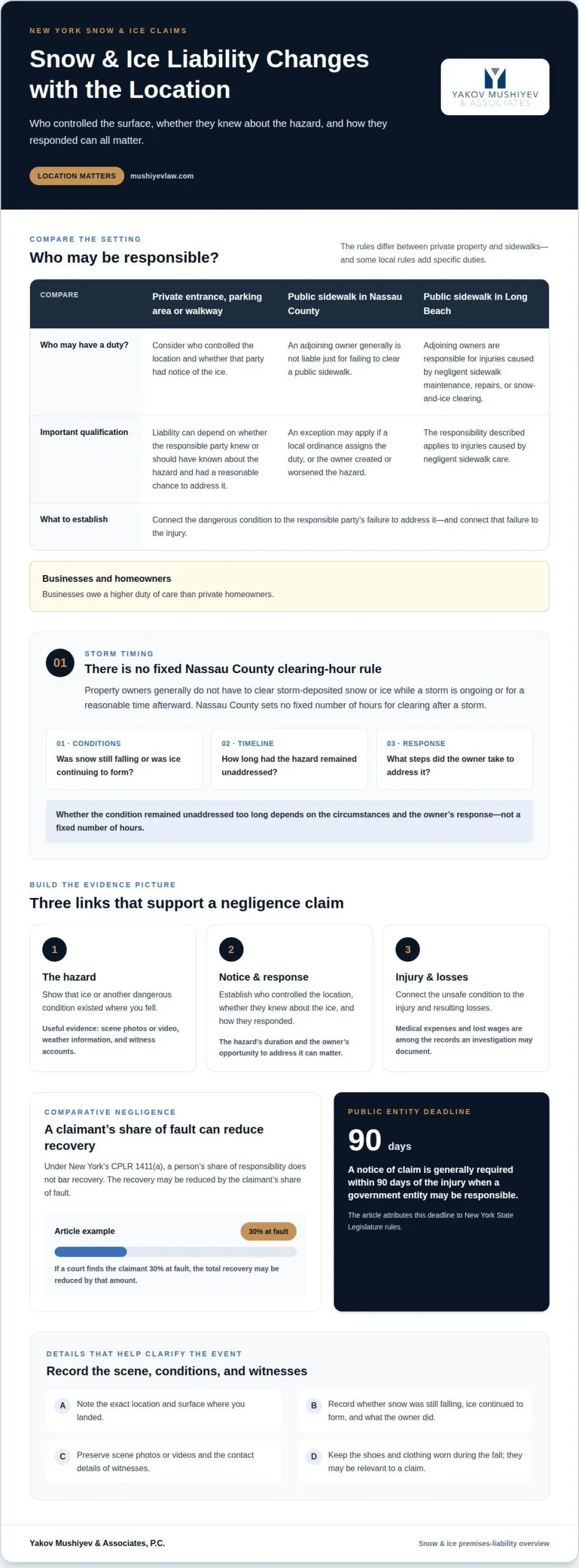
New York property owners generally don’t have to clear storm-deposited snow or ice while a storm is ongoing or for a reasonable time afterward. Nassau County sets no fixed number of hours for clearing snow after a storm. Whether a hazard remained unaddressed too long depends on the conditions and the owner’s response. Note whether snow was still falling, ice continued to form, and what the owner did. These observations can help establish the timeline.
A fall at a private entrance, parking area, or walkway raises different questions from one on a public sidewalk. In Nassau County, an adjoining owner generally isn’t liable just for failing to clear a public sidewalk, unless a local ordinance assigns that duty or the owner created or worsened the hazard. Long Beach assigns adjoining owners responsibility for injuries caused by negligent sidewalk maintenance, repairs, or snow-and-ice clearing. Businesses owe a higher duty of care than private homeowners.
If you’re still wondering, “What if my slip and fall happened on snow or ice in Nassau County?” focus on who controlled the location and what happened before your fall. Liability can turn on whether the responsible party had notice of the ice and a reasonable chance to address it. Runoff that refreezes beside a driveway or water that freezes beneath a gutter may create a hazard. If a government entity may be responsible, a claim generally requires a notice of claim within 90 days of the injury, according to the New York State Legislature.
Medical treatment and documenting injuries
Arrange medical care promptly after a fall on snow or ice, even if the pain seems manageable. A clinician can assess your injuries and document your symptoms close to the incident. Explain where you fell, how you landed, and which body parts hurt. Describe your immediate symptoms and any changes since the fall. For example, say whether knee pain began at the scene or worsened later. Accurate details help connect your medical records to the accident and guide appropriate care.
Be direct about what you remember. Describe slipping on snow or ice and the surface where it happened, such as an apartment entrance or walkway. Don’t guess about facts you didn’t see, including how long the ice was there or who created it. Your medical provider needs an accurate account of the fall and your symptoms, not a legal conclusion about responsibility. Follow treatment advice and keep appointment details, discharge papers, prescriptions, and bills together.
Falls on snow and ice can cause fractures, lacerations, back or neck injuries, soft-tissue damage, and traumatic brain injuries. Injuries may affect work, sleep, walking, or routine tasks. Keep a dated record of symptoms and limitations, such as difficulty climbing stairs after a fall. Save photos of visible injuries as they change, along with records of missed work and related expenses. These materials can help show how the injury affects you in a personal injury claim.
Preserve the shoes and clothing worn during the fall; footwear may be scrutinized in a claim. Keep copies of medical records and any written instructions, and avoid altering original photographs. An attorney reviewing the premises and medical timeline can identify gaps that may affect evidence of injury. For support with slip-and-fall injury claims, legal guidance can help organize records and assess what evidence may matter.
What is the Property Owner Liable For?
A property owner’s liability depends on the hazard, notice, and response. Evidence must connect the unsafe condition to your injuries and resulting losses.
Proving Negligence
To prove negligence, you must show that a responsible party failed to address a dangerous condition and that this failure caused your injury. The evidence must support each link, not merely show that a fall occurred. Photos, videos, weather reports, and witness accounts can help establish whether ice existed and remained untreated. How long the hazard existed and whether the owner had notice also matter.
A lawyer can investigate the incident, identify potentially responsible parties, and handle insurance communications. Records may show who controlled the location and whether that party knew about untreated ice. Witnesses can help confirm the condition, while weather information can provide context about snow and freezing. An investigation can also document medical expenses, lost wages, and pain and suffering for a compensation claim.
Comparative Negligence
Comparative negligence means a claimant’s recovery can be reduced by their share of fault. Under New York’s CPLR 1411(a), a person’s share of responsibility doesn’t bar recovery. If a court finds a claimant 30 percent at fault, the total recovery may be reduced by that amount. That rule makes evidence about how the fall happened important to the value of a claim.
An insurer may argue that a visitor failed to notice an obvious hazard or chose an unsafe path. The evidence must address those arguments alongside the owner’s conduct. For instance, a video may show the route available to a visitor and the condition of the walking surface. Sidewalk responsibility can also depend on location: New York City Administrative Code §7-210 assigns most abutting property owners responsibility for adjacent public sidewalks. Nassau County sidewalk rules differ, so identifying the precise location and applicable duty matters.
Statute of limitations for New York slip-and-fall lawsuits
The deadline depends on who controlled the property where you fell. For an injury on private property, New York generally has a three-year statute of limitations, according to the New York State Legislature. A fall in a privately owned parking lot follows the private-property category, even if the lot serves an apartment building or business. Identify the property owner and location early. Those details help determine the applicable deadline and who must receive legal notice.
A claim involving a public entity follows a shorter timeline. A claim involving a public entity may have a shorter filing deadline, so confirm the applicable timeline promptly. According to the New York State Legislature, a claim against a public entity generally requires a notice of claim within 90 days of the injury. Treat those as distinct deadlines, not interchangeable steps. For example, sending notice does not itself start the lawsuit. Confirming whether a town, county, or other public entity controlled the sidewalk or lot is essential.
Unlike a car accident claim, a snow-and-ice case may first turn on who owned or maintained the surface. A parking lot may seem connected to a nearby store but belong to another entity. Responsibility may also differ between a public sidewalk and a private driveway. Gather the address, the entrance or lot location, and any incident report. These details help an attorney assess the proper defendant and filing timetable before evidence becomes harder to obtain.
Don’t wait for a settlement discussion to clarify the lawsuit deadline. Preserve photographs, medical records, and witness details while the condition and events remain easier to document. An attorney can investigate ownership, track notice and filing requirements, and build a reasonable timeline for the claim. If you need help assessing the deadline after a Nassau County fall, request a review of your filing timeline.
Yakov Mushiyev & Associates, P.C: Slip and Fall Legal Representation
Yakov Mushiyev & Associates, P.C. represents people injured in slip-and-fall incidents, including falls involving snow or ice. Consider legal help if responsibility is disputed, the hazard’s history is unclear, or an insurer challenges your claim. The firm can investigate the circumstances, identify potentially responsible parties, and pursue compensation for documented losses. Prompt attention can help preserve evidence and address deadlines, especially if a public entity may be involved.
If you were injured in a Nassau County slip and fall, contact Yakov Mushiyev & Associates, P.C. to discuss your situation.
Take the Next Step Toward Clarity
If your slip and fall happened on snow or ice in Nassau County, deciding what to do next can feel difficult while you’re managing an injury. Understanding how the incident, available evidence, and responsible parties affect your options can help you decide what comes next. A legal review can clarify what questions remain, which records may matter, and how to handle claim-related communications.
Each case turns on its own facts, including where the fall occurred and what evidence supports your account. Yakov Mushiyev & Associates, P.C. provides slip-and-fall legal representation for people seeking guidance after an injury. Consider reaching out before making decisions that could affect your claim. A free consultation can help identify a practical next step without committing you to a particular outcome.
Discuss your legal options with Yakov Mushiyev & Associates, P.C. Taking that step can help you move forward with greater clarity.
Frequently Asked Questions
Can I sue if I slipped on ice during a snowstorm?
A lawsuit may be possible, but an active storm affects the owner’s snow-removal duty. New York property owners generally aren’t required to clear storm-deposited snow or ice while the storm continues or for a reasonable time afterward. A claim may still involve ice the owner created or made worse, such as snow pushed onto a walking route. The storm’s timing and how the hazard formed matter.
Do I Have a Case if I Slip and Fall on Snow and Ice?
You may have a case if evidence connects a responsible party’s conduct to the hazard and your injury. Relevant details include who controlled the area, whether the condition was known, and whether a contractor’s work created or worsened it. A snow-removal contractor may be sued alongside a property owner, though contractor liability is generally narrower. For a fall in Nassau County or nearby Rosedale or Rochdale, Queens, pinpoint the exact property and walking surface.
How Long Do You Have to File?
For an injury claim involving private property, New York generally provides three years to file suit, according to the New York State Legislature. Deadlines for claims involving public entities may be shorter than those for private-property claims. A separate notice of claim generally must be served within 90 days of the injury. Identifying whether a town, private owner, or another entity controlled the location helps clarify which deadline applies.
I fell on a town sidewalk, do I have less time to make a claim?
If a public entity may be responsible, the shorter public-entity deadlines can apply: generally, a notice of claim is required within 90 days, and the lawsuit must begin within one year and 90 days. But a sidewalk’s location alone doesn’t establish who is liable. In Nassau County, an adjoining owner generally isn’t liable just for failing to clear a public sidewalk, unless a local ordinance imposes that duty or the owner created or worsened the hazard.
What if I was partly at fault for not watching where I was walking?
Being partly at fault doesn’t automatically prevent recovery in New York. A claimant’s recovery may be reduced based on their share of fault. For example, if a claimant is found 30 percent responsible, the total recovery may be reduced by 30 percent. Evidence about the route, lighting, visibility, and condition of the walking surface can help assess how responsibility should be divided.
What is Black Ice?
Black ice is a thin, transparent layer that can be difficult to see against pavement. It may form when melting snow refreezes, including near a driveway, or when water dripping from a gutter freezes on the ground. Whether an owner may be responsible can depend on whether they knew or should have known about the ice. Describe what you observed and felt rather than guessing how it formed.
These answers provide general information, not legal advice for a specific case. Details can vary across New York, including Nassau County and nearby Queens communities such as Rosedale and Rochdale.