
A tow truck is a work machine bolted onto a truck chassis, and most of the crashes we see with them come down to one of two things: the truck itself was driven badly, or the gear on the back was set up badly. If one of these rigs hit you, dropped a car on the road in front of you, or caught you while you stood beside it, a tow truck accident lawyer will want to know which of those two problems was in play, because that answer usually points to who pays.
How the Equipment Works, in Plain Terms
You can’t figure out what went wrong until you know what was supposed to happen. Three basic setups run the streets of Queens and Nassau.
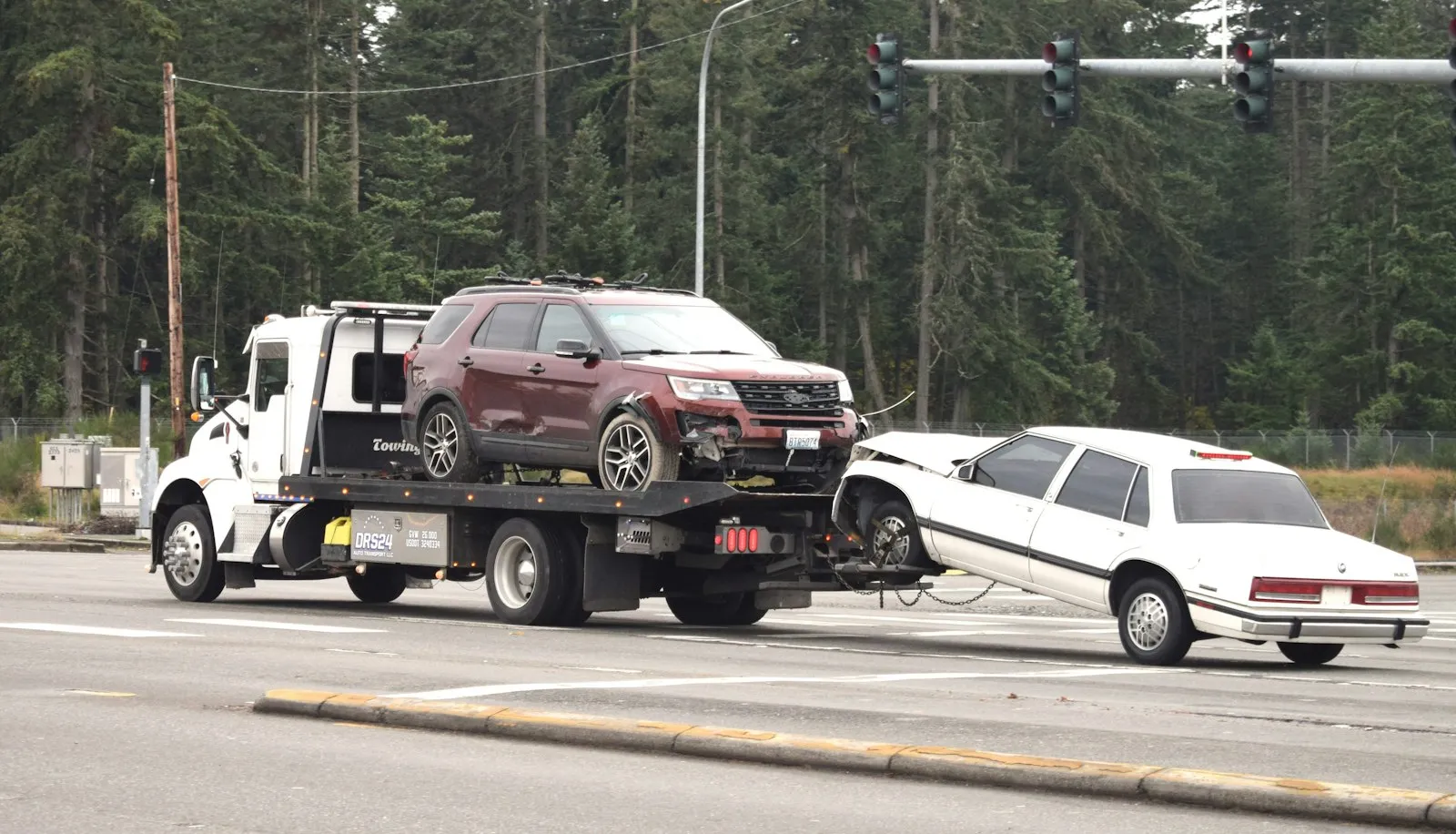
Wheel-lift. This is the most common light-duty rig. A metal yoke slides under the front or rear tires, cradles them, and lifts that end of the car off the pavement. The other two wheels stay on the road and roll. The weak point is that the car is only half carried, so its free wheels, steering and brakes all matter. Straps or wheel chains are supposed to hold the tires in the cradle, and safety chains are supposed to back that up.
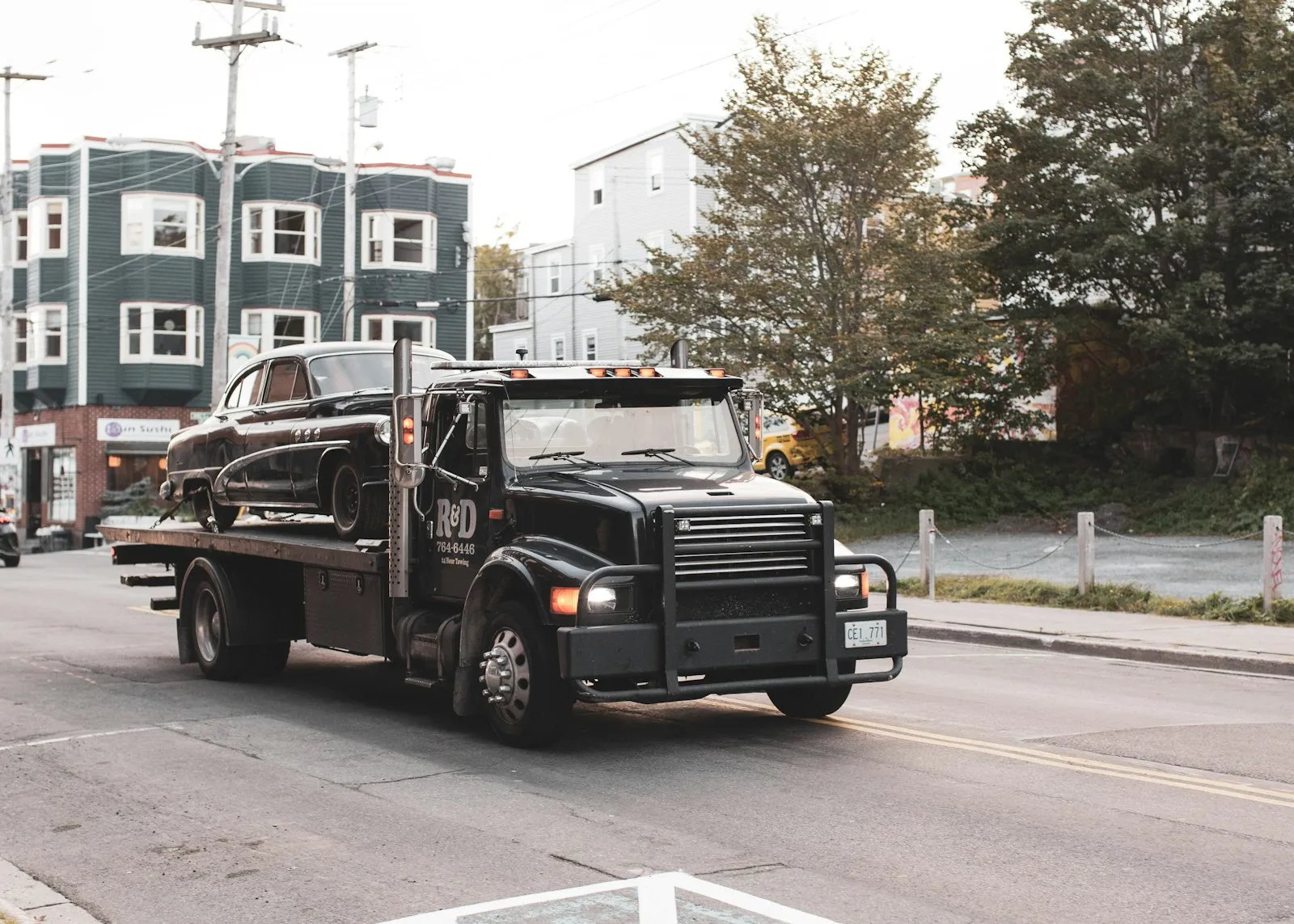
Flatbed. Also called a rollback or carrier. The whole bed tilts and slides back to form a ramp, a winch cable drags the car up, and then the bed levels out. Done right, the car rides with all four wheels off the ground and is tied down at each corner. A flatbed is the gentlest way to move a damaged car, but it puts a lot of weight high and toward the rear of the truck, and a car that isn’t tied down properly can shift or slide on that steel deck.
Integrated wrecker. These are the heavy units, the ones that tow buses, box trucks and tractor-trailers. The boom and underlift are built into the chassis, and the whole package is long, heavy and slow to stop.
Across all three, the securing hardware is the same family: grade-rated chains, ratchet straps, J-hooks, T-hooks, wheel nets and the winch cable itself. Every one of those pieces has a rated limit, and every one of them wears out.
Four Ways People Get Hurt
The tow truck hits someone. A loaded tow rig is heavy and sits high. It swings wide on turns, takes longer to stop, and has big blind spots off the passenger side. Some operators also race to fresh wrecks because the first truck there often gets the job. People call them chasers. Pedestrians in crosswalks and cyclists in painted lanes are the ones who pay for that rush.
The towed vehicle breaks loose. A car comes off a wheel-lift on the Van Wyck, or slides off a flatbed on a Nassau turnpike, or starts swaying behind the truck until the driver loses control of both. That’s a securing problem nearly every time.
Someone is hurt during hookup or loading. Owners like to stand right next to their car while it’s being hooked. Bystanders wander over. When a cable snaps, a hook slips, or a car rolls off a tilted bed, whoever is standing in the wrong spot takes the hit.
A driver hits the tow truck or the operator. A tow truck working the shoulder of the Belt Parkway or the Southern State is a stopped vehicle with a person walking around it. Drivers who don’t slow down or change lanes plow into the truck, the disabled car or the operator.
What Can Go Wrong With the Gear
When we look at a loose-load or hookup case, these are the usual suspects:
- Too few tie-downs, or tie-downs attached to suspension parts that flex or break instead of solid anchor points.
- Worn, stretched or kinked chains, and straps that are frayed, cut or sun-rotted.
- A winch cable with broken strands that should have been pulled from service.
- Safety chains skipped entirely on a wheel-lift tow because the run was “only a few blocks.”
- Steering on a wheel-lifted car left unlocked, so the free wheels wander and the car fishtails.
- A car loaded off-center on a flatbed, or a heavier vehicle on a light-duty carrier rated for less.
- Hydraulic leaks or worn pins in the boom or underlift that let the load drop.
- No cones, no flares and no amber lights while working a roadside job.
Most of those show up in photos taken right after the crash, and vanish once the truck is back at work.
The Move Over Law and Roadside Crashes
New York treats a tow truck working a breakdown as a protected roadside vehicle. Under VTL § 117-a, the definition of “hazard vehicle” covers vehicles specially equipped for towing disabled vehicles. Then VTL § 1144-a, the move over law, says that when you come up on a stopped hazard vehicle showing its amber lights, you have to take due care, and that includes moving over a lane when it’s safe to do so.
Why that matters for an injury case: when a driver breaks a traffic statute with no good excuse, New York courts generally count that broken rule as negligence on its face. So if a driver blew past a lit-up wrecker on the shoulder without slowing or shifting over and struck the operator, the stranded motorist, or the car being loaded, the statute does a lot of the heavy lifting on fault.
It cuts both ways. A tow truck parked in a live lane at night with no amber lights on may share the blame for the pileup that follows.
Who Pays When a Tow Truck Is at Fault
There are usually several possible pockets, and a tow truck accident lawyer will check each one rather than stop at the first.
The operator. The person behind the wheel or running the controls is the starting point.
The tow company. Employers are generally responsible for their employees’ negligence on the job. If the operator was working a call when the crash happened, the company is usually on the hook. Our explainer on how vicarious liability works in truck cases goes into that.
The truck’s owner. Under VTL § 388, whoever holds title generally answers for a permitted driver’s carelessness. The truck may be titled to someone other than the driver or even the company on the door, such as a relative, a holding company or a separate business.
Whoever ordered the tow. A dealership, a body shop, a police rotation list, a motor club or a parking lot owner may have called the truck. Making the call generally isn’t enough. They come in only if they were negligent themselves, such as knowingly sending work to an unsafe outfit.
Federal rules on bigger rigs. Heavier wreckers that cross state lines in commerce can fall under federal motor carrier rules, including the FMCSA hours-of-service limits. We look at an all-night recovery driver the same way we look at drowsy driver crash cases.
Tow companies carry commercial insurance, and those policies generally have higher limits than a personal auto policy. Tow companies operating in New York City are also licensed by the city, and the licensing paperwork can help pin down which company actually owned and ran a given truck when the name on the door isn’t clear.
City Tow Trucks and Contracted Tows
Some tow trucks in the five boroughs belong to the city, and others work under city contracts or rotation programs. If the truck that hurt you was a city vehicle, the clock is a lot shorter. For a city-owned truck, you generally get 90 days to serve a written notice of claim (see General Municipal Law § 50-e), which goes to the Comptroller in the five boroughs, and the suit generally has to be on file within a year and ninety days of the crash. The city can also call you in for a sworn examination before any suit, which we walk through in our article on the 50-h hearing.
A private company that simply got the call from police usually isn’t covered by the municipal rules, but sorting that out is one of a tow truck accident lawyer’s first jobs.
Evidence That Tells the Story
Tow work leaves a paper trail, and a lot of it lives on the company’s side. Here’s what we go after:
- Tow tickets and invoices. They show the job number, the pickup and drop-off points, the time, and often the type of tow and equipment used.
- Dispatch records. When the driver was sent and how many jobs were stacked up.
- GPS and telematics. Speed, route and stop times. If the driver was racing to a wreck, it tends to show up here.
- Dashcam and bodycam footage. From the tow truck, other drivers, buses and nearby storefronts.
- Photos of the hardware. Close-ups of every chain, strap, hook and anchor point, plus the tilt bed and wheel-lift, taken as soon after the crash as possible.
- Maintenance and inspection logs. When the winch cable was last replaced, when the hydraulics were serviced, when the straps were swapped out.
Send a preservation letter early, because trucks get repaired and cameras record over themselves.
Pedestrians, Cyclists and No-Fault
If a tow truck hit you while you were on foot or on a bike, the tow truck’s own policy generally picks up your no-fault benefits. Those benefits pay doctors and hospitals and replace a portion of lost pay no matter who caused the crash, and you generally have just 30 days to get the application in. Our no-fault insurance guide has the step-by-step.
People hurt walking get more on our pedestrian accident page, and riders hit in a bike lane should read our article on bicycle and e-bike crashes in Queens. If you were in a car, the general approach on our car accident page applies, with the tow-specific layers on top.
Serious Injury, Shared Fault and the Clock
The injury threshold. Because this is a motor vehicle case, a pain-and-suffering claim generally has to clear the threshold in Insurance Law § 5102(d). Fractures count. So can significant scarring, a permanent or significant loss of how a body part works, or being unable to do nearly everything you normally do on 90 or more of the 180 days right after the crash. The medical records have to show it. See a doctor and keep up with follow-up visits.
Your share of the blame. Insurers like to argue that an owner who stood too close to the hookup, or a driver who stopped short in front of a tow rig, caused their own injuries. Under CPLR § 1411, New York uses pure comparative fault, so any share assigned to you trims the award rather than wiping it out. The percentages are laid out in our comparative negligence primer.
Deadlines. Against a private tow company or driver, the general window to file is three years, set by section 214 of the CPLR. If someone was killed, the family’s wrongful death case generally runs on a two-year clock starting the day they died. And if a city vehicle is involved, the 90-day notice described above controls.
Talking to Our Office
Our shop is at 1 Cross Island Plaza, Suite 325, right where Rosedale meets the Nassau line by the Cross Island Parkway. Attorney Yakov Mushiyev and the team take injury cases across Queens, the other boroughs and Nassau, and over $80 million has come back to injured New Yorkers through our work. The first meeting is free, and nothing is owed to us unless we win. Conversations can happen in Russian, Spanish or English, at your kitchen table, by a hospital bed or on a video call. Heavy-vehicle work more broadly is on our truck accident page, and you can tell us what happened through the contact form or by phone at 718.775.3110.
Tow Truck Crash Questions
Do I need a tow truck accident lawyer if the tow company’s insurer already called me?
Before you give a recorded statement or sign anything, get advice on what the policy covers and whether other parties, like the truck’s owner, also belong in the claim.
The car on the flatbed slid off and hit me. Isn’t that obviously the tow company’s fault?
It often looks that way, and in some cases the law allows an inference of negligence when something like that ordinarily doesn’t happen without carelessness and the equipment was in the company’s control. You still want the photos, the tow ticket and the maintenance records to back it up.
I was hurt while my own car was being hooked up. Can I still bring a claim?
Generally yes. The operator controls the work zone and should keep people clear. If you were standing too close, your recovery may be reduced for that, but under New York’s comparative fault rule it isn’t eliminated.
What if the tow truck that hit me drove off?
Note the company name on the door, the plate and the direction it went. If the truck can’t be identified, look to the uninsured motorist coverage on a policy in your household, or to MVAIC if nobody at home has one.
Does a pre-existing back or neck problem hurt my case?
No. A defendant takes you as it finds you, and making an old condition worse is generally compensable. Your doctors will need to document the difference between before and after.
Visit Yakov Mushiyev & Associates
Our office is at 1 Cross Island Plaza, Suite 325, Rosedale, NY 11422, just off the Cross Island Parkway on the Queens–Nassau border. If you can’t come to us, we’ll come to you: at home, in the hospital or by video.

Talk to a Queens tow truck accident lawyer today
Yakov Mushiyev & Associates has recovered over $80 million for injured New Yorkers across the five boroughs and Nassau County. Consultations are free, available in English, Russian and Spanish, and there is no fee unless we win.
Call 718.775.3110 or contact us online for a free case review.
This article is general information, not legal advice. Every case is different. Attorney Advertising.