
What if a photo from a good day is used to suggest you’ve recovered, even though pain still limits your life? If you’re asking, “can the defense get my social media posts in Queens,” the answer isn’t simply yes or no. In a New York injury case, relevant posts may be requested even when your account is private, but that doesn’t automatically give the defense access to everything you’ve shared.
It’s understandable to worry that a brief caption, an old photo, or a friend’s tag could be treated as proof that you aren’t injured. A post can leave out important context, such as when the photo was taken, how long an activity lasted, or how you felt afterward. At the same time, online content may raise questions about your claimed injuries and daily activities. This article explains how social media may become evidence, why privacy settings don’t settle the issue, and what to do if a post or request concerns you.
You’ll also learn how to preserve existing posts, tags, and messages without creating a bigger problem by deleting potential evidence. If you’re dealing with a social-media request in Rosedale, Rochdale, or elsewhere in Queens, a personal injury lawyer can review the request and the context surrounding a disputed post.
Key Takeaways
- If you’re wondering, “can the defense get my social media posts in Queens,” relevant content may be requested, but a claim doesn’t automatically open your entire account.
- A photo or short post can leave out context, including when it was taken and how your injuries affect you afterward.
- Don’t delete, edit, or hide existing posts. Pause posts about your accident, injuries, health, treatment, or claim, and ask friends not to tag you.
- Read a discovery request carefully. The accounts, subjects, dates, and types of content it identifies can help clarify what the defense is seeking.
- A Queens injury lawyer can review a request or disputed post and assess its relevance, scope, and context.
Can the Defense Get Your Social Media Posts in a Queens Injury Claim?
The defense may seek social media content relevant to your injury claim, but filing a claim doesn’t automatically give it access to your entire account. A public post can be viewed without a litigation request. A request made during a lawsuit is different: it asks for information through the formal process of Discovery (law), and its scope may be disputed. Even if content is disclosed, that doesn’t mean a court will admit it or find it persuasive.
So, can the defense get my social media posts in Queens? The answer depends on what the defense seeks, how the content relates to the injuries and issues in dispute, and the rules that apply. Queens isn’t a separate exception that makes every post available. The request still requires a case-specific assessment.
What counts as social-media evidence in an injury case?
Potentially relevant material can include posts, photographs, videos, captions, comments, and other account activity. For example, a photo at a family gathering might be raised in connection with a claim about mobility. The date, duration of the activity, and circumstances around the event may provide important context. Online content is considered alongside other evidence, such as testimony and medical records. A post isn’t automatically admissible, accurate, or convincing simply because it exists.
Does a private account keep posts out of the case?
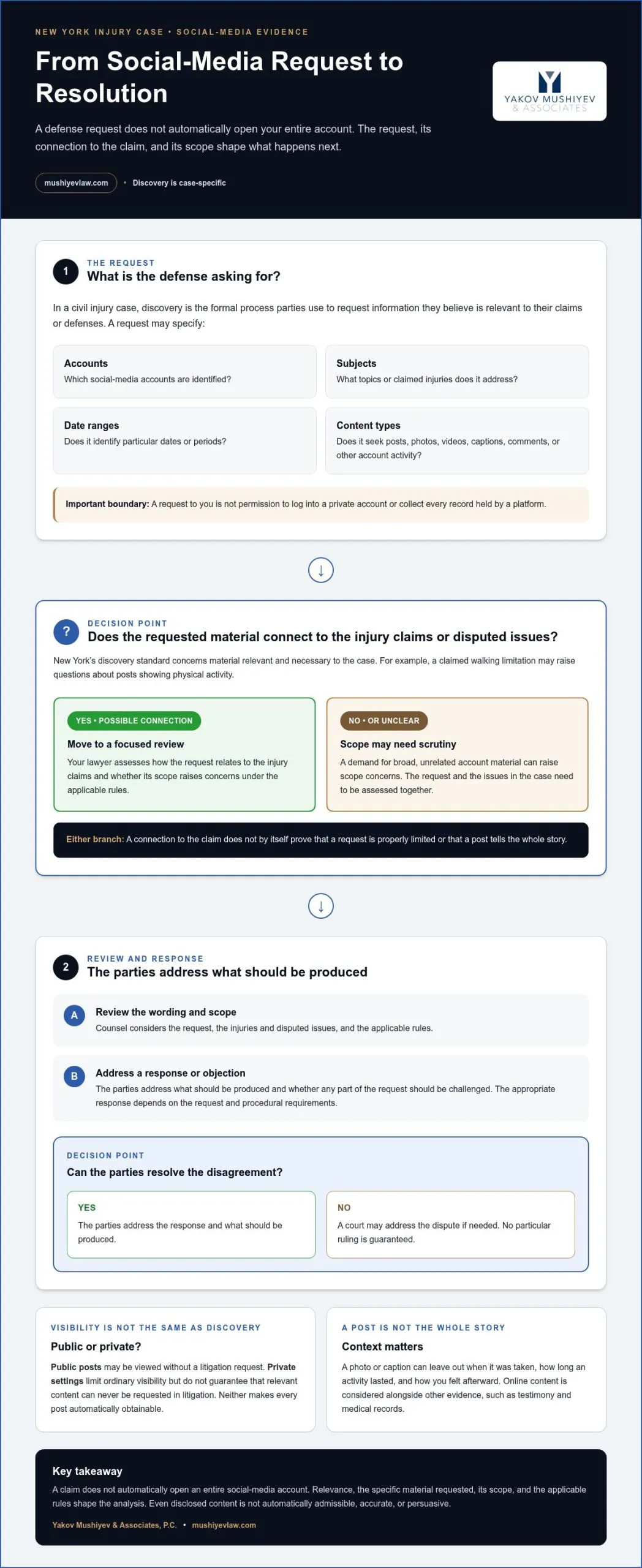
Privacy settings can limit who sees your posts publicly, but they don’t guarantee that relevant content can never be requested in litigation. Privacy settings govern ordinary visibility; discovery rules govern requests for information in a case. That doesn’t mean every private post or message is automatically obtainable. The request, its scope, and any response or court ruling matter.
Why the answer depends on the individual claim
New York’s discovery standard permits disclosure of material relevant and necessary to a case, but it doesn’t make an entire account automatically open for inspection. In Forman v. Henkin (2018), New York’s highest court rejected an all-or-nothing approach and tied discovery of private social media content to the claims at issue. A request connected to a claimed physical limitation may raise different questions from one seeking unrelated personal content.
Private settings alone do not determine whether relevant content is disclosed. The injury claims, the specific material requested, and the applicable rules shape the analysis. A lawyer can review a discovery request or disputed post to assess its relevance and scope. That review can clarify the issues, but no outcome should be assumed in advance.
How the Defense May Request and Review Social-Media Posts in New York
In a civil injury case, discovery is the formal process parties use to request information they believe is relevant to their claims or defenses. A defense request for social-media material is part of that process. It is not permission to log into a private account or collect every record held by a platform. If you’re asking, “can the defense get my social media posts in Queens,” the practical answer depends on the request, the case, and the rules that apply.
The process generally follows a sequence:
- Request: The defense identifies the material it seeks. The request may specify accounts, subjects, date ranges, or content related to claimed injuries.
- Review: Your lawyer assesses how the request relates to the injuries and disputed issues, and whether its scope raises concerns under the applicable rules.
- Response or objection: The parties address what should be produced and whether any part of the request should be challenged. The appropriate response depends on the request and procedural requirements.
- Court resolution, if needed: If the parties can’t resolve a dispute, a court may address it. No particular ruling is guaranteed.
What can happen after the defense requests posts?
A request might seek posts about a claimed mobility limitation or content from particular dates that the defense says relates to your injuries. The request itself doesn’t settle what must be produced. Counsel should review its wording, the issues in the case, and the current New York procedural requirements before advising on a response. Deadlines and response obligations can depend on the case, so don’t assume a general online description answers your situation.
Why relevance and scope matter
The connection to the claim matters. If you allege that an injury limits walking, a request about posts showing physical activity may raise questions about relevance. That doesn’t, by itself, prove that the request is properly limited or that the posts tell the whole story. A demand for broad, unrelated account material can also raise scope concerns. A lawyer can assess those issues without predicting how a court will rule.
Public posts, account holders, and third-party platforms
Publicly viewable content differs from material the defense asks you to disclose through litigation. A request directed to you doesn’t mean a lawyer can simply enter your private account or obtain every record from a platform. Requests involving a third-party platform can raise separate legal and procedural questions. The rules may depend on the kind of information sought, so broad claims about what a platform must provide aren’t reliable.
If you receive a demand, don’t guess what it covers or respond without understanding its scope. A lawyer can review the request and explain the issues specific to your case. Yakov Mushiyev & Associates, P.C. offers a free case review at 718-775-3110, with consultations available in English, Russian, and Spanish.
How a Photo or Post Can Be Misread Without Its Queens Case Context
A defense lawyer may point to a post and argue that it conflicts with what you’ve said about your injuries. But a photo captures one moment, not necessarily what happened before or afterward. A short outing may involve pain, help from someone else, or symptoms that worsened later. A single online image is a snapshot, not a complete medical history. If you’re concerned about a post, its date, caption, and surrounding circumstances matter.
Posts about activity and physical injuries
Imagine a photo from a family event that shows you standing. It doesn’t show how long you stood, whether you needed support, or whether you had pain afterward. A brief walk in Queens may look effortless in a picture, even if you had to rest soon after. The image alone doesn’t prove or disprove an injury. The defense may still use it to question claimed limitations, while testimony and medical evidence can help explain the fuller picture.
Captions, dates, and surrounding circumstances
Consider when the activity happened, what the caption says, and what was going on around it. A cheerful caption may describe a family occasion, not make a statement about your health. An old photo that’s reposted or a friend’s tag may also make the timing unclear. Preserve the original material and any context that helps establish what it depicts. Don’t edit or delete posts to change how they appear.
Posts before the accident and claims of inconsistency
Older content may come up if it relates to a disputed issue, but it isn’t automatically relevant just because it appears on your account. Pre-accident activity may show what you did before an injury; it doesn’t, by itself, establish your abilities afterward. A post from after the accident may be examined in relation to recovery, but its meaning still depends on timing and circumstances.
Context may include the original date, the event, assistance you received, and how you felt later. If a post seems inconsistent with your testimony, an explanation may clarify what the image leaves out. Keep available context intact, and discuss a concerning post with your lawyer rather than trying to change its appearance yourself. That gives your legal team an opportunity to assess how it relates to the specific injuries and limitations in your Queens claim.
Preserve Posts and Protect Your Queens Injury Claim
If you’re worried about how online content could affect your case, take a careful, steady approach. Don’t delete, edit, or hide existing posts, photographs, messages, or account records. Destroying potential evidence can create a larger problem and may raise questions that didn’t exist before. Instead, pause posts about the accident, your injuries, health, treatment, or claim. Set accounts to private, and ask friends not to tag you or post about these subjects.
A practical social-media preservation checklist
Keep the original material as it is, even if a post seems embarrassing, incomplete, or easy to misunderstand. Make a note of questions for your lawyer, such as whether a date is correct, a caption needs context, or a tag relates to an older photo. Don’t create a replacement post to explain or correct something already online. A new explanation may add confusion rather than clarify the original.
- Preserve relevant posts, photos, messages, and account records without changing them.
- Note dates, captions, tags, and surrounding details that may help explain the content.
- Pause new posts about your accident, injuries, health, treatment, or claim.
- Change privacy settings to limit public visibility, while understanding that this doesn’t determine what may be requested in litigation.
What to do about tags and messages
Ask friends and family not to tag you or post about your accident, injuries, health, or case. If you notice a tag or receive a message that may relate to your claim, preserve it and speak with counsel before taking action. Don’t delete a tag or message without discussing how to preserve it. Avoid discussing claim details in posts, comments, direct messages, or group chats. Online conversations can be copied or shared, and their context may not travel with them.
When to get case-specific help
If you receive a social-media discovery request, contact your lawyer promptly so the request can be reviewed in the context of your case. Share potentially relevant material with counsel and explain what happened around the post, when it appeared, and what details may be missing from the screen alone. A lawyer can assess the request and help you understand the issues without promising how a court will decide them.
Preserving records is one part of protecting a claim. Understanding how evidence fits into the broader New York personal injury claim process can also help you make informed choices as your case moves forward. Yakov Mushiyev & Associates, P.C. offers a free case review at 718-775-3110. Consultations are available in English, Russian, and Spanish.
How a Queens Injury Lawyer Can Address Social-Media Evidence
A social-media request can feel personal and overwhelming, especially when you’re unsure what the defense is asking for or how a post might be interpreted. A lawyer can review the request against the issues in your injury claim, help identify relevant material, and discuss preservation and response options. That doesn’t guarantee a particular ruling or outcome. It gives you a clearer, case-specific understanding before you act.
If you’re asking, “can the defense get my social media posts in Queens,” counsel can help distinguish what the defense is seeking from what may be relevant to the claim. The wording, dates, account activity, and context all matter. A careful review can also identify questions to raise about a request that appears broad or unrelated, without assuming how a court will resolve a dispute.
What counsel can review with you
Your lawyer can examine the request’s wording and scope, then compare it with the injuries and issues at stake. Together, you can identify potentially relevant posts and discuss details that may not be obvious from a screenshot, such as when content was shared, who added a tag, or what a caption referred to. Counsel can also explain preservation steps and response options based on your specific case.
Why local experience can matter to Queens claimants
Yakov Mushiyev & Associates, P.C. is based in Rosedale and represents injured people across all five boroughs and Nassau County, including people in Rochdale and elsewhere in Queens. The firm handles injury claims, including car accidents, slip and falls, and construction accidents. In a car accident claim, questions about online content are one part of a larger case; the firm’s Queens car accident claim guide explains broader issues injured people may face. No lawyer can promise how a request or case will be decided.
A straightforward next step
Bring the request, any concerning posts or tags, and the context you believe may be missing to a conversation with counsel. A lawyer can help you understand what questions the material raises and what steps may be appropriate, without asking you to alter or remove existing content. The details of your claim matter, so don’t rely on a general answer to decide how to respond to a specific demand.
Yakov Mushiyev & Associates, P.C. offers free initial consultations 24/7 in English, Russian, and Spanish. The 24/7 availability applies to consultations, not ongoing attorney case work. To discuss a social-media request or disputed post, request a free case review at 718-775-3110.
Take the Next Step With a Clear Plan
If you’re still asking, “can the defense get my social media posts in Queens,” don’t let uncertainty push you into a rushed response. A request or disputed post deserves a careful look at how it relates to your claim and what context could be missing. You don’t have to guess what the request means or what to do next.
Yakov Mushiyev & Associates, P.C. represents injured people in Queens. A lawyer, not a call center, reviews every message. Share what concerns you, including a discovery request or a post you believe could be misunderstood, and discuss the questions that need attention. A review can help you make informed choices, though no lawyer can promise a particular decision or result.
Schedule a free initial consultation to discuss your concern. A steady, informed next step can help you move forward with greater confidence.
Frequently Asked Questions
Can the defense request private social media posts in a Queens injury case?
Yes, the defense may request private content it considers relevant, but a request doesn’t automatically open your account to the other side. If you’re asking, “can the defense get my social media posts in Queens,” the answer depends on the claim, the request’s scope, and applicable discovery rules. A lawyer can review the specific demand and explain possible response options. This general information is not legal advice for your specific case.
Can the defense use social media posts from before my accident?
Possibly, if an older post relates to an issue in your injury claim. For example, a dated post about an activity might be raised if it bears on a disputed limitation, but it doesn’t automatically show your condition after the accident. Keep the original material and note anything that could clarify its date or meaning. Let your lawyer assess its significance. This general information is not legal advice for your specific case.
Should I delete social media posts after an accident?
No. Don’t delete or edit existing posts, even if you’re concerned they could be misunderstood. Destroying potential evidence may create a larger problem. Stop posting about the accident, your injuries, health, treatment, or claim, and preserve material that may relate to the case. If a post worries you, tell your lawyer rather than adding an online explanation.
Can a tagged photo affect my personal injury claim?
It may prompt questions if someone argues that it conflicts with your claimed injuries, but a tag doesn’t establish what you could do throughout the day or how you felt afterward. Keep the photo and relevant context, such as when the event occurred and who posted it. Ask friends not to tag you, and discuss concerning material with your lawyer before taking action.
Can the defense get my private messages about an accident?
A request for private messages isn’t automatic access to every conversation. Whether particular messages may need to be disclosed depends on what the defense asks for, how the messages relate to disputed issues, and the applicable rules. Don’t alter or delete messages that may concern the accident or claim. If you receive a demand, have your lawyer review its wording before you respond.
Can a smiling photo prove I was not injured?
No, a smiling photo alone doesn’t establish that you weren’t injured. It captures a moment, not necessarily your pain, treatment, limitations, or how you felt before and afterward. Someone may argue that the image conflicts with your account, so its date and circumstances can matter. Preserve the original post and share relevant context with your lawyer.
Does making my social media account private protect my injury claim?
A private setting can limit who sees your content publicly, but it doesn’t guarantee that relevant material can’t be requested during litigation. Don’t rely on privacy settings to address a discovery demand or preserve potential evidence. Pause posts about the accident, injuries, health, treatment, or claim, and ask friends not to tag you.