
Your credibility comes from honestly describing what you know, not from having a perfect memory. Knowing how to be a credible witness in your own injury case means answering truthfully, sharing what you personally saw or experienced, and admitting when you don’t know or can’t remember a detail. Clear, consistent answers matter more than guessing what someone wants to hear.
It’s understandable to worry that forgetting a detail or giving an imperfect account could weaken your case. But filling gaps with assumptions or exaggerating your injuries can create avoidable problems. A credible witness listens carefully, answers the question asked, and separates firsthand knowledge from information learned later.
This guide explains what can affect a witness’s credibility and how personal knowledge differs from being legally qualified to testify. You’ll also learn how to handle unclear questions, cross-examination, and questions about your injuries without speculating. Understanding what to expect can help you prepare to give your account honestly and steadily.
Key Takeaways
- Compare your account with relevant photos, video, and records so you can recognize what supports or differs from your recollection.
- Separate what you personally observed from what you learned later, and avoid guessing about causes or details beyond your knowledge.
- Listen to each question, ask for clarification when needed, and describe your injuries and their effects without exaggeration.
- Understand the difference between being legally qualified to testify and having testimony that a judge or jury finds persuasive.
What Is a Credible Witness?
A credible witness gives a clear, honest account based on personal knowledge. Photos, records, consistent testimony, and composed answers can help others assess that account.
Corroborating Testimony with Photos and Records
Corroboration means comparing testimony with evidence such as photographs, video, accident reports, and medical records. A photo of vehicle damage, for example, may support a witness’s description of a collision, while treatment records can help document what happened afterward.
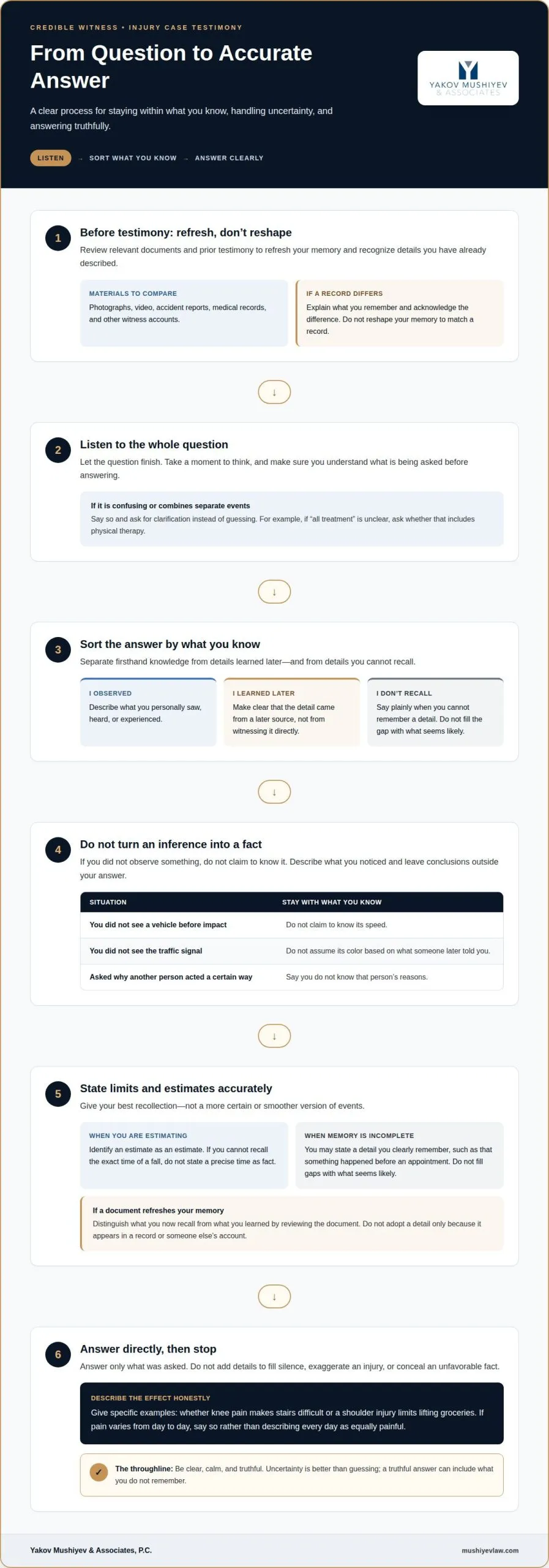
Review relevant materials before testifying, but don’t reshape your memory to match them. If a record differs from what you recall, explain what you remember and acknowledge the difference. An independent witness’s account may also support or challenge details, especially when it aligns with other evidence.
Listening and Reviewing Prior Testimony
Listen carefully, let the question finish, take a moment to think, and answer only what was asked. Before a deposition or trial, review relevant documents and your prior testimony to refresh your memory and recognize details you’ve already described.
A personal injury lawyer can explain the testimony process and help you practice answering likely questions truthfully. Preparation has an ethical boundary: your lawyer may help you communicate clearly, but shouldn’t tell you to invent, alter, or conceal facts. If a question is confusing, say so and ask for clarification instead of guessing.
Staying Composed While Testifying
Composure means responding calmly, even when questions feel frustrating or personal. Speak clearly at a moderate pace, remain polite to the judge and opposing counsel, and avoid sarcasm or jokes that could distract from your answer.
For example, if asked about a gap in treatment, pause and explain what you remember instead of reacting defensively. Staying calm doesn’t mean hiding pain or emotion. Describe your experience accurately, including how an injury affected daily activities, without exaggerating or minimizing it.
How Jurors Assess Credibility
In United States personal injury trials, jurors may consider a witness’s consistency, ability to recall details, demeanor, background, interests, and relationships with the parties. They can compare testimony with photographs, records, and other witnesses’ accounts.
Impartial testimony can matter because a witness with no apparent stake or close relationship may seem less influenced by a party’s interests. A relationship doesn’t automatically make testimony unreliable, but jurors may consider it alongside the account. They may also compare your description of the accident with earlier testimony and available evidence.
Avoiding speculation and sticking to facts
Learning how to be a credible witness in your own injury case starts with separating what you observed from what you infer. If you didn’t see a vehicle before impact, don’t claim to know how fast it was traveling. Describe what you personally noticed, such as hearing a crash and then seeing two damaged cars. Something you learned later is different from something you witnessed directly.
Pause when a question invites you to guess. If asked why another person acted a certain way, say you don’t know their reasons. If you didn’t see a traffic signal, don’t assume its color based on what someone later told you. If accurate, you can explain that you learned the detail afterward.
A key part of how to be a credible witness in your own injury case is answering the question without adding unsupported conclusions. If asked where you stood, give the location you remember. Don’t assume everyone nearby had the same view. If a question combines separate events, ask for clarification so you can address each part accurately.
Clearly identify an estimate as an estimate. If you can’t recall the exact time of a fall, don’t state a precise time as fact. You may remember it happened before an appointment, but say so only if that detail is clear to you. Don’t fill a gap in your memory with what seems likely or makes the timeline easier to explain.
Before testimony, sort details into what you remember firsthand, what you learned later, and what you can’t recall. That distinction helps keep answers accurate under pressure. If you need help understanding how these boundaries apply to your claim, injury-case legal guidance can help you prepare to testify within your personal knowledge.
Giving honest, accurate answers
Honest testimony means giving your best recollection, not the answer that seems most helpful. Don’t exaggerate an injury or conceal a fact because it feels unfavorable. If you remember stopping briefly after a collision but can’t recall the exact sequence, describe that limitation instead of creating a smoother story. A truthful answer can include uncertainty.
Memory has limits. If you can’t recall the date of a medical appointment or the color of a vehicle, say so plainly. Don’t adopt a detail just because it appears in a document or someone else’s account. If a record refreshes your memory, distinguish what you now recall from what you learned by reviewing it.
Make sure you understand a question before answering. If an attorney asks about “all treatment” and you’re unsure whether that includes physical therapy, ask for clarification. A brief pause gives you time to consider what was asked. Don’t add details just to fill silence; answer directly, then stop.
Describe accurately how an injury affects your life. For example, explain whether knee pain makes stairs difficult or a shoulder injury limits lifting groceries. If pain varies from day to day, say so rather than describing every day as equally painful. When relevant, explain emotional effects with specific examples instead of broad claims.
Review your medical history so you can identify doctors, procedures, reasons for treatment, and prescribed medication. If you don’t know a medical term or can’t remember a medication name, don’t guess. If you realize you misstated something during testimony, correct it clearly when you have the opportunity. Accuracy matters more than defending an answer you recognize was mistaken.
Personal knowledge and witness competency
Witness competency and credibility are separate issues. Competency concerns whether a person is legally qualified to testify; credibility concerns how persuasive the testimony seems. A person may be able to testify, yet face questions about perception, memory, or possible bias. For example, poor lighting could affect how clearly someone saw a license plate.
Your personal knowledge includes what you perceived or experienced yourself. In a New York injury claim, explain whether you witnessed an event or learned about it later. A witness who arrived after a fall may describe a wet floor they observed, but shouldn’t claim to know when the spill occurred unless they saw it happen.
Not seeing an accident doesn’t make every observation irrelevant. Someone who spoke with you immediately afterward may describe your words or visible condition at the time. Keep those observations separate from conclusions about what caused the crash or injury. A relationship with someone involved may be considered when evaluating testimony, but it doesn’t automatically determine whether the account is useful.
During a personal injury deposition, questions commonly cover how the incident happened, what you observed, your symptoms, medical care, and effects on daily activities. You may also be asked about your medical history, including doctors, procedures, and prescribed medication. Reviewing your records can help you identify relevant information, while your answers should remain grounded in what you know.
Before responding, consider how you know each detail: firsthand perception, a later conversation, or a document. That distinction helps keep your testimony precise without overstating your role as a witness. If you’re preparing to testify about an injury claim, discuss your injury case with a legal professional.
Yakov Mushiyev & Associates, P.C: Car Accident Legal Representation
Yakov Mushiyev & Associates, P.C. represents people injured in car accidents and helps them navigate the legal process, including preparing for testimony. If you’re concerned about your memory, medical treatment, or account of a collision, legal guidance can help you understand what to expect and how to describe your recollection accurately.
The firm also represents people injured in truck and motorcycle accidents, as well as slip and fall incidents. The legal support you need depends on the type of accident and the issues in your claim. Your testimony should remain honest and based on what you personally know.
Contact Yakov Mushiyev & Associates, P.C. to discuss your injury case.
Take the Next Step With Confidence
Testimony is part of a larger legal process, and preparing for it can raise questions that are difficult to sort through alone. Knowing how to be a credible witness in your own injury case means treating preparation as a chance to understand the process, not rehearse a perfect performance. Consider what concerns you most, such as discussing a difficult memory, explaining a gap in treatment, or responding when you don’t understand a question. Raise those concerns with a legal professional before testimony so there’s time to address them thoughtfully.
Yakov Mushiyev & Associates, P.C can discuss how legal representation may fit your injury claim and testimony concerns. If you’re ready to talk about your situation, contact Yakov Mushiyev & Associates, P.C. Take the next step at your pace, with a clearer understanding of what lies ahead.
Frequently Asked Questions
Can someone be a witness if they did not see the accident happen?
Yes. A witness can provide useful testimony without seeing the moment of impact because relevant observations may concern what happened before or afterward. Someone entering a store after a fall, for example, may describe a spill they personally saw. A person arriving after a collision can recount vehicle positions or conditions they observed, while distinguishing those details from what others later told them.
How Can Inconsistent Statements Affect Credibility?
An inconsistency can give opposing counsel grounds to question your account, especially if it concerns a central detail, such as where you were standing. Not every difference means dishonesty; a later answer may clarify an earlier, incomplete one. If you notice a genuine mistake in a statement, tell your attorney promptly and explain what you now remember, rather than repeating the mistake to appear consistent.
What Can Different Witnesses Establish?
Different witnesses can describe different parts of an event or its aftermath. An eyewitness may recount what they saw, while someone who arrived later can describe the scene’s condition. A person who spoke with you afterward may testify about that conversation, not the collision itself. Each account has value within its limits, and a witness’s relationship to the people involved can provide context.
What makes a plaintiff a credible witness in a personal injury case?
A credible plaintiff gives testimony that reflects genuine recollection, not an effort to sound flawless. For example, acknowledging that you don’t remember whether a conversation happened before or after a medical visit may be more reliable than choosing a sequence you don’t recall. Credibility also means being candid about relevant relationships or interests, so the jury can consider those circumstances alongside your account.
How should you prepare to testify in your own injury case?
Organize a simple recovery timeline using appointment dates, treatments, and notes about changes in daily activities. For a case involving an intersection in Rosedale, Rochdale, or Queens, write down the location and route as you remember them. Use the timeline to refresh your memory, not as a script. Your testimony should reflect your recollection, not wording designed to make events sound more persuasive.
How should you answer questions under oath during a deposition or trial?
Answer truthfully and make sure you understand each question before responding. If a question asks two things at once, ask for it to be separated; if you can’t hear it, request that it be repeated. This FAQ is not legal advice for your specific case. Your attorney can explain how deposition or trial procedures apply to your circumstances.