
A catastrophic injury’s costs do not end when emergency treatment does. A life care plan in a catastrophic injury case is a detailed projection of the future medical care, support, equipment, and other needs an injured person may have over time. It helps explain how an injury can reshape daily life and what ongoing care may require.
If you’re asking what a life care plan is in a catastrophic injury case, it matters most when an injury causes lasting changes, not just during initial recovery. Spinal cord injuries, traumatic brain injuries, amputations, severe burns, and other permanent impairments can create needs that extend well beyond hospital bills. A plan may account for treatment, rehabilitation, medications, assistive equipment, home modifications, and daily care, with projected costs tailored to the person’s needs and circumstances.
This article explains what a life care plan can include, how professionals estimate future expenses, and how the plan may support a Washington injury claim. It also explores which injuries may call for this kind of planning and why a detailed picture of future needs can matter when an insurer disputes the value of a claim.
Key Takeaways
- A life care plan maps the long-term support an injury may require, not just the treatment received immediately after an accident.
- Future cost estimates depend on individual medical needs, expected care over time, and the costs of equipment, services, and replacements.
- Detailed documentation can help explain future damages in a Washington injury claim, while insurers may challenge the assumptions behind a plan.
- Home changes and assistive technology can affect both a person’s independence and the resources needed for daily care.
- Permanent injuries vary widely, so recognizing which conditions may call for comprehensive planning is an important first step.
What is a Life Care Plan?
To understand what a life care plan in a catastrophic injury case does, look beyond the emergency room. It documents future care and support needs based on the injured person’s medical history, prognosis, and daily circumstances.
For an overview of future medical costs and life care plans, watch this video:
Estimating Future Support Needs
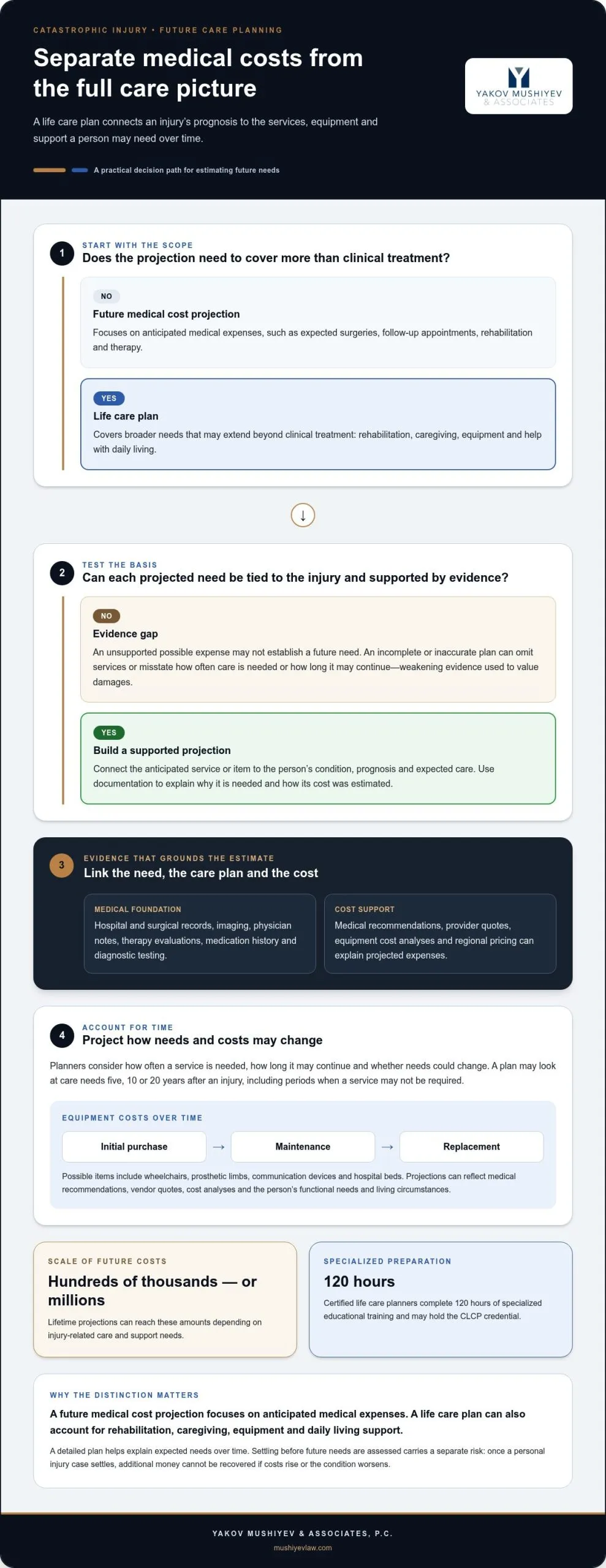
A life care plan estimates future support needs by connecting an injury’s prognosis with the services, equipment, and assistance the person may require. This matters because paraplegia can affect mobility, self-care, work, and community activities, not just medical treatment. Planners may consider physician visits, rehabilitation, therapy, medications, and in-home assistance, including how often each service may be needed and how long it may continue.
For example, a person with paraplegia may need daily assistance and ongoing medical monitoring. A plan describes those individual needs rather than relying on a standard schedule.
Documentation for Projected Costs
Documentation connects each projected expense to the person’s condition and anticipated care. A planner may review hospital and surgical records, imaging, physician notes, therapy evaluations, medication history, and diagnostic testing. These records provide a medical basis for projected services or items, rather than leaving estimates unsupported.
Medical recommendations, provider quotes, and equipment cost analyses can further explain how an expense was estimated. This evidence helps clarify claimed damages for insurers and, if needed, a judge or jury.
Future Medical Expenses in Injury Claims
Evidence of future medical expenses describes the care a person is expected to need and its reasonable cost. The projection matters because anticipated treatment must be tied to the injury and supported by evidence, not simply listed as a possible expense.
A life care plan can organize expected surgeries, follow-up appointments, rehabilitation, and therapy. For someone with paraplegia, for instance, it may explain why ongoing treatment or assistance is projected. Clear records and professional recommendations help establish the basis for those future needs in an injury claim.
Plans, Projections, and Accuracy Risks
A future medical cost projection focuses on anticipated medical expenses, while a life care plan can cover broader support, including rehabilitation, caregiving, equipment, and help with daily living. The distinction matters when an injury affects more than clinical treatment. An incomplete plan may omit necessary services; an inaccurate one may misstate how often care is needed or how long it will last.
Those gaps can weaken evidence used to value damages. Settling before assessing future needs carries a separate risk: once a personal injury case settles, the claimant cannot recover additional money if costs rise or the condition worsens. Careful documentation helps explain the injury’s expected effects over time.
Estimated lifetime costs for catastrophic injury victims
Lifetime projections can reach hundreds of thousands or even millions of dollars, depending on injury-related care and support needs. Certified life care planners, often trained in nursing, rehabilitation, or case management, assess those needs and develop a plan.
Estimating Lifetime Medical and Support Costs
Estimating lifetime costs means projecting the services and resources someone may need throughout the expected course of an injury. That estimate matters because a serious accident can create recurring expenses long after initial treatment ends.
Planners consider how often a service is needed, how long it may continue, and whether needs could change. They may use provider quotes and cost information for medical care, rehabilitation, medication, and in-home assistance. Economists can model future expenses and calculate present value, accounting for costs expected over decades rather than treating every future dollar as a dollar today.
Estimates must reflect the individual, not a fixed schedule. A plan may account for care needs five, 10, or 20 years after an injury, including periods when a service may not be required. Certified planners complete 120 hours of specialized educational training and may hold the Certified Life Care Planner (CLCP) credential.
Equipment and Replacement Costs
Equipment projections include initial purchases, maintenance, and replacement over the person’s expected lifetime. That matters because the purchase price alone can understate a device’s long-term financial impact.
A plan can account for medical recommendations, vendor quotes, cost analyses, and regional pricing when projecting equipment needs. Wheelchairs, prosthetic limbs, communication devices, and hospital beds may each have different replacement and upkeep requirements.
Planners also consider whether a device suits the person’s functional needs and living circumstances. For someone with limited mobility, the estimate may include multiple assistive devices and related maintenance. The supporting cost analysis explains why each item is needed and how often it may need replacement.
Lifetime Costs of Spinal Cord Injury
Spinal cord injury costs vary with the injury’s level and completeness, as well as the resulting support needs.
Those estimates show why a life care plan must connect broad cost figures to a person’s specific circumstances. A spinal cord injury may require ongoing medical care, rehabilitation, equipment, or daily assistance. A planner can describe the projected needs and their timing, while an economist may model their future financial impact.
For someone pursuing a claim after an accident, an injury attorney can help address how documented future needs fit into the damages being sought.
Use of life care plans in Washington personal injury cases
For an injured person in Rosedale, Rochdale, or elsewhere in Queens, a life care plan can explain how a catastrophic injury may affect future care and support. It organizes projected needs and evidence that may help clarify a personal injury claim handled by Yakov Mushiyev & Associates, P.C.
Purpose in Catastrophic Injury Cases
A life care plan describes anticipated care and support related to lasting harm. It matters because immediate medical records may not show how an injury could affect daily routines, independence, or work over time.
For example, someone with a traumatic brain injury may need ongoing supervision or behavioral health support. A person with paralysis may require daily assistance and continued medical monitoring. A planner can work with the person’s doctors and other health professionals to connect projected needs to the individual’s condition and prognosis. This can help families organize care and explain its long-term impact in a claim arising from an accident in Queens.
Injuries That May Require a Plan
A plan may be relevant when an injury permanently changes a person’s function, independence, or ability to work. Identifying those effects matters because future support needs can extend beyond treatment for the initial injury.
Examples include spinal cord injuries resulting in paralysis, traumatic amputations, and traumatic brain injuries with permanent impairment. Multiple serious fractures, loss of vision or hearing, severe burns, severe scarring or disfigurement, and organ loss can also create continuing needs. A plan may address effects on self-care, communication, employment, and participation in community activities. If an injury prevents someone from returning to previous work, projected lost earning capacity, benefits, or retraining may also be relevant to the claim.
Life Care Plans as Claim Evidence
A life care plan can document anticipated needs and support a request for compensation in a personal injury claim. Clear evidence helps show how the injury may affect the injured person’s future, rather than leaving those consequences abstract.
The planner may prepare a report and testify as an expert witness. Medical records, professional recommendations, and cost documentation support the projections. The injured person’s own testimony may also describe hardships an assessment overlooks, including difficulties with mobility, self-care, or communication.
Insurance companies may retain experts to challenge a plan’s assumptions. Disputes can involve whether a service is necessary, related to the injury, likely to be needed, or reasonably projected in frequency and cost. Experts may also disagree about equipment lifespan, life expectancy, or alternatives. The parties may address competing evidence in negotiation; if a case goes to court, a judge or jury evaluates it. A plan does not automatically make every listed expense recoverable, so its reasoning and supporting evidence matter.
Assistive technology and home modifications
A life care plan can project more than medical expenses. For someone with a spinal cord injury, it may also account for equipment, home modifications, transportation, and assistance with daily activities. These needs can affect whether the person can safely move through their home, attend appointments, and maintain independence.
The plan should connect each proposed expense to a functional need. A wheelchair ramp, for example, may address difficulty entering a home, while a bathroom modification may support safer bathing. This detail helps explain the purpose of each cost to insurers, judges, and juries.
Home and Vehicle Adaptations
Adaptive equipment may be needed at home and in a vehicle. A life care plan can include wheelchair ramps, bathroom modifications, vehicle adaptations, and equipment such as patient-lifting devices. The right choices depend on the person’s mobility, self-care needs, and living arrangements.
Cost projections can include installation, maintenance, and replacement when applicable. A plan should explain how each modification supports daily function rather than simply listing equipment. For example, a ramp may make a home entrance accessible, while vehicle adaptations may support travel to medical appointments. These details help show how the injury affects routine activities.
In-Home Care and Travel
When an injured person needs help with bathing, dressing, or meal preparation, the plan may estimate skilled nursing or other daily assistance. It can also account for care at home or in a nursing home, based on the person’s support needs. The frequency and duration of assistance affect the projected expense.
Transportation is part of the assessment, too. A plan may include travel to local medical appointments or trips to see out-of-state specialists. If a person cannot travel independently, the plan should reflect the practical support required for those visits. Household services may also matter when the injury prevents someone from completing routine tasks.
Nursing Home Cost Context
These Oklahoma figures offer cost context, not a Washington estimate. Care expenses vary with location and the level of support required.
In a New York injury claim, a life care plan should distinguish projected local expenses from figures drawn from another state. A well-supported estimate identifies the care setting, type of assistance, equipment, and travel needs relevant to the injured person. That specificity lets insurers and juries evaluate how home modifications and ongoing support relate to the injury, rather than treating them as unexplained additions to a claim.
Injuries that may require a life-care plan
A life-care plan may be useful when an injury permanently changes a person’s abilities and creates ongoing support needs. A catastrophic injury is one from which the injured person cannot ever fully recover. The practical question is how the condition affects treatment, independence, work, and daily life. A diagnosis alone does not describe those needs. A detailed assessment connects the injury to future care.
Spinal cord injuries that result in paralysis can affect mobility, self-care, and access to a home or vehicle. Someone with paraplegia may need mobility equipment, help with bathing or dressing, and continuing medical monitoring. A plan can describe the specific assistance required and how often it may be needed. That detail helps distinguish a lasting support need from a short-term recovery expense.
A traumatic brain injury with permanent impairment can affect memory, communication, behavior, and judgment. For example, a person may need cognitive rehabilitation, psychological counseling, supervision, or help returning to work. The effects can be less visible than a physical injury, but still reshape daily routines. A plan can document those functional limits alongside treatment recommendations and the support needed at home.
Traumatic amputations and multiple serious fractures may also require long-term planning. An amputation can involve prosthetic limbs, rehabilitation, and future equipment needs. Serious fractures may limit movement or make everyday tasks difficult, even after initial treatment. A life care assessment should connect each projected service or device to the person’s condition, rather than assuming every injury creates the same future needs.
Other examples include severe burns, loss of vision or hearing, severe scarring or disfigurement, and organ loss. A person with vision loss may need help with daily activities; severe burns may require ongoing medical care and rehabilitation. Lasting effects differ from person to person. Relevant evidence includes how the injury changes mobility, communication, self-care, employment, and participation in community activities.
The clearest takeaway is that a life care plan is about lasting consequences, not a label on a medical chart. A person with a serious injury may need a plan when future care, equipment, or assistance extends beyond initial treatment. An attorney evaluating an injury claim can consider how medical records, professional recommendations, and the injured person’s own account document those effects. That evidence helps explain the support needs arising from the injury.
Yakov Mushiyev & Associates, P.C: Car Accident Legal Representation
Yakov Mushiyev & Associates, P.C. represents people injured in car accidents, including those facing serious injuries and future care needs. The firm also provides legal representation for truck, motorcycle, and slip-and-fall accidents. If an insurer disputes the extent of an injury or the compensation sought for ongoing care, legal representation can help address the claim and the evidence supporting it.
A life care plan may help document future needs, but it does not resolve every dispute about an injury claim. The relevant records, care projections, and evidence of how the accident affected daily life all matter. If you have questions about an accident-related injury claim, contact Yakov Mushiyev & Associates, P.C to discuss your situation.
Take the Next Step Toward Protecting Your Claim
Understanding what a life care plan in a catastrophic injury case can document is only part of preparing for the future. The next step is keeping a clear record of how the injury affects daily life, treatment, work, and support needs. Organize medical records, care recommendations, and notes about changing limitations. These details can help make the human impact visible alongside the medical evidence.
When an accident leaves you facing lasting consequences, legal guidance can help you address the claim and its supporting evidence. Yakov Mushiyev & Associates, P.C. provides car, truck, and slip-and-fall accident legal representation for people injured in these incidents. A useful next step is a conversation about your circumstances and the claim you need to pursue.
Contact Yakov Mushiyev & Associates, P.C to discuss your injury claim and move forward with clarity.
Frequently Asked Questions
These answers provide general information, not legal advice for a specific case. Injury claims and evidence of future care can differ, including for people in Rosedale, Rochdale, and Queens.
How Are Costs Assigned to the Plan?
Costs are estimated by matching each anticipated need with evidence of its expected price and use. A planner may review a treating professional’s recommendation, obtain equipment or service quotes, and estimate frequency and duration. For example, projecting recurring therapy requires more than the price of a single visit: the estimate must reflect how often sessions are expected and for how long. This itemized approach makes the reasoning behind each projection clear.
How are future care costs calculated?
Future care costs are calculated by projecting the type, frequency, and duration of needed services, then estimating their financial impact over time. A planner may use provider pricing, equipment quotes, and expected replacement needs. An economist can model expenses extending over decades and estimate their present value. For example, projecting recurring in-home assistance involves estimating the schedule and length of care, rather than treating it as a one-time expense. In a catastrophic injury case, this calculation ties each projected service to an anticipated need.
What is a life care plan in a catastrophic injury case?
It is a detailed assessment of anticipated future care and support needs after a serious, lasting injury. The plan links those needs to the person’s condition and daily circumstances. For example, it may explain why someone needs ongoing supervision after a traumatic brain injury. It can help families organize care and present future needs clearly in a personal injury claim, with supporting records and recommendations connected to each projected service.
What information and services are included in a life care plan?
A plan may include projected treatment, prescription medications, rehabilitation, counseling, assistive equipment, home modifications, transportation, and in-home care. It can also describe potential complications and the expected timing or frequency of services. For example, if a person needs communication support, the plan may document the equipment and its anticipated replacement. Which items appear depends on the individual’s injury, prognosis, and practical care requirements.
How does a life care planner assess a catastrophically injured person’s future needs?
A planner reviews medical records and evaluates how the injury affects daily functioning, then considers the prognosis and anticipated support. Records may include hospital and surgical reports, imaging, physician notes, therapy evaluations, and medication history. Interviews with the injured person and family can clarify practical issues, such as mobility, sleep, household tasks, communication, and employment. Those details connect medical evidence with real-world care needs.
How are future medical costs and life care plan expenses calculated?
Future medical costs focus on anticipated medical treatment, while broader plan expenses may cover support beyond clinical care. Planners use medical recommendations and pricing information for services or equipment, then consider how often needs arise and how long they continue. An economist may model costs over time. For example, a projection can distinguish periodic specialist visits from ongoing daily assistance, rather than combining them into one unexplained total.
Can the opposing side challenge or rebut a life care plan?
Yes. The opposing side may hire experts to dispute whether a projected service is necessary, related to the injury, likely to be needed, or priced appropriately. It may also challenge frequency, equipment lifespan, expected duration, or a less expensive alternative. For example, experts may disagree about how often a device needs replacement. Negotiations can address those disputes; if a case reaches court, the judge or jury evaluates the evidence.
How much does a life care plan cost in the United States?
The work involved depends on the records, injury complexity, number of projected needs, and cost research required. This is the cost of preparing the plan, not the lifetime care expenses it projects. Those future expenses are assessed separately and vary with the person’s circumstances. Understanding what a life care plan in a catastrophic injury case covers can clarify that distinction.