
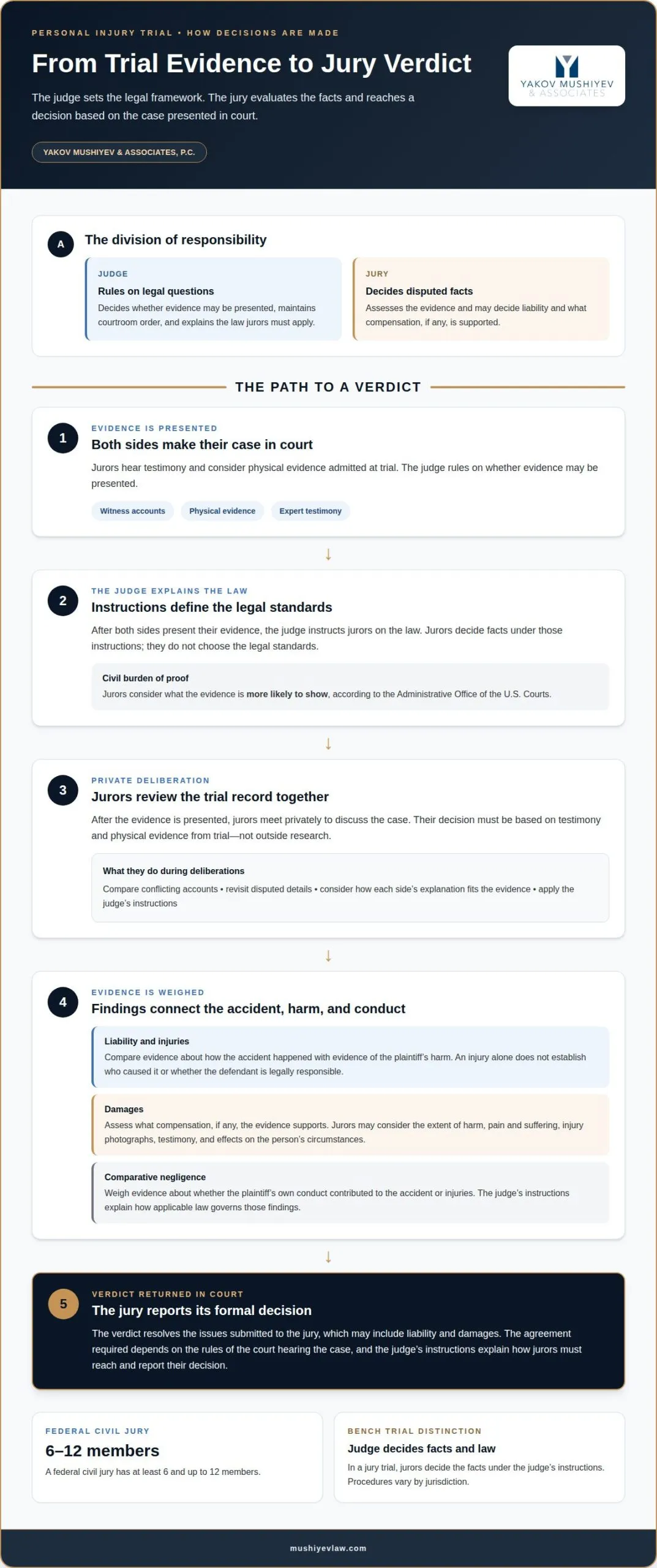
In a personal injury trial, the jury evaluates the evidence and decides disputed facts, including whether someone is liable and what compensation is appropriate. The judge determines the law, rules on which evidence may be presented, and explains the legal standards jurors must apply. In civil cases, the burden of proof asks what the evidence is more likely to show, according to the Administrative Office of the U.S. Courts.
It’s understandable to ask what a jury’s role is in a personal injury trial when the outcome may affect your recovery and future. The judge and jury have different responsibilities, and understanding who decides what can make the process clearer.
This article explains how those responsibilities are divided, how prospective jurors are questioned and selected, and how jurors weigh testimony and other evidence when deciding liability and damages. It also covers deliberations and how a verdict is reached.
Key Takeaways
- Understand how the judge’s legal rulings differ from the jury’s decisions about facts, liability, and compensation.
- Learn how jurors deliberate privately and reach a verdict based on the case presented at trial.
- See how testimony and physical evidence help jurors assess what happened, the injuries, and potential damages.
- Find out how voir dire and juror challenges help identify a jury able to consider the case fairly.
Who Decides Your Fate in a Personal Injury Case: Judge or Jury?
In a personal injury case, the judge rules on legal questions, while jurors decide disputed facts and may determine liability and damages. To understand a jury’s role in a personal injury trial, start with that division: the judge explains the law, and jurors apply it to the evidence.
Civil Verdicts and Majority Decisions
A civil verdict is the jury’s formal decision on the questions submitted for consideration. In a civil trial, the burden of proof asks what the evidence is more likely to show, according to the Administrative Office of the U.S. Courts. Jurors use that standard to evaluate the parties’ claims and evidence. In a personal injury case, the verdict may resolve disputed facts and determine whether compensation is appropriate.
The agreement required for a verdict depends on the rules of the court hearing the case. The judge’s instructions explain how jurors must reach and report their decision. Understanding a jury’s role in a personal injury trial means recognizing that jurors decide facts, not the legal standards they must apply.
The Right to a Civil Jury Trial
The Seventh Amendment guarantees the right to a jury trial in civil matters in the United States. In federal civil court, a jury has at least 6 and up to 12 members. That distinction matters because jurors, rather than a judge alone, may decide factual disputes when a case proceeds before a jury.
Jury procedures vary by jurisdiction, including how a jury trial is requested and how jurors reach a verdict. For a case connected to Rosedale, Rochdale, or Queens, the applicable court rules govern the procedure. In a bench trial, the judge decides both facts and law. In a jury trial, jurors decide the facts under the judge’s instructions.
The judge also rules on whether evidence may be presented and maintains order in the courtroom. After both sides present their evidence, the judge instructs jurors on the law. Jurors then assess the facts under those instructions. This division leaves legal rulings to the judge and fact-finding to the jury.
Jury deliberations and verdicts
After both sides finish presenting evidence, jurors meet privately to discuss the case. Their deliberations shape the verdict and may determine the outcome for the plaintiff and defendant.
The Jury’s Role in Deliberations
Deliberation is the jury’s private review of the evidence and arguments before reaching a verdict. Jurors consider the case together rather than making separate decisions based on information from outside the courtroom.
Jurors must base their decision on testimony and physical evidence presented at trial, not outside research. For example, when evaluating conflicting accounts of a collision, jurors weigh the witnesses and exhibits admitted in court. This keeps the parties’ arguments and evidence at the center of the decision.
Deliberations matter because jurors examine how the evidence fits together. They weigh the plaintiff’s account against the defendant’s position, then apply the judge’s instructions. Their shared assessment may shape findings about responsibility and damages.
Reaching a Verdict
A verdict is the jury’s formal decision on the issues submitted for consideration. To reach it, jurors discuss the trial record and decide which conclusions the evidence supports under the law.
The decision must rest on what was presented in court. Jurors can compare witness testimony with physical evidence, revisit disputed details, and consider how each side’s account explains the events. They then decide the issues the court has asked them to resolve.
When deliberations end, the jury returns its verdict in court. The decision resolves the issues submitted to the jury, which may include liability and damages. It marks the end of the jury’s fact-finding role in the trial.
The jury’s role in evaluating evidence and deciding liability and damages
Jurors apply the judge’s instructions to evidence about the accident, responsibility, and harm. Their findings determine liability and whether the evidence supports damages, including pain and suffering.
Evaluating Liability and Injuries
Jurors evaluate liability and injuries by comparing evidence about how the accident happened with evidence of the plaintiff’s harm. They consider witness accounts, physical evidence, and expert testimony presented at trial. For example, jurors may compare the parties’ accounts of a collision with photographs and medical testimony. The judge’s instructions set out the legal standards; jurors decide which facts the evidence supports. An injury alone does not establish who caused it or whether the defendant is legally responsible.
Assessing Damages
Assessing damages means deciding what compensation, if any, the evidence supports for the injuries. Jurors consider the extent of the harm and may evaluate pain and suffering using injury photographs, testimony, and evidence about whether injuries are serious and permanent. They also consider how the injury affected the person’s circumstances. Each claimed loss must be assessed against the trial evidence. This helps jurors distinguish supported harm from claims the evidence does not establish.
Comparative Negligence and the Verdict
Comparative negligence concerns whether the plaintiff’s own conduct contributed to the accident or injuries. Jurors may weigh evidence about the plaintiff’s actions alongside evidence about the defendant’s responsibility. For instance, they may assess testimony describing each person’s conduct before a collision. The judge’s instructions explain how the applicable law governs those findings. The result may affect the verdict and damages, depending on the legal rules applied in the case.
During deliberations, jurors connect their findings about the accident, injuries, and each party’s conduct. Their verdict reflects the evidence and instructions, not assumptions about what seems fair outside the courtroom.
Voir dire and jury selection
Before trial evidence is heard, prospective jurors are questioned and the court selects the panel. This screening helps identify people who can fairly evaluate the plaintiff’s claims and the defendant’s response.
Voir dire is the process of asking prospective jurors about their backgrounds, beliefs, and life experiences. Attorneys may explore whether a person can weigh evidence about liability without favoring either party. For example, experience with a similar accident may prompt questions about whether the person can set aside personal views and follow the judge’s instructions.
Courts form jury pools by randomly selecting names from public records, such as voter registrations and driver’s license lists. Random selection creates the pool; voir dire allows attorneys and the court to explore potential bias before jurors are selected. Questions may reveal whether a prospective juror has a close relationship with a party or strong views that could affect impartiality.
If an attorney believes a prospective juror cannot be fair, the attorney may ask the court to remove that person for cause. Reasons may include an inability to follow the law or a close relationship with someone involved in the case. Attorneys may make unlimited challenges for cause, but the court decides whether the stated reason justifies removal.
Attorneys also have limited peremptory challenges, which allow removal without stating a reason. In a federal civil trial, each side has 3 peremptory strikes. Those challenges cannot be used to exclude jurors because of race or gender. The distinction matters: a cause challenge requires a reason, while a peremptory strike does not, subject to that prohibition.
After challenges, selected jurors are sworn in and the trial begins. Their answers during voir dire help identify potential bias; they do not decide who should win. If you have questions about how jury selection relates to an injury claim, discuss your personal injury case with an attorney.
Yakov Mushiyev & Associates, P.C: Car Accident Legal Representation
Yakov Mushiyev & Associates, P.C. represents people injured in car accidents, including those facing disputed accounts of how a crash happened or who is responsible. The firm’s car accident legal representation can help address the evidence and legal issues involved in pursuing an injury claim.
The firm also represents people injured in truck and motorcycle accidents and those hurt in slip and fall incidents. If an accident has left you with injuries and questions about liability or compensation, legal guidance can help you understand the issues in your case and consider next steps.
Contact Yakov Mushiyev & Associates, P.C. to discuss your accident injury case.
Take the Next Step With a Clear Plan
Understanding a jury’s role in a personal injury trial can help you identify the questions that matter to your situation. Focus on the facts of your injury, the available evidence, and the decisions you may need to make. A clear conversation about those issues can help you approach the process with greater direction.
If an accident has affected your health, work, or daily life, you don’t have to sort through the legal questions alone. Yakov Mushiyev & Associates, P.C. can discuss your injury claim and explain the legal issues involved. Share what happened and ask about steps that may fit your circumstances.
Contact Yakov Mushiyev & Associates, P.C. for guidance on your next step. You can move forward with a clearer understanding of your options.
Frequently Asked Questions
Why Opt for a Jury?
A jury brings community members into the process of deciding factual disputes. That public participation can support confidence in the civil justice system, but a jury trial is not automatically right for every case. For someone in Rosedale, Rochdale, or Queens, the decision depends on the disputed issues, the evidence, and the applicable court procedures.
Can a juror take notes during the case?
Jurors should follow the judge’s directions about note-taking in the courtroom. If notes are permitted, they can help a juror remember testimony, but they are not evidence and cannot replace the trial record. For example, a note about when a witness saw an accident should be checked against the testimony, not treated as proof on its own.
What does a jury decide in a personal injury trial?
A jury decides the factual questions the court submits for its decision. In a collision case, those questions may involve how the crash happened, whether the defendant is responsible, and what injuries the evidence supports. The verdict addresses the issues presented at trial, not every concern either party may have. The judge handles legal rulings and explains the applicable law.
Does the jury determine whether the defendant was negligent?
Yes, when negligence is a disputed issue for the jury to decide. Jurors consider evidence of the defendant’s conduct and apply the judge’s instructions to determine whether that conduct meets the applicable legal standard. For instance, they may compare a driver’s account with witness testimony and physical evidence. The jury’s finding must rest on the trial record, not assumptions about the defendant.
How does a jury decide if the defendant caused the injury?
Jurors assess whether the evidence connects the defendant’s conduct to the injury. They may compare the accident timeline, witness accounts, physical evidence, and testimony about the harm. For example, conflicting descriptions of a collision may affect how jurors understand its cause. The judge’s legal instructions guide their decision, while deliberations allow jurors to assess how the evidence fits together.
What types of damages can a jury award in a personal injury case?
A jury may award compensation for proven harm, including pain and suffering. To assess that harm, jurors may consider injury photographs, testimony, and evidence about whether an injury is serious or permanent. The damages decision must be grounded in the evidence presented at trial. What a jury may award depends on the claims submitted and the judge’s instructions on the law.
This FAQ provides general information, not legal advice for a specific case.