
An insurance adjuster’s primary objective is to protect their company’s bottom line by convincing you that a career-ending injury is merely a temporary setback. If you are facing the devastating aftermath of a severe accident in New York, you are likely wondering how to prove I can no longer work due to my injuries while watching your steady income vanish. It is exhausting to fight the terrifying fear of being forced back into a job your body can no longer physically perform, especially while facing relentless pressure from aggressive corporate tactics to settle for less than your claim is worth.
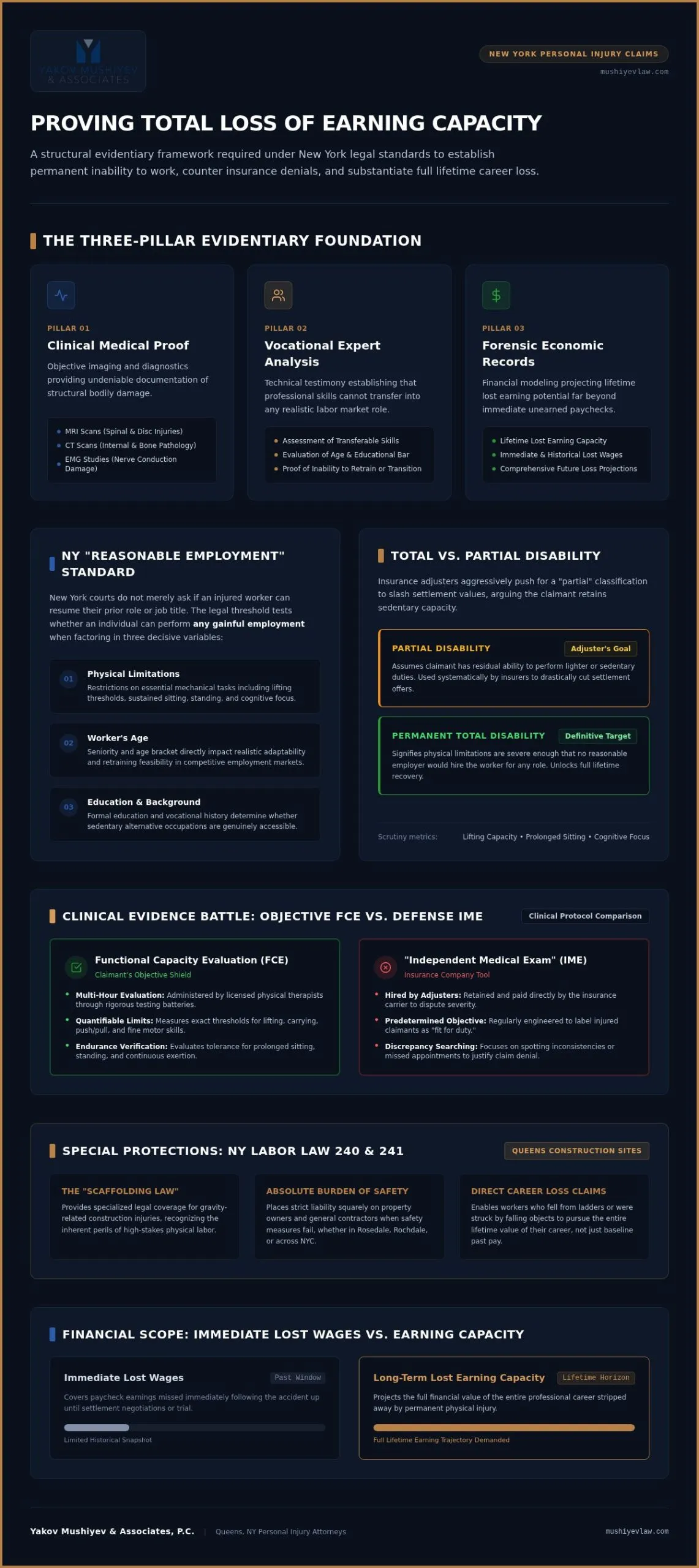
You do not have to face these powerful entities without a shield. This guide details the exact evidence and legal strategies required to prove a total loss of earning capacity in a New York personal injury claim. We will break down how a precise combination of clinical medical proof, vocational expert analysis, and forensic economic documentation can validate your physical limitations and secure a settlement that covers your lifetime lost wages.
Key Takeaways
- Master the “Reasonable Employment” standard to understand why New York courts look beyond your previous job title when determining total disability.
- Discover how a Functional Capacity Evaluation serves as the clinical evidence needed to validate your physical restrictions against insurance company denials.
- Learn how to prove I can no longer work due to my injuries by utilizing vocational experts who can testify about your inability to transition into new roles.
- Differentiate between immediate lost wages and long-term lost earning capacity to ensure your settlement covers your entire financial future.
- Uncover the reality behind “Independent Medical Exams” and the specific steps you must take to protect your case from aggressive insurance adjusters.
Understanding the Legal Standard for “Inability to Work” in New York
The legal system in New York does not grant compensation based on a handshake or a simple doctor’s note. It demands clinical precision and an unwavering evidentiary trail. When you are wondering how to prove I can no longer work due to my injuries, you are essentially asking how to meet the state’s rigorous “Reasonable Employment” standard. This standard doesn’t just ask if you can return to your previous job; it evaluates whether your physical limitations, combined with your age and education, prevent you from performing any type of gainful employment. It’s a high bar, but it is one we are prepared to clear.
Total vs. Partial Disability in NY Claims
New York courts categorize disability into two main tiers: partial and total. A partial disability suggests you’ve lost some capacity to work but could theoretically perform lighter, sedentary duties. Insurance adjusters fight tooth and nail for this classification because it allows them to slash your settlement offer. Conversely, a permanent total disability is the definitive target for high-value claims. It signifies that your injuries are so severe that no reasonable employer would hire you for any role. The court scrutinizes your ability to perform basic tasks like lifting, sitting for extended periods, or maintaining cognitive focus. To navigate this, The Role of Vocational Experts becomes critical. These professionals provide the technical testimony needed to prove that your “transferable skills” are effectively useless in your current physical state.
The Impact of NY Labor Law 240 and 241
If you were injured on a Queens construction site, specialized statutes offer you a powerful shield that other personal injury victims don’t have. New York Labor Law 240, frequently called the “Scaffolding Law,” provides strict liability protection for workers who suffer gravity-related injuries. Whether you fell from a ladder in Rosedale or were struck by a falling object at a site in Rochdale, these laws place the absolute burden of safety on property owners and general contractors. Proving a loss of earning capacity under these statutes is often more direct because the law recognizes the inherent danger of high-stakes labor. We don’t just ask for past lost wages. We demand the full value of the career that was stripped away from you. Understanding how to prove I can no longer work due to my injuries in the context of construction requires an attorney who knows the nuances of these specific Labor Laws and refuses to back down against powerful insurance entities.
Building a Bulletproof Medical Record to Support Your Claim
Your medical records are not just clinical notes. They are the primary evidence in your battle against multi-billion dollar insurance companies. When you are determining how to prove I can no longer work due to my injuries, you must understand that your doctor’s chart is the first place an adjuster looks for a reason to deny your claim. They search for inconsistencies, missed appointments, and any indication that you are exaggerating your limitations. To win, your records must reflect a relentless commitment to recovery and a clear, objective link between your accident and your current physical state.
Objective evidence like MRIs, CT scans, and EMG nerve conduction studies provide the undeniable proof of physical damage. However, these tests don’t always tell the whole story of how an injury affects your ability to perform a specific job. You must be vocal with your providers about your daily requirements. If you’re a construction worker in Rosedale who can no longer climb a ladder, that specific limitation must be documented. While the Social Security Administration has its own medical evidence requirements, personal injury claims in New York demand even higher levels of specificity regarding your unique professional duties. If you are unsure if your current records are sufficient, speaking with a dedicated Queens injury attorney can help you identify and fill critical evidentiary gaps.
The Functional Capacity Evaluation (FCE)
The FCE is a specialized, multi-hour physical assessment designed to quantify exactly what you can and cannot do. A physical therapist will put you through a series of tests to measure your lifting capacity, your ability to sit or stand for prolonged periods, and your fine motor skills. This is the ultimate weapon against the insurance company’s “Independent Medical Exam” (IME). While the IME doctor is paid by the insurance company to find you “fit for duty,” a comprehensive FCE provides a data-driven rebuttal that is difficult to ignore in court.
Consistency and Credibility in Medical Records
Gaps in treatment are fatal to a lost wage claim. If you stop going to physical therapy because you’re discouraged, the insurance company will argue that you’ve reached “maximum medical improvement” or that you aren’t actually in pain. You must also avoid the temptation to be a “tough guy” during checkups. Minimizing your symptoms to a nurse might feel like a sign of strength, but in a legal context, it’s a recorded admission that you’re fine. We recommend keeping a daily pain journal to track how your injuries interfere with basic tasks. When these personal accounts align perfectly with your clinical records, your credibility becomes unshakeable.
The Role of Vocational Experts in Proving Disability
Medical records prove the physical damage, but they don’t always translate that damage into lost dollars and cents. A vocational expert is a specialized consultant who analyzes your ability to earn a living within the current economy. We utilize these experts to bridge the gap between your clinical diagnosis and your actual employability. While your doctor focuses on healing your body, the vocational expert focuses on the viability of your career. This testimony is essential for establishing the legal definition of disability in your specific case. It transforms your personal struggle into a documented economic reality that insurance companies cannot easily dismiss.
Many injured New Yorkers wonder how to prove I can no longer work due to my injuries when an insurance company claims they can simply switch to a desk job. A vocational expert dismantles this argument by performing a comprehensive evaluation of your professional history and physical limitations. They don’t just wait for a trial to speak; we use their findings during the negotiation phase to force insurance adjusters to acknowledge the full scope of your financial loss. If you aren’t using an expert to map out your career path, you’re leaving your future to chance.
The Transferable Skills Analysis
The insurance company’s favorite tactic is suggesting you can retrain for a new career. A Transferable Skills Analysis (TSA) proves why this is often impossible. This analysis looks at your education, age, and previous work experience to determine if you have skills that apply to sedentary work. If you’ve spent twenty years as a Queens construction worker, your skills are rooted in physical labor and technical site knowledge. New York law recognizes that you can’t be expected to suddenly master office software or administrative tasks you’ve never performed. Age also plays a decisive role. Courts understand that an older worker faces significantly higher hurdles when attempting to re-enter a competitive job market with a new set of physical restrictions.
Labor Market Surveys in Queens and NYC
We don’t let insurance adjusters rely on theoretical job openings. A vocational expert conducts a Labor Market Survey to see what jobs actually exist in areas like Rosedale and Rochdale. If an adjuster claims you can work as a “light-duty security guard,” the expert investigates whether those jobs are available and if they truly accommodate your specific medical needs. This process involves:
- Proving that “sedentary” jobs still require physical stamina you may no longer possess.
- Highlighting the lack of local opportunities that fit your new physical profile.
- Exposing the “Walmart greeter” argument as a myth that ignores the actual physical demands of standing for eight-hour shifts.
By providing a localized view of the job market, we ensure your claim is grounded in reality rather than insurance company fantasies. We act as your shield, ensuring that every expert we hire is focused on one goal: securing the lifetime compensation you deserve.
Calculating and Documenting Lost Earning Capacity
Your past paystubs only tell half the story. While lost wages cover the money you have already missed since the accident, lost earning capacity addresses the career-long financial vacuum created by your permanent limitations. Understanding how to prove I can no longer work due to my injuries requires moving beyond simple tax returns. It demands a forward-looking analysis of what your life would have looked like had the negligence of another party not intervened. Insurance adjusters want to treat your injury as a temporary inconvenience; we treat it as the total destruction of your financial potential.
Forensic Economic Reports
To secure the maximum value for your claim, we employ forensic economists to project your lifetime losses. These experts don’t just look at what you made last year. They calculate your projected earnings through your expected retirement age, factoring in anticipated raises, promotions, and cost-of-living adjustments. If you were on a trajectory to become a foreman or a specialized supervisor, that potential income is part of your damages. The economist also accounts for inflation, ensuring that the settlement you receive today still holds its value decades from now. These reports are the backbone of multi-million dollar verdicts because they translate physical pain into undeniable mathematical certainty. If you are worried about your long-term survival, contact our firm to begin building your financial recovery strategy.
Documenting the “Hidden” Costs of Not Working
Your salary is only one component of your total compensation package. When an injury ends your career, you lose a suite of “hidden” benefits that often total hundreds of thousands of dollars over a lifetime. We leave no stone unturned when documenting these losses:
- Employer-Sponsored Health Insurance: The value of your health plan must be replaced, as you will now likely face higher premiums for private coverage.
- Union Pensions and Benefits: For many workers in Rosedale and Rochdale, union membership provides a specific pension structure that is decimated when you can no longer complete your service years.
- Retirement Contributions: We calculate the loss of 401(k) matches and the long-term impact on your Social Security benefits, which are tied to your lifetime earnings.
Proving how to prove I can no longer work due to my injuries means showing the court that you aren’t just losing a paycheck. You are losing a retirement, a safety net, and the ability to provide for your family’s future. We act as your shield against insurance tactics that try to ignore these critical fringe benefits, ensuring every dollar of your lost capacity is accounted for in your final settlement.
How a Relentless Queens Injury Attorney Shields You from Insurance Tactics
Insurance companies employ sophisticated strategies to protect their billion-dollar bottom lines. They don’t want to pay for your lifetime of lost wages; they want to settle for the smallest amount possible. When you are determining how to prove I can no longer work due to my injuries, you’re entering a high-stakes chess match against a corporate grandmaster. You need a shield. You need a relentless advocate who understands the street-smart tactics of NYC litigation. Yakov Mushiyev & Associates, P.C. provides that definitive resolution. We don’t just file paperwork. We prepare for war against negligent parties and their powerful insurers.
Our firm focuses on the technical nuances of how to prove I can no longer work due to my injuries to ensure no stone is left unturned. Whether you were injured in a construction accident, a truck crash, or a serious slip and fall, we act as your primary defense. We handle all communication with adjusters, preventing you from making recorded statements that could be twisted and used against you later. Our team prepares you for every deposition and hearing with clinical precision, ensuring you can speak confidently about your limitations without falling into defense traps.
Defeating the Insurance Company IME
The “Independent Medical Exam” (IME) is a calculated misnomer. These physicians are hired and paid by insurance carriers specifically to find reasons to downplay your trauma. They might spend only five minutes with you before writing a report that claims you are “fit for duty.” We counter these biased reports by cross-referencing them with your actual clinical history and the objective data from your Functional Capacity Evaluation. We ensure your rights are protected during these exams, preventing doctors from using leading questions or deceptive physical tests to undermine your credibility. If a report is clearly fraudulent, we are prepared to expose that bias in court.
The Path to a Fair Settlement in Queens
Regional expertise is a decisive factor in New York litigation. Queens juries in areas like Rosedale and Rochdale have a deep understanding of the value of hard work and the devastation of losing a career. We leverage this local knowledge to position your case for maximum impact. The timeline of a lost-earning-capacity claim is complex, but we guide you through every stage of the journey. Our no-win, no-fee contingency model means you never face financial risk while we fight for justice. You deserve a settlement that reflects your true loss, not a low-ball offer designed to save an insurance company money. Get a free assessment of your lost wage claim today.
Secure Your Financial Future and Reclaim Your Justice
Your career and financial stability are too important to leave in the hands of insurance adjusters who prioritize corporate profits over your well-being. By combining objective medical records with vocational expertise and forensic economic data, you establish an unshakeable case for total loss of earning capacity. Understanding how to prove I can no longer work due to my injuries is the definitive first step toward reclaiming the life that was taken from you after a devastating accident.
Yakov Mushiyev & Associates, P.C. acts as your necessary shield against aggressive insurance tactics. With over 20 years of collective experience fighting for NY victims, our firm brings specialized knowledge of NY Labor Law and construction site safety to every high-stakes claim. We operate on a risk-free, no-win, no-fee contingency model, which means there are zero upfront costs for your family. We only get paid if you win. Don’t let a negligent party or a powerful insurance entity dictate the terms of your future. Talk to a Relentless Queens Injury Advocate Now and take decisive action toward the restoration you deserve. We’re ready to stand by your side.
Frequently Asked Questions
Can I still get a settlement if I can work a part-time job?
Yes, you can still pursue a settlement for partial disability. New York law recognizes that a reduced earning capacity still constitutes a significant loss. If your injuries prevent you from returning to full-time labor in Rosedale or Rochdale, we calculate the difference between your pre-accident salary and your current part-time potential. This ensures you’re compensated for the permanent financial gap created by the negligence of the opposing party.
How long does it take to prove permanent disability in a NY lawsuit?
Proving permanent disability typically takes between 12 and 24 months, depending on the complexity of the medical evidence. The court requires you to reach “Maximum Medical Improvement” before a definitive assessment can be made. During this period, our firm coordinates with clinical specialists and vocational experts to build a comprehensive evidentiary trail. We move with urgency to ensure your case stays on track within the New York court system.
What if the insurance company says my injuries are pre-existing?
An insurance carrier cannot deny your claim simply because you had a prior condition. Under the “Eggshell Skull” doctrine in New York, a defendant is liable for the aggravation of a pre-existing injury. We utilize comparative diagnostic imaging to show how the recent accident worsened your baseline health. By highlighting specific new limitations, we demonstrate how to prove I can no longer work due to my injuries despite your medical history.
Do I need a vocational expert if my doctor says I can’t work?
Yes, a vocational expert is often necessary because medical opinions focus on health, whereas vocational opinions focus on employability. While your doctor can testify to your physical restrictions, a vocational expert explains how those restrictions eliminate your ability to find jobs in the Queens labor market. This dual-layered approach creates a shield against insurance adjusters who argue that you could technically perform light-duty tasks in a different industry.
How much does a vocational expert cost for my case?
You don’t pay anything out of pocket for expert witnesses when you hire our firm. We advance all litigation costs, including the fees for vocational assessments and forensic economists, as part of our client-first philosophy. These costs are only reimbursed if we successfully secure a settlement or verdict for you. This arrangement allows Queens families to access high-level technical expertise without the burden of upfront financial risk during a crisis.
Can I sue for lost wages if I was working “off the books”?
You can still seek compensation for lost earning capacity even if your income wasn’t traditional. New York courts look at your actual ability to earn, not just your tax filings. We use alternative documentation like bank statements, witness testimony, and historical industry standards to establish your baseline income. Our firm acts as a relentless advocate for all workers in Rosedale, ensuring that “off the books” status doesn’t bar you from justice.
What happens to my claim if I try to go back to work and fail?
Attempting to return to work and failing often strengthens your claim by providing practical proof of your disability. It shows the court that you made a good-faith effort to regain your livelihood but were physically unable to sustain the labor. We document these failed attempts to reinforce how to prove I can no longer work due to my injuries. This evidence demonstrates that your limitations are not theoretical but are verified by real-world experience.
Is a “Functional Capacity Evaluation” required by law in New York?
A Functional Capacity Evaluation (FCE) isn’t strictly mandated by statute, but it is a standard evidentiary requirement in high-stakes litigation. Without an FCE, your claim relies solely on subjective reports of pain, which insurance companies easily dismiss. By undergoing this clinical testing, you provide objective data on your lifting, standing, and sitting limits. This evaluation serves as a definitive resolution to disputes regarding your actual physical capacity for employment.