
What if the driver who injured you has no insurance, or too little to cover your losses? After a New York crash, you may be asking, “when can I use my own uninsured motorist coverage?” Your policy may provide a path to compensation, but whether it applies depends on the circumstances, the coverage you carry, and the policy’s requirements.
Uninsured motorist (UM) coverage, supplementary underinsured motorist (SUM) coverage, no-fault benefits, and collision coverage serve different purposes. Identifying which type of loss you’re dealing with can help clarify where to report a claim and what records to preserve. Notice requirements and deadlines matter, too, and an insurer may dispute whether coverage applies.
This article explains when UM or SUM coverage may come into play, how these protections differ from no-fault and collision coverage, and what steps can help protect a claim. It also covers why prompt reporting, careful documentation, and review of your policy and insurer correspondence matter if a coverage dispute arises. The information is general and isn’t legal advice for your specific case.
Key Takeaways
- When can I use my own uninsured motorist coverage? Your policy may apply when a responsible driver lacks qualifying insurance, but eligibility depends on the policy, accident facts, and New York rules.
- UM, SUM, no-fault, and collision coverage serve different purposes. Identify the type of loss and the coverage trigger before deciding which claim to pursue.
- Eligibility may depend on the policy’s definition of an insured person, the responsible driver’s insurance, available limits, and supporting evidence.
- After a crash, seek medical care, preserve relevant records, review your policy, and notify the appropriate insurer promptly according to its notice requirements.
- A lawyer can assess policy language, claim records, and the insurer’s position to help clarify coverage questions, without guaranteeing a particular result.
When can I use my own uninsured motorist coverage in New York?
Your own auto policy may apply when another responsible driver lacks qualifying insurance. If you’re asking, “when can I use my own uninsured motorist coverage,” the answer depends on more than whether the other driver has an insurance card. The policy language, accident facts, potentially responsible parties, and New York rules all matter. A coverage claim isn’t automatic just because you were hurt in a crash.
Uninsured motorist (UM) coverage is protection under your own auto policy that may apply to bodily injury caused by a responsible driver without qualifying insurance, subject to the policy terms and New York law. The general uninsured motorist clause concept helps explain why this protection exists, but it doesn’t determine whether a particular New York claim qualifies.
Keep two questions separate: Was another party legally responsible for the crash, and does the policy cover you and these circumstances? Even when the first answer appears clear, the insurer may examine who was driving, who was injured, which policy applies, and whether the available evidence supports the claim.
Crashes involving an uninsured or unidentified driver
If an at-fault driver has no applicable insurance, a claim may be made under a policy’s UM coverage rather than against an insurer for that driver. The policy may cover certain people beyond the named policyholder, but its definition of an insured person controls.
A hit-and-run may raise a UM question, but an unknown driver’s identity doesn’t establish eligibility by itself. New York reporting and evidence conditions may apply, and the details can affect whether the claim proceeds. Preserve available evidence and document what happened promptly. Don’t assume every hit-and-run qualifies.
When the other driver has insurance, but it may not be enough
A driver with insurance presents a different question from a driver with none. Supplementary uninsured/underinsured motorist coverage, commonly called SUM, may be relevant when the other driver’s liability coverage is inadequate in relation to your damages and the SUM protection available under your policy. SUM is separate from basic UM coverage, so don’t assume the same rules or result apply.
The insurer’s limits, the policies potentially involved, the injuries and losses, and the terms governing SUM all require review. For example, a driver may have liability insurance, yet a serious injury claim may still raise a question about whether SUM coverage is available. That possibility doesn’t establish eligibility or guarantee payment. The applicable policy and New York requirements must be evaluated against the specific facts.
In Queens, including Rosedale and Rochdale, identifying the right coverage is only the starting point. Establishing responsibility, confirming who qualifies as an insured, and documenting available coverage are separate parts of the analysis. Don’t treat “uninsured,” “underinsured,” and “unknown driver” as interchangeable labels. Each can lead to different policy questions, and timely, careful review can help preserve the facts needed to assess them.
How New York UM, SUM, no-fault, and collision coverage differ
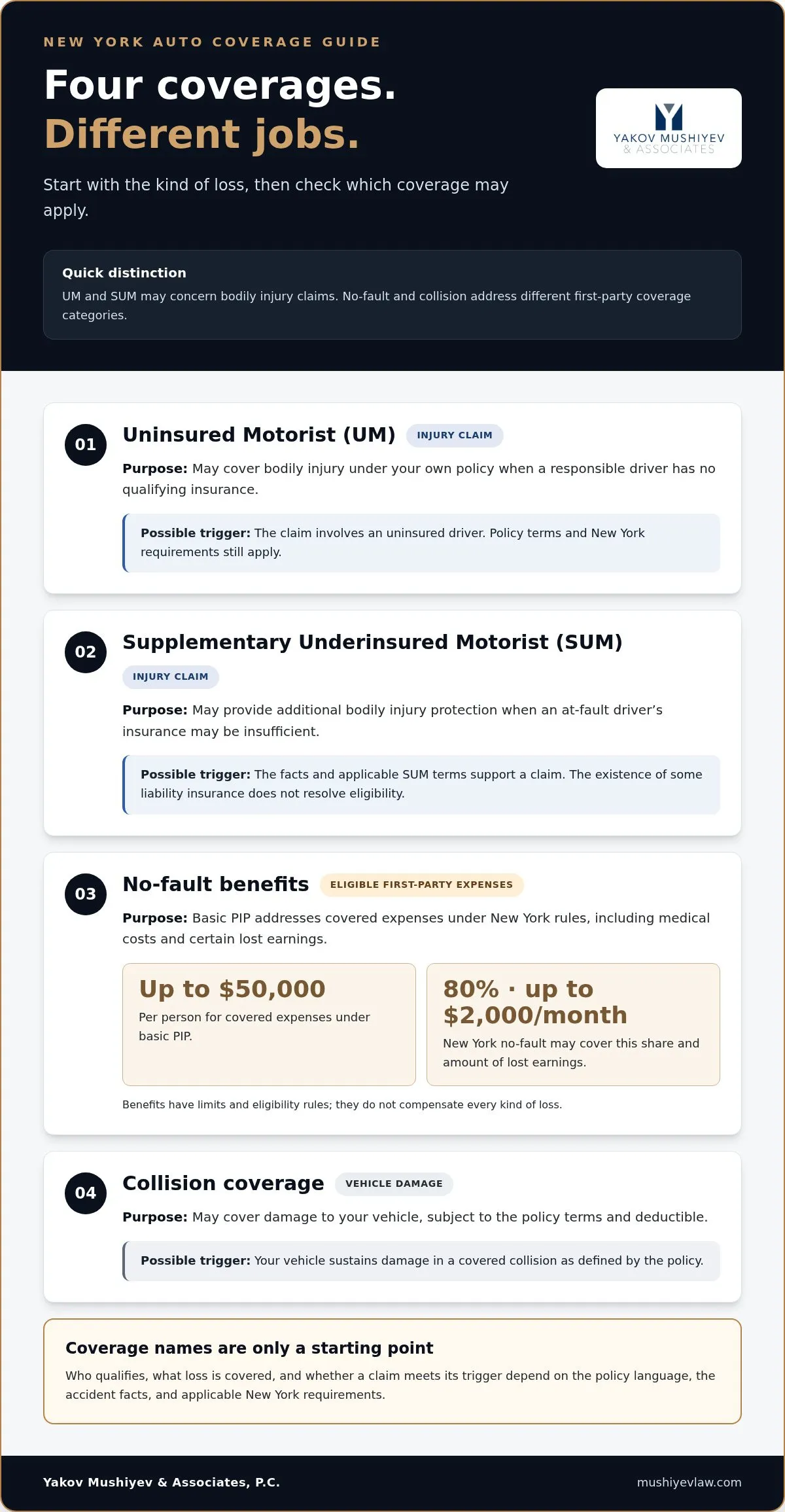
These coverages can appear on the same auto policy, but they address different losses and have different triggers. A practical way to sort them is to ask whether the claim concerns injuries, vehicle damage, or both. Then check the policy language: coverage names alone don’t establish who qualifies or what the insurer may owe.
| Coverage | Purpose | Typical trigger |
|---|---|---|
| UM | May cover bodily injury under your own policy when a responsible driver has no qualifying insurance. | A claim involves an uninsured driver, subject to the policy and New York requirements. |
| SUM | May provide additional bodily injury protection when an at-fault driver has insurance that may be insufficient. | The facts and applicable SUM terms support a claim. The existence of some liability insurance doesn’t resolve eligibility. |
| No-fault benefits | Address eligible first-party injury expenses under New York rules, not every loss. Basic PIP includes up to $50,000 per person for covered expenses, including medical costs and certain lost earnings. | An eligible person seeks covered benefits under the applicable no-fault rules and policy. |
| Collision | May cover damage to your vehicle, subject to policy terms and the deductible. | Your vehicle sustains damage in a covered collision, as defined by the policy. |
UM and SUM concern potential injury claims; no-fault and collision address different first-party coverage categories and don’t automatically replace them. New York no-fault may cover 80% of lost earnings, up to $2,000 per month, along with certain other necessary expenses. Those benefits have limits and eligibility rules, and they don’t compensate every kind of loss.
UM versus SUM: what changes when the other driver has some coverage?
UM generally concerns a responsible driver with no qualifying insurance. SUM, or supplementary uninsured/underinsured motorist coverage, may be relevant when the at-fault driver has insurance but the available liability coverage may be inadequate. If you’re asking when you can use your own uninsured motorist coverage, first identify whether the other driver had applicable insurance. Then assess the separate policy terms for UM or SUM. The existence of some insurance doesn’t settle SUM eligibility.
Look beyond a policy summary. Compare the declarations page, which identifies listed coverages and limits, with the endorsements that may set out additional terms. Those documents can help clarify what protection applies, but the accident facts and New York requirements still matter.
Your own policy’s other coverages are not interchangeable
A crash can raise more than one coverage question. No-fault benefits may address eligible injury expenses; collision may address vehicle repairs; and UM or SUM may apply to an injury claim involving another driver’s insurance status. Don’t assume one coverage pays every loss, that multiple coverages guarantee duplicate payment, or that a particular coverage always pays first.
Keep your declarations page, full policy and endorsements, claim forms, repair estimates, and insurer letters together. If an insurer disputes how coverage applies, a New York car accident lawyer can review the policy documents and claim communications in light of the crash facts.
Who may qualify, and what can affect a New York UM claim?
Whether a UM claim is available depends on several separate questions, not simply whether you were hurt in a crash. The policy must cover the person and circumstances involved, a responsible driver’s insurance status must be established, and the claim must be supported by evidence. Even if coverage may apply, the losses potentially covered depend on the policy and governing law.
If you’re asking, “when can I use my own uninsured motorist coverage,” start by identifying these issues:
- Insured status: Does the policy’s definition include the injured person in the circumstances of the crash?
- Responsibility: What evidence indicates that another driver caused or contributed to the collision?
- Policy status and limits: Was the relevant policy in effect, and what coverage and limits do its terms provide?
- Proof: Do the available records support the account of the crash, injuries, and insurance circumstances?
Whose policy might matter after a crash?
Review the injured person’s own auto policy and, where relevant, policies held by people in the household. A driver, passenger, or household member may be treated differently depending on the policy’s wording and the facts. Terms concerning resident relatives, permissive use, and specific vehicles can raise New York coverage questions. Don’t assume that living in the same home or riding in a covered vehicle automatically makes someone an insured.
For example, a passenger injured in a Queens crash may need to examine more than the policy attached to the vehicle they occupied. The passenger’s own policy or a household policy could be relevant, but only a review of the actual language and circumstances can clarify whether it applies. Keep complete policy documents, including declarations and endorsements, rather than relying on a summary or verbal description of coverage.
Evidence that can help establish what happened
Preserve material that may help establish the collision, identify drivers and vehicles, and document injuries. Useful records may include a crash report, photographs of the scene and vehicle damage, witness names and contact details, vehicle or insurance information, and medical records. Keep copies together and note where each item came from. Evidence can clarify coverage questions, but no single document guarantees that a claim will succeed.
Hit-and-run facts need particular care. If the other driver left or couldn’t be identified, record what you remember and preserve available photographs, witness information, and communications. New York may impose specific reporting or corroboration conditions for these claims, so don’t assume that an unidentified driver automatically qualifies as an uninsured motorist. The applicable requirements should be assessed against the circumstances and policy.
A careful review separates who may be insured, who may be responsible, which policy was active, and what the evidence supports. That analysis can reveal unanswered coverage questions before assumptions or missing records make a claim harder to assess.
What steps should you take before pursuing your own UM coverage?
After a crash, focus first on your health and on preserving a clear record. If you’re asking when you can use your own uninsured motorist coverage, the answer may depend on policy terms, evidence, and notice requirements. Insurers may investigate coverage, responsibility, injuries, and claimed losses. A careful sequence can help you preserve important information while those issues are assessed.
- Get medical attention promptly. Seek an evaluation for injuries, follow medical guidance, and keep records of visits, diagnoses, and treatment. Tell providers about symptoms even if they seem minor at first, and avoid minimizing how the crash affected you.
- Preserve the claim record. Save photographs, crash-related documents, witness details, repair information, medical records, bills, and messages from insurers. Keep copies of anything you submit and note when you sent it.
- Review the available policies. Locate the declarations page, full policy, UM or SUM endorsements, and renewal documents. These can identify relevant coverage and terms. Don’t rely only on a summary or assumptions about another driver’s insurance.
- Give notice promptly and appropriately. Follow the notice instructions in the applicable policy and report the crash to the insurer or insurers that may be relevant. Requirements can vary by policy and claim type, so don’t assume a single deadline applies to every UM or SUM claim.
Review the policy and organize the claim record
Put policy documents and claim materials in one place. Keep a dated log of calls, letters, emails, expenses, medical visits, and claim submissions. Record the name of the person you spoke with and what was discussed. Separate confirmed facts, such as information shown in a crash report, from assumptions about whether the other driver had insurance or which policy applies.
This organization can make it easier to respond to questions and spot missing information. It also helps keep different parts of the claim distinct: the crash circumstances, available policies, injuries, and losses being reported.
Watch for deadlines, denials, and settlement pressure
Policy notice requirements and legal deadlines may differ. The applicable time limits can depend on the type of claim and its facts, so verify them rather than relying on a general deadline found online. If an insurer disputes coverage or sends a denial, keep the complete letter and note any response dates stated in it.
An early settlement offer is a proposal, not a reliable valuation of every injury or loss. Before accepting or signing a release, consider having a lawyer review the offer, policy language, and claim record. The firm’s New York personal injury claim process guide explains how organized documentation can support an informed review. For guidance about your circumstances, you can discuss your UM coverage questions with a New York car accident lawyer.
How a New York lawyer can help assess a UM or SUM claim
A UM or SUM claim can involve overlapping policies, detailed endorsements, disputed facts, and insurer decisions that affect what happens next. A New York car accident lawyer can review the documents and circumstances together, explain potential coverage questions, and help you understand what information may still be needed. That assessment can bring clarity, but it can’t guarantee that a policy applies or that an insurer will pay.
If you’re asking, “when can I use my own uninsured motorist coverage,” legal review can help distinguish a UM issue from a possible SUM claim and other insurance benefits. Counsel may examine the policy language, claim submissions, medical and crash records, insurer correspondence, and the reasons the insurer gives for accepting, questioning, or denying coverage. The goal is an informed view of your options, not a promise of a particular result.
Questions an attorney may examine in your case
A focused review may address which policy and endorsement could apply, whether you meet that policy’s definition of an insured, and what evidence supports the collision circumstances, injuries, and other driver’s insurance status. Counsel can also examine the insurer’s position against the policy terms and identify notice, claim, or dispute deadlines that may govern. The relevant deadlines and procedures require case-specific legal review.
Those questions should be considered together, not in isolation. For example, an insurer’s position about who qualifies for coverage may depend on policy wording as well as who was driving, who owned the vehicle, and where the injured person lived. Reviewing the complete record can help identify disputed facts, missing documents, and issues that may need a response.
Discuss your situation with a local injury law firm
Yakov Mushiyev & Associates, P.C. is based in Rosedale and represents people injured in motor vehicle accidents across New York City’s five boroughs and Nassau County, including Queens communities such as Rochdale. The firm can review policy language, claim records, and insurer communications to help assess coverage questions. Its Queens car accident legal representation helps injured people understand their legal options after a crash.
You can request a free initial consultation, available 24/7, in English, Russian, or Spanish, to discuss the circumstances of your accident. The firm works on a contingency basis: No fee unless we win. To talk about your situation, discuss your New York accident claim. This article, including its FAQ answers, provides general information and isn’t legal advice for a specific case.
Take the next step with clarity
Questions about insurance coverage can linger while you focus on healing and getting daily life back on track. You don’t have to resolve every policy question alone. A focused legal assessment can help turn uncertainty into a clearer plan, including which documents to preserve and which issues may need attention next.
If you’re still wondering when can I use my own uninsured motorist coverage, consider the question alongside the facts of your crash and the insurance information you have. Don’t assume that an insurer’s position is the final word, but don’t rely on assumptions either. The terms and evidence deserve careful review before you make decisions that could affect your claim.
Take a practical first step: organize your records, note any communications or deadlines, and seek guidance tailored to your circumstances. A conversation can help you understand the questions to ask and the options worth considering, without promising a particular outcome.
Discuss your New York accident claim and take the next step with greater confidence.
Frequently Asked Questions
Can I use my own uninsured motorist coverage after a hit-and-run in New York?
A hit-and-run may raise a UM claim in New York, but coverage isn’t automatic. The insurer may need information about how the collision happened, what vehicles were involved, and whether the policy’s conditions are met. Preserve photos, witness contact details, nearby camera information, and any available vehicle description. Report the crash promptly to the appropriate authorities and insurer, and review the reporting and notice requirements that apply to your situation. This is general information, not legal advice for your specific case.
Can a passenger use their own uninsured motorist coverage after a New York crash?
Yes, a passenger may have a potential claim under their own policy or a household policy, depending on the policy wording and crash facts. For example, a passenger riding in a friend’s car shouldn’t assume only the vehicle owner’s coverage matters. Definitions of insured persons, residence, vehicle use, and other policy terms can affect the analysis. Review the actual policy documents before drawing conclusions. This is general information, not legal advice for your specific case.
Can I use UM coverage if the other driver has insurance?
Possibly, but if the other driver carries insurance, the issue may involve supplementary uninsured/underinsured motorist (SUM) coverage rather than a standard UM claim. SUM may be relevant if available liability coverage is inadequate, but its terms and New York rules control whether a claim qualifies. The insurer’s limits, your policy, and documented losses all matter; no universal payment formula applies.
Will making a UM claim raise my insurance rates in New York?
There’s no reliable blanket answer. Whether a UM claim affects premiums can depend on the insurer, policy language, claim circumstances, and applicable rules, so don’t assume either an increase or no change. If your premium changes, keep the renewal notice and ask the insurer to explain the reason and policy basis for the adjustment. A lawyer can review a dispute about claim handling.
Can I file a UM claim if I was partly responsible for the crash?
Possibly. A finding that you shared responsibility may affect how a claim is evaluated, but it doesn’t by itself answer whether UM coverage is available. The policy terms, evidence about each driver’s conduct, and applicable New York law must be considered together. If the insurer disputes responsibility or relies on a fault assessment you believe is incomplete, preserve related records and seek legal review.
How long do I have to notify my insurer about a UM claim?
Notify the insurer promptly, because applicable notice and proof requirements depend on the policy and New York rules. A hit-and-run or other unusual circumstance may involve additional reporting conditions, so don’t rely on a deadline quoted for a different claim type. Locate your policy’s notice instructions, record when and how you reported the crash, and keep copies of submitted forms and correspondence.