
The death of an at-fault driver does not mean the death of your personal injury claim. You’ve likely spent months fighting for justice, only to be hit with the news that the defendant has passed away. It is natural to feel like your path to compensation has reached a dead end or that the insurance company finally found a loophole to avoid paying. You are probably asking, what if the at-fault driver dies before my case is settled? In New York, the law is clear: your right to recovery survives. We understand the anxiety that probate court and legal delays cause, but we refuse to let a defendant’s passing derail your financial future.
This guide provides the precision you need to protect your claim and secure the settlement you deserve. You will discover how the 18-month statutory tolling under CPLR 210(b) works, the specific steps for substituting an estate representative, and how insurance payouts function when the policyholder is no longer living. We move your case from a state of uncertainty into a strategic, aggressive pursuit of justice. Your journey toward restoration continues, regardless of the defendant’s status. We are here to act as your shield and ensure the insurance carriers meet their contractual obligations in full.
Key Takeaways
- New York law ensures your claim survives the defendant’s death. Your legal action transforms into a claim against the driver’s estate.
- Learn the answer to what if the at-fault driver dies before my case is settled. New York’s ‘Survival of Actions’ doctrine protects your right to recovery.
- Discover the specific legal protections provided by CPLR 210(b). This statute grants a mandatory 18-month extension to the statute of limitations.
- Navigate the mandatory court stay with precision. A formal substitution process is required to keep your litigation moving forward.
- Leverage expert advocacy in the Surrogate’s Court. This prevents insurance carriers from using a defendant’s death as a tactic to delay justice.
Does Your Claim Survive When the At-Fault Driver Passes Away?
The news that the driver responsible for your injuries has passed away often triggers a wave of panic. You’ve been enduring physical pain and mounting medical bills, only to face a new, seemingly insurmountable obstacle. We want to be clear: your case is not over. While the individual is gone, the legal liability they created remains very much alive. You are likely wondering, what if the at-fault driver dies before my case is settled? In New York, your right to seek justice is protected by specific statutes designed to prevent negligent parties from escaping accountability through death. We refuse to let a procedural change stop your pursuit of fair compensation.
The Survival of Actions Doctrine in New York
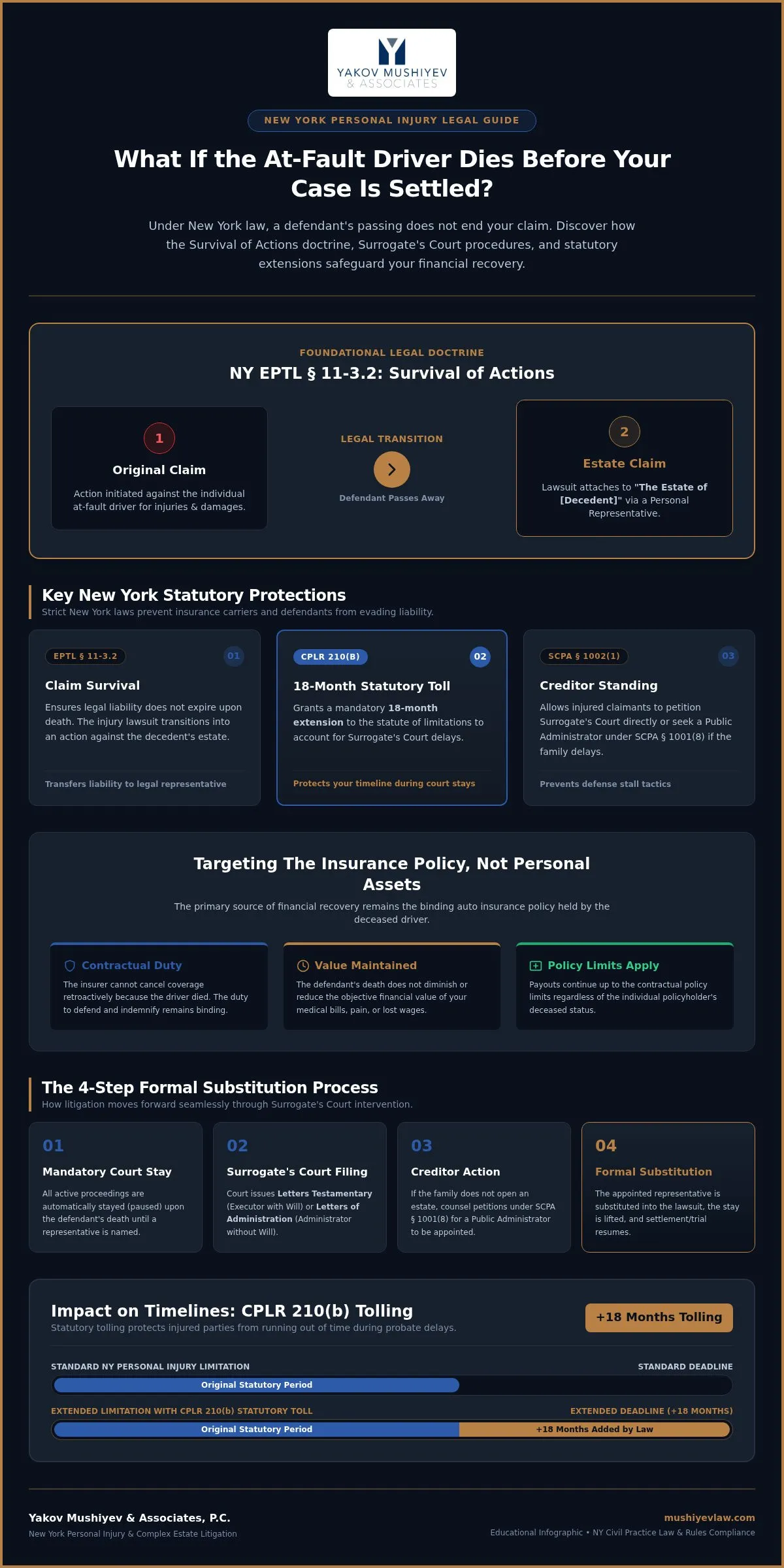
Under New York Estates, Powers and Trusts Law (EPTL) § 11-3.2, your personal injury claim survives the death of the defendant. Survival of Actions is the legal principle that prevents a claim from expiring upon a party’s death. This means your lawsuit doesn’t vanish; instead, it transitions. The law views your claim as a liability that attaches to the decedent’s estate. While you can no longer sue the individual directly, you can maintain the action against their personal representative. This distinction is vital to your recovery. You are moving from a battle against a person to a battle against a “legal person,” which is the estate. We navigate the complexities of probate and surrogate court proceedings to ensure this transition is seamless and your rights remain fully intact. An estate is not an independent legal entity in New York, so naming the correct representative is the only way to keep your case moving.
Why the Insurance Policy Remains the Primary Target
The most important factor to remember is that you aren’t typically pursuing a grieving family’s personal inheritance. You are pursuing the insurance coverage the driver paid for specifically to cover these scenarios. The contract between the driver and their insurance company remains legally binding. The insurer is contractually obligated to defend the estate and pay out any settlement or judgment up to the policy limits. What if the at-fault driver dies before my case is settled and the insurance company stops talking? We step in immediately. Insurance companies often try to capitalize on the confusion surrounding a death to delay payments. We hold them to the terms of their policy. Consider these facts:
- The insurance company cannot cancel a policy retroactively because the driver died.
- The insurer’s duty to indemnify, or pay the claim, persists regardless of the policyholder’s status.
- The defendant’s death does not reduce the objective value of your injuries or lost wages.
The insurance company’s deep pockets remain the ultimate source of your recovery. We act as your shield, ensuring they honor their obligations and do not use a tragic event as a loophole to avoid justice.
The Role of the Estate and Surrogate’s Court
When a driver passes away, the legal target of your claim shifts from a person to an entity. You are no longer litigating against an individual; you’re litigating against “The Estate of [Name].” This shift requires immediate intervention in the Surrogate’s Court. The court acts as the gatekeeper, ensuring a proper representative is in place to handle the decedent’s liabilities. Without this appointment, your case cannot proceed. We monitor probate filings with clinical precision to ensure your claim doesn’t stall while the defendant’s affairs are settled.
What is a Personal Representative?
A personal representative is the individual legally authorized to act on behalf of the deceased driver’s estate. If the driver had a will, the court issues “Letters Testamentary” to an Executor. If there was no will, the court issues “Letters of Administration” to an Administrator. This representative becomes the new defendant in your lawsuit. They have the legal authority to sign settlement papers and defend the estate’s interests in court.
Many families hesitate to open an estate, especially if there are few personal assets. This delay is a tactic insurance companies often use to avoid paying. However, under Surrogate’s Court Procedure Act (SCPA) § 1002(1), you have standing as a potential creditor to petition the court yourself. We often petition for the appointment of a Public Administrator under SCPA § 1001(8) to ensure the case stays on track. If you’re asking, what if the at-fault driver dies before my case is settled and no one takes charge, we take that charge for you. We don’t wait for the family to act. We force the issue to keep your recovery moving.
Navigating the Queens Surrogate’s Court
For residents in Rosedale or Rochdale, this legal battle often moves to the Queens Surrogate’s Court in Jamaica. This creates a dual-court scenario. Your injury claim remains in Civil or Supreme Court, but the authority to continue that claim must be secured in Surrogate’s Court. This requires a personal injury lawyer in Rosedale, Queens who understands the friction between these two systems. We manage the filings in both courts simultaneously.
We monitor probate filings daily. If an estate is opened, we move to substitute the representative immediately. If it isn’t, we file the necessary petitions, often starting with a baseline fee of $45.00 when the estate value is unknown. This proactive approach prevents your case from languishing in a legal vacuum. If you need a firm that understands these local nuances, you can request a case evaluation to see how we protect your interests. We act as your shield against insurance companies that try to capitalize on these procedural hurdles.
The Process of Substitution: Moving the Case Forward
The moment a defendant passes away, your litigation enters a state of legal suspended animation. Under New York Civil Practice Law and Rules (CPLR) § 1015(a), the death of a party divests the court of jurisdiction. This means the case stops immediately. No motions can be decided, no discovery can be exchanged, and no trial dates can be honored. This pause is not a suggestion; it is a mandatory requirement. We act quickly to break this deadlock, ensuring that a temporary procedural hurdle does not become a permanent barrier to your recovery.
The Automatic Stay of Litigation
This “automatic stay” freezes every deadline in your case. If a judge issues an order while this stay is in effect, that order is legally null and void. For a plaintiff, this period is often the most frustrating phase of the litigation. Your depositions are canceled, and your trial date is vacated. The risk of taking any legal action during this time is high, as any progress made without a proper defendant is a waste of resources. We use this interval to perform the intensive background work required to identify the correct successor, turning a period of court-mandated silence into a strategic advantage.
Filing the Motion for Substitution
To restart the clock, we must file a formal Motion for Substitution under CPLR 1021. This is the definitive resolution to the stay. The process follows a strict protocol to ensure the court regains its authority to hear your case. Many injured parties worry about the complexity of this shift, asking, what if the at-fault driver dies before my case is settled and there is no one left to sue? We follow a proven three-step process to answer that challenge:
- Step 1: Secure the Death Certificate. We obtain official proof of death to satisfy the court’s evidentiary requirements.
- Step 2: Identify the Representative. We search for a named executor or, if the family has not acted, we petition for a Public Administrator to be appointed as the defendant.
- Step 3: Formal Filing. We submit the motion in the court where your injury case is pending, requesting that the estate representative be named as the new defendant.
If the defendant had no assets and no estate was opened, the insurance company may believe they are in the clear. They are wrong. We have the experience to move the case forward even in the absence of a family-led probate process. We force the appointment of a representative solely to allow your action against the insurance policy to continue. Time is of the essence, as a failure to move for substitution within a “reasonable time” can subject your entire action to dismissal. We do not allow that to happen.
Impact on Timelines and the Statute of Limitations
Time is usually the enemy in personal injury litigation, but a defendant’s death provides a rare, statutory reprieve. While you might fear that a death brings your case to a permanent halt, New York law actually provides a safety net to ensure your rights aren’t extinguished by a funeral. However, this extension is not an excuse for passivity. If you’re asking, what if the at-fault driver dies before my case is settled, you must understand that while the deadline moves, the complexity of the filing increases. We use this extra time to build a more formidable case, not to wait for the insurance company to act.
The 18-Month Extension (Tolling)
Under NY CPLR 210(b), if a person liable for a cause of action dies, an additional 18 months is added to the statute of limitations for commencing an action against their representative. This is known as “tolling.” In a standard New York personal injury case, you typically have three years from the date of the accident to file a lawsuit. If the at-fault driver dies before you commence that action, your filing window can effectively expand to four and a half years. This provision exists specifically to protect victims from losing their rights during the often-lengthy probate process. Calculating this new deadline accurately requires precise legal counsel, as the tolling period applies only if the death occurs before the original statute of limitations expires. We calculate these dates with clinical certainty to ensure your claim remains viable.
Why Delays Occur and How to Mitigate Them
Despite the 18-month extension, the “probate lag” in the New York City court system is a reality. The Queens Surrogate’s Court, which handles estates for Rosedale and Rochdale residents, often faces significant backlogs. If a family is unresponsive or refuses to open an estate, your case can sit in a “dead file” for months. We mitigate these delays by utilizing the Public Administrator option under SCPA § 1001(8). We don’t wait for the defendant’s family to decide when your case moves forward. We take the initiative to petition the court ourselves, ensuring a fiduciary is appointed so the litigation can proceed. Aggressive advocacy is the only way to prevent your claim from being buried under administrative red tape. If you’re concerned about how these timelines affect your specific recovery, you should contact our Queens office for a case review today. We act as your shield against the procedural delays that insurance companies use to wear down your resolve.
How Yakov Mushiyev & Associates, P.C. Navigates Complex Estate Claims
The death of a defendant is often the moment an insurance company starts looking for the exit. They hope you’ll get lost in the Surrogate’s Court or simply give up on the litigation. We don’t let that happen. Our firm, Yakov Mushiyev & Associates, P.C., acts as a shield, ensuring that your recovery remains the priority regardless of the defendant’s status. We have the technical resources and the tenacity to track down estate representatives and force the litigation forward. Our experience in the NYC court system allows us to navigate these hurdles with clinical precision.
Aggressive Representation Against Insurers
We force insurance carriers to stay at the negotiating table. A defendant’s passing does not erase their negligence, and it certainly doesn’t erase the insurer’s duty to pay. We explore every possible avenue for recovery, including umbrella policies and secondary coverage that might otherwise go unnoticed. If you are asking, what if the at-fault driver dies before my case is settled and the insurer stops responding, we provide the definitive resolution. We hold these powerful entities accountable to their contractual obligations. Our commitment is backed by our “No Win, No Fee” promise. This ensures you have access to elite legal representation without any upfront financial risk. We take on the complexity so you can focus on your healing.
A Strategic Shield for Queens Residents
Navigating the NYC court system requires more than just legal knowledge; it requires street-smart tactics and local connections. As a personal injury lawyer Rosedale NY, we understand the specific nuances of our community. We serve the Rosedale and Rochdale areas with a deep understanding of the Queens Surrogate’s Court. We know the local court clerks. We understand how to cut through the administrative red tape that often entangles these cases. Whether your accident happened near Brookville Park or on a busy local thoroughfare, we provide the regional expertise necessary to win.
Having a car accident lawyer Jamaica Avenue means you have an advocate who can handle the logistics of the Queens legal landscape with maximum efficiency. We transition you from a state of crisis into a state of decisive action. Don’t let a procedural complication rob you of your justice. We invite you to contact us for a complimentary, protective consultation. We will review your specific situation and outline the strategic steps needed to secure your compensation. Time is of the essence in these matters. We are ready to move forward for you today.
Secure Your Recovery Regardless of the Circumstances
You now understand that a defendant’s passing is a procedural shift, not a legal dead end. New York law provides specific protections, like the 18-month statute of limitations extension, to ensure your voice is heard in court. You don’t have to wonder what if the at-fault driver dies before my case is settled while facing the power of insurance carriers alone. We act as your shield, navigating the complexities of the Queens Surrogate’s Court to keep your litigation moving forward.
With over 20 years of NYC personal injury experience, our firm, Yakov Mushiyev & Associates, P.C., specializes in these high-stakes transitions. We offer specialized knowledge of NY Surrogate’s Court procedures and a strict “No Win, No Fee” model. This means you get elite advocacy without any financial risk. Don’t let a defendant’s death derail your justice, contact Yakov Mushiyev & Associates, P.C. for a free case evaluation today. Your path to restoration is still open, and we are ready to fight for every dollar you deserve.
Frequently Asked Questions
Can I still sue if the at-fault driver died in the accident?
Yes. New York law allows claims to survive the death of the defendant. The lawsuit is filed against the personal representative of the driver’s estate. This ensures that the driver’s liability doesn’t vanish. For residents in Rosedale or Rochdale, this often involves the Queens Surrogate’s Court. We handle the transition from suing an individual to suing an estate entity, protecting your right to seek full compensation for your injuries.
Who pays the settlement if the driver is dead?
The driver’s automobile insurance company remains contractually obligated to pay the settlement. Even though the policyholder has passed away, the insurance contract survives. The insurer must defend the estate and indemnify any judgment or settlement up to the policy limits. You are typically seeking funds from the insurance carrier, not the personal assets of the grieving family. We hold these multi-billion dollar companies to their legal obligations, ensuring they don’t escape their duties.
How long does it take to settle a case against a deceased driver’s estate?
Cases involving a deceased defendant often take longer due to the probate process. You must wait for the Surrogate’s Court to appoint an administrator before the litigation can proceed. This “probate lag” can add several months to the timeline. However, we use aggressive tactics to expedite the appointment of a representative. Our deep knowledge of Queens court procedures helps us minimize these delays and keep your recovery on the fastest possible track.
Do I have to sue the driver’s family directly?
No, you do not sue the family members personally. You sue the driver’s estate through its legal representative. The family’s personal bank accounts and assets are generally not at risk unless the insurance coverage is insufficient and the estate itself has significant wealth. In most NYC car accident cases, the focus remains entirely on the insurance policy limits. We act as a shield, managing the legal technicalities so you don’t have to deal with the family.
What happens if the deceased driver had no insurance?
If the at-fault driver was uninsured, you would likely file a claim under your own Supplementary Uninsured/Underinsured Motorist (SUM) coverage. This policy protects you when the negligent party cannot pay. You are essentially asking your own insurer to step into the shoes of the at-fault driver. If you’re wondering what if the at-fault driver dies before my case is settled and they were uninsured, we immediately pivot to trigger your own policy benefits.
Does the statute of limitations change if the defendant dies?
Yes, it can actually be extended. Under NY CPLR 210(b), if the person liable for your injuries dies before you start the lawsuit, an 18-month “toll” is added to the deadline. This means a standard three-year window can become four and a half years. This extension provides the necessary time to navigate the Surrogate’s Court. We calculate these precise deadlines to ensure your filing is timely and your legal rights are fully preserved.
What is a ‘Motion for Substitution’ in a New York car accident case?
A Motion for Substitution is a formal legal request to replace the deceased defendant with their estate’s representative. When a party dies during active litigation, the case is automatically stayed, or frozen. Filing this motion under CPLR 1021 is the only way to “unfreeze” the case and restart discovery or trial proceedings. We handle this technical filing with clinical precision, ensuring the court regains jurisdiction so we can continue fighting for your settlement and recovery.
Will the death of the driver make my settlement smaller?
No, the driver’s death does not reduce the objective value of your claim. Your medical expenses, lost wages, and pain and suffering remain the same. The insurance company is still liable for the full amount of the policy limits. If you are concerned about what if the at-fault driver dies before my case is settled, know that our goal is to maximize your recovery. We refuse to let insurers use a death to devalue your trauma.