
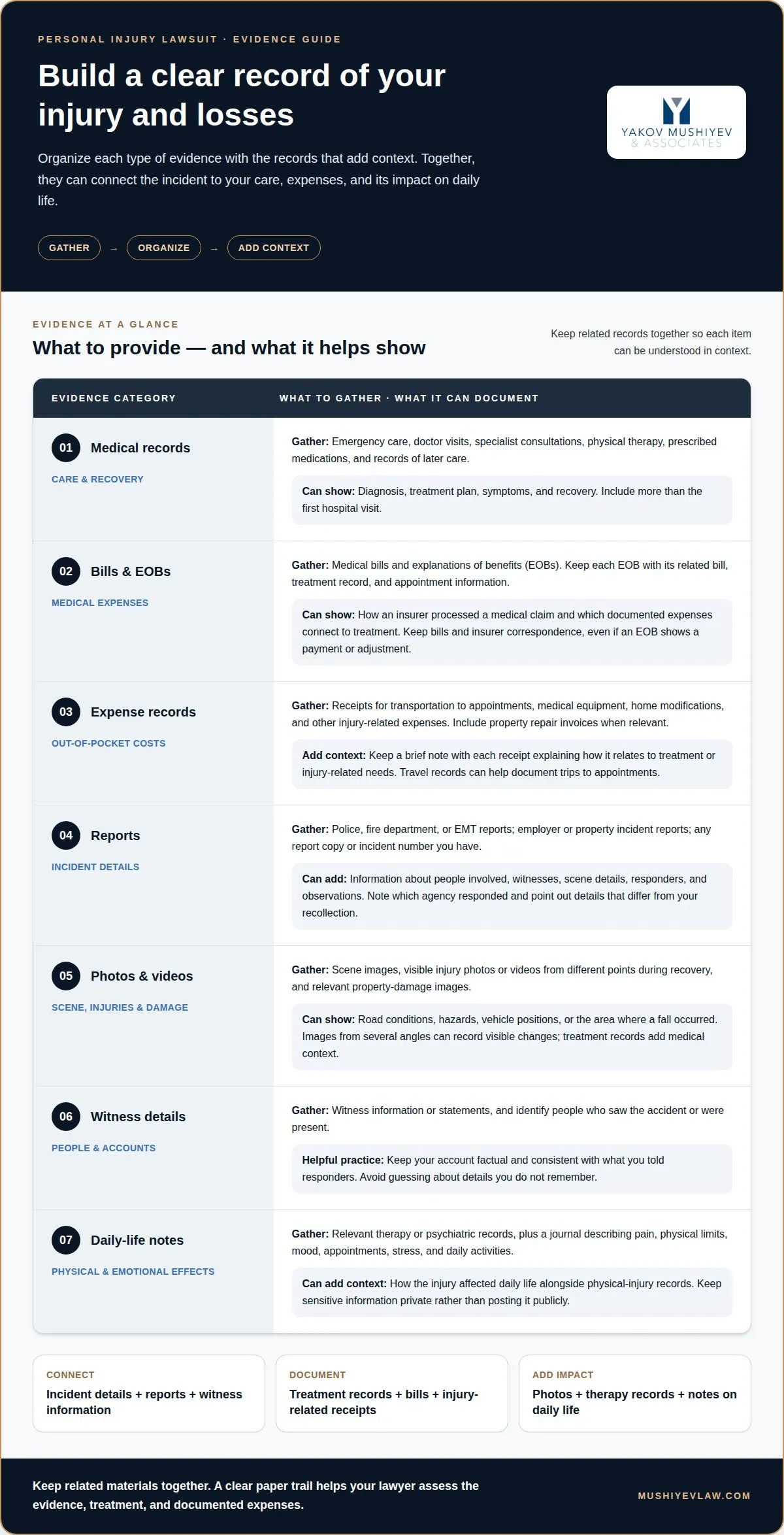
To understand what documents you need to provide in your injury lawsuit, start with medical records and bills, police or incident reports, photographs, wage records, and witness information. Therapy or psychiatric records may also help document emotional effects. Together, these materials can show how the injury happened, what care you received, and how it affected your work and daily life.
After an accident, it’s common to focus on treatment and put paperwork aside. But clear, organized records can help connect the incident to your injuries and losses. Gaps may make that connection harder to establish.
This guide explains why documentation matters and what to gather, including medical bills, treatment records, reports, photos, wage information, and therapy or psychiatric records when relevant. You’ll learn how each category can support your account of what happened and its impact on your life.
Key Takeaways
- Gather records from emergency care through follow-up treatment, along with bills and receipts that show injury-related expenses.
- Police or incident reports can help establish what happened; witness details and statements may add useful context.
- Photos and videos can preserve evidence of the scene, visible injuries, and property damage as they change over time.
- Psychiatric records and notes about changes in daily life can help document emotional effects alongside physical injuries.
Medical records, bills, and treatment documentation
Medical records and expense documents connect an accident to your injuries, treatment, and financial losses. Give your lawyer a complete, organized account of care and its effects.
-
How Your Lawyer Gathers Medical Records
Provide records from emergency care, doctor visits, specialist consultations, physical therapy, and prescribed medications. These documents can show your diagnosis, treatment plan, symptoms, and recovery. Include records of later care, not just the first hospital visit.
Keep your descriptions of symptoms consistent with what you told healthcare providers. Share relevant therapy or psychiatric records, too. Alongside treatment notes, a journal describing pain, physical limits, mood, and daily activities can help show how the injury affected your life and support a pain-and-suffering claim.
-
How Your Lawyer Reviews Bills and Benefit Explanations
Provide medical bills and explanations of benefits for your lawyer to review together. An explanation of benefits, or EOB, records how an insurer processed a medical claim. Keep each EOB with the related bill, treatment record, and appointment information.
For example, an emergency-room bill can be reviewed alongside the visit record showing the diagnosis and care provided. Organize specialist, imaging, and physical therapy bills with their corresponding records. A clear paper trail helps your lawyer assess documented medical expenses and understand the treatment connected to the accident. Don’t discard bills or insurer correspondence because a payment or adjustment appears on an EOB.
-
Documenting Accident-Related Expenses for Your Claim
Share receipts and records for out-of-pocket expenses tied to your injury. These may include transportation to medical appointments, medical equipment, and home modifications. Keep each receipt with a brief note explaining how it relates to your treatment or injury-related needs.
Travel records can help document trips to appointments, while equipment receipts identify costs not shown on a provider’s bill. Include other injury-related receipts and property repair invoices when relevant. These records help your lawyer assess expenses alongside medical bills and treatment records. A journal can also record appointments, physical limitations, and stress affecting daily activities, adding context to documented losses.
Police and incident reports
Reports can preserve details about how an accident happened and who was present. Tell your lawyer which authorities or property representatives responded, and share any report numbers or copies you have.
-
Reporting the Accident With Your Lawyer’s Guidance
Tell your lawyer whether you reported the incident to police, an employer, or a property representative. Identify the location, approximate sequence of events, and people who witnessed the accident. Your lawyer can help assess how to preserve a clear account of what happened.
Keep your description factual and consistent with what you told responders. If an officer provided an incident number, pass it along to help locate the police report. Avoid guessing about details you don’t remember. A precise account helps your lawyer assess the available evidence for a personal injury lawsuit.
-
How Your Lawyer Obtains Police and Responder Reports
Tell your lawyer which responders attended, including police, firefighters, or emergency medical technicians. Share the incident number, responding agency, and any paperwork you received. If you don’t have a copy, those details can help identify the relevant report.
A police accident report may summarize the people involved, witnesses, and scene details. Fire department or EMT reports may add information about the response and observations at the scene. Keep each report with related accident paperwork, and point out details that differ from your recollection. These records can help your lawyer evaluate what happened and support a compensation claim.
-
How Your Lawyer Collects Property Incident Reports
Tell your lawyer if a business, construction site, or other property representative created an incident report. Provide the property’s name and location, the date of the event, and the representative’s contact details if available. Share any copy or report number you received.
If you were injured on the property, ask for a copy before leaving when circumstances allow, then give it to your lawyer. The report may preserve how the incident was recorded and identify people involved. Keep it with related correspondence rather than relying on memory alone. Personal injury lawyers can help assess how available reports support your account and claim for compensation.
Why do you need documentation of a personal injury?
Photos and videos can show how an accident happened and how injuries or property damage changed. If you’re wondering, “What documents do I need to provide in my injury lawsuit?”, share relevant evidence with your lawyer and keep sensitive information private rather than posting it publicly.
-
Preserving Accident-Scene Photos and Videos for Your Lawyer
Give your lawyer scene photos, videos, available accident reports, and witness information or statements. Images of road conditions, hazards, vehicle positions, or the area where a fall occurred can help establish context. For a car crash, roadway and vehicle images may show details that a brief report doesn’t capture.
Evidence varies by incident: a car accident, slip and fall, and workplace injury may involve different reports and witnesses. Ask your lawyer which materials are relevant before sharing sensitive records with an insurer or posting details publicly.
-
Sharing Injury Photos With Your Lawyer
Provide injury photos or videos taken at different points during recovery. Images from several angles may record visible changes, while treatment records add medical context. Share these materials directly with your lawyer rather than posting them publicly, especially when they reveal private health information.
Share property-damage photos, videos, repair estimates, and related notes with your lawyer. For example, pair images of vehicle damage with a repair estimate. Together, these records may help explain the physical impact of the incident and the costs being claimed.
-
Documenting Property Damage for Your Claim
People also ask, “What documents do I need to provide in my injury lawsuit?” Give your lawyer relevant records and discuss what should remain private, including sensitive medical information. Reports, photographs, and written or recorded witness statements can help document the event and observations while they’re fresh.
People also ask, “What documents do I need to provide in my injury lawsuit?” Give your lawyer relevant records and discuss what should remain private, including sensitive medical information. Reports, photographs, and written or recorded witness statements can help document the event and observations while they’re fresh.
Injury photographs and psychiatric records
Therapy records, employment documents, and organized copies can help explain how an injury affected your health, work, and daily life.
- Give your attorney records of injury-related expenses, including transportation to appointments, medical equipment, or home modifications. Keep receipts and invoices with brief notes explaining how they relate to the injury. Also provide relevant medical bills and treatment records. For a severe injury involving several providers and expense categories, a dated inventory can help keep the case organized during settlement discussions.
- Give your attorney records of injury-related expenses, including transportation to appointments, medical equipment, or home modifications. Keep receipts and invoices with brief notes identifying their connection to the injury. Also provide copies of relevant medical bills and treatment records. A severe injury may involve several providers and expense categories, so a dated inventory can help keep the personal injury case organized during settlement discussions.
- Provide employment records if the injury caused missed work or reduced income. Pay stubs, W-2 information, work schedules, and employer wage statements can help document lost wages. An employer letter that identifies missed hours and lost wages can add detail. These records help connect work absences to the injury and show how it affected earnings.
- Organize paper and digital copies by category and date, then keep an inventory of the records you’ve shared. Your attorney can request relevant medical records and arrange materials so treatment, expenses, and work impacts are easier to review. Store copies securely and preserve insurer correspondence with the related documents. Get help organizing your injury case records with a legal professional.
Yakov Mushiyev & Associates, P.C
Yakov Mushiyev & Associates, P.C can help you understand how records relate to a personal injury claim and what evidence may support your case. If your injury followed a car, truck, or motorcycle accident, or a slip and fall, the firm provides legal representation for these matters. An attorney can review the available information, identify gaps, and explain how medical records, reports, photographs, and expense documents may support your account.
You don’t need to have every document gathered before seeking legal guidance. If you’re unsure what to share, or an insurer is challenging your account or losses, discuss the records you have and the incident details with the firm.
Contact Yakov Mushiyev & Associates, P.C to discuss your injury case.
Take the Next Step With Confidence
Yakov Mushiyev & Associates, P.C. represents people in car accident, slip-and-fall, and truck accident matters. The firm can review your situation and help you understand how legal representation may fit your next steps. You can raise concerns about the incident, your records, or how the injury has affected your life.
Yakov Mushiyev & Associates, P.C. represents people in car accident, slip-and-fall, and truck accident matters. The firm can review your situation and help you understand how legal representation may fit your next steps. You can raise concerns about the incident, your records, or how the injury has affected your life.
Contact Yakov Mushiyev & Associates, P.C. to discuss your situation. Taking that first step can help you move forward with greater clarity and support.
Frequently Asked Questions
These answers provide general information, not legal advice about your specific case. Consult a lawyer for guidance tailored to your circumstances.
What should your lawyer document to support your injury claim?
Forgetting a record doesn’t automatically end an injury claim. Tell your lawyer what is missing and what you remember, including where or when the information may have been created. Your lawyer may help gather additional evidence or address gaps. A witness’s name or a provider’s office, for example, may help locate information you didn’t keep.
What happens if I forget to document something?
Useful supporting materials can include records about the incident, medical care, expenses, income, witnesses, and insurance. The documents relevant to a lawsuit depend on the facts and issues being established. Gathering evidence doesn’t mean every record must be filed with court papers. Preserve original files and share relevant materials with your lawyer, who can assess what supports your claim.
What documents are needed to file a personal injury lawsuit in the United States?
Provide records from each provider who treated the injury, including emergency care, follow-up visits, specialist consultations, imaging, physical therapy, and prescribed medications. Include related bills and explanations of benefits so the treatment and charges can be reviewed together. If care continues, tell your lawyer about upcoming appointments and new providers, then add those records as they become available.
What medical records and bills should I provide for an injury claim?
Your lawyer can sort records by category and date, maintain an inventory, and identify gaps that may need attention. Preserve paper and digital copies, label files clearly, and store them securely. In Rosedale, Rochdale, and Queens, Yakov Mushiyev & Associates, P.C. can assess accident-related legal claims and organize relevant case information for review.
What insurance and financial documents are needed to document injury damages?
Share relevant insurance policy details and correspondence from your insurer or the other party’s insurer. For vehicle crashes, keep insurance information for everyone involved. To document financial effects, provide pay stubs, W-2 information, work schedules, employer wage statements, and receipts for injury-related expenses. These materials help distinguish medical costs, income losses, and other out-of-pocket impacts.
How can your lawyer help organize and preserve evidence and documents for an injury lawsuit?
Your lawyer can sort records by category and date, keep an inventory, and identify gaps that may need attention. Preserve both paper and digital copies, label files clearly, and store them securely. In Rosedale, Rochdale, and Queens, Yakov Mushiyev & Associates, P.C. can help assess accident-related legal claims and organize relevant case information for review.