
Package delivery has quietly reshaped traffic in Queens. Residential blocks in Bayside, Fresh Meadows, and Rosedale that once saw a mail truck and the occasional moving van now host a steady parade of branded vans, step vans, and rented cargo trucks from morning to well after dark. More stops mean more double parking, more backing maneuvers, more drivers on tight schedules, and more pedestrians stepping around vehicles. This analysis looks at delivery truck crashes the way a safety analyst would: first the risk factors and the data, then prevention, then the legal rights of people who get hurt. If you are looking for a delivery truck accident lawyer in Queens, the final sections explain how liability and insurance usually work.
A note on sources. We cite national figures only where they come from the agency that publishes them, and we link to the source. We do not invent local statistics, and where Queens-specific numbers are not available here, we describe the conditions rather than guess.
The Risk Profile: Why Delivery Vehicles Behave Differently
A delivery truck is not simply a smaller tractor-trailer. Its operating pattern is the opposite: short trips, constant stops, and most of its time on local streets rather than highways. That pattern creates a distinctive set of hazards.
Risk factor 1: Stop density
A route driver may make a large number of stops in a single shift. Every stop involves decelerating, finding (or not finding) a legal space, exiting the vehicle, and merging back into traffic. On commercial corridors such as Northern Boulevard, Queens Boulevard, Hillside Avenue, Jamaica Avenue, and Merrick Boulevard, legal curb space is scarce, and double parking forces cars, buses, and cyclists to swing into adjacent lanes or oncoming traffic.
Risk factor 2: Backing and low-speed maneuvers
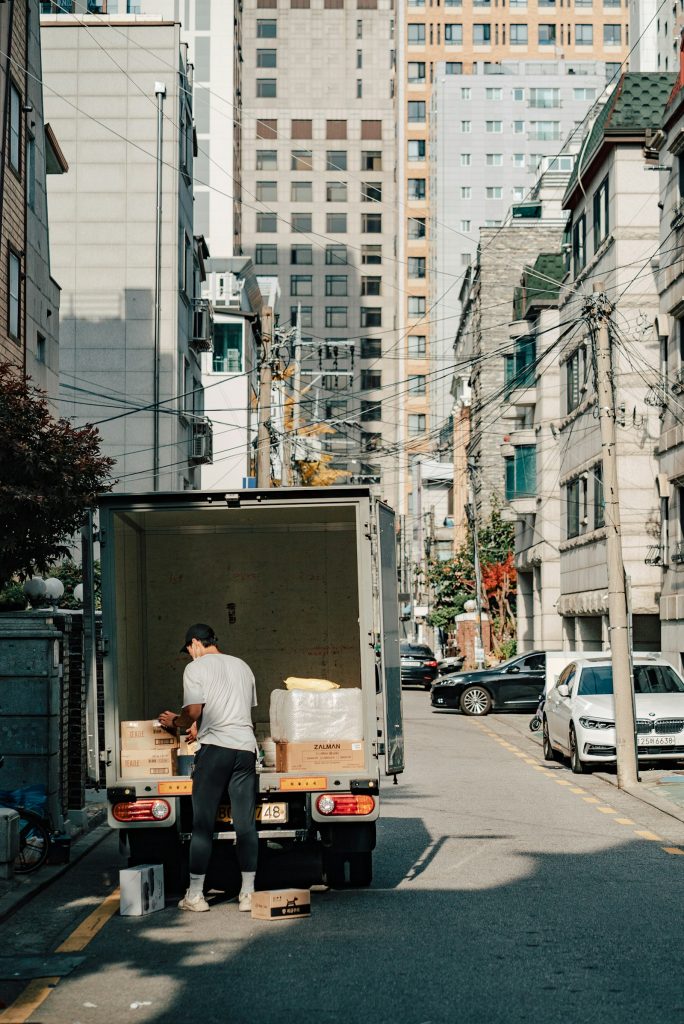
Step vans and box-style delivery trucks have large rear blind zones. Backing into a driveway, reversing out of a dead-end street, or repositioning in a parking lot are common moments for pedestrians, especially children and older adults, to be struck at low speed but with serious consequences.
Risk factor 3: Schedule pressure and distraction
Delivery drivers rely on handheld scanners, routing apps, and dispatch messages. New York bans hand-held phone and portable electronic device use while driving under VTL §1225-c and §1225-d, but the operational temptation to glance at the next stop is constant. The National Highway Traffic Safety Administration reports that 3,208 people were killed in motor vehicle crashes involving distracted drivers in 2024, and it notes that sending or reading a text takes your eyes off the road for about 5 seconds, which at 55 mph is like driving the length of a football field with your eyes closed. Delivery vans rarely travel at 55 mph in Queens, but at any speed, seconds of inattention near a crosswalk are what matter.
Risk factor 4: Pedestrian exposure
Delivery work is pedestrian-heavy by nature: the driver is a pedestrian at every stop, and residential and retail streets are full of people on foot. Nationally, NHTSA’s pedestrian safety data shows that 7,080 pedestrians were killed and more than 71,000 were injured in traffic crashes in 2024, or roughly one pedestrian death every 74 minutes. New York law speaks directly to this risk. Under VTL §1146, every driver must exercise due care to avoid colliding with pedestrians and bicyclists.
Risk factor 5: Driver experience and fleet structure
Peak seasons bring temporary and newer drivers. Some delivery networks rely heavily on contractors rather than direct employees. Amazon commonly uses third-party Delivery Service Partners (DSPs); FedEx Ground uses independent contractor service providers; UPS drivers are generally UPS employees. The way a fleet is structured affects training, supervision, vehicle maintenance, and later, who is legally responsible.
Risk factor 6: Door zones and cyclists
Delivery drivers exit on the street side and swing open rear and side doors. A cyclist riding along Queens Boulevard’s protected lanes or a painted lane on a side street can be “doored,” or forced into traffic by a van stopped in the bike lane.
Mapping the Exposure: Queens Corridors With Heavy Delivery Activity
Without inventing crash counts, we can still describe where conditions concentrate. Delivery exposure in Queens clusters in four types of places:
- Dense commercial strips: Main Street and Roosevelt Avenue in Flushing, Steinway Street in Astoria, Jamaica Avenue in Jamaica, Austin Street in Forest Hills, and Bell Boulevard in Bayside. High pedestrian volume plus double parking.
- Multi-lane arterials: Queens Boulevard, Northern Boulevard, Woodhaven Boulevard, and Hillside Avenue, where vans pull in and out across lanes of faster traffic.
- Industrial and distribution zones: Long Island City, Maspeth, College Point, and the areas around JFK Airport along Rockaway Boulevard and Conduit Avenue, where last-mile facilities stage vehicles.
- Residential grids in eastern and southeast Queens: Fresh Meadows, Bellerose, Laurelton, and Rosedale, where vans back into driveways and move through narrow streets lined with parked cars.
Larger commercial vehicles cannot use the Grand Central, Cross Island, Belt, or Jackie Robinson Parkways, so they rely on the Long Island Expressway, Van Wyck, Clearview, BQE, and local truck routes. Because delivery stops are everywhere, the local-street portion of that traffic reaches nearly every corner of the borough.
Prevention: What Reduces Delivery Truck Crash Risk
Prevention is not the injured person’s burden. Still, understanding what safe operation looks like is useful for two reasons: it helps everyone on the street, and it defines the standard of care a delivery company can be measured against after a crash.
| Risk factor | Fleet and driver practices that reduce it | What pedestrians, cyclists, and drivers can do |
|---|---|---|
| Stop density and double parking | Route planning that uses legal loading zones; avoiding stops in crosswalks, bus stops, and bike lanes | Pass stopped vans slowly; watch for drivers exiting and people crossing in front |
| Backing | Backup cameras and sensors; avoiding unnecessary reversing; walking around the vehicle first | Never walk directly behind a stopped van with its reverse lights on |
| Distraction | Mounted devices, hands-free workflows, and policies against using scanners while moving | Make eye contact with drivers before crossing |
| Fatigue and schedule pressure | Realistic route loads, breaks, and supervision of hours | Expect hurried movements late in the day and in peak season |
| Door zones | Checking mirrors before opening doors; not stopping in bike lanes | Cyclists should ride outside the door zone when it is safe to do so |
| Inexperience | Training on urban maneuvering, blind spots, and pedestrian awareness | Give extra space to vans that seem lost or are reading addresses |
When a company’s practices fall short of these basics, and that failure leads to injury, the gap between what should have happened and what did happen becomes the core of a negligence claim.
Legal Rights: How a Delivery Truck Accident Lawyer in Queens Analyzes Liability
After the safety picture, the legal analysis follows a predictable sequence: who was negligent, who is legally responsible for that negligence, and what insurance covers it.
Step 1: The driver’s conduct
Common negligence findings in delivery crashes include unsafe backing, failing to yield to pedestrians, distracted driving, unsafe double parking, opening a door into traffic, following too closely, and speeding to make up time. Under VTL §1129, drivers must not follow more closely than is reasonable and prudent, and in rear-end collisions New York courts generally presume the rear driver negligent absent a non-negligent explanation.
Step 2: Who answers for the driver
This is where delivery cases become technical. Depending on the facts, responsibility may extend to:
- The employer. If the driver is an employee acting within the scope of employment, the employer may be responsible. UPS drivers, for example, are generally UPS employees.
- A contractor company. Amazon commonly uses third-party Delivery Service Partners, and FedEx Ground uses independent contractor service providers. The contractor that employs the driver may be a primary defendant.
- The brand. Whether a national company can also be held responsible for a contractor’s driver depends on the facts, including control, contracts, and vehicle ownership. It may be, but it is not automatic.
- The vehicle owner. Under VTL §388, a vehicle owner can be vicariously liable for the negligence of someone driving with permission. Delivery vans are often leased or rented, so ownership must be traced.
Step 3: Insurance layers
New York’s no-fault system pays first for basic economic loss, regardless of fault, up to $50,000 per person: medical bills, 80% of lost earnings up to $2,000 per month, and up to $25 per day for other reasonable expenses. The application is generally due within 30 days. Drivers and passengers typically claim through their own vehicle’s policy, while pedestrians and bicyclists struck by a vehicle generally claim no-fault through that vehicle’s insurer. Motorcycle operators and passengers are not covered by New York no-fault. Beyond no-fault, claims proceed against the liability coverage of the responsible parties, which may include commercial policies held by contractors and fleet owners.
Step 4: The serious injury threshold and fault allocation
To recover pain and suffering after a motor vehicle accident, an injured person must show a “serious injury” under Insurance Law §5102(d), such as a fracture, significant disfigurement, permanent loss of use, or a significant or permanent consequential limitation. Economic loss above no-fault can be pursued regardless. Fault is then allocated among the parties under CPLR 1411.
2026 update: For motor-vehicle personal injury actions commenced on or after May 26, 2026, New York moved to modified comparative fault: a claimant whose fault exceeds the defendants’ combined fault (more than 50%) recovers nothing, and a claimant at 50% or less has recovery reduced by their share. The same law removed the “90/180-day” category from the §5102(d) serious injury definition. Delivery-company insurers commonly argue that a pedestrian crossed mid-block or a cyclist rode outside the lane, so evidence of how the crash occurred carries even more weight.
The Evidence Inventory
Delivery vehicles are among the most heavily instrumented vehicles on local streets, which can help an injured person if the data is preserved quickly. Useful evidence frequently includes:
- Telematics and GPS data showing speed, location, and hard-braking events.
- Route and stop logs, including package scan timestamps that place the driver at specific points.
- Forward-facing and driver-facing camera footage, where the fleet uses it.
- Contracts between the delivery brand, the contractor, and vehicle lessors.
- Driver training and safety records.
- Nearby business, residential doorbell, and traffic camera footage, which may be overwritten quickly.
- The police report and the DMV MV-104 report, which drivers must file within 10 days when anyone is injured or property damage exceeds $1,000.
A preservation letter sent early asks the responsible companies to keep these records intact.
Deadlines
The general personal injury statute of limitations in New York is three years under CPLR 214(5). Shorter deadlines apply in important situations: a crash involving a city vehicle, such as a DSNY truck, or an MTA bus generally requires a Notice of Claim within 90 days and a lawsuit within one year and 90 days. Wrongful death claims generally must be brought within two years of death.
Three Queens Landmarks, Three Different Traffic Environments
Each of these places sits in a different traffic setting, from a waterfront parkway to a residential park a short drive from our office.
Little Neck Bay and the Joe Michaels Mile
The Joe Michaels Mile is a popular waterfront path in Bayside that runs along Little Neck Bay beside the Cross Island Parkway, roughly between the Fort Totten area and the Bayside Marina. Walkers, runners, and cyclists use it for its open views of the bay and the Throgs Neck Bridge. The path itself is separated from traffic, but reaching it often means crossing busy approaches near the parkway and Bell Boulevard, where delivery vans serve shops and homes. Families biking to the path should take care at those crossings.
Cunningham Park
Cunningham Park, spread across the Fresh Meadows and Hollis Hills area, is one of the larger parks in Queens, with ball fields, a well-known tennis center, wooded trails, and a preserved section of the historic Long Island Motor Parkway, the early twentieth-century auto road built by William K. Vanderbilt Jr., now a paved path. The park is bordered by heavily traveled roads including Francis Lewis Boulevard and Union Turnpike, and residential streets nearby see steady delivery traffic. Pedestrians walking to the park should watch for vans pulling in and out.
Brookville Park in Rosedale
Brookville Park is a neighborhood park in Rosedale with playgrounds, athletic fields, and green space that serves families across southeast Queens. It lies along Brookville Boulevard, close to the Belt Parkway and Conduit Avenue, and just a short drive from our office at Cross Island Plaza. The residential blocks around the park see plenty of delivery vans, and nearby commercial traffic around JFK’s cargo area adds larger trucks to local roads. It is a good reminder that delivery risk is not just a downtown problem.
Directions to Our Rosedale Office from Bayside
From the Joe Michaels Mile in Bayside, get on the Cross Island Parkway southbound, which runs right alongside Little Neck Bay. Follow it south past Alley Pond Park, the Grand Central Parkway, Hillside Avenue, and Belmont Park until it reaches the Belt Parkway near Rosedale. Exit and follow local streets to 1 Cross Island Plaza, Suite 325. Commercial vehicles cannot use this parkway route.
Delivery Truck Crash FAQ: Data, Liability, and Next Steps
Who is responsible if an Amazon delivery van hits me?
It depends on the facts. Amazon commonly uses third-party Delivery Service Partners, which employ the drivers. The driver and the DSP may be responsible, and depending on control, contracts, and vehicle ownership, Amazon may be as well. Vehicle owners can also be vicariously liable under VTL §388 for a permissive driver’s negligence. Sorting out these relationships is one of the first tasks in a delivery van case.
Is a FedEx or UPS crash handled differently?
Potentially. FedEx Ground uses independent contractor service providers, so the contractor that employs the driver is often a key party. UPS drivers are generally UPS employees, which can simplify the question of who answers for the driver’s conduct. In every case, the specific facts, contracts, and insurance policies determine who may be liable and what coverage applies.
I was walking when a delivery truck hit me. Whose insurance pays first?
Pedestrians struck by a vehicle generally claim no-fault benefits through that vehicle’s insurer. No-fault covers basic economic loss up to $50,000 per person, including medical bills, 80% of lost earnings up to $2,000 per month, and up to $25 per day for other reasonable expenses. The application is generally due within 30 days, so it should be filed promptly.
The van was double parked and I hit it. Can I still have a claim?
Possibly. Illegal or unsafe double parking can be a contributing cause of a crash, and fault may be shared among drivers. Under New York’s comparative fault rules, your own share would reduce any recovery, and for motor-vehicle actions commenced on or after May 26, 2026, being more than 50% at fault bars recovery. The details of position, lighting, and visibility matter.
How common are distracted-driving crashes?
According to NHTSA, 3,208 people were killed in motor vehicle crashes involving distracted drivers in 2024. NHTSA also notes that reading or sending a text takes your eyes off the road for about 5 seconds. Delivery drivers use scanners, routing apps, and phones throughout their shifts, so distraction is a recurring theme in these claims. New York bans hand-held device use while driving under VTL §1225-c and §1225-d.
What evidence should be preserved after a delivery truck crash?
Telematics and GPS data, package scan logs, in-vehicle camera footage, driver training records, contracts between the brand and contractor, and nearby security or doorbell video. Private video may be recorded over quickly. A preservation letter sent early helps keep these records intact, and photographs of the van’s markings and plate taken at the scene can help identify the right companies.
Do I need a serious injury to sue?
To recover pain and suffering after a New York motor vehicle accident, you must meet the serious injury threshold in Insurance Law §5102(d), which includes fractures, significant disfigurement, permanent loss of use, and significant or permanent consequential limitations, among others. Economic loss above no-fault can be pursued regardless. For actions commenced on or after May 26, 2026, the “90/180-day” category no longer applies.
How long do I have to file a delivery truck injury claim?
Generally three years under CPLR 214(5). However, if a city vehicle or MTA bus was involved, a Notice of Claim is generally required within 90 days and a lawsuit within one year and 90 days. Wrongful death actions generally must be filed within two years of death. No-fault has its own 30-day application deadline, which is often the first one people miss.
What if the delivery driver was hurt too?
An injured delivery driver typically has a workers’ compensation claim if they are an employee, and workers’ compensation generally bars suing one’s own employer. However, a driver may still have a claim against a third party, such as another motorist who caused the crash. Classification as an employee or independent contractor can affect the analysis.
Where is your office relative to Bayside and Fresh Meadows?
Our office is at 1 Cross Island Plaza, Suite 325, in Rosedale, near where the Cross Island Parkway meets the Belt Parkway. From Bayside and Fresh Meadows, the Cross Island Parkway southbound is usually the most direct route by car. You can call 718.775.3110 to talk about your crash and arrange a time to meet.
Related: For a full overview of how our firm handles these claims, visit our Delivery Truck Accident Lawyer in Queens page.
Speak With a Delivery Truck Accident Lawyer in Queens
The data points in one direction: more delivery stops mean more conflict points between vans, pedestrians, cyclists, and drivers. When one of those conflicts ends in injury, the legal questions are layered, from contractor relationships to insurance coverage to the new 2026 fault rule. Yakov Mushiyev & Associates, P.C. handles these cases across Queens, including for neighbors who need a Bellerose delivery truck accident attorney. Our broader New York truck accident practice covers larger commercial vehicles, and if a rented or fleet cargo truck was involved, see our page for a box truck accident lawyer in Queens. Distraction is often central to these cases, which our Queens distracted driving accident lawyer page explores further. You can also review the full list of personal injury practice areas we handle.
Call Yakov Mushiyev & Associates, P.C. at 718.775.3110 or contact our Rosedale office online to discuss your case with a delivery truck accident lawyer in Queens.
General information, not legal advice. Attorney Advertising. Prior results do not guarantee a similar outcome.