
An escalator is a staircase that never stops being a machine. Every step is a metal pallet riding on a chain, every handrail is a rubber belt pulled by its own drive, and every landing is a gap that has to stay narrow enough to swallow nothing. When one of those parts wears, slips or gets ignored, a rider in a Queens mall or a subway mezzanine pays for it. This guide looks at escalators and elevators the way an inspector would, part by part, and asks the question an escalator accident lawyer asks first: which failure happened, and who was supposed to prevent it?
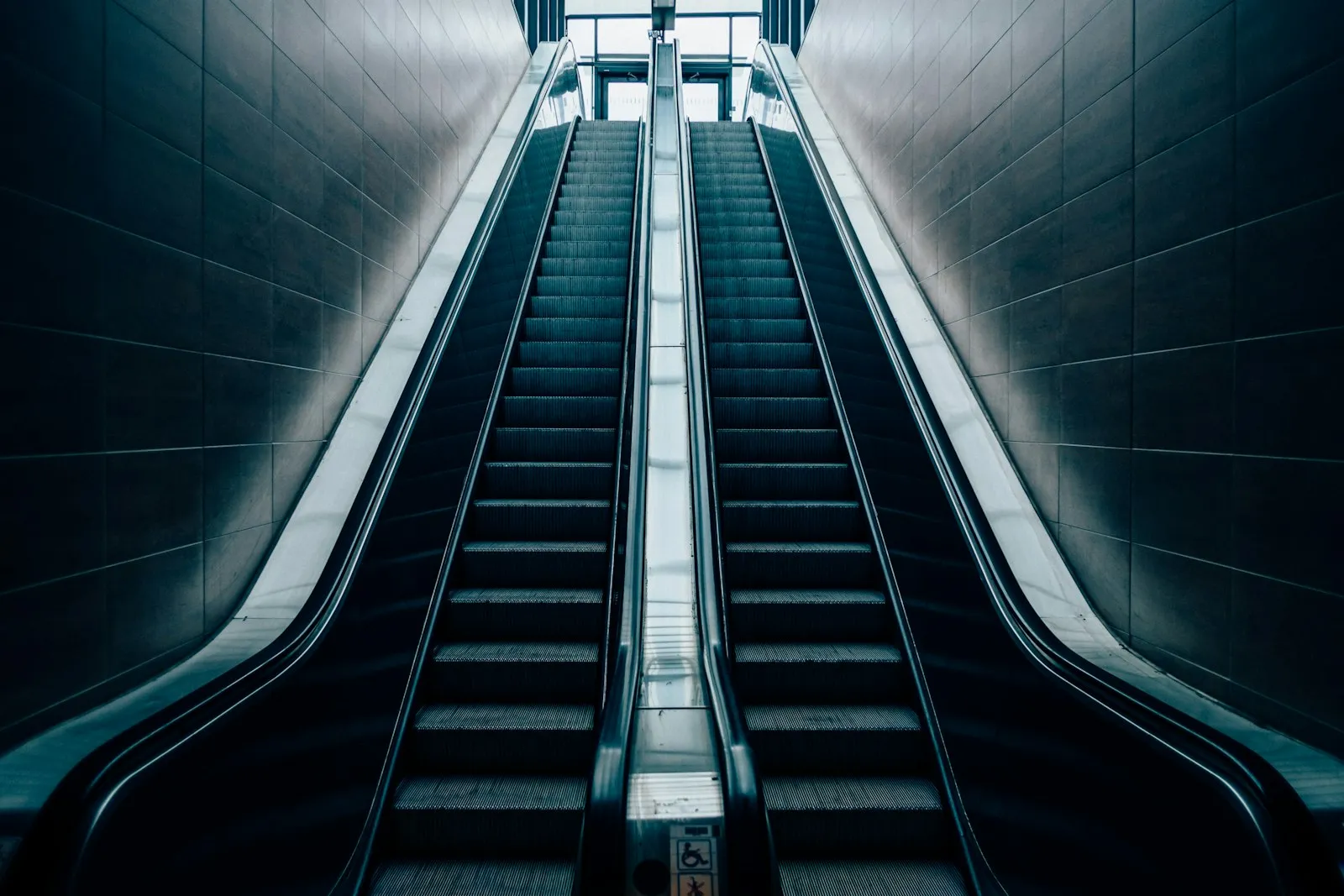
Where These Injuries Happen in Queens and Across NYC
Shopping centers and department stores run banks of escalators between floors, often packed on weekends with strollers, bags and children. Office towers push crowds through elevator lobbies at rush hour. Apartment buildings depend on one or two cars that tenants ride every day, sometimes with aging controllers and doors.
Then there is public transit. Subway stations operated by NYC Transit and Long Island Rail Road stations both rely on escalators and elevators to carry riders between street, mezzanine and platform. A claim arising from one of them follows a different track, covered further down.
Two groups are especially at risk: young children, whose small shoes and loose clothing fit into gaps adults never notice, and older adults, whose balance may not recover from a sudden jolt.
Inside the Escalator: The Parts That Fail
An inspector starts with the equipment, not the rider, because each failure leaves a signature. These components turn up most often in injury cases:
- Comb plates. At the top and bottom landings, a toothed plate meshes with grooves in the steps so that nothing can slide between them. Broken or missing teeth open a gap where a shoe tip, a sandal strap or a child’s fingers can be drawn in.
- Skirt panels. The smooth side walls beside the steps. If the clearance between step and skirt widens, or the panel lacks its brushes or deflectors, soft footwear and trailing clothing can be pulled into the space as the steps travel.
- Steps and step chain. Each step rides on rollers attached to a chain. A cracked, loose or missing step, or a chain that has stretched and jumps, can make the staircase lurch or leave a rider stepping onto nothing.
- Handrails. The rail is supposed to move at the same speed as the steps. When it drags behind or races ahead, a rider holding on is pulled forward or backward, which is a common way people lose their footing.
- Brakes and drive. A brake that grabs too hard throws riders down the incline during a stop. A brake or drive that slips can let a loaded escalator run backward, a reversal that sends a crowd tumbling toward the lower landing.
- Safety switches and sensors. Escalators are built with switches meant to stop the unit when something is caught or a component moves out of place. A disabled, bypassed or poorly adjusted switch can let a dangerous condition continue, or cause an abrupt, violent stop.
Crowding magnifies all of this, because one person falling takes others along.
Inside the Elevator: Misleveling, Doors and Sudden Movement
Elevators fail differently. The most frequent problem is misleveling, where the car stops above or below the landing. A passenger walking out, or pushing a cart, walker or wheelchair, meets a ledge that should not exist. The resulting fall often looks like a classic trip, and it is investigated much like one under New York slip and fall law, except that the defect sits inside a machine rather than on a sidewalk.
Door edges are the second weak point. Elevator doors rely on a reopening device, typically a light curtain or a mechanical safety edge, to detect a person in the opening and reverse. If that device is dirty, misaligned or failing, the doors close on a passenger’s arm, shoulder or torso, sometimes with real force. Shoulder injuries from door strikes are common enough that readers may want to look at the firm’s piece on rotator cuff and labral tear claims.
The third category is sudden movement: a car that drops several feet, stops abruptly between floors or moves with its doors still open. An elevator accident of this kind almost always points back to the controller, brakes, ropes or leveling system, which brings maintenance into the center of the case.

Mapping the Failure to the Responsible Party
Once the failed component is known, the next step is to ask who had the job of keeping it working. In New York, two parties usually sit in that position.
The property owner
Owners of buildings, malls and stores generally owe visitors reasonable care to keep their premises, including the elevators and escalators on them, in a reasonably safe condition. For apartment buildings, Multiple Dwelling Law § 78 adds that every multiple dwelling and every part of it must be kept in good repair, and the owner is responsible. Tenants hurt in a building elevator may find the firm’s guide to landlord negligence claims in Queens apartments useful for the broader picture. Owner liability is part of the larger field of premises liability.
The elevator maintenance company
Most owners do not service their own equipment. They sign a service contract with an elevator or escalator company that sends mechanics for routine maintenance, inspections and callbacks. A maintenance company that agrees to keep the equipment in safe working order can be held liable when it fails to correct a condition it knew about or should have discovered with reasonable care, or when its own repair work was done negligently. A recurring misleveling complaint that went unfixed, a handrail logged as slipping on three visits in a row, or a part swapped out the week before a failure are the kinds of facts that draw the contractor into a claim.
Frequently both parties end up named, each blaming the other. Sorting that out is a records exercise, which is where an escalator accident lawyer spends much of the early work.
When the Accident Itself Is Evidence
Escalators do not normally reverse under a load of passengers. Elevator cars do not normally drop between floors. New York law recognizes a doctrine called res ipsa loquitur, Latin for “the thing speaks for itself.” In some cases, it may allow a jury to infer negligence where the event is the kind that ordinarily does not happen without someone’s negligence, and the equipment was in the defendant’s exclusive control. It does not fit every incident, but it can matter where the rider has no way to see inside the drive or controller.
Even so, the stronger case is usually the one backed by documents.
The Paper Trail: Records That Reveal What Went Wrong
Elevators and escalators generate records. A careful investigation asks for all of them:
- Maintenance logs showing routine service visits and what the mechanic checked or adjusted.
- Service tickets and callback records documenting complaints, outages and repairs between scheduled visits.
- Inspection and testing records, including any violations or deficiencies noted.
- The service contract between owner and contractor, which defines who was responsible for what.
- Surveillance video from the mall, store, lobby or station, which often captures the incident and the moments before it.
- Incident reports written by security, building staff or station personnel.
- Parts orders and repair invoices that show whether a component was replaced, and when.
Video is the most fragile item on that list, because many systems record over themselves on a rolling basis. The firm’s article on getting security camera footage after a fall explains how preservation requests work. Maintenance and service records are usually obtained through formal discovery once a lawsuit is filed, which is one reason an early preservation letter to both owner and contractor carries weight.
A Short Checklist for Injured Riders
The injury comes first. When it is possible, these steps help preserve the facts:
- Get medical attention, and follow up with a doctor even if the injury seems minor at first.
- Report the incident to building management, store security or station staff, and ask that a written report be made.
- Photograph the spot: the comb plate, the gap, the step, the uneven floor at the elevator, and any warning signs or barriers.
- Keep the shoes and clothing worn that day, especially anything torn or caught.
- Write down the names and phone numbers of witnesses.
- Note the exact location, such as the escalator number, the elevator car, the store entrance or the station exit.
- Keep a record of symptoms and missed activities; the firm’s guide on keeping an injury diary walks through how.

Subway and LIRR Escalators: The Government Track
Escalators and elevators inside subway stations are generally the responsibility of NYC Transit, part of the Metropolitan Transportation Authority. Claims against NYC Transit and the MTA come with a much tighter timeline than claims against private owners. Under Public Authorities Law § 1212, a notice of claim generally has to be served within 90 days of the incident, and the lawsuit generally has to be started within one year and 90 days. Miss the notice window and the claim can be lost before anyone looks at the machine.
The notice of claim can also lead to a pre-suit examination under oath. The firm’s explainer on the 50-h hearing describes what that session involves, and its broader article on subway and MTA transit injury claims covers station hazards beyond escalators. LIRR stations add another layer, because ownership and operation of a given station, and of its escalators, may fall to different entities, so identifying the correct party quickly is part of the job. An escalator accident lawyer reviewing a station case will generally treat the 90-day mark as the first deadline that matters.
Deadlines for Private Buildings, Stores and Malls
When the escalator or elevator belongs to a private owner, the general rule is different. Most New York personal injury suits must be filed within three years under CPLR § 214. Records and video, though, can disappear long before then. A building owned by the City or by NYCHA falls back onto the shorter notice-of-claim schedule, which is why the identity of the owner gets checked early.
Shared Fault and Pre-Existing Conditions
Defendants in these cases often point at the rider. The argument might be that the person was not holding the handrail, was looking at a phone, was wearing loose footwear, or let a child sit on the steps. New York follows pure comparative fault under CPLR § 1411, so a rider who bears some share of the blame generally still recovers, with the award reduced by that share. The mechanics of that reduction are laid out in the firm’s guide to comparative negligence in New York.
Older riders sometimes worry that an earlier knee or back problem will sink a claim. A defendant generally takes an injured person as it finds them, so aggravation of a pre-existing condition is generally compensable. And because these are premises cases rather than car cases, the motor-vehicle “serious injury” threshold under the Insurance Law does not apply.
How Yakov Mushiyev & Associates Approaches These Cases
Machine-failure cases reward patience with paperwork: tracking down service contracts, identifying the contractor and matching the failed component to whoever was responsible for it. From its office at 1 Cross Island Plaza in Rosedale, on the line between Queens and Nassau, the firm handles injury claims for people across the five boroughs and Nassau County, and its clients have recovered over $80 million in total. Consultations are free, there is no fee unless the case is won, and attorney Yakov Mushiyev’s team works in English, Russian and Spanish, including visits at home, in the hospital or by video. An escalator accident lawyer at the firm can be reached through the contact page or at 718.775.3110.
Questions Riders Ask After an Escalator or Elevator Injury
Can the elevator company be sued, or only the building owner?
Both may be responsible. An owner generally owes reasonable care to keep the equipment safe, and a maintenance company with a service contract can be liable when it failed to fix a condition it knew or should have known about, or performed a repair negligently.
Does it matter that I was not holding the handrail?
It may reduce a recovery, but it generally does not bar one. Under New York’s pure comparative fault rule, any damages are reduced by the injured rider’s share of fault, if any.
How long is there to file after a fall on a subway escalator?
Claims against NYC Transit and the MTA generally require a notice of claim within 90 days and a lawsuit within one year and 90 days. Private-property claims generally carry a three-year limit.
What if no one saw the escalator malfunction?
Video, maintenance logs, service tickets and incident reports often fill that gap. In some cases, res ipsa loquitur may also allow an inference of negligence where the event would not ordinarily happen without it and the equipment was in the defendant’s exclusive control.
Is a misleveled elevator treated like a trip hazard?
In practical terms, often yes. A car that stops above or below the floor creates a height difference much like a raised sidewalk slab, and the investigation focuses on who knew about the leveling problem and whether it was corrected.
Visit Yakov Mushiyev & Associates
Our office is at 1 Cross Island Plaza, Suite 325, Rosedale, NY 11422, just off the Cross Island Parkway on the Queens–Nassau border. If you can’t come to us, we’ll come to you: at home, in the hospital or by video.

Talk to a NYC escalator accident lawyer today
Yakov Mushiyev & Associates has recovered over $80 million for injured New Yorkers across the five boroughs and Nassau County. Consultations are free, available in English, Russian and Spanish, and there is no fee unless we win.
Call 718.775.3110 or contact us online for a free case review.
This article is general information, not legal advice. Every case is different. Attorney Advertising.